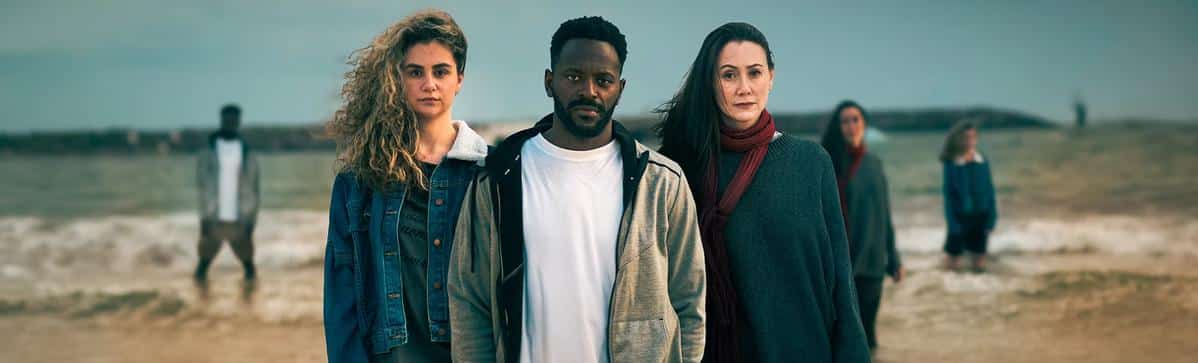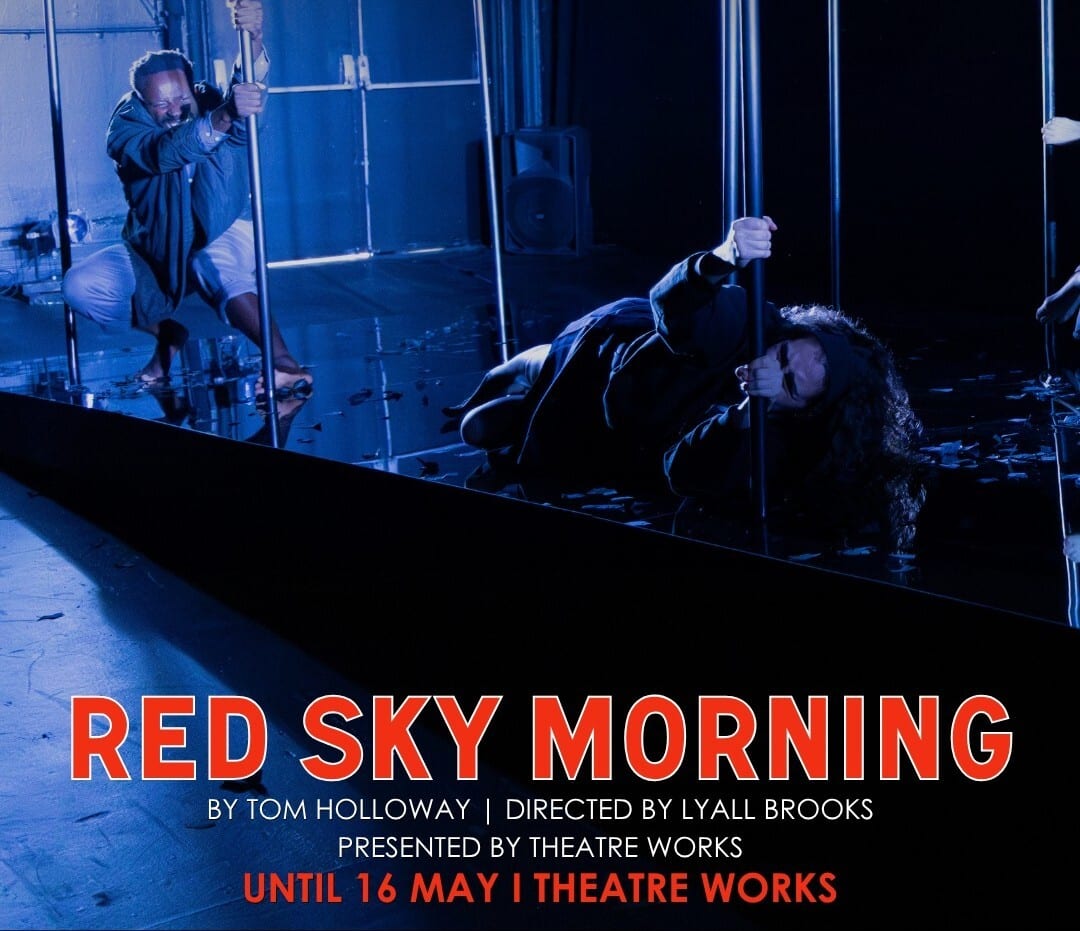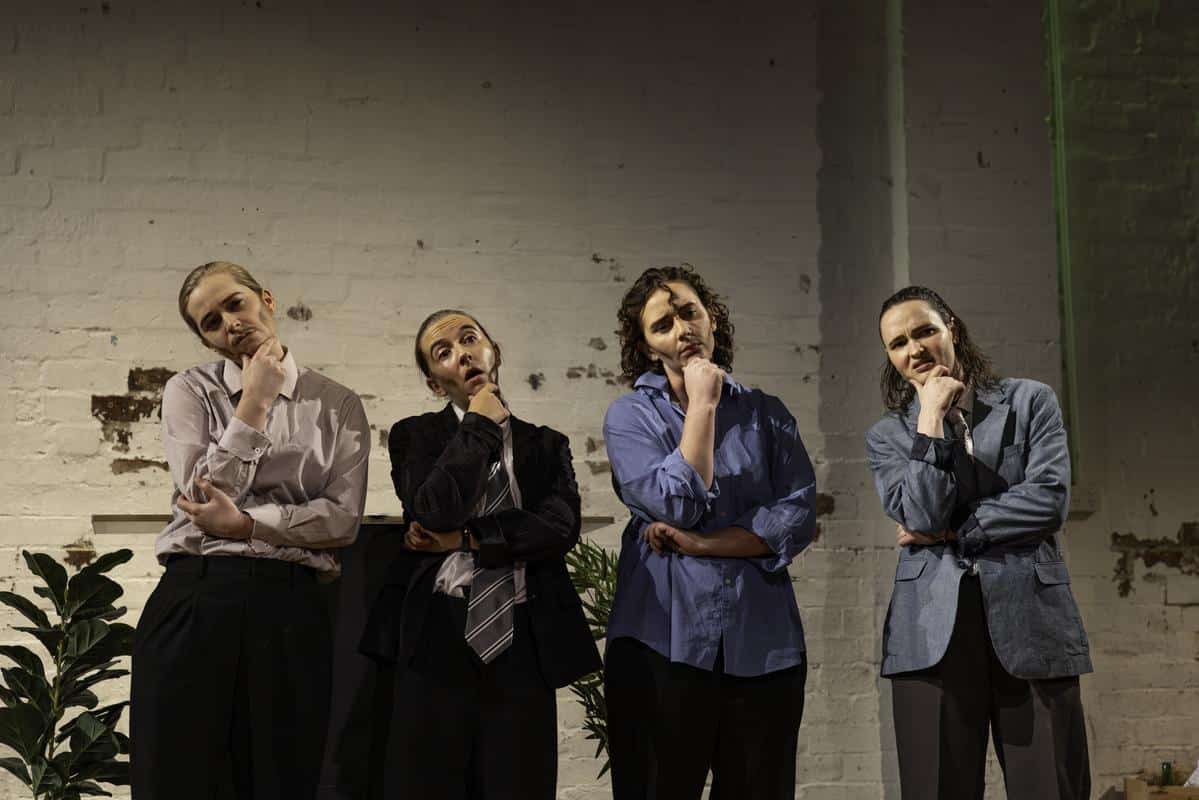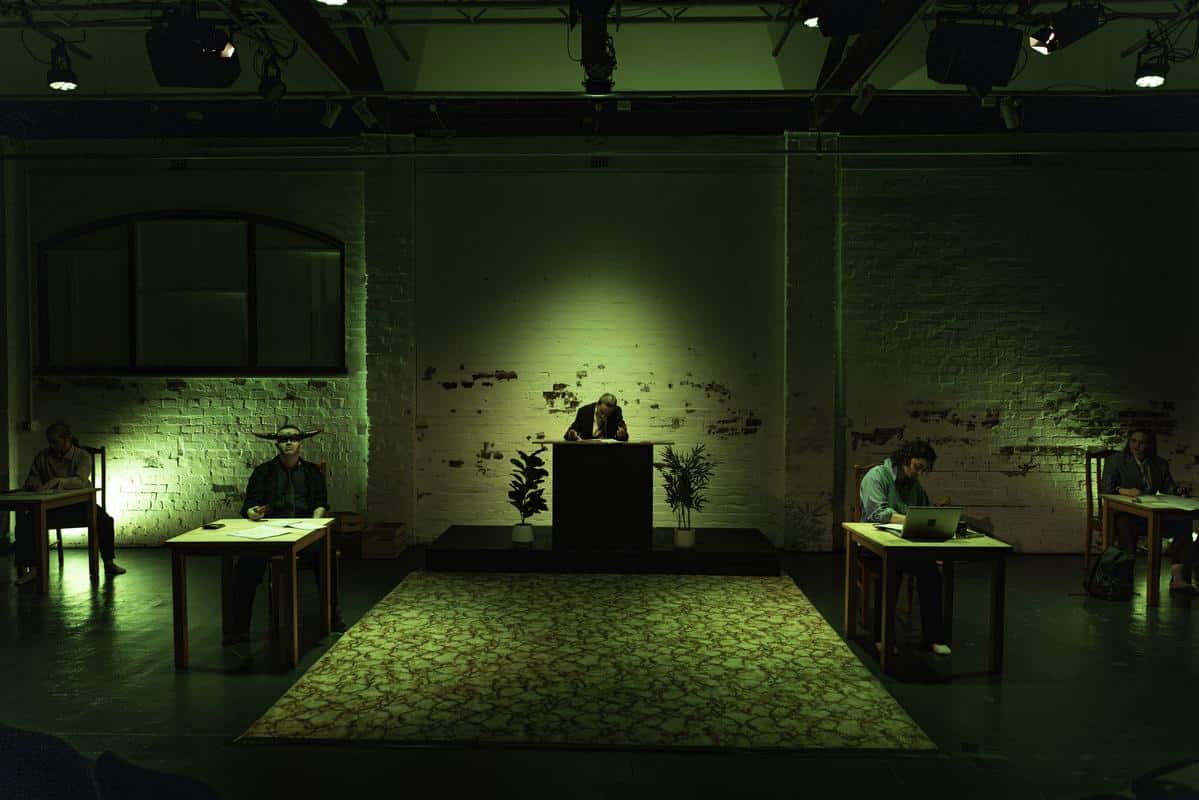
Now is a show exploring a family and how they move through Now- a virtual reality that pulls the one (or i call him the child) into it, as the one feels it is the future, and the only way forward. The one’s parents, like many parents, don’t understand what he’s doing in the Now, and the disconnection of the familial dynamics are central to the show. Although awkward in a review, the namelessness of the characters makes much more sense within the context of the show.
Now is set after COVID, in a dystopian future. Slowly paced, X (Helene Tardif) tries to come to terms with how her son, the One (Andrew Drava) lives his life. X and her husband (Marc Opitz) tell the audience how COVID made the other one selfish, and it becomes clear immediately that the relationship between X and her husband lacks a foundation of respect and trust. This is an issue that continues to plague the show.
The One finds everything he needs online, including a partner (Georgina Scott). The One’s partner introduces herself to the audience whilst singing happy birthday to herself, a sad representation of the future where somewhere like the Now brings people together, but also isolates us from each other. The One and his partner enter the Now using their glasses, and continue to spend all their time in the Now.
The show established a tense relationship between the parents from the beginning, with the father being particularly disagreeable, inflexible and stubborn. A point of conflict for X, the One, and the Father, is how the One enjoys and finds success in the Now. The Father loses his job and the dynamic between father and son becomes tense and frustrating. The Father is rude, and the One is dismissive. Neither are willing to talk to the other. The Father’s behaviour continues to escalate, until he has an outburst that impacts the whole family.
Now dove into dystopia and family dynamics. Some of the behaviours of the characters felt unearned, aggression (in particular from the father) felt like it appeared out of nowhere, with little base. Similarly X and the One forgive the Father, which feels unearned, given how little the Father reflected on his behaviour and the impact it has on his family. This show tried to explore dynamics of a family falling apart, but only shallowly explores motivations and drive behind each character’s actions.
From the producers of Celtic Illusion, comes a powerful new theatrical experience in Ireland: The Voyage, an epic celebration of Ireland’s history, heart, and heritage brought to life through authentic voices, live music, and world-class Irish dance. Emotional, exhilarating, and deeply immersive, Ireland: The Voyage invites audiences to feel the pulse of a nation – it’s triumphs, its tragedies, its music, and its unbreakable spirit, in a live experience you will never forget!
I was fortunate to be able to delve into this world of all things Ireland currently touring around our country.
Firstly, in my years in dancing (over five decades) I’ve only ever seen Irish dancing twice in my life before (shameful I know!). Once at a high school talent show, and once when I organised a display floorshow at one of our dance fundraisers (everyone commented afterwards how good it was).
This style of dance has sustained as entertainment for decades in theatres around the world, on cruise ships, feature festivals and more. And certainly now I can fully understand why. Whether or not you are Irish, love Irish dancing or music, or just enjoy any stage performances generally; Irish vibes are contagious and captivating!
This show however is much more than just an Irish jig to a whistling tune; it is a real journey of shared stories, history and spirit.
We learn in detail from our host Giselle about the interesting Irish instruments being played in the traditional Irish band, which remains in full view throughout the show on stage. Each band member is also introduced by name with a little of their Irish background and musical accomplishments. They are all simply brilliant musicians and together bring this show wholly to life.
Irish songs sung both in English and traditional language by Giselle O’Meara are truly unforgettable. Her superior voice carries off each and every note like a fine instrument you could easily listen to for hours. Not loud and showy, but gentle and sweet; welcoming and inviting us to just enjoy!
I closed my eyes a number of times purposefully to listen and take it all in. Not only am I learning along the way about Ireland, a place I loved visiting 25 years ago, I am growing a great appreciation for this music and sound.
Shining stars are evident in the Irish dance champions – a trio mesmerize us with unbroken unison of speed and grace, extraordinary flexibility and control in traditional Gaelic; skillful solo features of rapidly increasing intricate footwork are an honour to witness, and later in the show we will clap along to particular beats in joyful harmony encouraged.
This beautiful show was such a lovely relaxing night out, and my Mum who came with me went home to try and find the great Irish love song ‘Grace’ to add to her playlist.
Thank you so much to the cast, musicians and team at Base Entertainment for this chance to broaden my knowledge of Ireland whilst at the same time tapping my foot along to some incredible music and songs from this voyage on stage transporting us all in the lucky audience to the Emerald Isle afar.
Ticket link: https://www.irelandthevoyage.com/
INSTAGRAM: @ireland_thevoyage
Tour includes cities and towns all over Australia and New Zealand.
Cast: Giselle O’Meara (Champion Irish dancer and former lead vocalist for Michael Flatley’s global phenomenon Lord of the Dance Arena Tour) Sara O’Hara (World Top 20 Irish Dancing Championship) Liam Mcweeny (former quadruple Australian National Champion Irish Dancer) Corey White (runner-up Australian International Oireachtas)
Musicians: Tim Gleeson (guitar and Irish drum, the bodhrán) Cormac O’Hanlon (concertina) Ciara McGoldrick (low and high pitch whistles) Muireann O’Dwyer (harp)
Camberwell Grammarians’ Theatre presents ‘The First Curtain Festival’. A 2 hour celebration of seven original short plays, written by local playwrights and staged by Melbourne-born talent. Each play is directed by a seasoned or rising director from the community and audiences are in for a wonderful night of variety.
All plays shown at each performance:
THE LAST OF THE GENTLEMEN SLEUTHS by Noah Sargent, directed by William Rotor Trapped by a blizzard, five of the world’s greatest gentlemen sleuths must solve the murder of Mr. Corpse before they all turn on each other instead. Who did it?!
BYSTANDER by Jennifer Pacey, directed by Ben Klein The unthinkable has happened. A man has thrown himself in front of an arriving train. Three women tell the story of what they saw, trying to make sense of it all, and of themselves. Please be advised this play contains suicide.
CHIPS by James Gordon, directed by James Gordon It is Ghafour’s first day of work at Apopotatosis: a company that takes randomly selected people from the Australian population and turns them into chips to then sell off for profit. What could possibly go wrong? Contains coarse language.
DROP DEAD by Benjamin Chesler, directed by Lakshmi Ganapathy In the dead of night, in the middle of winter, a slapdash team chop firewood – but nature has other plans for them… An Australian Gothic play that’ll make you think twice about venturing out into the bush at night. Contains loud noises and strobe lighting.
EMILY TAKES A LOVER by Julie Murphy, directed by Julie Murphy Emily’s husband is having an affair. Will she get her revenge? Contains themes of adultery, abortion and toxic family dynamics.
SALMON by Peter Farrar, directed by Angus Fitzpatrick During rush hour a frustrated chef and an apathetic waiter have a heart-to-heart in the alleyway outside of the fine dining kitchen.
THAT STORY ABOUT THE LOUVRE by DS Magid, directed by Jai Barlow Ever hear the one about the impressionist who broke into the Louvre to finish a painting?
This was perhaps the most varied night out at a theatre I’ve experienced. Seven different short plays in one sitting, so something for everyone to sit back and enjoy, assess and chat about afterwards.
I love to immerse myself in the world of the actors in front of me for a couple of hours. This one local to me in my favorite little Clayton Theatrette, easy to get to and park – bonus!
All the scripts were pretty clever, but I liked best ‘CHIPS’ surprisingly which I guessed correctly in advance would be crazy! It was definitely super dooper crazy! ‘CHIPS’ received the biggest laughs of the night so it made the perfect Final piece. Imagine a factory where humans are turned into potato chips – goodness how does a writer come up with such cooky creativity and make it work! Shout out here to Simona Riftin in the cast, her vibrance for roles in community theatre is infectious and I’ve seen her in a number of plays now. Henry Vo had fantastic interaction with Benjamin Chesler who was equally great and his line of being the ‘f….. boss’ spread uncontrollable loud laughter across the entire crowd.
Coming in a close second for me on the program would be my appreciation for ‘BYSTANDER’. Extremely well acted by all the girls; Alexia Brady and Shirin Albert were amazing with their feelings expressed and Crystal Haig (WAAPA grad.) was astoundingly believable in her explanation of how her character felt in watching someone jump in front of a train, and going through the trauma how she was ‘not fine’. I do believe ‘BYSTANDER’ is an award deserving script and took a deep amount of emotional courage from both the writer and actors.
My hubby’s favourite was ‘THE LAST GENTLEMEN SLEUTHS’ as wondering and wandering through a who-dunnit with a cast that also involves the audience with tips along the way is always a lot of fun. The actors’ language accents were excellent and when those same talented people came out in different items throughout the night they really showed off their extraordinary versatility!
Seeing original work is a privilege and Camberwell Grammarians’ Theatre Company (CGTC) is a community theatre company formed to encourage alumni, friends and families of Camberwell Grammar School to continue, revive or ignite a drive for the performing arts. It was easy to see their love for the performing arts and what a wonderful way to stay connected and connect to others at the same time. Theatre has so many aspects in which one can be involved, it’s a pity not more schools have these types of groups ongoing after school is finished. I know I would’ve loved to have been involved in one.
I went into this production of The Diary of Anne Frank as I suspect many others did, knowing the loose story – the discovery of a young girl’s journal narrating life in hiding during the German occupation of Amsterdam – but not, perhaps, having read the book itself.
From the moment the lights go up on the small, cluttered space, drowned by shadows both literal and figurative, this production captures with painful accuracy the claustrophobia of several families living in forced confinement. They survive on ever more meagre rations and heavily edited news brought by their kindly protectors, who attempt to shield them from the worst of what is happening outside. The constant threat of discovery sits like a weighted blanket over every scene, adding a quiet but relentless tension as each family struggles to remain hopeful, generous and kind while their world shrinks day by day.
The ensemble work is strong. Otto Frank stands as a pillar of spiritual fortitude: humble, strong and deeply kind, bearing the circumstances with a remarkable evenness of temper. In contrast, Mr Van Daan is angry, argumentative and more than a little selfish, his frustrations simmering beneath the surface until he explodes with increasing frequency as the interminable incarceration continues. The dentist, last to arrive at the safe haven, is anxious, pessimistic and at times almost nihilistic, his moments of brutal honesty tipping the families into near hysteria. Together they offer a convincing portrait of people reacting to unimaginable pressure in very human ways.
At the emotional centre of the story is Anne herself, portrayed as robust, energetic and mischievous. She pushes against authority in the way only a teenager can, and her relationship with her father forms the soft heart of the play: he is her safe harbour, the one person who truly sees her. Her relationship with her mother, by contrast, is distant and strained in a way that will feel painfully familiar to many parents of teenagers.
What struck me most was how modern Anne feels. She believes she is far more enlightened than the generations before her but does not always see her own shortcomings. She misunderstands her mother and pushes back against rules and expectations around demeanour and behaviour. In short, she is exactly like the young people we know today, which somehow makes her fate even harder to absorb. Despite the fear surrounding her, Anne’s spirit remains largely undimmed – though the night scenes reveal a more complex reality. She suffers terrible nightmares about being taken by the Green Police, waking screaming in the small hours, exposing the terror beneath her bravado while also highlighting the remarkable way the young still manage to feel invincible even in the face of great danger.
One line stays with you long after the curtain falls. Anne remarks that they are living in a way that no young people ever have before. It calls to mind our own young people, living through a time of unprecedented advancement and enormous divisive change. It is a sobering thought: that humanity can move forward in so many ways and yet still find itself circling back towards division, fear, greed and cruelty.
What I found particularly moving was the moment at the end of the first half when the family sing the Hanukkah song. It brought a genuine tear to my eye, witnessing these families – hunted, discriminated against, living under the ever-present threat of the concentration camps – still finding a moment to express gratitude and companionship. When you consider the enormous suffering happening in the world right now and the bitter irony of it, the moment lands with even greater emotional force.
The second half carries a fragile sense of hope. The allies have landed and liberation seems almost within reach after two long years of hiding. For a moment, the audience allows itself to breathe – to believe that all will be well. Then they are discovered. The families are taken away, dispersed among the concentration camps, and we all know the terrible ending that follows.
The play is also quietly funny at times, particularly in its portrayal of family dynamics. It is remarkable how little has changed in the relationships between mothers and daughters or fathers and sons, even when history itself is collapsing outside the door.
Overall, whilst not the most polished of performances, the production is surprisingly moving. It leaves the audience with a renewed sense of gratitude for freedoms so easily taken for granted and prompts a quieter reflection on our own daily lives. For two years these families felt no wind on their faces, had no privacy, no freedom to step outside and almost no information from the outside world. Today we consume a constant stream of news, commentary and noise until we are utterly overwhelmed by it. Perhaps this ceaseless input is what keeps us over-aware but still underactive when it comes to shaping our own futures. I cannot help but wonder whether any of us would make as good a job of surviving that stillness as they did.
In the end, this is not only a historical story. It is a timely reminder of the fragility of freedom and of the extraordinary resilience of the human spirit. And perhaps, like Anne Frank, given everything that is currently unfolding in our world, we are all still quietly clinging to the same two poignant words.