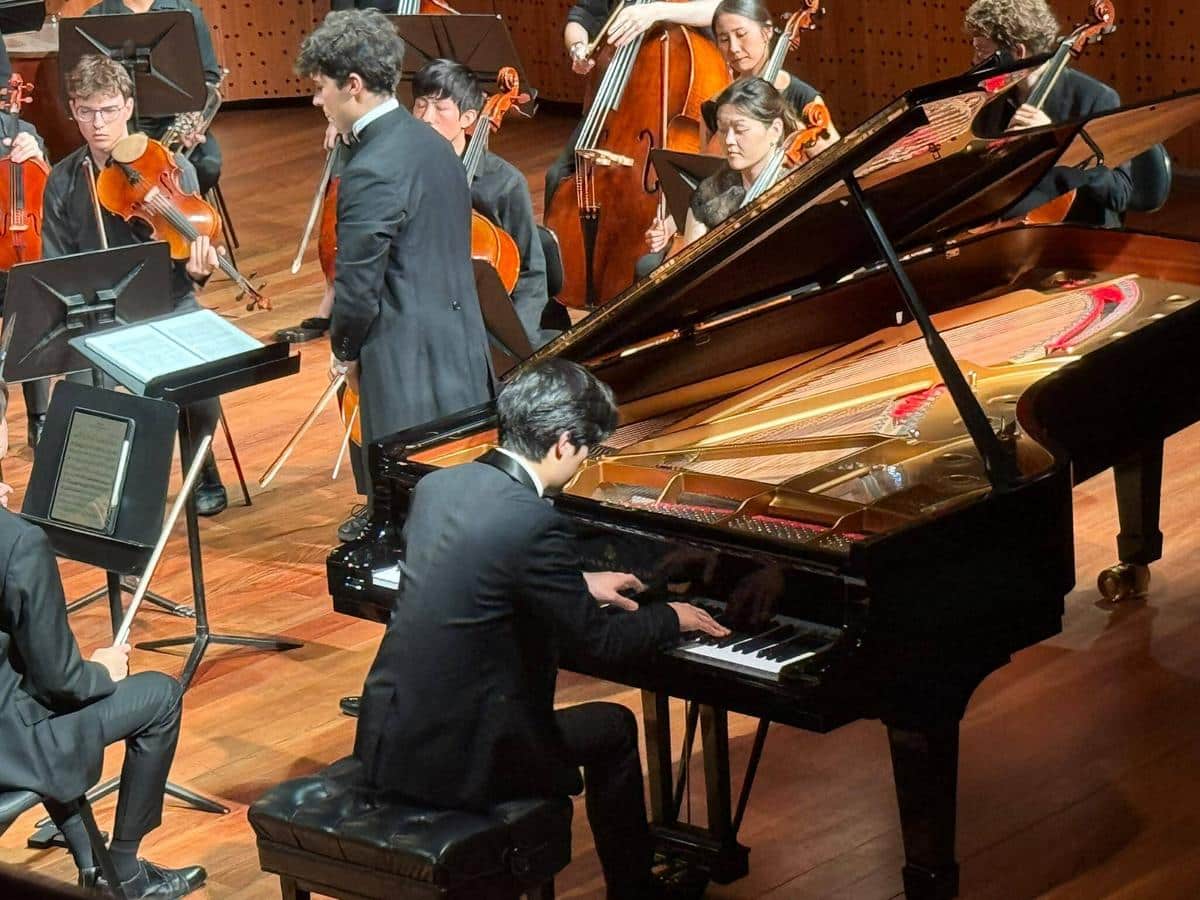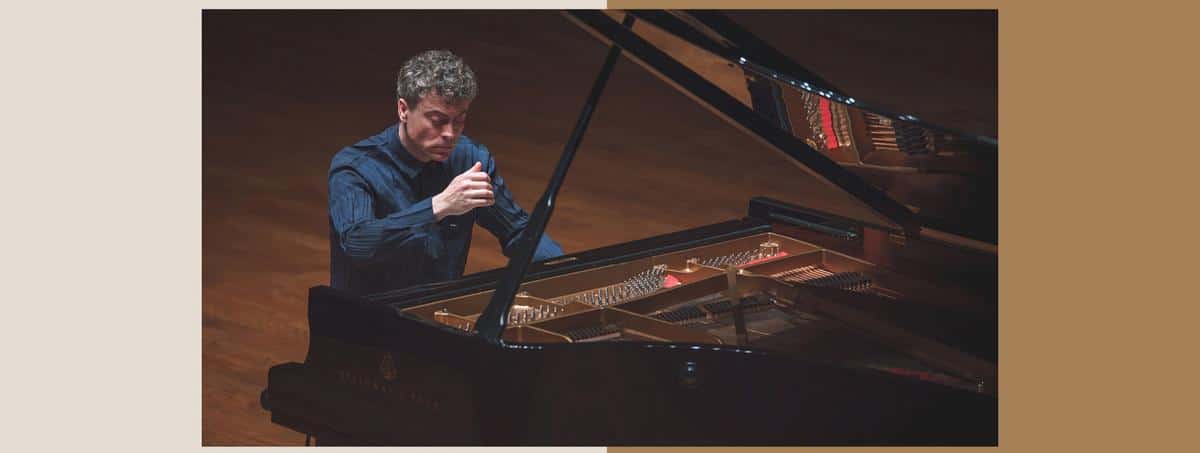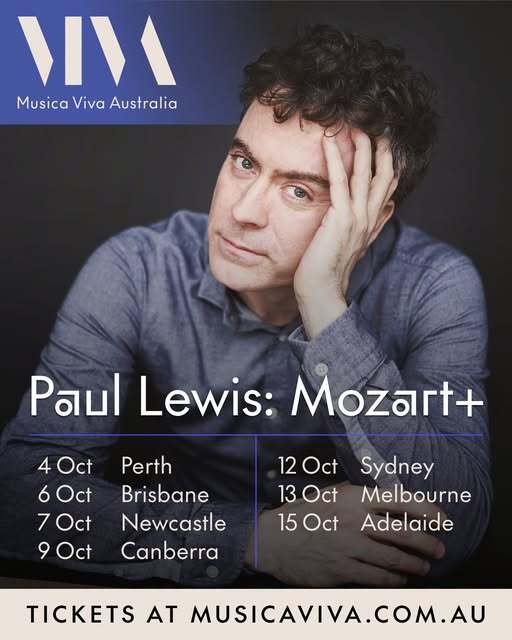
The stage at Perth’s Winthrop Hall was adorned with blue curtains, and a very elegant black Steinways Grand Piano positioned center stage. Then a figure in black suit crossed to thunderous applause from the audience, and Mr Paul Lewis CBE bowed and took his place at the piano. What came next can only be described as breathtaking. Mr Lewis began his performance with a perfect and flawless rendition of Wolfgang Amadeus Mozart’s Piano Sonata 10 in C Major. A beautiful, mesmerizing piece of music presented skillfully.
Mr Lewis completed his first act with the equally beautiful L’isle Joyeuse (The Isle of Joy) composed by Claude Debussy, again performed with perfection. Debussy and Mozart were very different in their composition styles, however when both framed the delightful music of Francis Poulenc’s Improvisations Pour le Piano (Improvisations for Piano) the mélange, or fusion, of the three composers was perfect.
The second act of Mr Lewis’ performance was just as beautiful as the first. Mr Lewis opened with more selections from Poulenc’s Improvisation Pour le Piano. At the end of two of the pieces was a lone, solitary note, which on both occasions resulted in a giggle from the audience.
Mozart+ act 2 was concluded by Mozart’s Piano Sonata 14 in C Minor. Another beautiful, flawless performance.
Mr Lewis provided the audience with an encore of a piece from Chopin. Another delightful composition.
Throughout the performance one could not only hear but could also see the passion that Mr Lewis has for classical music as his facial expressions showed all. It is no wonder that he has performed with the Berlin Philharmonic, London Symphony Orchestra, Los Angeles Philharmonic, et al. His renditions are simply the most beautiful and superb this author has ever witnessed in person.
In Mr Lewis’ own words he has, for many years, “wanted to spend some time focusing on Mozart’s piano sonatas and have long felt sceptical of the broadly held view that these remarkable works are the poor siblings of his piano concertos”. I must agree with Mr Lewis as the selected sonatas are just as beautiful as the composer’s full concertos.
I had the pleasure of attending the performance with my 6 year old son, who enjoys live theatre and classical music as much as I, and when asked for his thoughts on the performance he summed it up in one solitary word, “Amazing”.
The audience were completely captured by the extreme talent on the stage, and the beautiful music that filled the auditorium, and this author believes that each audience for the remainder of Paul Lewis: Mozart+ Australian tour will be equally bewitched by his talent and presentation.
Making a show about nothing sounds simple enough. For SKINT, it raised a few awkward questions about what we’re actually leaving at the door when we go out for a laugh. Ahead of SLUGS at Melbourne Fringe, the team talks puppets, plastic shirts and whether switching off is ever quite that straightforward.
About The Show – SLUGS
What is this show about?
It’s about nothing! Completely and utterly nothing! A perfect nothing of a show to smooth-brain you for one whole hour. An hour where no one has to think about anything political or existential or anxiety-inducing. What could possibly go wrong?
How would you describe this show to someone who has never seen anything like it before?
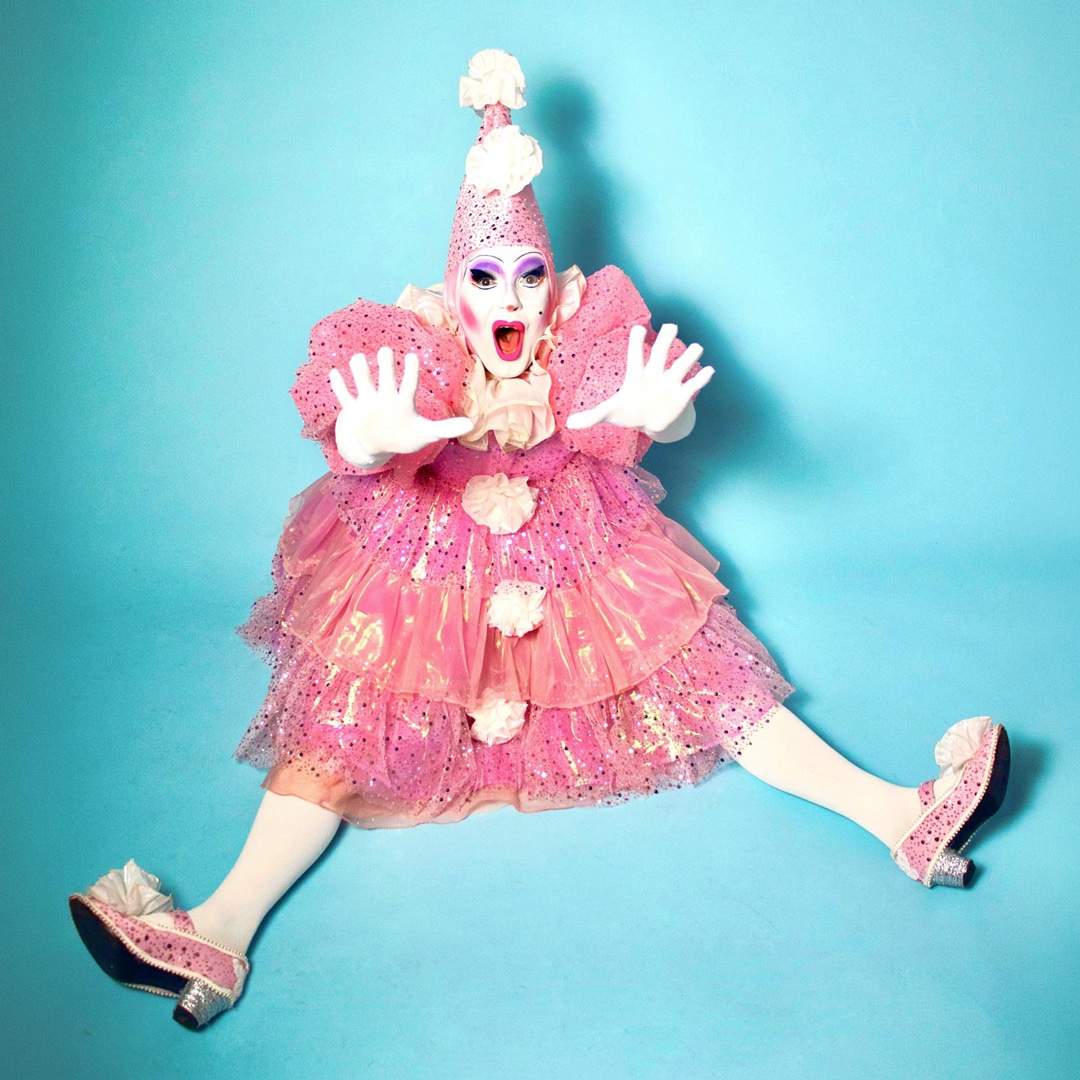
It’s part comedy, part techno-concert, part gross-out freak show, with puppets!
How did this show come together? What was the creative starting point?
For many years, we had been talking about making a band called SLUGS, or maybe a puppet band, or maybe a show with puppets and music and high energy comedy. We would often joke, while working on other shows, “oh well, that idea is far too much, but it’d be perfect for SLUGS” but had no real unifying idea for this supposed show. It was a bucket where we’d dump all those “too much” ideas. Then after we began touring the international Fringe circuit for a couple years, we began to notice a tendency present in many “comedy” shows (though by no means was it exclusive to this genre) – shows that asked us to leave the world at the door and be free and laugh for an hour. We felt (and feel) somewhat complicated feelings about this. We began to wonder what if we tried to make a true show about nothing. Could we? Should we? What makes something a “nothing”? What makes it a “something”? What would it reveal about the act of trying to not think about the political nature of our lives?
What is the element of the show that is hardest to explain but unmissable in person?
The sweat. We cannot reiterate enough how much this is a high energy show. We actively have to fuel ourselves with electrolytes after. Our plastic shirts will never smell clean, no matter how much we wash them.
That and the live feed camera puppets, they really transform the space in a surprising and delightfully simple way.
Who is this show for? Who is going to have the time of their life?
SLUGS is for everyone burnt out from scrolling, exhausted from headlines, and suspects their best days are behind them. It’s the perfect cocktail of genre-less chaos for that part of our mind that sees a killer meme and can’t decide whether to cry out of laughter or tears.
What is going to genuinely shock or delight people?
We think we look very cute in our plastic-blow-up-chairs-turned-cunty-tops and feel it is the perfect intersection of our desire to look cute and stupid.
What do you want the audience to feel in the final moment?
Joy! Laughter! A reprieve from despair! It has been an increasingly pessimistic few years and finding the energy and drive to keep going is hard. It’s brutal. It’s been on our Sluggie minds quite a lot.
Thanks to the SLUGS team for chatting with us. To book tickets to SLUGS, you can find session details and tickets on the Melbourne Fringe website.
For a relaxing Sunday afternoon, being immersed in the sounds of film and gaming music scores performed by the Ku-ring-gai Philharmonic Orchestra (KPO) was perfection. The choice of songs was varied, from the widely known “Star Wars Suite” composed by the legendary John Williams to other songs that I was not familiar with, such as Jeremy Soule’s “Song of the Dragonborn”.
The KPO’s deliberate choice of song order was clever, which took the audience on an emotional musical journey with ups and downs like a wave. The KPO alternated playing intense songs, then moved next to a quieter song, then back to a powerful piece.
A standout song was the meditative beauty “Benjamin”, originally from the ABC/ International film and television series, “The Hymns of the Forefathers”. Listening to this song live was quite special, as we were fortunate to witness the composer conduct his own piece. The song “Benjamin” was named after his three year old son. KPO’s Artistic Director and Chief Conductor Paul Terracini used his baton, signalling tempo and guiding the orchestra in all of the song performances, except this one. Instead, it was beautiful to see the love and depth of feeling he had for his own piece. He did not use his baton, he conducted with his whole body and arms, swaying to the tempo, and it was mesmerising to watch.
Before each performance, Terracini introduced each song with some background information on each composer and some information on the song. The KPO’s first song was the “Star Wars Suite”, and from the very first opening note, the power and precision of the orchestra created an exciting start. The “Imperial March” was played with perfect precision, with the sharpness of the trumpets, bassoons, trombones and tuba intermingled with the frenetic violins and full orchestration to create the menacing Darth Vader theme. This Suite arrangement displayed an example of the alternating powerful and gentle song format, with sweet and regal “Princess Leia’s Theme” following the boisterous main theme. The different tempo and soft beauty of “Yoda’s Theme” with the harp, and the grandiosity of the “Throne Room and End Title” contrasted with each other and conjured up scenes from this classic movie into my mind.
The magic of the KPO’s music continued with “Spirited Away Suite”. Joe Hisaishi composed for Hayao Miyazaki’s animated films from Studio Ghibli. I had seen the 2001 anime “Spirited Away” a long time ago and did not remember the music, so it was with curiosity that I began to listen to this suite. The piano infused a gentle and curious beginning with “One Summer’s Day” and as this song progressed, it shone of innocent wonder. The harp plucking represented the moon to me, in “Night Time Coming”, with a lovely lullaby. This was followed by “The Gods”, which had a dramatic element, with the percussion leading the effects in some parts. This suite featured lovely solos by harpist Kaela Phillips and Concertmaster Violin Lead Anne Marie Braid. The effect of a solo, and then the orchestra joining in was effective in creating a musically flowing journey for the audience.
After the interval, the KPO performed the soundtracks and music from “Song of the Dragonborn”, “The Elden Ring 2022”, “Spartacus”, “Benjamin” and ended with “Fellowship of the Ring Suite”.
Japanese Composer Yuka Kitamura’s “Elden Ring 2022” theme was arranged by Jonathan Shaw and was a very strong and powerful piece. Beginning gently, the quick metamorphosis into a highly dramatic theme, with the brass, wind instruments, violins, percussion and metallic percussion gong’s calling was impressive.
“Spartacus”, was composed by Aram Khachaturian. This song was written for a ballet in 1954, and the retelling of a Thracian gladiator reuniting with his wife after she was captured, was romantic. The middle part of the song hinted at a shadowed darker time, and the echo of a call and response of the orchestra was instrumental in building the dramatic intensity to a crescendo. The ending of the song relayed the couple’s tender love, as the tempo calmed and the lead violinist brought the story to a peaceful end.
Jeremy Soule’s “Song of the Dragonborn” played next and began in the Dragonborn’s ‘tongue’ – shouts which are heard alongside the horns and violins and were an effective way to introduce the mood. This was an uplifting and courageous song and in some parts it lifted my imagination skyward. This was a very regal song utilising strong brass and percussion to create a mediaeval themed mood.
“The Lord of the Rings: Fellowship of the Ring Symphonic Suite”, arranged by John Whitney, was the last piece the KPO performed and was a wonderful piece to end on. Composer, conductor and orchestrator Howard Shore’s film scores have earned Academy Awards, Golden Globes and Grammy Awards and this suite, beautifully played by the KPO, showcased his talent. The LotR suite included distinct sweeping movements for different character themes. Most notably, the heavier colours during one part came through with sharp precision with the brass and percussion, and then was contrasted with the piccolo, flutes and strings for lighter moments.
The talented musicians from the the Ku-ring-gai Philharmonic Orchestra, led by conductor Paul Terracini created a magical afternoon. This was an encompassing musical journey into the imaginative world of make believe worlds of film, animation and gaming. If you are a music lover, you must listen to a live KPO performance in the future. There is a free community concert called Nothing is Forever, on September 20 2026 at the Turramurra Uniting Church.
Spirited Away Movie and Gaming Music was performed at The Concourse Concert Hall in Chatswood. Time: 2 hours with a 20 minute interval.
In today’s world, what does it mean to be free? Is it a feeling of liberation from the rules that society dictates, or is it a fire of truth within us that refuses to simmer down?
Marking a 2-year benchmark, ‘The Deplorables’, an award-winning production by female-led regional theatre company Skin of our Teeth Productions, marks its final inning at Theatre Works with empowered pride and pure, theatrical joy. Where in a span of 70 minutes, the audience is fully immersed into a no-holds-barred historical tale of female bravery and resilience set in 1874 in Bendigo, where an all-women’s cricket charity match takes place to great communal acclaim with lots of money raised and 22 women praised for their sporting prowess.
As they celebrate their joy and liberation, chaos and backlash ensue – when the press declares that these women are ‘Deplorable’ for playing a male-dominated game, and should instead ‘know their place’ and ‘stay home’. As the story unfolds, we experience the courage and resilience these women face – to fight for their sense of freedom: to be who they are without limitation.
Written and directed by Christine Davey, and composed and choreographed by the very multi-talented Tess Parker, this heart-warming story begins with a minimal yet highly-symbolic set framed around this 19th-century period. Four descending pillars of chains cleverly embellished with stage props used throughout, in particular; a hand-held 19th-century moustache to depict the male-roles. Birds resting in cages near signs that say ‘Rules Of The Game’. Red and blue uniformed blazers displayed on sewing bodices marking the juxtaposition of identity; of the changing roles that are budding in that society. A curvy armchair depicting a feminine world in which they must sit quietly. While behind, in a trunk marked with the word ‘Hope’ – colourful cricket bats rest in anticipation – hoping to get a game, or perhaps hoping that society changes its tune.
Blending engaging Australian music and striking physical movement, this delightful, quick-witted, show consists of six highly-talented women who bring commitment to their roles with immense energy and enthusiasm; each bringing different layers to tell this courageous tale.
Marie-Claire Tchernomoroff stuns as Barbara Rae with such tender emotion, immediately connecting to the audience with dreams – of achieving more than just sitting still. Of harbouring a secret wish: to fly freely like the bird she tenderly holds in her hands, away from its stilted cage. Danae Reid as Miss Gerber and Aeonie Ostik-Smith as Katie Petrie bring the musical comedy elements of this show to new heights, with beautiful, heartfelt singing and added flavour, displaying their loving relationship with subtle sensitivity. But Tess Parker, stepping into the role of Miss Murdoch? Absolutely steals the show. With her ball of blazing comedic energy, she combines the exact ingredients of humour, storytelling and sass that engaged me thoroughly. Tess Parker managed to entangle me into a world of a 19th-century woman, who despite her limitations, continued to fight for momentary joys – in humour and in sadness. For in watching her, I too was able to embody the feeling of inner-sovereignty, in a world that perhaps even today, seeks to halt the path of what it truly means to be free, for all of us.