
Neighbourhood Watch

Neighbourhood Watch

Neighbourhood Watch Rating

★★★★★

Click if you liked this article

4

This was my first visit to Lane Cove Theatre Company, I was met by warm greeters at the door. The intimate space then added to that cosy sense of community-mindedness. The warmth and passion of director Kathryn Thomas, delivering the acknowledgment of country and welcoming us, was a great start. I was excited for what lay ahead.

The Wednesday 11am session is, I can now confirm, a genuinely civilised way to experience theatre. It is also, the perfect hour for this attention-challenged reviewer to see Lally Katz’s Neighbourhood Watch; a hefty play dealing with some big issues centring the question of when and why we stopped knocking on each other’s doors.

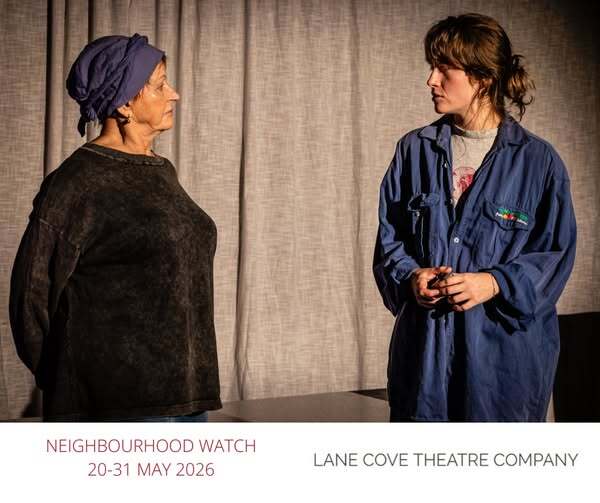
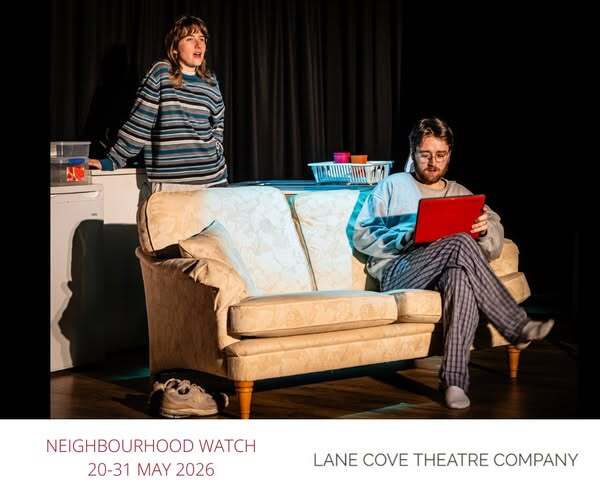
The set divides the stage into two distinct domestic worlds. To one side, Ana’s home; layered with the sentimental clutter of a long life, ornaments and keepsakes crowding a shelf beside antique chairs upholstered in faded pink. To the other, the sparse, slightly chaotic territory of youth; a cream sofa with an ironing board for a companion. That ironing board is doing a lot of thematic work, as it turns out.

Directors Kathryn Thomas and Christopher O’Shea, use a creative light and sound design to split stage with real intelligence; symbolic darkness pooling around characters who are unheard or unreachable, light carving out the emotional temperature of each scene with quiet precision.

The play opens on Isobel Rabbidge as Catherine, standing alone in the dark. When the lights rise, what we see is a young person held together by very little; their melancholy is in their posture and anguish across their face. It’s a bold, wordless opening statement, and Rabbidge earns it. Christopher O’Shea’s Ken arrives to break the spell, and together they establish the housemate dynamic with warmth and comic ease, celebrating Kevin ’07, negotiating the competing distractions of World of Warcraft and compulsive ironing, gently circling each other’s wounds.

The neighbourhood assembles around them: the polished, self-contained Christina; the relentless Nancy with her Neighbourhood Watch clipboard; and Milova, whose dogged pursuit of friendship Ana meets with hostility. We see the collective loneliness, and we are frustrated by the missed connections.
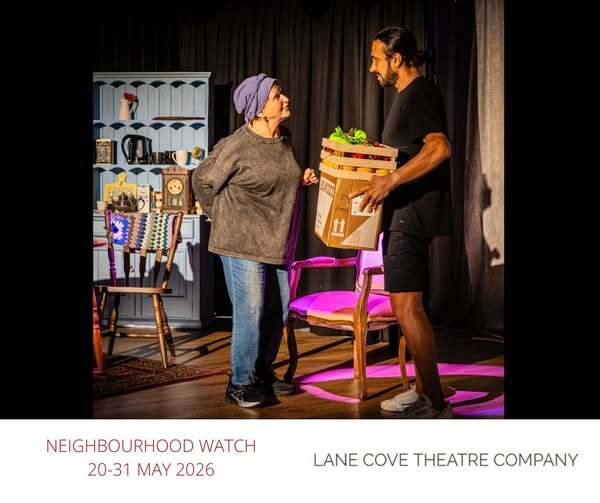


Then Ana arrives in full. I found out later that Miriam Fagueret’s authentic and powerful performance is a stage debut! Her Ana is genuine, funny, heartbreaking and fierce, an eighty-year-old woman who has survived prisoner of war camps across three countries and is absolutely not about to be managed by anyone. Fagueret finds the dark comedy in Ana’s mistrust without ever softening what lies beneath it, and when the play shifts into its magical realist register; reaching back into wartime Hungary through gorgeous ensemble work, she anchors those sequences with a lived-in gravity that is quietly extraordinary.

The production’s best moments arrive when the cast moves as a collective. The ensemble, including Caitlin Clancy, Penny Day, Gabriel Jab’bar, Jack Stout and Luca Savini, create the bridge between past and present with a physical attentiveness that gives the magic realism its legitimacy. Being an opening session, there were a few stumbles; entirely forgivable, and in truth, the trust and responsiveness between Rabbidge and Fagueret in navigating those moments only deepened the sense of a tight-knit ensemble at work.

The second act darkens considerably. Catherine’s truth and Ana’s collide, and Rabbidge meets the challenge with a raw, heart-wrenching honesty. The chemistry between the two leads is the engine of the whole piece; you feel the unlikely love of this odd couple friendship, which makes its ruptures genuinely painful.

Neighbourhood Watch is a long piece, and it carries weighty themes: grief, isolation, trauma, the peculiar modern loneliness of living wall-to-wall with strangers. But it is lifted throughout by the warmth of its central relationship and by a company that clearly believes in what they’re making.

For the HSC students who will study this text, seeing it live is an extraordinary gift. For everyone else: this is exactly the kind of story that reminds you what theatre, and neighbourhoods, are actually for.

To book tickets to Neighbourhood Watch, please visit http://www.lanecovetheatrecompany.com.au.

Photographer: Paul Frontczak

Spread the word on your favourite platform!

We Laughed, We Cried, We Grooved, We Swooned!

A Transgender Woman On The Internet, Crying

A Transgender Woman On The Internet, Crying Rating

★★★★★

Click if you liked this article

1

Wow. Yesterday was the International Day of Trans Visibility, and what better way to honour such an important occasion than by seeing Cassie Hamilton’s hyperpop musical, “A Transgender Woman on the Internet, Crying”.

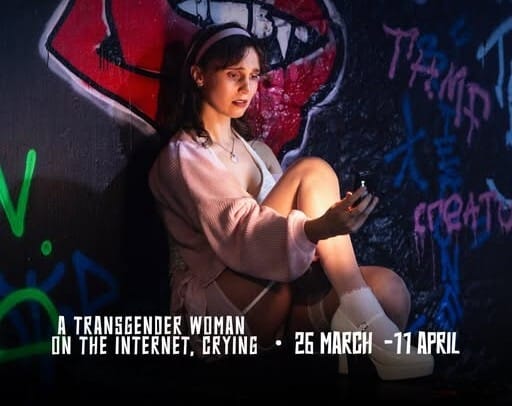
I love the Old Fitz, not least because of the complete transformation of the set with every new show. This one was brilliantly done, with stylised graffiti and old skool speakers that pumped out the hyperpop hits. What is “hyperpop”? Thanks, Mouth_Feel, played by Rosie Rai, for answering that question. This is one of many questions raised, asked, and answered in this powerful and vulnerable piece of work; some you never thought to ask, some you should have thought to ask, and some most of us have no right to ask. All are handled with a delicate balance of truth through song, delivered with poignancy and emotion by this incredibly talented cast.

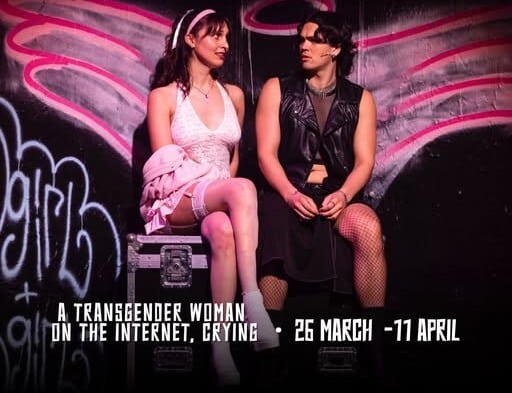
The story centres around Avis O’Hara, aka the DIY Doll, played by the epically talented writer and creator Cassie Hamilton. Avis has built an online platform by leaning into being “the right kind of trans”; with an emphasis on “right”, where those internalised self-hate pathways sometimes end up aligning. I first came across Cassie Hamilton in ATYP’s production of “Converted!” and was excited when this project was announced, eagerly awaiting a Sydney season. Even more so when two of my favourites, Blake Appelqvist (who I’ve been fangirling since Fangirls) and Teo Vergara (stole my heart in Jagged Little Pill), were announced, and it was a pleasure to make the acquaintance of the equally talented Rosie Rai. These four powerhouses bring their own unique authenticity and depth to their characters. Blake plays Corrin Verbeck, a left-tube vlogger who, along with besties Mouth_Feel and Sasha (Vergara), is sick of the toxic messaging by people like Avis and conspires to expose her.

It’s a classic frenemies-to-lovers story, but also a beautiful celebration and deeply moving collective healing and purging of complex trauma for one of the world’s most marginalised and persecuted groups of people. The foursome harmonise beautifully, with vocals (musical direction by Lillian Hearne) and choreography by Dan Ham and Riley Gill that allow each performer to shine.


Jean Tong’s direction is a real asset to the production, grounding and guiding the chaos with a deft hand. Tong allows high energy and spontaneity to flourish while maintaining a sharp pace and a strong emotional through line. There is a kind of guerrilla-theatre quality to the staging that feels entirely appropriate here, and the performers absolutely thrive within it. It is a confident, responsive directorial vision that gives the work room to be both playful and devastating.

The creative team deserves huge credit for the world they’ve built. Ruby Jenkins’ set is grungy, eye-catching, and feels like a playground for the characters to gleefully exist in. Rachel Lee and Nick Moloney’s lighting leans into clichĂ© musical-theatre lighting state, and the work is better for it. Dan Ham’s choreography is crafted not only to capture each character’s movement, but to allow each performer to comfortably move within their abilities and fully relish the dance breaks. The lighting and sound design are engaging and responsive, with one of the most impactful moments coming when the production makes the brilliant choice of pure silence at a significant emotional peak.

The trans joy and journey are loud and proud, as they should be. But this work is also an important commentary on the fast-moving pace of online interaction, how quickly acceptance and encouragement can turn into control and isolation, and then just as easily flip into hatred and the dreaded “cancelling”. It highlights the impact of keyboard warriors and the knife’s edge of finding online belonging while surrendering freedom, autonomy, and authentic self-expression. It shines a dark light on the struggles many face when it comes to cyber culture, particularly in specific communities.

The audience was thoroughly engaged throughout. We laughed, we cried, we grooved, we swooned. This is a truly well-written, beautifully crafted show that is a must-see. I might just need to go along and see it again if I can manage to secure a ticket before they sell out.

To book tickets to A Transgender Woman On The Internet, Crying, please visit https://www.oldfitztheatre.com.au/a-transgender-woman-on-the-internet-crying.

Photographer: Brett Boardman

Spread the word on your favourite platform!

Moving, Off-Beat, And Deeply Tender

Tonsils + Tweezers

Tonsils + Tweezers Rating

★★★★★

Click if you liked this article

3

As we enter the theatre, an actor in boxers, a singlet, and a sleeveless tuxedo top is already on stage, catching our attention with a scientific riddle and collecting our answers as we take our seats. When the lights focus on them, the show officially begins, the riddle now in the hands of two figures we come to know as Lewis (Tweezers) and Tonsils, our excitable and endearing narrator.

The set, designed by Bella Saltearn, is deceptively simple; vintage wallpaper, a small corner kitchenette, two chairs off to the side. It grounds us in a space that slips gently through times, ages, and memories.

Early on, we’re warned something terrible will happen in eight minutes, setting an urgent emotional pace for Tonsils as they try to save Lewis from whatever fate lies ahead.

Max and Beth enter as narrative threads of their own. Their present-day scenes (preparing to perform Macbeth) become a vehicle for reflecting on the past. Gradually, it’s revealed that Max was one of the “Fountain Boys,” childhood bullies of Lewis and Tonsils.

Matthew Phillips’ tightly orchestrated sound design, paired with Poppy Townsend’s nuanced lighting, adds immense texture. What seems simple at first quickly reveals itself to be intricately timed, every shadow and flicker purposeful, especially as moments of puppetry and shadowplay appear.


Lia T’s delicate compositions, together with handmade props and playful visual touches, bring a sense of whimsy that keeps us laughing even as the story edges toward heartbreak.

This is part of the emotional rollercoaster of this piece; you go from belly laughs to a shocked silence, or deep tenderness in moments. This is the show’s quiet brilliance, sustained by an exceptional ensemble. Ariyan  Sharma, as Tonsils, fills every inch of the space with captivating energy, never losing the thread even through unexpected moments (a broken glass in the audience doesn’t faze Ariyan for a second). Caitlin  Green and Toby  Carey offer depth and grounded humour, while Victor Y Z Xu’s performance as Lewis is a slow-build ache, leaving more than a few of us wiping away tears by their powerful performance in the final moments of the play.

Lucy Rossen’s direction is thoughtful, playful, and deeply human. Lucy navigates Will O’Mahony’s script with care, finding the humour within the heaviness and the truth within the surreal. Tonsils + Tweezers is a darkly funny and haunting exploration of friendship, grief, and the fragile membrane between imagination and reality.

There is a reference to how Macbeth is known as “A tragedy of the imagination
” and this is clearly drawing a correlation between Macbeth and Tonsils + Tweezers. We are seeing what happens when the veil between reality and imagination is held together by the flimsiest thread.

It’s deep themes, and hard subjects are not for everyone but it was truly enjoyable from start to finish, and relatable on so many levels (some you wouldn’t want to share with most people). It was light, painful and incredibly touching all at once. It will leave you tender but grateful.

To book tickets to Tonsils + Tweezers, please visit https://www.oldfitztheatre.com.au/tonsils-tweezers.

Photographer: Nicholas Warrand

Spread the word on your favourite platform!

Important and Deeply Moving: First Nations Theatre Not To Be Missed

Dear Son

Dear Son Rating

★★★★★

Click if you liked this article

2

Walking into Belvoir St Theatre felt like reconnecting with an old friend, one whom I have had multiple warm experiences with over the years, and Dear Son only deepened that relationship. Those who know me are aware of my self‑preservation from “spoilers”, so I walk into these situations with just the bare bones of what delight is about to unfold. I was unaware what other “old friends” would be part of this powerful experience.

When director and co‑adapter Isaac Drandic stepped onstage before the show to tell us that Luke Carroll was ill and could not perform, I was briefly disappointed, having known Luke in my youth and followed his career since. Brief is the key word, because it was announced he was being replaced by Aaron Pedersen, an actor who once showed me immense kindness when I was a wide‑eyed Melbourne wanderer in another life, and whose work I also hold in very high esteem. In other words, I already knew I was in for quite a treat before a single word was spoken.​

Dear Son, based on the book by Thomas Mayo and adapted for the stage by Drandic and co‑adapter John Harvey, gathers five Indigenous men in what feels like a coastal “men’s shed” to ask, again and again, “What is it to be a man?” through letters, yarns, song and embodied storytelling. The set design by Kevin O’Brien creates warmth and place with deceptively simple means: sandy ground, a rustic wooden covering, two park tables and a glowing sunrise upstage, an inviting representation of a communal gathering space that is both specific and symbolic. It immediately feels connective, it feels personal.


Our five Indigenous actors – Jimi Bani, Waangenga Blanco, Kirk Page, Aaron Pedersen and Tibian Wyles – begin by waving reverently to the audience as words are projected behind them. Video designer Craig Wilkinson’s projections fill the upstage screen with terms like “Father”, “Son”, “Artist”, “Protector”, held by these strong, proud figures as they claim space and create warmth, before those words are undercut and complicated by others that have been used as weapons against Indigenous people for generations, ushering us into Act 1: Letters of Struggle.

The group moves between letters to fathers and sons, shared conversation, humour that is deliciously specific, and moments of song supported by composer and sound designer Wil Hughes’ evocative soundscape. They unpack the impacts of colonisation and the generational trauma wrought by acts of violence, malevolence and cruelty, while also honouring resistance, love and the everyday work of breaking cycles. Lighting designer David Walters gently shifts us through time and tone, from campfire intimacy to something closer to ceremony, with haze and shadow allowing the stories to sit in a liminal, memory‑like space.

The individual performances are powerful, moving and deeply poignant, and the ensemble work is quietly transcendent. It is hard to believe that Pedersen has entered the fold so recently; he integrates with a calm, centred presence that never pulls focus from the collective but deepens it. Wyles often anchors the musical moments with guitar and voice, Bani brings an easy charisma and storyteller’s ease, and Page moves deftly between gravitas and wry humour. Blanco, who also serves as choreographer and movement director, gives the production its physical language.

These stories unite the men in shared trauma, and a far more powerful desire to transcend it by breaking the walls of toxic masculinity down. It’s an important dialogue and unpacking for men, but they are also very clear on the importance of women in their stories and how respect for women should be centred.

There are familiar public figures and stories represented amongst the letters and the production was beautiful, emotional and powerful, but the real tear‑jerker was when each artist shared their own personal lived experience and a meaningful piece of themselves in reverence to the vulnerability they have been celebrating and advocating for throughout.

Dear Son is an important and deeply moving work of First Nations theatre that should not be missed.

To book tickets to Dear Son, please visit https://belvoir.com.au/productions/dear-son/.

Photographer: Stephen Wilson Barker

Spread the word on your favourite platform!

Subscribe to What's The Show

Reviews, show news and what is on, straight to your inbox.