Neighbourhood Watch

Neighbourhood Watch

Neighbourhood Watch Rating

Click if you liked this article

1

This was my first visit to Lane Cove Theatre Company, I was met by warm greeters at the door. The intimate space then added to that cosy sense of community-mindedness. The warmth and passion of director Kathryn Thomas, delivering the acknowledgment of country and welcoming us, was a great start. I was excited for what lay ahead.

The Wednesday 11am session is, I can now confirm, a genuinely civilised way to experience theatre. It is also, the perfect hour for this attention-challenged reviewer to see Lally Katz’s Neighbourhood Watch; a hefty play dealing with some big issues centring the question of when and why we stopped knocking on each other’s doors.

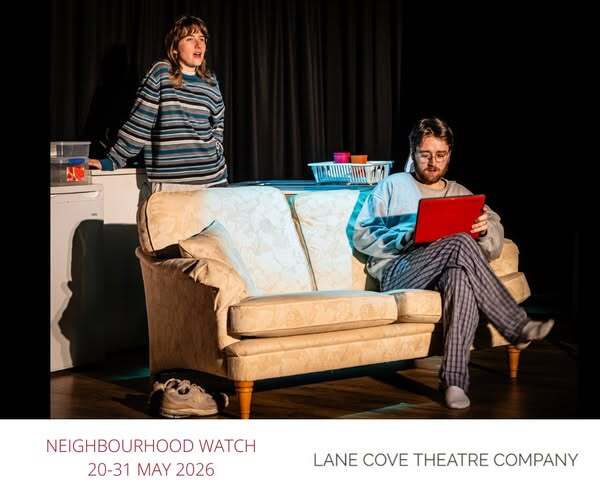
The set divides the stage into two distinct domestic worlds. To one side, Ana’s home; layered with the sentimental clutter of a long life, ornaments and keepsakes crowding a shelf beside antique chairs upholstered in faded pink. To the other, the sparse, slightly chaotic territory of youth; a cream sofa with an ironing board for a companion. That ironing board is doing a lot of thematic work, as it turns out.

Directors Kathryn Thomas and Christopher O’Shea, use a creative light and sound design to split stage with real intelligence; symbolic darkness pooling around characters who are unheard or unreachable, light carving out the emotional temperature of each scene with quiet precision.

The play opens on Isobel Rabbidge as Catherine, standing alone in the dark. When the lights rise, what we see is a young person held together by very little; their melancholy is in their posture and anguish across their face. It’s a bold, wordless opening statement, and Rabbidge earns it. Christopher O’Shea’s Ken arrives to break the spell, and together they establish the housemate dynamic with warmth and comic ease, celebrating Kevin ’07, negotiating the competing distractions of World of Warcraft and compulsive ironing, gently circling each other’s wounds.

The neighbourhood assembles around them: the polished, self-contained Christina; the relentless Nancy with her Neighbourhood Watch clipboard; and Milova, whose dogged pursuit of friendship Ana meets with hostility. We see the collective loneliness, and we are frustrated by the missed connections.



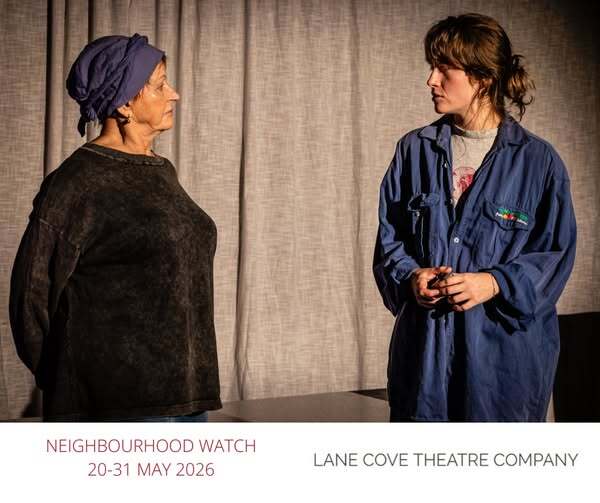
Then Ana arrives in full. I found out later that Miriam Fagueret’s authentic and powerful performance is a stage debut! Her Ana is genuine, funny, heartbreaking and fierce, an eighty-year-old woman who has survived prisoner of war camps across three countries and is absolutely not about to be managed by anyone. Fagueret finds the dark comedy in Ana’s mistrust without ever softening what lies beneath it, and when the play shifts into its magical realist register; reaching back into wartime Hungary through gorgeous ensemble work, she anchors those sequences with a lived-in gravity that is quietly extraordinary.

The production’s best moments arrive when the cast moves as a collective. The ensemble, including Caitlin Clancy, Penny Day, Gabriel Jab’bar, Jack Stout and Luca Savini, create the bridge between past and present with a physical attentiveness that gives the magic realism its legitimacy. Being an opening session, there were a few stumbles; entirely forgivable, and in truth, the trust and responsiveness between Rabbidge and Fagueret in navigating those moments only deepened the sense of a tight-knit ensemble at work.

The second act darkens considerably. Catherine’s truth and Ana’s collide, and Rabbidge meets the challenge with a raw, heart-wrenching honesty. The chemistry between the two leads is the engine of the whole piece; you feel the unlikely love of this odd couple friendship, which makes its ruptures genuinely painful.

Neighbourhood Watch is a long piece, and it carries weighty themes: grief, isolation, trauma, the peculiar modern loneliness of living wall-to-wall with strangers. But it is lifted throughout by the warmth of its central relationship and by a company that clearly believes in what they’re making.

For the HSC students who will study this text, seeing it live is an extraordinary gift. For everyone else: this is exactly the kind of story that reminds you what theatre, and neighbourhoods, are actually for.

To book tickets to Neighbourhood Watch, please visit http://www.lanecovetheatrecompany.com.au.

Photographer: Paul Frontczak

Spread the word on your favourite platform!

The “Calendar Girls” Idea Takes Off, More Than Expected!

Calendar Girls

Calendar Girls Rating

Click if you liked this article

3

The Lane Cove Theatre Company’s production of Calendar Girls was absolutely delightful, where fresh “sunflowery-goodness” shone from the stage via the actors! Although the play has a serious undertone, with one of the character’s husband, John (Darren Gibson) passing away from leukemia, Director, Light and Sound Designer Kathy Petrakis led the company towards showcasing an inspiring story which evolved into a powerful celebration of a group of women. The story highlights their bravery in stepping beyond their comfort zone along with the unbreakable bonds of friendship.

Based on a true story, Calendar Girls opens with a group of mature women attempting to do a yoga class, led by Chris (Michelle Bellamy), which dissolves into teasing each other. The audience quickly sees the easy-going friendship between these women, who meet regularly in Yorkshire at the Women’s Institute.

When the unthinkable happens and John falls sick, diagnosed with leukemia, his wife Annie (Anita Lenzo) is devastated. Having been previously viewed as a bright and positive presence on stage, Gibson’s portrayal of his character John struck me deeply, as he convincingly shrinks into his former self – sitting in a wheelchair and speaking weakly- evoking a powerful emotional impact.

When he passes, the way this is told was respectfully done, with writer Tim Firth ensuring that John’s legacy and wish for his loved ones would be like his favourite flower, the sunflower. The line “the last phase of the sunflower is the most glorious” appears to live on as a blessing. So begins a heartfelt mission to raise money for leukaemia research and to improve the relatives’ waiting room in the hospital by replacing an old uncomfortable lounge.


Chris and Annie come up with the idea for their group of friends to pose nude for the upcoming WI calendar, and it takes some convincing for the others to agree. Bellamy’s portrayal of outgoing Chris was noteworthy, and she showed the vulnerability of her character as well as her fierce strength. Lenzo playing the grieving widow Annie, was acted with heart and a quiet determination.

Each of the women were given props to use in their photo shoot. I won’t give any spoilers away, except to say that how the photo shoot was done, was in equal parts both tasteful and hilarious! I would imagine that this task of having a live “nude” photoshoot onstage would have been a challenge, so well done to the cast and crew. The audience loved this scene!

Blake Nicholas, portraying the calendar’s photographer Lawrence, and later toward the end of the play, another photographer named Liam, gave strong performances as both. Pauline Garner’s character Marie gave her the opportunity to showcase her comedic flair as the uptight head of the WI Yorkshire branch, particularly in a scene where she is playing a game of badminton with Ruth.

What I really liked about Calendar Girls was that each woman in this friendship group had a story to tell and the actors brought their own character’s individuality and quirky personalities to the forefront with sleek nuances and body language. No single character was “the star”. I think that this united the audience closer to the characters. Janette Chambers brought her musical and singing background to the stage playing the confident church organist Cora, the Vicker’s daughter, with spunk! Jessie was played with a twinkling cheekiness by Karen Firmstone, and her delivery of a certain line during the calendar photo shoot had the audience in bouts of laughter. Georgina Philpott, who played Celia, nailed her character’s vibrant personality well. Josephine Birch’s character Ruth had a wide scope of emotions due to her situation which played out as time went on, and she portrayed Ruth’s fragility to strength perfectly. The Yorkshire accent is a difficult one to master, and I’m sure that the cast will continue to polish this distinct accent as the season unfolds.

Calendar Girls felt authentic, in a way that only a well written true story can. The ending was a tribute to people who have been affected by cancer and it was moving and respectful. When we were told the end fundraising total for the “WI Alternative Calendar”, I left the theatre feeling hopeful and impressed by the strength of community and the power of lasting friendships. If you want to feel this way too, combined with a few belly laughs, go and see Calendar Girls in Lane Cove!

Tickets: www.trybooking.com/events/landing/1508641
Duration: 2 hours with interval
Season: 20 February – 1 March 2026
The Pottery Lane Performance Space
1 Pottery Lane, Lane Cove NSW 2066
(There is onsite parking, for free after 6pm)

To book tickets to Calendar Girls, please visit https://www.lanecovetheatrecompany.com.au/.

Photographer: Jim Crew, Lane Cove Creative Photography

Spread the word on your favourite platform!