
Gioia Mia – Sweetheart

Italian Film Festival - Sweetheart (Gioia Mia)

Italian Film Festival – Sweetheart (Gioia Mia) Rating

Click if you liked this article

‘Gioia Mia’ or ‘Sweetheart’ is a gentle, coming of age film with a wonderful cast. It is a moving and thoughtful journey addressing abandonment and the young and old who have loved and lost, with secrets that still hurt. Written and directed by Margherita Spampinato in her feature film debut, we are enveloped in a young boy’s life where his only communication is with his phone.

Sent off to live with an old aunt who is full of regrets and frustration, the two clash as age, technology and a different way of life collide. Nico is played by Marco Fiore and his face flashes with obstinate retorts, trembles with hurt and sadness and finally beams with joy. Every event and conversation sweeps across his face. His aunt, Gela, played by Aurora Quattrocchi, is the classic, traditional religious aunt who has shut herself and her heart away. Her life is acted out quietly with restraint but with a fullness of emotion as she and Nico spark against each other as both are at different ends of a lifecycle. They learn how to bond and there are sweet moments as Nico moves from technology to tradition and Gela accepts him into her heart.
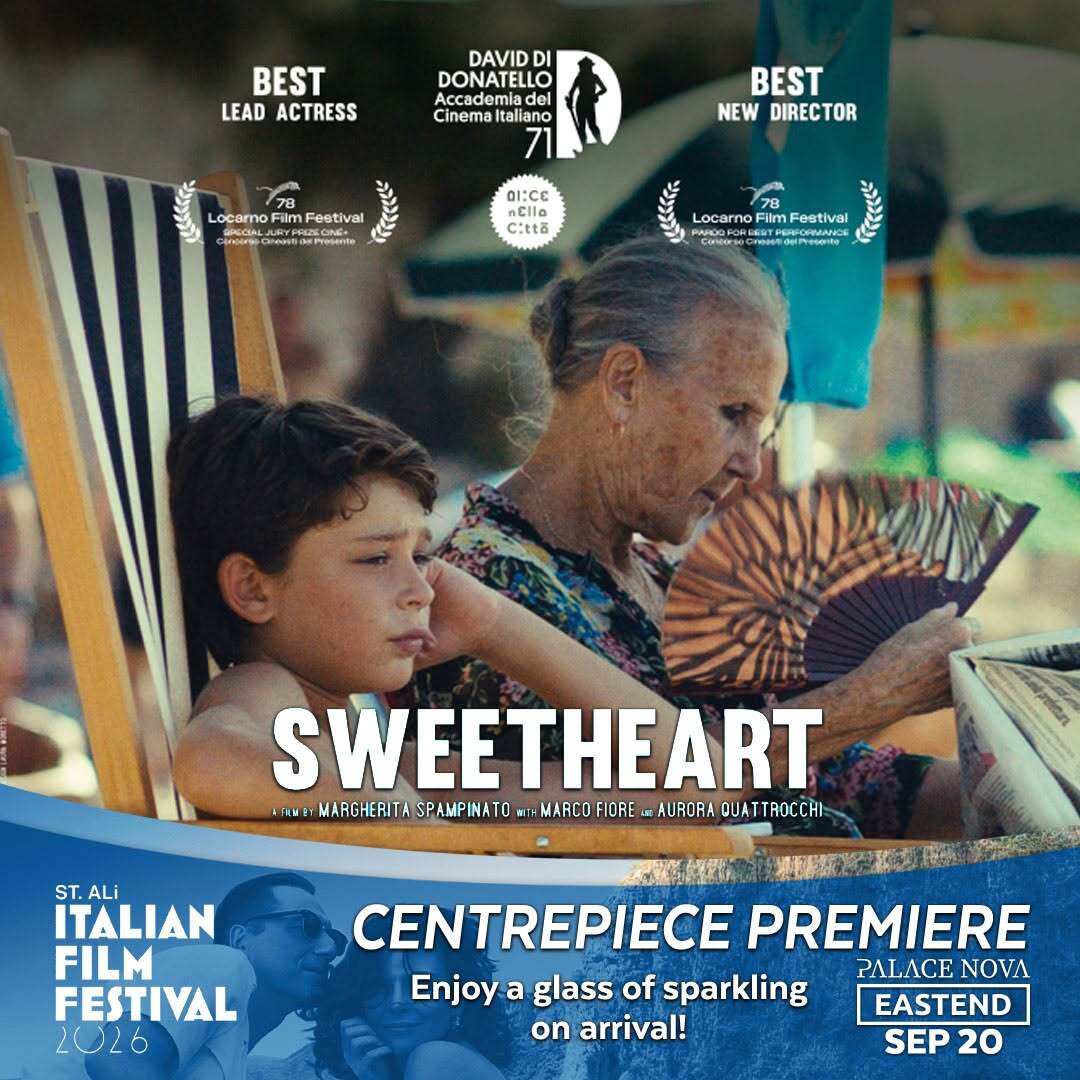
 

Without giving away the gentle plot, there is a tribe of grandmas hilariously offering advice when none is requested. They bake sugar cookies as that is their answer to grief, shouting orders from balconies in the traditional way whilst others use technology. It is a fading world in a beautiful fading town. The women have gone through life together and forgiven what could be as they observe their grandchildren play and grow.

A group of children is feisty with the leader, Rosa, a growing young girl played by Martina Miami, resenting an outsider. Martina is a foil to Nico as they clash and reject each other. They finally recognise they are both abandoned children with similar feelings, they bond together and there is a lovely sense that all will be right in the end.

With shades of ‘Cinema Paradiso’, the glorious Italian light is a backdrop adding to a sense of the summer heat and oppressiveness of life and emotions. With an emphasis on close up cinematography all of the acting is in the faces and is played without over-dramatising for effect. That being said, it is Marco Fiore and Aurora Quattrocchi who hold our attention and draw us in.

To book tickets to Italian Film Festival – Sweetheart (Gioia Mia), please visit https://italianfilmfestival.com.au/films/iff26-sweetheart.

Spread the word on your favourite platform!

The Life Apart

The Life Apart (Italian Film Festival)

The Life Apart (Italian Film Festival) Rating

Click if you liked this article

4

The Life Apart is everything aficionados of European cinema long for — poetic obscurity, powerful performances, and cinematography so lush you want to step inside the frame. Paired with a hauntingly beautiful classical score, it delivers a sensory experience that lingers long after the final credits roll.

Set against the backdrop of an elegant Italian palazzo, the film captures the glamour and quiet dysfunction of bourgeois family life. The story begins with joy: the long-awaited arrival of a baby to a seemingly perfect couple — a striking, Penélope Cruz look alike, mother and her accomplished husband, a respected doctor. The nursery is pristine, a devoted maid is ever-present, and an affectionate aunt is ready to help. Yet, this ideal world unravels the moment the baby, Rebecca, is born with a prominent birthmark on her face and neck.

From here, the narrative dives into the mother’s fragile psyche. Her descent into mental illness is portrayed with empathy and depth — torn between shielding her daughter from a cruel world and hiding her away entirely. The father’s helplessness and the strength of the mysterious aunt, who champions Rebecca’s education and introduces her to the piano, offer a poignant contrast.


As Rebecca grows, so does her resilience. She finds solace and acceptance in an unlikely friend from a very different walk of life — a spirited girl who challenges societal norms with ease. Through this friendship, Rebecca discovers self-worth and agency, even as her mother spirals further into despair.

The film does not shy away from tragedy, but it also doesn’t let grief define its ending. Instead, it gently guides the audience — and its characters — toward hope, growth, and a redefinition of beauty, love, and family.

Themes of fate, identity, societal pressure, and inner strength are woven with subtlety and sophistication. Director and cast handle emotional nuance with a light but sure touch, while the cinematography elevates every moment into painterly perfection.

A must-watch for lovers of European cinema and classical music, The Life Apart is both a heartbreaking and life-affirming journey. Let it transport you to Italy and envelop you in its rich atmosphere. This is the kind of film you carry with you, reflecting on its quiet power long after the screen fades to black.

To book tickets to The Life Apart (Italian Film Festival), please visit https://italianfilmfestival.com.au/films/iff25-the-life-apart.

Spread the word on your favourite platform!

Signorinella: Little Miss (Italian Film Festival)

Signorinella: Little Miss (Italian Film Festival)

Signorinella: Little Miss (Italian Film Festival) Rating

Click if you liked this article

6

When they began migrating to Australia pre-World War II, Italian’s were given plots of land in the harsh outback to call their own. From there, they worked hard to ensure the land would thrive, build their businesses, and their families. Even while they were labelled as a threat by Australians in 1939, they didn’t let this stop them from building the best version of their lives.

“Signorella: Little Miss” explores how Italian women have contributed to the history of Australia, from fashion to politics, food to art, and almost everything in between. With feminism as the core theme, the interviewees are charming, lively women reminiscing on their stories in Australia, and showing a resilience that can only come from having to repeatedly explain to their friends and acquaintances that good food is so much more than just a Sunday roast of potatoes and carrots.

Through the documentary, we are treated to family pictures – some of which are brought to life, and animated to show smiling faces and happy interactions – showing the lives of the young Italians while they tell their stories. Some of these women were not allowed to leave Italy without first being married, and were married by proxy, with their husbands waiting patiently for them in Australia. We are treated to a beautiful story from one interviewee deciding to come to Australia after seeing a picture of her future husband, and creating a beautiful family together.

“… sometimes destiny takes you there whether we believe it or not.”


Some viewers will find it amusing that even then, through well-written letters and years-old photographs, men were catfishing women into marriage. So not many of these proxy weddings were meant to last.

We hear not only from Italian migrants, but also from politicians, activists, magazine editors, chefs, business owners, singers, and more. The women on the screen are inspiring, well spoken, and beautifully dressed. Some chose to speak in Italian, some in English, and some a little of both, but they all share the same passion for their heritage, and their homes.

The focus for the documentary is on how Italian women have been quiet, hard-working building blocks in Australia, but we can’t ignore the stories of how they have been girl-bossing since they found their way to Australia. From keeping their families afloat while the men were taken away to internment camps, to finding themselves smack in the middle of the “man’s world” and refusing to back down, these proud women are an inspiration to everyone.

Through the documentary we are told, and shown, the Italian outlook on life: Anything is possible. And these women prove that.

“Life is most beautiful when it is diverse.” Tina Arena.

To book tickets to Signorinella: Little Miss (Italian Film Festival), please visit https://italianfilmfestival.com.au/films/iff25-signorinella-little-miss.

Spread the word on your favourite platform!

Film Review: The Boy with Pink Trousers (2025 ST. ALi Italian Film Festival)

The Boy With Pink Trousers (Italian Film Festival)

The Boy With Pink Trousers (Italian Film Festival) Rating

Click if you liked this article

Film Review: The Boy with Pink Trousers (2025 ST. ALi Italian Film Festival)

The Boy with Pink Trousers is based on the actual story of Andrea Spezzacatena, a fifteen-year-old boy from Rome who was severely cyberbullied and is loosely built on his mother’s, Teresa Manes, autobiographical novel, ‘Andrea: Oltre Il Pantalone Rosa’. The film is an engaging sensitive retelling of Andrea’s story, beautifully acted by the three young leads and is a cautionary tale in this age of social media obsession.

The film begins with Andrea recalling his birth and contemplating what would have happened in his life, shifting then to an older Andrea watching DVDs of him and his family in happy times and wondering when his parents’, Teresa (Claudia Pandolfi) and Tommaso (Corrado Fortuna), relationship began to fail. Moving then to teenaged Andrea (Samuele Carrino) practicing piano as Teresa receives a call from Andrea’s school informing her that he has won a scholarship because of his excellent academic achievement. To celebrate, they go to the funfair with Daniele (Pietro Serpi), Andrea’s younger brother.

As the story progresses, Andrea auditions for a choir that will perform for the Pope where he becomes in awe of another student Christian (Andrea Arru) also auditioning for the choir. At the start of the eighth grade Christian, who is repeating a year, and Andrea become classmates. Andrea is befriended by fellow eight grader Sara (Sara Ciocca) after Andrea deliberately gets into trouble in class. Andrea becomes friends with Christian after Christian asks him to help him with his studies but Christian distances Andrea after Andrea is chosen to perform for the Pope, but Christian isn’t.


After Andrea’s parents split, he confides in Christian who shares the contents of their discussion with the rest of the class. As Andrea and Sara move into High School, they discover that Christian, who was going to a different school, has joined their school and is in the same classes as them. Christian plots against Andrea which leads to calamitous bullying.

The Boy with Pink Trousers is director Margherita Ferri second full-length feature film and she and writer/producer, Roberto Proia, treat the subject matter delicately highlighting Andrea’s journey in the film sympathetically. Martina Cocco’s cinematography is subtle and warm, adding depth and emotion to the film. The music by Francesco Cerasi sits well with the events in the plot. The main theme is “Canta ancora” performed by Arisa which won Best Original Song at the Nastro d’Argento.

The three young leads, Samuele Carrino, Sara Ciocca and Andrea Arru, deliver excellent performances, particularly Carrino who carries most of the screen time of the film with aplomb. They are superbly assisted by Claudia Pandolfi and Corrado Fortuna.

The Boy with Pink Trousers was the highest grossing Italian movie of 2024 for good reason, it is a compassionate portrayal of a sensitive topic featuring exceptional performances by the young cast that will bring a tear to your eye.

Reviewed by Rob McKinnon

Rating; 8 out of 10
Genre: Drama
YouTube trailer: The Boy with Pink Pants trailer I PÖFF28

To book tickets to The Boy With Pink Trousers (Italian Film Festival), please visit https://italianfilmfestival.com.au/films/iff25-the-boy-with-pink-trousers.

Spread the word on your favourite platform!

Subscribe to What's The Show

Reviews, show news and what is on, straight to your inbox.