A Promenade of Shorts – The Red Phoenix Theatre Company

A Promenade of Shorts

A Promenade of Shorts Rating

Click if you liked this article

1

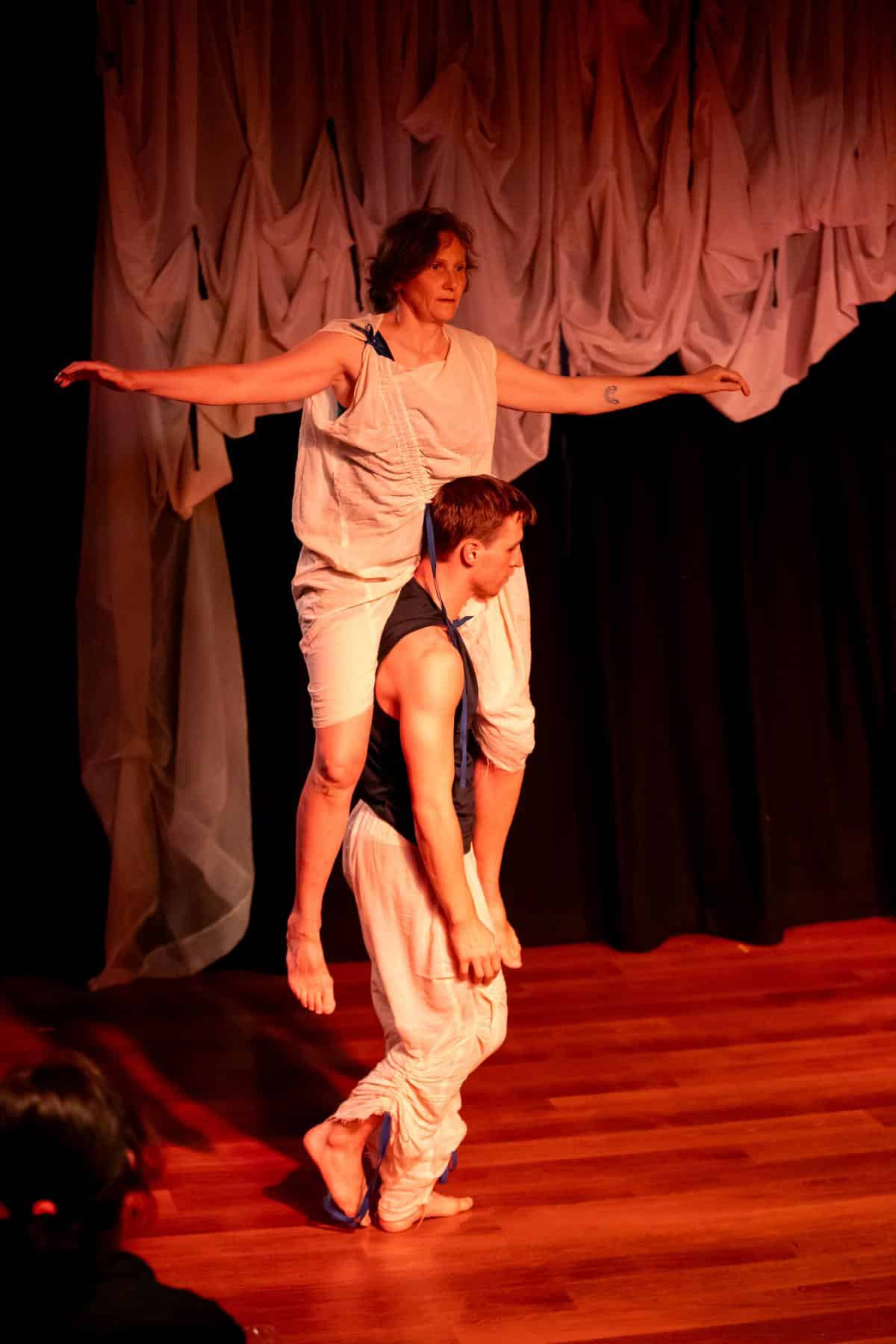
The concept of A Promenade of Shorts was born out of COVID restrictions in April 2020 when crowd sizes had to be limited to a small number. Due to the previous success of the concept, in 2026 the Red Phoenix Theatre Company presents season 3 of A Promenade of Shorts now at the Goodwood Theatre whereby 29 actors perform in 9 plays each of 10 minutes. They are performed in different areas of the theatre with great success. The plays are expertly executed over 3 sessions with 2 breaks and provide a highly entertaining experience.

Over the course of the evening, Tour Guides (Anne Doherty, Kate Prescott and Olivia Jan Parker) lead 3 groups of audience members through the distinct performance spaces where 3 plays are performed at each space.

In the Main Theatre the following are performed:

1. In Farce (written by Steven Bucko, directed by Norm Caddick)

Cast:
Front Desk Staff Jo Coventry
Man Matt Chapman
Husband Adam Tuominen
Wife Anita Zamberlan Canala
Plot Device Krystal Cave

2. Chilled Wine (written by Dorothy Lambert, directed by Alicia Zorkovic)

Cast:
Charlotte Jessica Corrie
Louise Laura Tregloan
Gemma Monika Lapka

3. Go to the Light (written by Laurie Allen, directed by Alicia Zorkovic)

Cast:
Roxie Peta Shannon
Sophie Cheryl Douglas
Dad Malcolm Walton
Will Tom Tassone

In The Bar the following are performed:

4. Bottle for a Special Occasion (written by William Kovacsik, directed by Hayley Horton)

Cast:
Martin Stuart Perce
Judith Lyn Wilson

5. On Queue (written by Morey Norkin, directed by Hayley Horton)

Cast:
Man 1 Jack Robins
Man 2 Jethro Pidd

6. Choices (written by James McLindon, directed by Hayley Horton)

Cast:
Debt Counselor Rebecca Kemp
Prospective Client Laura Lines


In The Studio the following are performed:

7. Road Trip (written by Jan Probst, directed by Libby Drake)

Cast:
Allen Lindsay Dunn
Mary Joanne St Clair
Aunt Pat Katie Packer
Uncle Joe John Rosen
Jack Jai Pearce
Michael Charlie Butler

8. When I Fall in Love it Will Be … (written by Susan Middaugh, directed by Libby Drake)

Cast:
Florence Campbell Lisa Lanzi
Ed Ferris Adrian Barnes

9. Mrs Thrale Lays On … Tea! (written by Rob Taylor, directed by Libby Drake)

Cast:
Mrs Thrale Sharon Malujlo
Polly Zoe Battersby
Dr Johnson Michael Eustice

Over the 9 plays the audience learns the ordinances in the town of Farce, not to trust a man working his way through the alphabet, how many Facebook likes you could get on your death bed, what’s the best wines for a cheating husband, how 2 men can make a queue, how to repay your student loan, how to plan a family road trip, how to cope with spouses who have dementia in residential care and what Mrs Thrale and Dr Johnson do after tea – very naughty!

The plays are often funny, sometimes hilariously, but there is also a mixture of sadness, and all are expertly acted. Each performance space presents its own demands which are adeptly and seamlessly resolved by the company’s crew members. Each audience member will have their favourite play of the evening and is also required to vote for it which is a difficult task due to the high-quality of all of them.

The Red Phoenix Theatre Company is to be congratulated for providing a magnificent evening of entertainment with season 3 of A Promenade of Shorts, with something for all audience members, it is in every respect a triumph deserving full houses.

Reviewed by Rob McKinnon
Rating; 5/5

A Promenade of Shorts remaining sessions are:
January 17, 21, 22, 23 & 24 @ 7.30pm. Sunday January 18 @ 2.00pm

Venue: Goodwood Theatre
166 Goodwood Road, Goodwood SA 5034

Tickets: https://www.trybooking.com/events/landing/1419827

To book tickets to A Promenade of Shorts, please visit https://www.redphoenixtheatre.com/nextplay/.

Spread the word on your favourite platform!

Kokuhō Opens the 2025 Japanese Film Festival With Power, Precision and Pure Theatrical Brilliance

Kokuho (Opening Night Reception - Japanese Film Festival)

Kokuho (Opening Night Reception – Japanese Film Festival) Rating

Click if you liked this article

The Japanese Film Festival is in its twenty-ninth year, and the festival continues to build its reputation as one of the most significant celebrations of Japanese cinema outside Japan. What began in 1997 with three small community screenings has grown into a nationwide cultural program that brings together new releases direct from Japanese cinemas, rare 35 millimetre prints, guest appearances, Q and A sessions and opportunities to experience both traditional and contemporary Japanese culture.

Opening night in Melbourne this year was buzzing from the moment the audience arrived. There was a warm sense of community at this festival, and that feeling was matched by a spread that included some of the best mochi I have ever had, generously provided by Roboto. The mood was festive, the theatre was full, and the anticipation for the flagship film was high.

This year’s opening film is Kokuhō, directed by Lee Sang il. The title means National Treasure, a fitting name given the cultural impact the film has had in Japan. Based on the best-selling novel by Shūichi Yoshida, Kokuhō stormed the Japanese box office in mid-2025 and continued to grow in popularity throughout the year. Audiences flocked to it repeatedly, word of mouth turning it into a major cultural milestone.

Unusually for a live-action drama, Kokuhō also became a major force on the international festival circuit. While Japanese films that break into global award categories are often animated features, Kokuhō made waves at Cannes and several other significant festivals. It was one of the most awarded and widely discussed Japanese films of the year, raising expectations ahead of its arrival in Australia.

A Story Shaped by Lineage, Ambition and Art

The story begins in Nagasaki in 1964 with a moment of shocking violence. Young Kikuo witnesses the murder of his father, a powerful leader of a yakuza organisation. This trauma marks him for life and shapes his intense desire to build a new future for himself. After his father’s death, Kikuo is taken in by the great kabuki master Hanjirō Hanai, played by the legendary Ken Watanabe. Under Hanai’s strict yet compassionate guidance, Kikuo begins to train as a kabuki performer alongside the master’s own son, Shunsuke.

The film follows the intertwined destinies of the two boys as they grow into men and into rivals. Their training is demanding. Their devotion to kabuki becomes an all-consuming pursuit that demands sacrifice, emotional depth and personal transformation. The film spans several decades, charting their rise through acting schools, rehearsal rooms and eventually onto Japan’s most prestigious kabuki stages.

Ryō Yoshizawa gives a powerful performance as Kikuo. He carries the weight of grief, ambition and longing with remarkable nuance. Ryūsei Yokohama as Shunsuke provides the perfect counterpoint, the son of a famous master who must grapple with the burden of legacy and expectation. The complex relationship between the two men provides the emotional core of the film. They are raised like brothers, yet they push and pull against each other constantly as their shared ambition becomes a source of love, frustration and pain.


Drama in Every Sense of the Word

Kokuhō is a drama in the richest sense. It is a story about artistic excellence, intense rivalry and deep emotional turmoil. It is also a story about Japan itself. The film is set during a period of enormous cultural transition. The country was emerging from the aftermath of the Second World War and moving into a modern future. This tension between old and new plays out both on the stage and in the characters’ lives.

One of the most impressive achievements of the film is the way it integrates kabuki into the narrative. Kabuki is known for its bold makeup, elaborate costumes, stylised movement and heightened delivery. For audiences unfamiliar with it, the artform can at first seem exaggerated. The film teaches viewers how to understand its emotional language. Rehearsal scenes show how performers learn to express pain, longing and joy through intonation and precise physicality. As Kikuo and Shunsuke train, we begin to see how their real lives mirror the classic tales they perform on stage.

The kabuki performances are staged with extraordinary visual beauty. The cinematography captures the richness of the costumes, the elegance of the sets and the commanding presence of the actors. The film allows several kabuki scenes to unfold in full, giving the audience a chance to experience the art form as though sitting in the theatre. These scenes also run in parallel with the offstage story, heightening the emotional impact.

A Film That Welcomes Newcomers to Kabuki

One of the film’s great strengths is its accessibility. Even if you have never seen kabuki before, Kokuhō draws you gently into its world. The characters learn and rehearse in ways that reveal the mechanics of the art. As the audience sees them refine their craft and receive feedback from Hanai, kabuki becomes easier to follow and understand. By the time the major stage scenes arrive, the heightened style feels entirely natural because the film has taught us how to read it.

This makes Kokuhō not only a gripping drama but also a cultural education. It provides a rare cinematic window into an artform that has survived for centuries and continues to hold a revered place in Japanese cultural identity.

A Rich Tapestry of Old and New Japan

The film also explores the social and cultural tensions of the era. Kikuo’s yakuza background places him at odds with the traditions and purity expected of kabuki performers. Meanwhile, Shunsuke must contend with the expectations placed upon him as the heir to a master performer. Japan itself is changing, and so are the worlds these men inhabit. The clash between traditional norms and a rapidly modernising society gives the film an added depth.

Verdict: A Masterwork of Emotion and Artistry

Kokuhō is a triumph of storytelling, performance and direction. It is a sweeping epic that never loses sight of the intimate emotional journeys at its heart. The performances are sublime, the direction confident, and the visual experience unforgettable. It balances scale, beauty and emotional truth.

As the opening feature for the 2025 Japanese Film Festival, it could not be more fitting. It embodies the richness and diversity of Japanese cinema and highlights the festival’s commitment to showcasing films that push artistic boundaries and capture the imagination.

The Japanese Film Festival runs nationwide from October to December 2025. To explore the full program, visit the festival website and enjoy a celebration of Japanese cinema that continues to grow in scope, ambition and cultural impact.

To book tickets to Kokuho (Opening Night Reception – Japanese Film Festival), please visit https://japanesefilmfestival.net/film/kokuho/.

Spread the word on your favourite platform!

Alice in Wonderland

Tea Tree Players Presents Shirley Valentine

Alice in Wonderland Rating

Click if you liked this article

2

Alice in Wonderland is not an unknown story, loved and enjoyed for its unique and unpredictable storyline. To portray the story through interactive theatre, the Tea Tree Players have assembled a spectacular collection of fluorescent sets, matching props, carefully crafted costumes, and well-considered use of the stage (and audience) to tell their story of Alice and her Wonderland friends. Be prepared to cheer on the heroes’ adventures, boo the decisions of the bad guys … and maybe even be on the receiving end of some flirtatious characters.

You can expect to see the usual characters, along with some welcome fresh faces who easily draw laughter from the crowd. After being introduced to the uptight matron of the “Home for Lost & Unwanted Girls” we follow three of the girls from the home – two of whom have surprisingly deep voices – follow the Dame Edna-esque Cook down the rabbit hole to rescue Alice, who is enchanting in her iconic blue dress as she follows the hopping white rabbit and the adventurous royal gardener. The Cheshire Cat can be seen slinking about the wings, guiding our characters with an elegant purr. The Caterpillar commands the stage while Tweedle-Dee and Tweedle-Dum encourage a sing-along. The Mad Hatter and his sidekick, the March Hare, match energy, while their friend the dormouse squeaks his way into our hearts. Every actor breathes life into their character, even the younger actors whose characters have no lines are noticeable – their costumes fitting in perfectly and their presence unmissable. When it comes to the Red Queen and her hair-raising laugh, she introduces us to the card guards who take everything a little too literally (as well as expertly changing the sets between scenes), and the kind, exposition-giving King. Each character has a memorable line or moment to take away with you after the show.

Alice In Wonderland

The pantomime is a fun-filled, happy ending story, rife with fourth wall breaks and crowd participation, of which the actors expertly encourage and roll with the heckling from the audience. The lighting matches every scene and is timed perfectly with its corresponding scenes – the fluorescent lighting adds an extra layer of Wonderland mystique, especially when you spot the fluorescent props scattered throughout. Both the lighting and music had no missed cues, but on occasion the sound overwhelmed the actors’ voices. Outside of the music trying to steal the spotlight, the actors were well spoken and mostly well heard – a few times the softer spoken actors could’ve projected a tad further, but it was also clear they knew this and were working on it. I look forward to seeing those actors again and seeing how they have improved.

The costumes were handmade, and perfectly suited for each individual character, from the overall fit to the smaller details and sequins. Through the demands of the physical slapstick style, the costumes did not fail the actors and stayed in place with nary a loose thread or zipper unzipping. To pair with the costumes, the makeup was expertly applied, particularly for those with a full face of makeup – be sure to keep your eyes peeled for some small details amongst the makeup and costumes, you won’t be disappointed!

With a well-dressed cast ready to interact with the audience, Tea Tree Players presents a fun night of adventure through Wonderland well worth the interaction.

To book tickets to Alice in Wonderland, please visit https://teatreeplayers.com/production/alice-in-wonderland/.

Spread the word on your favourite platform!

Adrift in New York

Adrift in New York

Adrift in New York Rating

Click if you liked this article

1

The Rep presents a masterfully executed traditional melodrama with Adrift In New York that requires the usual audience participation and is a thoroughly entertaining night at the Arts Theatre.

This style of melodrama emerged in France in the early nineteenth century and rapidly spread throughout the world becoming the favourite form of theatrical performances for the following century. A great number of plays were produced in this genre containing the staples of a love interest, moral conflicts, exaggerated acting in a fast-paced plot with music and happy conclusions. The audience is required to aah and ooh or boo and cheer and sing to the familiar songs if they want.

This story is set in the 1890’s and begins in the Weston family’s farmhouse where Aunt Sarah Weston (Jude Hines) and Martha Weston (Abigail Papps) are discussing the arrival of a letter for Nellie Weston (TJ Baker) from the villain Francis “Desperate” Desmond (Dylan Haar). Silas Weston (Russel Ford), Martha and Nellie’s father, announces that the wealthy Mr. Willoughby has been murdered and robbed. Nellie enters and it is discovered that Desmond has offered to take Nellie to New York to make her a great singer. The hero Jack Merriwell (LA Foale) arrives then Desmond and as the events unfold Desmond’s plot to steal the love of Nellie and to take over the farm which he believes has underground oil is revealed. The twists begin as the battle between good and bad engages.


The second act is set in a Bowery music hall then the conclusion in the third act is back at the farmhouse. The audience is superbly entertained at the start and end of each act with vaudeville sets by the wonderful chorus, including the hilarious balloon dance. There is also a segment where the audience can sing the classics, “Give My Regards to Broadway”, “A Bicycle Built for Two”, “Down by the Sea” and others.

Director Rose Vallen’s experience comes to the fore in this excellent production containing all the elements of a successful melodrama as the cast move seamlessly around the stage extracting the mandatory audience participation. The set design is minimal but effective. The music from the band, Sandi McMenamin and Rowan Dennis, is perfectly performed and holds the show together.

The cast is outstanding, Jude Hines expertise shines as she both masterfully handles the role of Aunt Sarah and guides the audience in eliciting the required responses to the hero and the villain. Newcomer Abigail Papps, in only her second production, has a first-rate grasp on the necessary exuberance required for a melodrama performance sparkling in the role of Martha. TJ Baker and LA Foale are similarly excellent, and Dylan Haar is terrifically dastardly as the villain. The rest of the cast and chorus are also marvellous, especially the scene stealing Penni Hamilton-Smith.

While a traditional melodrama may not be to everyone’s taste this production of Adrift in New York executes the genre expertly and is a great fun night for those who want to boo the villain and cheer the hero and sing to old favourites.

Reviewed by Rob McKinnon

Adrift in New York remaining sessions are:
15 November at 7.30 pm
16 November at 2.00 pm
19-21 November at 7.30 pm
22 November 2.00pm

Venue: Arts Theatre
53 Angas St Adelaide

Tickets: 8212 5777 or adeliaderep.com

To book tickets to Adrift in New York, please visit https://adelaiderep.com/season-2025/adrift-in-new-york.

Photographer: Richard Parkhill

Spread the word on your favourite platform!