
Click if you liked this article
7
Debra Oswald’s dramedy, Mr Bailey’s Minder, is a funny, life-enhancing, and deeply moving play about the ugly side of artistic temperament, friendship, family, and the longing for a better life.
Through her characters, playwright Debra Oswald paints a poignant portrait of what we need for forgiveness. Bristling in the beginning with what some might call caustic humour, the play builds through complexities that fiendishly remind us that underneath our veneers, there are rich layers of human experience, revealing a luminous inner beauty found in folks who’ve been scarred for life by life.
Leo Bailey, reputedly one of Australia’s greatest living artists, battles the ravages of alcohol abuse and indulgent misbehaviour, leading to self-loathing and cynicism, culminating in him needing round-the-clock care. His daughter Margo, the only one of his many children prepared to help, does so by staying aloof. She has been through a string of minders for her father.
Therese, fresh out of jail, desperate for a home and job, down to her last option, accepts the challenge to be Leo’s live-in minder. Determined to succeed, even if it means going head-to-head with her cantankerous charge, she battles bravely, seeking some sort of redemption.
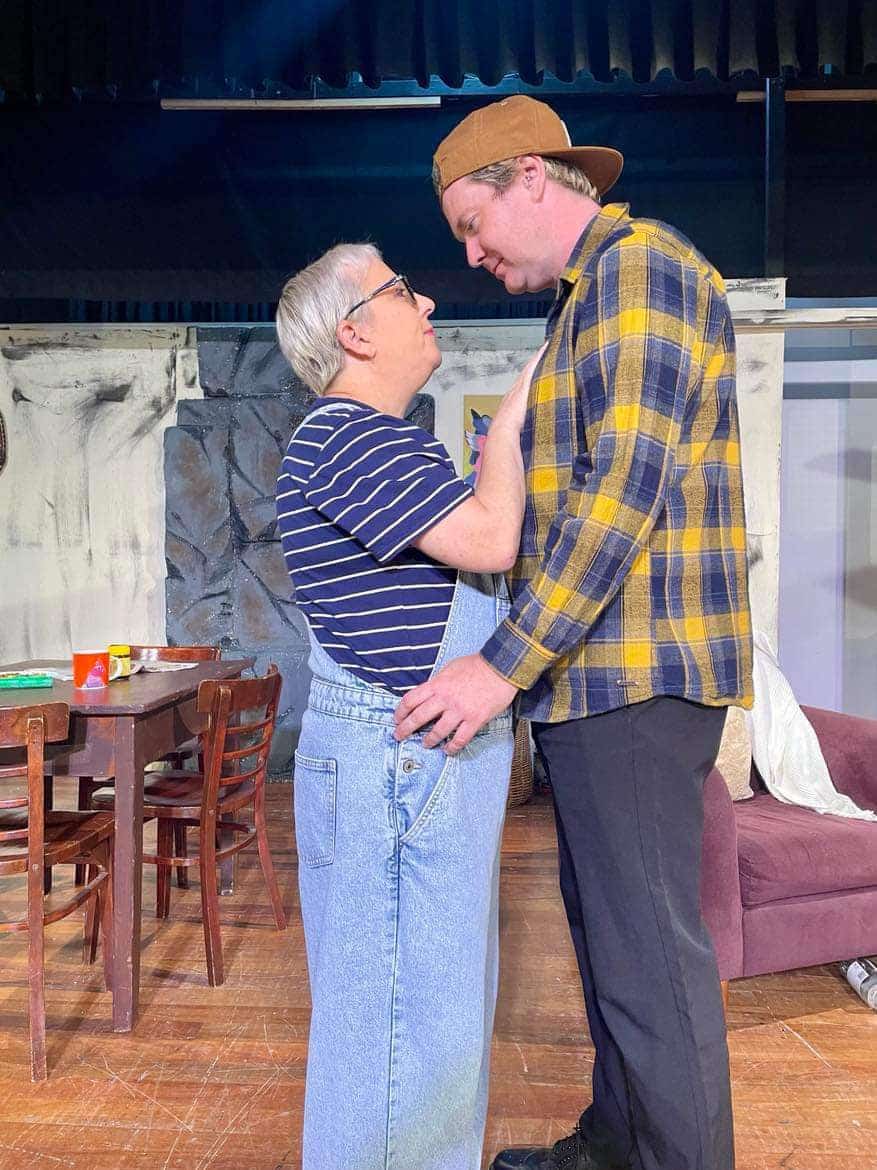
Karl, an obliging handyman tasked with the removal of a valuable mural, sees the good in Leo and is a little keen on Therese. He returns repeatedly, offering practical friendship.
The production contains strong language and adult themes. Ironically, it is staged inside a beautifully appointed church hall at 52 Merthyr Road, New Farm, by Nash Theatre. Director Phil Carney does a marvellous job with his cast, keeping the energy high without hurry, exploiting the comedy of awkward moments, and allowing the shift into pathos. The final moments mix excruciating irony with a glimpse of forgiveness.

John Stibbard, as Leo, enters down the stairs of his dilapidated house, oozing poison and malignancy. Despite all he says, does, and has done, we empathise. Stibbard brings warmth to the role, first through humour and then deep pathos when he sees for the first time in decades his favourite of the many pictures he’s painted.
Leo bathed his subjects in luminosity and himself in fame. However, he wasn’t so good as a husband and father. The role of Margo, his daughter, is tricky. But Linda Morgan blends the requisite primness with resentment. Therese, played by Susan O’Toole Cridland, is down to Earth, forthright, and courageous in sharing a strong bond with Leo: shame about their pasts. The play demands a burgeoning chemistry between Therese and Leo, and they achieve that as their characters let down their guards.
Gary Farmer-Trickett plays two roles: Gavin, a despicable minor character for a few moments, and Karl, whose burgeoning interest in Therese is well-understated.
The production should succeed by virtue of word of mouth alone. Here’s my two cents worth. See it for yourselves. You’ll find the experience valuable. Performances are on Friday and Saturday nights: 17, 18, 24, 25, 31 May, and 1 June. Matinee 18 May.