84 Charing Cross Road

84 Charing Cross Road

84 Charing Cross Road Rating

Click if you liked this article

0

If you haven’t read the book, and it is a true story, you have missed out but the second best thing is seeing the play. It captures post war Britain still recovering, short on food, living on coupons and making sense of the previous world war. As the play develops we are taken through England’s important historical moments including Queen Elizabeth’s coronation and celebration.

On the other side of the world, in fast-paced New York, a dollar-poor screen writer becomes a beloved contact to first one and then all in a small London vintage bookshop. It is a joy to hear such witty retorts but also to witness the gentle relationship between brash New York and formal London both in changing times for their countries and lives. Letters are exchanged as books are requested and as years go by, the audience witnesses changes in lifestyle and relationships from a formal correspondence to a warm and witty friendship. The audience audibly responded with laughter and sadness as the letters were read and reacted to.


The set was wonderfully lit in warm tones with the bookshop and New York apartment juxtaposed to represent the changing lives of both cities and characters. The set and costume designer had sourced and found genuine or reproduction clothes, jewellery, hats and even seamed stockings that set the era and style so authentically. Floor to ceiling shelves of books enhanced the feeling of being in a bookshop whilst the New York apartment was decorated in a more modern style. There was an intimate connection between the audience and actors being in the round giving the feeling of entering each world.

All actors were believable but the two main actors representing the writer, Helene Hanff and Frank Doel, the bookstore manager, captured the audience’s attention from the start. Helene presented a genuine New York strong accent and for those who have lived in New York, the body language, phrases and pace of delivery rang true. Frank wore the British suits and accent and politeness revealing a deeper side to him as their friendship evolved. The cameo actors were true to their time and the sense of a ‘family’ of colleagues revealed itself as each character interacted with Helene’s letters. Their non-verbal body language was at times funny and at other times, poignant but totally believable. The audience cared for each character and wanted to know about their dreams and aspirations. Knowing that the book is true made us want to find out what happened to each person in the future.

The play showed how well-written dialogue taken from genuine letters creates an atmosphere and audience connection with no clever props or actions required. It was the opening night and the actors and director were rewarded by a standing ovation and loud applause.

To book tickets to 84 Charing Cross Road, please visit https://www.ensemble.com.au/shows/84-charing-cross-road/.

Photographer: Prudence Upton
Spread the word on your favourite platform!

Bette & Joan: Exquisite Acting From Two Top Dames

Bette & Joan

Bette & Joan Rating

Click if you liked this article

The theatre was abuzz as the audience took their seats, anticipating the legendary cat fight ahead.

Two dressing tables, both alike in dignity, face the audience. Behind them – a facade – flats from the film set of “Whatever Happened to Baby Jane” are standing, reverse side towards the audience. We are invited into their private world, to peak behind the scenes.

They were leading ladies of the silver screen so why was “Whatever Happened to Baby Jane” the only picture they ever made together?

A New York Times critic once wrote that to reach their level of stardom, a woman “needed the constitution of a horse and the temperament of a wildcat.”

The rivalry between Bette Davis and Joan Crawford is the stuff of Hollywood legend. Tinseltown was rocked by their personal feud for years. Even at age 79 Davis would say of Crawford: “We’re very different kinds of women, different kinds of actresses… she was a fool… she wasn’t very smart.”

Jeanette Cronin and Lucia Mastrantone reign supreme as the battling pair, both fulfilling the writer’s words with admirable physical and vocal skill.


The clash of personality styles is fully realised – Bette Davis (Cronin) as the consummate artist striving for the pinnacle of performance and Joan Crawford (Mastrantone) the OCD actress obsessed with beauty who clawed her way to the top via the casting couch.

Cronin and Mastrantone are well cast and their characterisations specifically detailed, with excellent dialect work by Linda Nicolls-Gidley.

Joan: “Even close to death one must always resemble a star.”

The fourth wall is broken throughout, except in the moments of interaction between the two. This device works brilliantly as we are included in the Machiavellian plots as well as the moments of poignancy.

Direction by Liesel Badorrek is tight, scenes detailed. Exquisite choices using black and white video imagery, some live, some recorded, designed by Cameron Smith, enhance the Golden-Age Hollywood feel. Dialogue is paced well, with great rhythm and timing.

Costumes and sets by Grace Deacon are fabulous, immersing the audience. Kelsey Lee’s lighting design is flawless. The Ensemble Theatre becomes a backstage corner of a 1960s Hollywood lot.

The scenes turn on a dime, one moment we are brought to tears, the next – gaffaws as one of our divas drunkenly stumbles. But it is the painful moments, as their traumatic history is revealed that are truly moving.

Highly recommended. Sharpen your claws and get a ticket.

To book tickets to Bette & Joan, please visit https://www.ensemble.com.au/shows/bette-and-joan/.

Photographer: Prudence Upton
Spread the word on your favourite platform!

The Social Ladder

The Social Ladder

The Social Ladder Rating

Click if you liked this article

8

At its world premiere, The Social Ladder found an impeccably apt home at the Ensemble Theatre—the country’s longest continuously running professional theatre company—perched in rarified Kirribilli, with Sydney Harbour shimmering outside like an accessory quietly signaling old money. One could hardly imagine a more socially literate setting for a play so exquisitely preoccupied with rank, aspiration, and the fragile choreography of belonging.

Penned by David Williamson AO—Australia’s grand maître of social satire, whose canon includes such drawing-room dissections as Emerald City and Don’s Party—this latest work turns its incisive gaze toward status itself: how it is curated, performed, and so desperately desired. Williamson’s dialogue is once again sharp as cut crystal, producing laughter that curdles almost immediately into recognition.

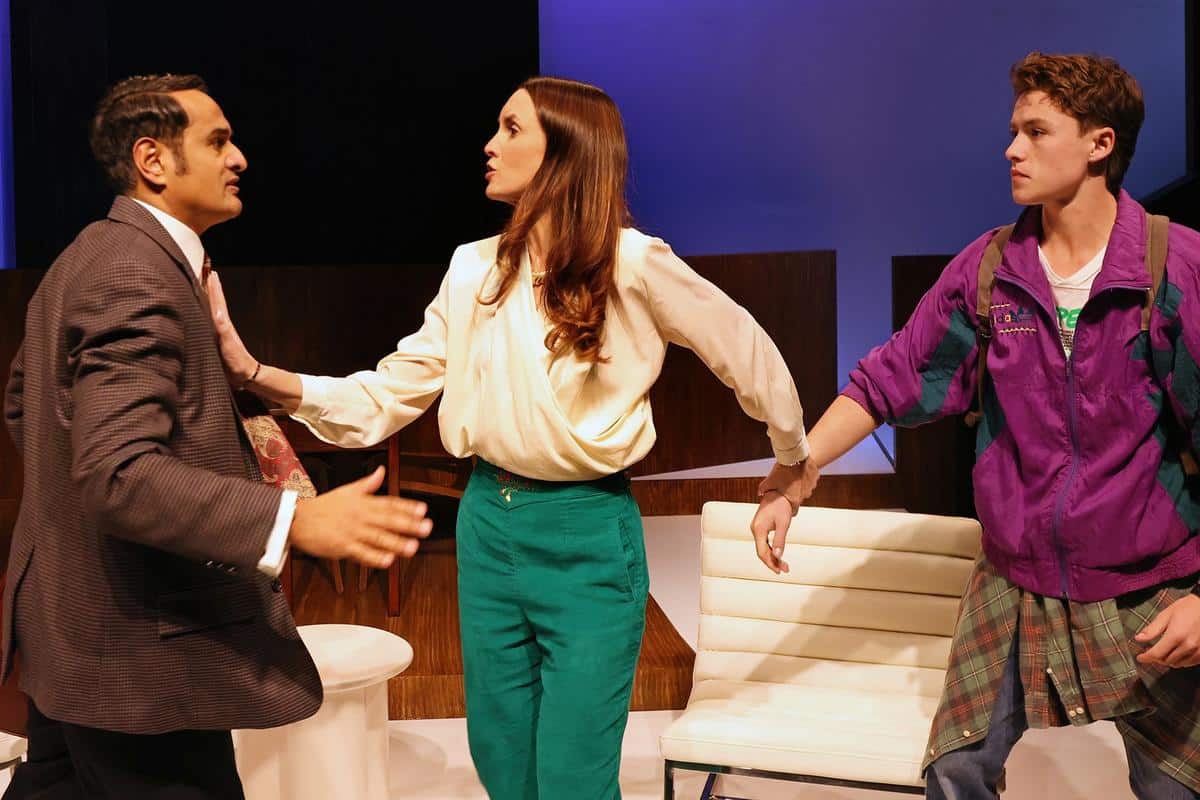
In an age of relentless social visibility, where curated online selves often eclipse private truths, The Social Ladder feels not merely timely but almost uncomfortably current. The premise is elegantly contained: three couples, six agendas, one dinner party designed as a social audition. At its centre is Katie (Mandy Bishop), a woman of unmistakable ambition and unmistakably non-elite origins. Hailing from resolutely middle-class Engadine, her accent alone threatens to betray her aspirations, yet she is convinced—fervently—that her talents merit elevation.


Her chosen ladder rung arrives in the form of Sydney power couple Charles (Andrew McFarlane) and Catherine Mallory (Sarah Chadwick), art-collecting, influence-wielding exemplars of cultural capital. A few fleeting schoolyard encounters with Catherine ignite Katie’s belief that proximity might equal access. Thus, the dinner is conceived: not a gathering, but a campaign.

No expense is spared. Catering is outsourced, furniture rented, and even an “artistic masterpiece” hired to telegraph taste. Appearances, after all, are everything. To soften the social calculus, Katie also invites her neighbours—old friends, Ben (Matt Minto), a once-promising film industry figure now professionally becalmed, and Laura (Jo Downing), a dance teacher whose achievements lack the requisite sheen. Their invitation is both olive branch and afterthought.

Naturally, the evening implodes. The food never arrives, the wine order is forgotten, and the borrowed artwork is revealed—mortifyingly—to belong to the very guests meant to be impressed. As façades fracture, civility gives way to desperation, deceit, and the ignominy of cheap wine and takeaway pizza.

The staging is slyly symbolic: three chandeliers ascending in grandeur, empty picture frames lining the walls, furniture beautiful but uncomfortable—an elegant visual shorthand for hollow status and performative taste. Performances across the board are finely tuned, creating the uncanny sensation of eavesdropping on a private catastrophe.

By the final unraveling—replete with secrets, betrayals, humiliations, and small redemptions—the audience is left laughing, wincing, and quietly auditing their own social manoeuvres. One exits the theatre not just entertained, but unsettled, pondering the price paid for a seat at the high-end table—and whether it was ever worth it.

To book tickets to The Social Ladder, please visit https://www.ensemble.com.au/shows/the-social-ladder/.

Photographer: Phil Erbacher

Spread the word on your favourite platform!

Dial M for Murder – A Killer Thriller at the Ensemble Theatre

Dial M for Murder

Dial M for Murder Rating

Click if you liked this article

Where can you find yourself as an observer to a murder, a diabolical plot and the twists and turns of an inverted mystery? Onstage at the Ensemble Theatre’s Australian premiere of Dial M for Murder! Jeffrey Hatcher’s adaptation of Frederick Knott’s 1952 stage thriller masterfully explores classic motives for murder—fear, jealousy, revenge and greed—through a script that continuously kept me guessing about how the story would ultimately unfold.

Set in the 1950’s, two women reunite in London after an absence of time. Set and costume designer Nick Fry added small details which enhanced this period. There’s a rotary dial phone sitting on a wooden stand and art deco furniture in the loungeroom. Sitting together on the couch, a stylishly dressed Margot (Anna Samson) asks Maxine (Madeleine Jones) “How would you murder me?” Maxine begins to casually list, in alphabetical order, several ways that she could kill her. This was an intriguing start to the play, and we learn that Maxine is a writer of murder thriller novels. One of Hatcher’s changes to the original script features Maxine as a female (originally a male), giving a modern update to the story with these two characters being secret lovers in a lesbian relationship, even though Margot was married.

The cleverness of Hatcher’s script is hidden in the breadcrumbs of clues he leaves along the way. In this opening conversation, certain details are hinted at that the audience might not immediately notice but will later have an “aha” moment upon reflection. There is one method mentioned by Maxine highlighted in the characters’ conversation, and it is indeed used in a future scene which appears to throw some suspicion on Maxine.


There are many layers in Dial M for Murder, which could have gotten sticky if not for the wonderful way the director Mark Kilmurry kept the play at a suspenseful pace. Margot’s husband Tony Wendice (Garth Holcombe) wants his wife dead, Captain Lesgate (David Soncin) and Maxine find themselves involved in this situation and Inspector Hubbard (Kenneth Moraleda) is driven to discover the truth. Everyone finds themselves in a tangled web of misinformation and intrigue. As a ‘whodunnit’ mystery murder it is inverted because the audience knows exactly what happened and ‘who did it’ right from the beginning. Then we experience how the detective figures it out. Kenneth as the Inspector reminded me of Columbo and his almost bumbling way of cloaking what he was thinking to appear not so intelligent, until he lays out the crime and you realise how brilliantly logical his mind worked.

Anna Samson brought depth into her character Margot, showing her character’s vulnerability. Her stillness in the aftermath of a tragedy showed reality bleeding into her consciousness and it was powerful. Kudos to Madeleine Jones for Maxine’s broad New York accent.

Garth Holcombe was simply outstanding as Tony! Standing tall dressed impeccably in a dark suit, he appeared as an upper-class suave gentleman. However, it wasn’t long before the audience saw the real Tony; a smug, sneaky, and malicious man intent on carrying out ‘the perfect crime’ to kill his wife. It wasn’t so much in his dialogue, but in the quiet, small, almost imperceptible movements he made – such as a twitch of his mouth or a shift of his eyes that Garth performed which screamed loudly of Tony’s duplicitous and arrogant nature.

Madeleine Picard’s music and sound design during the play’s tense moments was atmospheric and evocative, reminiscent of the suspense found in a Hitchcock film. Combined with Matt Cox’s lighting design, especially during the storm where flashes of lightning dramatically illuminated the characters’ struggle in the life-and-death situation, the effect was truly exceptional.

Scattered throughout the play were some funny lines which were delivered perfectly by the cast to create some pockets of dark humour. Dial M for Murder was a tightly produced, fast paced play which was entertaining and had the audience at the edge of their seats. Although this is a ‘you-know-who-dunnit’ murder thriller, it’s one that keeps you guessing with numerous surprising twists and unexpected developments until the very satisfying conclusion. Don’t miss it!

Dial M for Murder is playing at the Ensemble Theatre. 78 McDougall St, Kirribilli
Season run: 28 Nov 2025 – 11 Jan 2026
Time: 2 hours 20 minutes, including interval
Tickets: www.ensemble.com.au/shows/dial-m-for-murder

To book tickets to Dial M for Murder, please visit https://www.ensemble.com.au/shows/dial-m-for-murder/.

Spread the word on your favourite platform!