The Social Ladder

The Social Ladder

The Social Ladder Rating

Click if you liked this article

At its world premiere, The Social Ladder found an impeccably apt home at the Ensemble Theatre—the country’s longest continuously running professional theatre company—perched in rarified Kirribilli, with Sydney Harbour shimmering outside like an accessory quietly signaling old money. One could hardly imagine a more socially literate setting for a play so exquisitely preoccupied with rank, aspiration, and the fragile choreography of belonging.

Penned by David Williamson AO—Australia’s grand maître of social satire, whose canon includes such drawing-room dissections as Emerald City and Don’s Party—this latest work turns its incisive gaze toward status itself: how it is curated, performed, and so desperately desired. Williamson’s dialogue is once again sharp as cut crystal, producing laughter that curdles almost immediately into recognition.

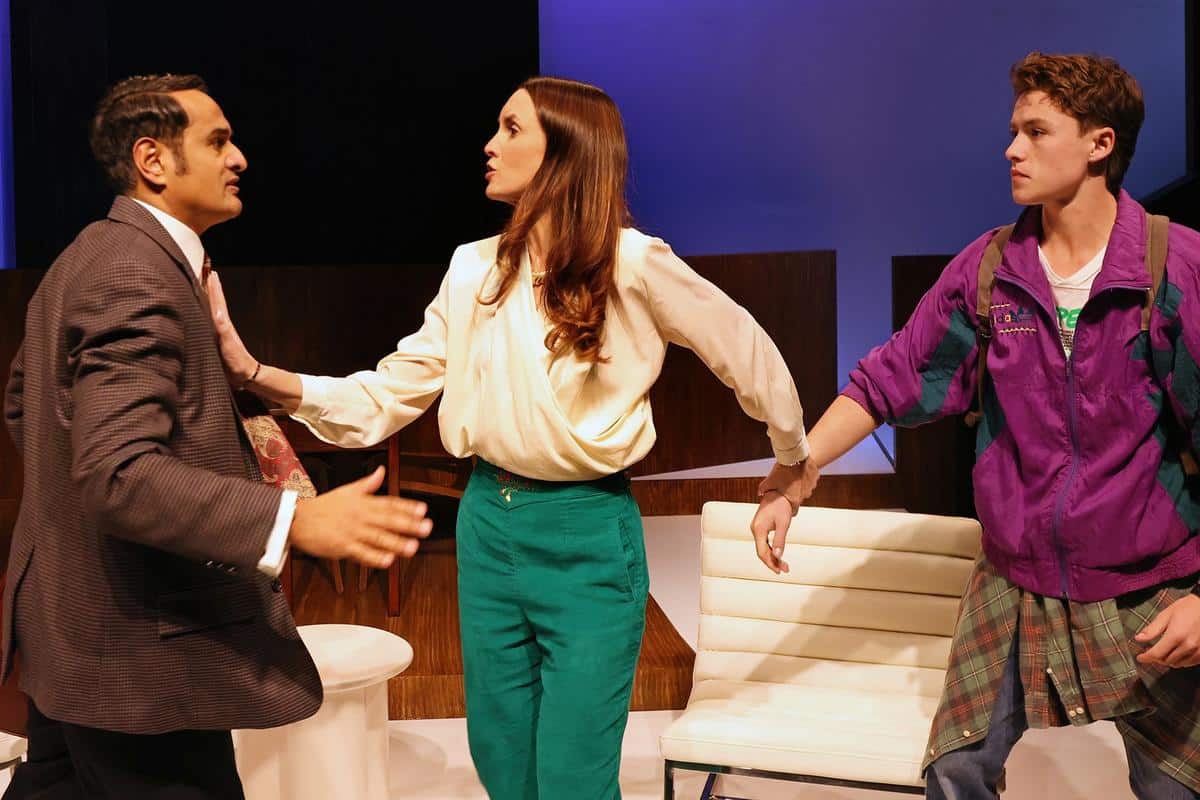
In an age of relentless social visibility, where curated online selves often eclipse private truths, The Social Ladder feels not merely timely but almost uncomfortably current. The premise is elegantly contained: three couples, six agendas, one dinner party designed as a social audition. At its centre is Katie (Mandy Bishop), a woman of unmistakable ambition and unmistakably non-elite origins. Hailing from resolutely middle-class Engadine, her accent alone threatens to betray her aspirations, yet she is convinced—fervently—that her talents merit elevation.


Her chosen ladder rung arrives in the form of Sydney power couple Charles (Andrew McFarlane) and Catherine Mallory (Sarah Chadwick), art-collecting, influence-wielding exemplars of cultural capital. A few fleeting schoolyard encounters with Catherine ignite Katie’s belief that proximity might equal access. Thus, the dinner is conceived: not a gathering, but a campaign.

No expense is spared. Catering is outsourced, furniture rented, and even an “artistic masterpiece” hired to telegraph taste. Appearances, after all, are everything. To soften the social calculus, Katie also invites her neighbours—old friends, Ben (Matt Minto), a once-promising film industry figure now professionally becalmed, and Laura (Jo Downing), a dance teacher whose achievements lack the requisite sheen. Their invitation is both olive branch and afterthought.

Naturally, the evening implodes. The food never arrives, the wine order is forgotten, and the borrowed artwork is revealed—mortifyingly—to belong to the very guests meant to be impressed. As façades fracture, civility gives way to desperation, deceit, and the ignominy of cheap wine and takeaway pizza.

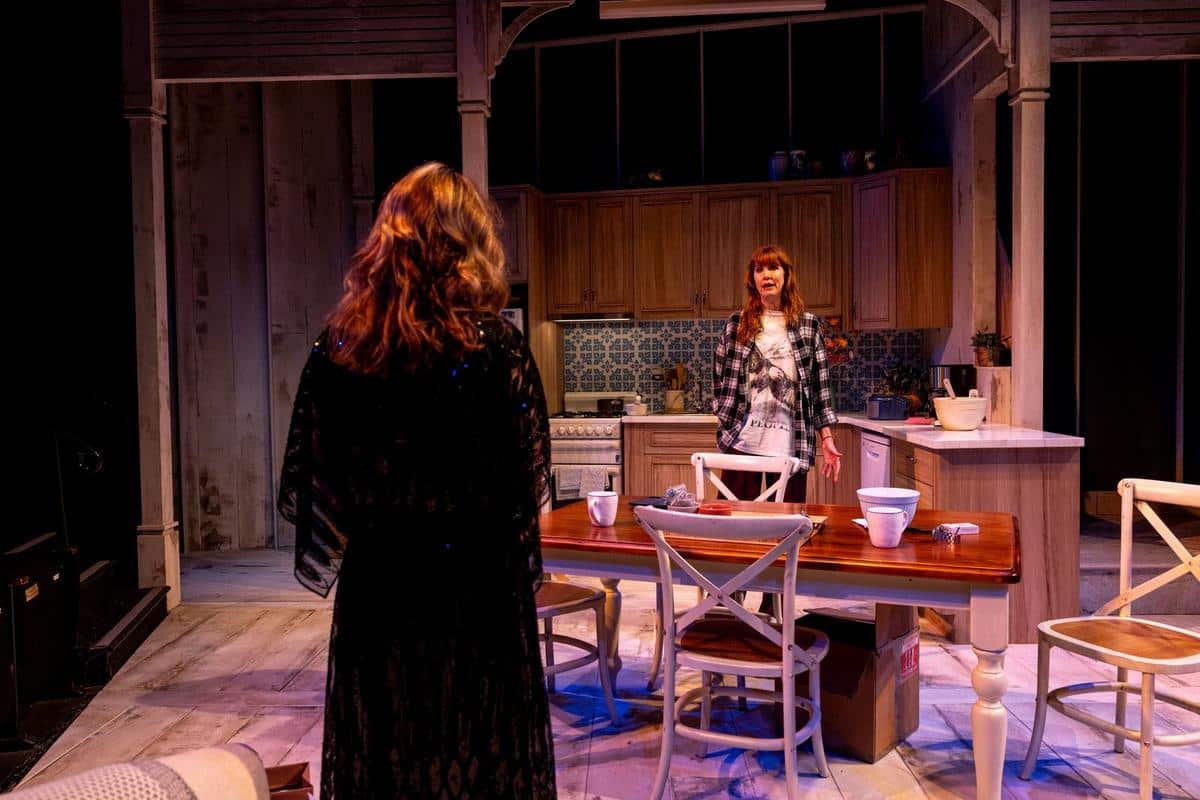
The staging is slyly symbolic: three chandeliers ascending in grandeur, empty picture frames lining the walls, furniture beautiful but uncomfortable—an elegant visual shorthand for hollow status and performative taste. Performances across the board are finely tuned, creating the uncanny sensation of eavesdropping on a private catastrophe.

By the final unraveling—replete with secrets, betrayals, humiliations, and small redemptions—the audience is left laughing, wincing, and quietly auditing their own social manoeuvres. One exits the theatre not just entertained, but unsettled, pondering the price paid for a seat at the high-end table—and whether it was ever worth it.

To book tickets to The Social Ladder, please visit https://www.ensemble.com.au/shows/the-social-ladder/.

Photographer: Phil Erbacher

Spread the word on your favourite platform!

Dial M for Murder – A Killer Thriller at the Ensemble Theatre

Dial M for Murder

Dial M for Murder Rating

Click if you liked this article

Where can you find yourself as an observer to a murder, a diabolical plot and the twists and turns of an inverted mystery? Onstage at the Ensemble Theatre’s Australian premiere of Dial M for Murder! Jeffrey Hatcher’s adaptation of Frederick Knott’s 1952 stage thriller masterfully explores classic motives for murder—fear, jealousy, revenge and greed—through a script that continuously kept me guessing about how the story would ultimately unfold.

Set in the 1950’s, two women reunite in London after an absence of time. Set and costume designer Nick Fry added small details which enhanced this period. There’s a rotary dial phone sitting on a wooden stand and art deco furniture in the loungeroom. Sitting together on the couch, a stylishly dressed Margot (Anna Samson) asks Maxine (Madeleine Jones) “How would you murder me?” Maxine begins to casually list, in alphabetical order, several ways that she could kill her. This was an intriguing start to the play, and we learn that Maxine is a writer of murder thriller novels. One of Hatcher’s changes to the original script features Maxine as a female (originally a male), giving a modern update to the story with these two characters being secret lovers in a lesbian relationship, even though Margot was married.

The cleverness of Hatcher’s script is hidden in the breadcrumbs of clues he leaves along the way. In this opening conversation, certain details are hinted at that the audience might not immediately notice but will later have an “aha” moment upon reflection. There is one method mentioned by Maxine highlighted in the characters’ conversation, and it is indeed used in a future scene which appears to throw some suspicion on Maxine.


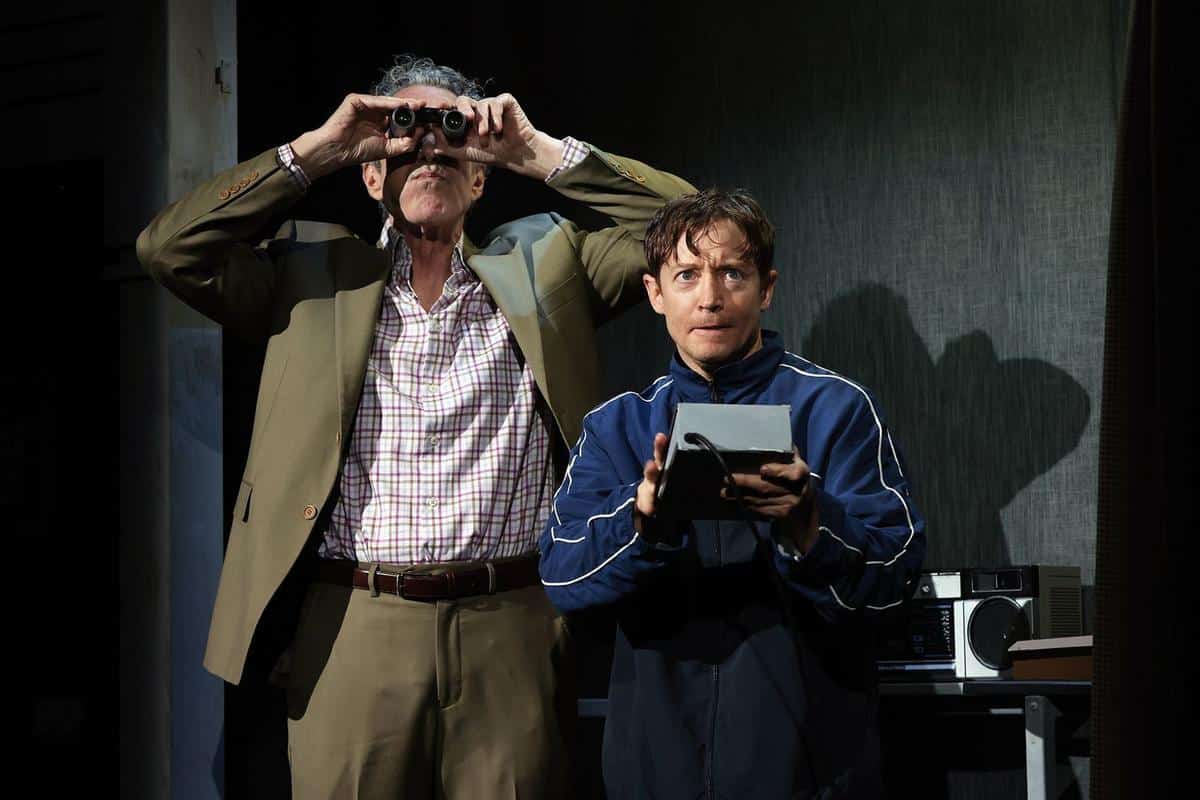
There are many layers in Dial M for Murder, which could have gotten sticky if not for the wonderful way the director Mark Kilmurry kept the play at a suspenseful pace. Margot’s husband Tony Wendice (Garth Holcombe) wants his wife dead, Captain Lesgate (David Soncin) and Maxine find themselves involved in this situation and Inspector Hubbard (Kenneth Moraleda) is driven to discover the truth. Everyone finds themselves in a tangled web of misinformation and intrigue. As a ‘whodunnit’ mystery murder it is inverted because the audience knows exactly what happened and ‘who did it’ right from the beginning. Then we experience how the detective figures it out. Kenneth as the Inspector reminded me of Columbo and his almost bumbling way of cloaking what he was thinking to appear not so intelligent, until he lays out the crime and you realise how brilliantly logical his mind worked.

Anna Samson brought depth into her character Margot, showing her character’s vulnerability. Her stillness in the aftermath of a tragedy showed reality bleeding into her consciousness and it was powerful. Kudos to Madeleine Jones for Maxine’s broad New York accent.

Garth Holcombe was simply outstanding as Tony! Standing tall dressed impeccably in a dark suit, he appeared as an upper-class suave gentleman. However, it wasn’t long before the audience saw the real Tony; a smug, sneaky, and malicious man intent on carrying out ‘the perfect crime’ to kill his wife. It wasn’t so much in his dialogue, but in the quiet, small, almost imperceptible movements he made – such as a twitch of his mouth or a shift of his eyes that Garth performed which screamed loudly of Tony’s duplicitous and arrogant nature.

Madeleine Picard’s music and sound design during the play’s tense moments was atmospheric and evocative, reminiscent of the suspense found in a Hitchcock film. Combined with Matt Cox’s lighting design, especially during the storm where flashes of lightning dramatically illuminated the characters’ struggle in the life-and-death situation, the effect was truly exceptional.

Scattered throughout the play were some funny lines which were delivered perfectly by the cast to create some pockets of dark humour. Dial M for Murder was a tightly produced, fast paced play which was entertaining and had the audience at the edge of their seats. Although this is a ‘you-know-who-dunnit’ murder thriller, it’s one that keeps you guessing with numerous surprising twists and unexpected developments until the very satisfying conclusion. Don’t miss it!

Dial M for Murder is playing at the Ensemble Theatre. 78 McDougall St, Kirribilli
Season run: 28 Nov 2025 – 11 Jan 2026
Time: 2 hours 20 minutes, including interval
Tickets: www.ensemble.com.au/shows/dial-m-for-murder

To book tickets to Dial M for Murder, please visit https://www.ensemble.com.au/shows/dial-m-for-murder/.

Spread the word on your favourite platform!

Fasten Your Seat-Belts, This One Soars!

Fly Girl

Fly Girl Rating

Click if you liked this article

3

I’ll take the chicken, but I have ZERO beef with Fly Girl!

Inspired by the true story of Deborah Lawrie, Australia’s first female commercial airline pilot, Fly Girl hits new heights as a clever, heartfelt and joyously funny but important retelling of one woman’s fight to get off the ground in an era when airlines thought “the fairer sex” should serve the nuts, not fly the planes.

The Ensemble Theatre’s intimate setting is the perfect launchpad. The set bursts with 70s orange, jet-age charm and a black flight tracker hanging centre stage. We’re greeted by flight attendants in high-waisted orange trousers, pinstriped shirts and iconic caps who usher us to our seats with perfect period poise and playful improvisation. The energy before take-off is pure fun; bright, bustling, and buzzing with anticipation.

Writers and performers Genevieve Hegney and Catherine Moore open the evening by announcing we can expect 40 characters, 5 actors and “not one stage crew.” They aren’t kidding. The entire cast (including Cleo Meinck as Deb, Emma Palmer, Alex Kirwan, and the writers themselves) morph seamlessly between roles, each transformation part of the fabric of the storytelling. Props shift and scenes change in full view, yet it never breaks the rhythm. If anything, it adds to the show’s theatrical charm, blending quick wit and creative ingenuity into narrative flow.


We meet Deb as a determined teen, inspired by her dad’s love of flying. By her early twenties, she’s applying to Ansett, only to discover that no amount of skill will outweigh a hiring policy drenched in sexism. Reg Ansett, rendered here with delicious absurdity, dismisses women as “unsuitable” for flying due to supposedly unpredictable “female issues.” Deb persists, taking on Ansett with a David and Goliath style battle, helped along by the sisterhood collectively engaging in the “Girlcott” of 1979.

The jokes hit hard and fast, weaponising humour to expose the absurdity of systemic discrimination. Real headlines are seen on the prop newspapers including “Pregnancy! Is it a disease?”, echoing the playground logic of the airline’s defence. Amid the laughter, the truth stings. For all its sparkle and comic verve, Fly Girl packs emotional punch.

The cast’s chemistry is electric, their comic timing impeccable, and their energy infectious. The audience was audibly along for the ride, laughter giving way to silent tears as history reasserted its gravity. I overheard someone in the bathroom talking about remembering the whole situation as it was happening and what an amazing experience it was to now watch the show. The hardest emotional landing comes when Lawrie herself joins the cast onstage for curtain call with her solicitor from the landmark anti-discrimination case; a moment that reduced already standing ovation to more applause and greater sobs.

Director Janine Watson keeps the tone perfectly balanced; funny yet furious, heartfelt and powerful. Fly Girl is theatre that entertains first, then quietly takes flight as something greater: a tribute to resilience, equality, and one woman’s fight that changed the course of Australian history.

Fasten your seat-belts… this one soars.

To book tickets to Fly Girl, please visit https://www.ensemble.com.au/shows/fly-girl/.

Photographer: Prudence Upton
Spread the word on your favourite platform!