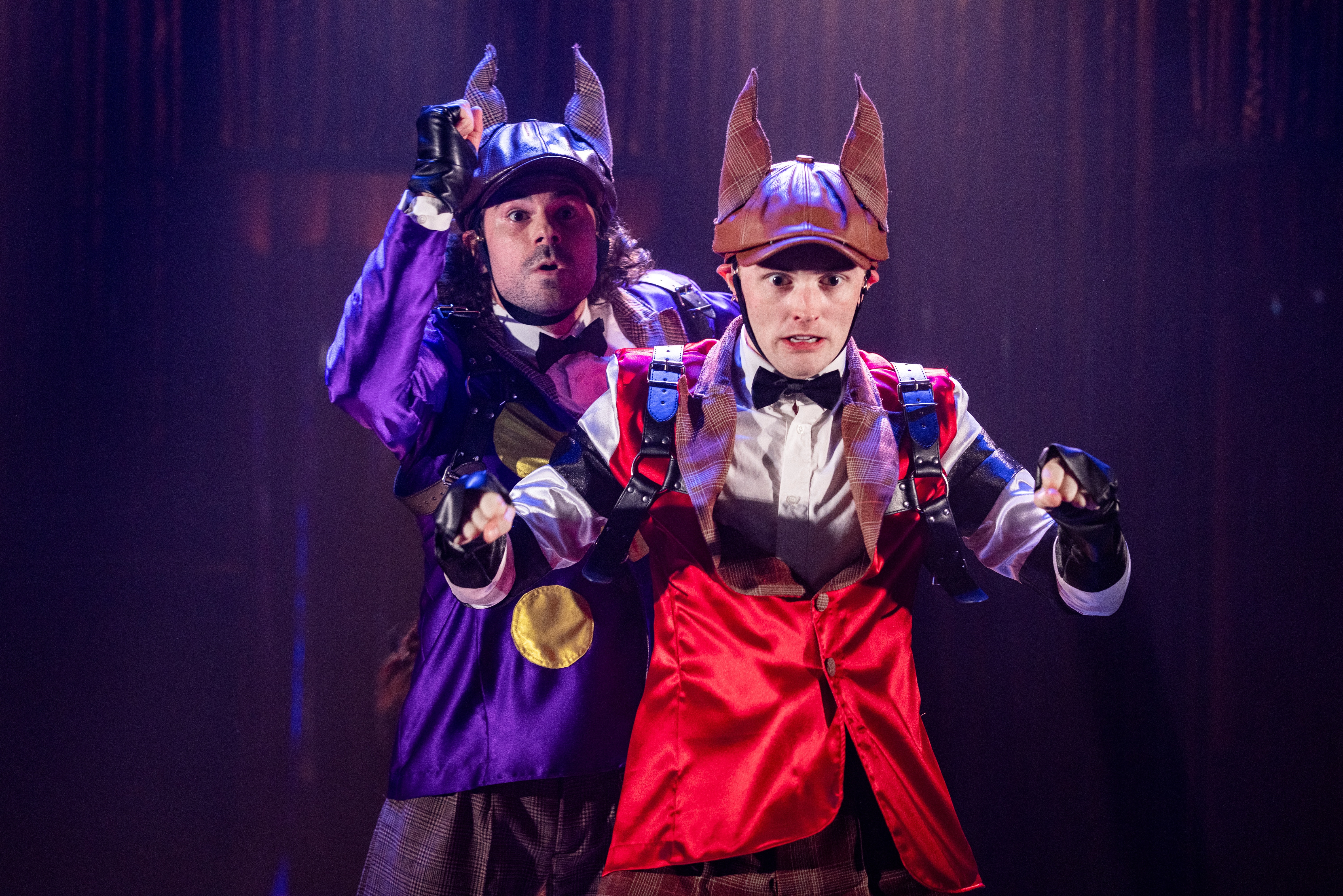
Hayes Theatre Co is thrilled to announce the award-winning sold-out hit of 2025, Phar Lap: The Electro-Swing Musical, will return in 2027. This new Australian musical with the biggest heart returns to Sydney in an expanded, unbridled production playing at Carriageworks, before a national tour including a season at Melbourne Theatre Company, Merrigong Theatre Company, Geelong Arts Centre, The Art House Wyong, and many more.
A gangly Kiwi racehorse. A trainer down on his luck. A nation ready to believe in a long-shot. Phar Lap: The Electro-Swing Musical is the rags-to-riches story that galloped into history, reimagined with heart, wit and a toe-tapping electro-swing score. The road isn’t easy – there are gambling scandals, double-crosses, an attempted shooting and a career-threatening addiction to sugar. It’s high stakes, high drama and highly historically accurate.
Phar Lap boasts an irresistible electro-swing score by Steven Kramer, with inspirations from Duke Ellington to Daft Punk. Brassy, lively and retro – these songs will take you from the race course to the rave hall.
It was an unprecedented sold-out hit at Hayes in 2025, and now Phar Lap gallops back to Sydney, again starring New Zealand born but Australian claimed triple threat Joel Granger (Guys and Dolls, The Book of Mormon) as the titular hero.
Winner of three 2025 Sydney Theatre Awards including Best Production of a Musical, Best Direction of a Musical (Sheridan Harbridge) and Best Performance in a Leading Role in a Musical (Joel Granger), Phar Lap swaps horse shoes for tap shoes celebrating Australia’s big-hearted equine hero.
★★★★★ “Phar Lap is everything you’d expect from the Hayes – irreverent, funny, slightly chaotic – but the elegant story-telling, lovable characters and electric performances take it to the next level.” – Sydney Morning Herald ★★★★★ “Dazzlingly clever.” – Stage Noise ★★★★☆ “Likely to gallop into Australian musical theatre history … an odds-on favourite to sell out as soon as it leaves the starting gates.” – Limelight ★★★★☆ “Steven Kramer delivers a remarkable trifecta: great music, sharp lyrics, and an outrageously bonkers book to match.” – Cultural Binge
“Phar Lap is a really special show – it’s funny, it’s clever, it’s undeniably unique – and truly deserving of the praise it’s received as a new Australian classic. Audiences at our Hayes season were genuinely bowled over by this energetic, irreverent telling of a story that’s so deeply ingrained in our collective culture – so it’s very exciting that many more people will now have the chance to see it.” – Richard Carroll and Victoria Falconer, Artistic Directors, Hayes Theatre Co.
Pop the champagne, harness up and get ready for a wild ride. Phar Lap: The Electro-Swing Musical is the show that will stop the nation in 2027!
PHAR LAP: THE ELECTRO-SWING MUSICAL
Book, Music and Lyrics by Steven Kramer
Director: Sheridan Harbridge
Musical Supervisor: David Gardos
Musical Director: David Youings
Choreographer: Ellen Simpson
Set Designer: Hailley Hunt
Costume Designer: Mason Browne
Lighting Designer: Trent Suidgeest
Sound Designer: Liam Roche
Arranger and Orchestrator: Jack Earle
Orchestrator and Track Producer: Steve Toulmin
Starring Joel Granger
SEASON DETAILS Venue: Carriageworks, 245 Wilson St, Eveleigh Season: 8 July – 8 August 2027 Times: Tues 6.30pm, Wed-Sat 7.30pm, Wed & Sat 2pm, Sun 5pm Price: From $94 Adult, $84 Concession/Group, $79 Under 35 Bookings: www.hayestheatre.com.au | (02) 8065 7337 TICKETS ON SALE NOW FROM https://hayestheatre.com.au/event/phar-lap-2027-carriageworks/
Mmmmmm… conceptual. Such was the tagline of Tommy Misa’s seventy-five minute exploration into grief and culture, Working Class Clown. And yet, what was immediately impressive about the piece, is that it wasn’t. Not really. The show, although tackling conceptual ideas, used Samoan clowning and a deep and grounded connection to the mundanity of life to traverse those ideas with an empathetic intelligence and humour that made sure it never flew too unreachably high into cerebralism. In the towering industrial theatres of Carriageworks, a stage set with what upon first glance looks like nothing more than a pile of leaves and towering poles is nestled. Against the concrete backdrop, they seem almost out of place as natural objects, which, in many ways, becomes the point.
As the piece opened, Misa’s performance strengths became immediately obvious. Misa moved like a dancer, each micro-adjustment fluid and controlled; a charismatic performer with an easy sensuality that spoke to the argument of the piece. Every emotion, confusion, grief, excitement, happiness, sat firmly in his body as the narrator took us through one of the early Samoan myths of creation. As he joined us in the modern day, we were gifted with the stunningly effective costume design of Katie-Louise and Lilian Nicol-Ford, an oversized blue linen shirt and pants that effortlessly elevated Misa’s physical work on stage. This was accentuated once more by Amber Silk’s lighting design, done so well and concentrating each moment so deliciously that I am officially converted against the lights-up lights-down shows I once championed.
As we moved into the modern day, the piece took on its more grounded, honest edge. We joined Misa in line for Centrelink, and felt both their boredom and desperation as the system once again ignored them. Both we, the audience, and Tommy, the performer, coped with this ignoring of our needs through laughter. In front of our eyes, Tommy became the disinterested government worker, the eastern suburb white friend who can never truly understand what poverty feels like, and the teachers who turned their nose up instead of reaching out with understanding.
Each moment, when scratched just beyond the surface of humour relays a tragic institutional truth about our society, and yet, when faced with the reality of what little those of us who are ignored by the system can do about it, our only choice is to laugh. Laughter, in a sense, was the thesis of the piece. Can we decolonize ourselves through laughter? Can we use it to move through grief? Can we use it to heal?
Another significant throughline of the piece was language. Like many, growing up in primary and high school in Sydney, I was told that most indigenous languages in Australia and the Pacific were either dead, or mostly dead. The hidden underlying message of that wording being, there’s no use bothering to try and save them. Working Class Clown disproved this with a grin and audience participation. As the sole performer on stage, the audience, in many ways, became the secondary character, and our interaction was done almost entirely within the framework of the Samoan language. Through the comedy of the text, and the mass of people learning at the same time, one thought came immediately to my mind: this isn’t that hard. And so I return to comedy as a tool of decolonization.
Perhaps the tragedy of high school and university history classes had told me that imperialism was simply too great a power to ever contend with, but here, in this room of strangers, imperialism showed its delicate white underbelly and revealed to us its weakness of empathy. This also connected us intimately to the culture being explored on stage, and allowed us to almost grieve as a collective, and in turn, provide Misa with the safe space to be as vulnerable as he was.
As a performer, Misa continued to impress. His vocal work was deliberate, and controlled right down to the breath work, which we heard perhaps too much of at the level his mic was set at. Their comedic timing and character work remained a highlight of the show experience, and his subtle shifts into the emotional lowpoints of the script once again proved to me the power of the double-sided coin of comedy and tragedy. Further, the piece sat very culturally inside Sydney, which was a welcome change from the more conceptual shows on the market which are set more inside an “idea” than a place. Towards Misa’s more emotional moments, he did briefly fall into rhythmic traps which leaned more demonstrative than legitimately emotive, however with the content being discussed, I couldn’t truly fault them. It also didn’t stop every emotional moment from giving me full body goosebumps, as we watched legitimate emotions sit just behind the emotional guard of performing.
Lighting also continued to show off, both with moments of individual spotlight, and particularly memorable moments of the lights coming up on us as the audience, forcing us to participate. Another highlight was the voice-message from Gussy, played by Imbi, which was performed beautifully, and gave Misa the break they needed to create the emotional high that would carry them for the rest of the show. However, I must admit my favourite moment, one that brought me fully to tears, was Misa’s retelling of a family in line for housing – which they don’t get – and the gifting of a dandelion from the family’s oldest son to his exhausted mother.
A one-man show is a challenge, it gives you no one to rely on but yourself, and it was here that one of the only two true weaknesses of the show appeared. At a smattering of points throughout the show, Misa began to say something and then rapidly changed direction, which left the sentence not quite making sense. This came to a head as a line drop, which although is not a crime in and of itself, did manifest as a drop in confidence which affected the later half of the show. This, however, I am empathetic about. It is difficult enough to learn a part in an ensemble piece, where there are people on stage that can bail you out. A one-man show is an entirely different beast, and this show was almost half an hour longer than the others I’ve seen this year.
A truly mammoth amount of content for a singular performer. The piece’s second, and truly I believe only other flaw, was that although it made interesting points, the connective tissue between those points was often weak. This problem was much less noticeable in the first half of the piece, but towards the end, as the script tried to fit more and more ideas into itself in dwindling time, the jumps became more and more distinct – which caused confusing pivots between emotional states that didn’t quite make sense. However, each individual idea on its own was well fleshed out and conceptually impressive, even as the larger cohesiveness of the argument began to warp.
Easily the most impressive portion of the show was watching Misa, and then Misa and some brave volunteers from the audience who weren’t wearing wobbly heels like I was, build the world in front of us. This began with Misa building a puppet in real time out of paper, which was used beautifully to represent his child self. However, the second, and more impressive example, was the building of the home. The section began with one of the rawest displays of vulnerability I’ve ever seen on stage, as the lights came up on all of us whilst Misa honestly asked for help to lift the roof onto the poles he’d placed down.
As the home came together, the emotion hidden behind those guardrails of performance crept to the surface, and as the sunset behind the home was created, both Misa and their audience were left in a choked awe (and admittedly misty-eyed). Indeed, it became never-more clear than in that moment that we weren’t just watching a character work through something, but Misa himself process his grief in front of us.
Working Class Clown functions spectacularly as an exploration of grief through comedy and culture, and although it trips on minor faults of performance and argument, as a cohesive experience, it was an incredibly impressive piece of theatre. Each element was well considered and equally well executed, and I left with both a true sense of emotional catharsis, and a deeper understanding of a culture that I hadn’t had the chance to learn much about.
The setting for Trophy Boys at Carriageworks was simple. A spinning whiteboard, and high school tables and chairs; a typical classroom. However, the themes in this dark satire are not simple – and the 70 minutes are spent delving into what it means to have the youthful arrogance of being seventeen, a privileged life and the perks that come from attending an exclusive boys’ school.
It is the night of the final Year 12 debate between St Imperium College and their sister school. The four boys, Owen, Scott, David and Jared, are preparing to confidently obtain the trophy and the glory of winning, especially after winning for many consecutive years beforehand.
However, the board spins around and the topic they are to argue clearly throws them into panic. Their topic is to argue that feminism has failed women. Their initial reaction showed their fears, that they did not want to be cancelled, or portrayed as an anti-feminist. “I love women!” Jared (Fran Sweeney-Walsh) declares several times throughout the show. Is Jared trying to convince the audience, or himself? Sweeney-Walsh created a believable Jared, a jock who I could imagine being comfortable on the footy field with his mates, as well as having high tea in the Queen Victoria Building with his mum.
In one of the play’s initial scenes, where the four friends perform a type of strip tease dance for the audience garnered many laughs from the audience. This posturing of the boys showed their youth and confidence, and by the end of the play, I wondered if this scene had a deeper meaning. Perhaps the deliberate choice of having a non-binary and female cast dressed in drag, and as boys, doing a strip tease, presented a masculine point undermining feminism? Or it could simply have been a bit of comic relief of teenaged boys, before the heavier topics arose.
The audience doesn’t get to see the actual debate. This play is in real time, of the discussions and secrets revealed about each student during the pre-debate prep session, and this is what makes Trophy Boys original. By being an observer, the audience is taken along into a performance focusing on each boy’s character, all of whom consider themselves to be elite in their fancy school uniforms adorned with badges (from the cast’s actual school days), but whose actions provoke suspect as each boy’s façade is exposed. The name of their school, St Imperium College, already exudes ‘absolute power’ as does the name of the play, and I felt that at the beginning, the boys would have considered themselves as somewhat a “trophy” to anyone they dated.
All cast members had powerful performances, with Gaby Seow as Scott and Leigh Lule as David carrying the story further. Myfanwy Hocking as Owen delivered a speech towards the end which captivated the audience. Lighting designer Katie Stefkidis’ spotlight on the characters provided a sharp impact to their words.
Trophy Boys’ writer Emmanuelle Mattana was a competitive high school debater so could bring the nature of the preparation to the stage. She had been subject of misogynistic remarks from boys in the opposing debating team, and a historic sexual assault allegation from 1988 spurred her on to write Trophy Boys. Mattana also took on the role of Scott onstage from 2022-2024.
Directed by Marni Mount, Trophy Boys is a social commentary about the ingrained nature of toxic masculinity in today’s world, homophobia and the power of privilege that protects its own people, no matter what.
I saw Trophy Boy’s opening performance on Thursday 24th July 2025, which ended with a standing ovation.
Trophy Boys is playing at Carriageworks from 24 July to 3 August and will be touring at the Riverside Theatre from 6- 9 August 2025.
In Sydney Chamber Opera’s Aphrodite, the act of looking becomes its own kind of violence. Composed by acclaimed American composer Nico Muhly with a libretto by Laura Lethlean, and presented in association with Omega Ensemble, this striking new work reimagines the goddess of love not as a figure of desire but as a symbol of distortion; a mirror in which the modern self dissolves.
The story follows Ava, a thoughtful academic whose book, The Aphrodite Complex, catapults her to sudden fame after being adapted into a hit documentary. As her public image grows, her personal life fractures. Ava becomes consumed by the pursuit of perfection, sculpting herself for the gaze of others while losing touch with intimacy, authenticity, and selfhood. When the goddess Aphrodite herself appears, cool, composed, and elusive, Ava’s carefully constructed world begins to collapse.
Director Alexander Berlage’s use of live video is both conceptually and theatrically masterful. Cameras flank the stage, embedded in mobile phones, and hang from the ceiling, capturing the performers in extreme close-up. These images, not just of faces but of hands, feet, clothing, trembling skin, are projected on a large screen above the stage, which simultaneously displays the libretto. What emerges is a fragmented portrait of each character: isolated body parts, captured and magnified, turned into objects of scrutiny and aesthetic judgement.
Rather than drawing the audience closer, these hyper-intimate visuals create distance. We are not watching the characters as whole people; we are dissecting them. The body becomes content. Ava becomes an image. Even her moments of vulnerability are caught, cropped, and curated. The overhead camera is particularly cruel: it frames her from above like an anatomical specimen, cold and clinical, as if the goddess herself were observing.
Jessica O’Donoghue gives a deeply affecting performance as Ava, vocally assured and emotionally transparent. Her portrayal balances intellect and fragility, making Ava’s descent into disconnection feel both inevitable and tragic. Puerto Rican soprano Meechot Marrero, in her Australian debut, brings an arresting stillness to Aphrodite. Her presence is magnetic and inscrutable, her voice radiant. She is not temptation incarnate but myth personified; unknowable, unmoved.
Muhly’s score is luminous and precise, shifting between shimmering textures and silences that seem to stretch time. The Omega Ensemble plays with clarity and control, amplifying the opera’s psychological tension without overwhelming its introspective tone.
Aphrodite is a cool, elegant gut-punch of an opera, a work that refuses sentimentality in favour of scalpel-like insight. It’s about beauty, yes, but more importantly, it’s about the cost of being seen only in parts. By disassembling its characters on screen and in sound, it delivers a quietly devastating truth: there can be no connection until we are allowed to exist as whole.