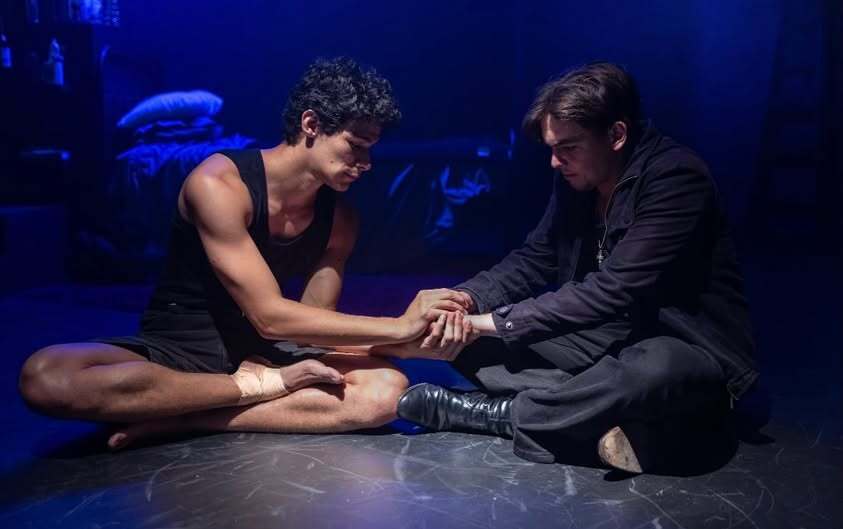
It took until 2013 for gay marriage laws to pass in England. Although it may feel like we’ve made strides towards change, in a lot of ways, queerness had a bright, shining five to seven years in the sun before it began to slide backwards again in modern politics. Es & Flo is a little bit about this – and why marriage is such an essential part of the fight – but it’s also mostly about the complexity of lifelong relationships, and the intimate sense of loss and betrayal we feel when someone we love begins to slip through our fingers.
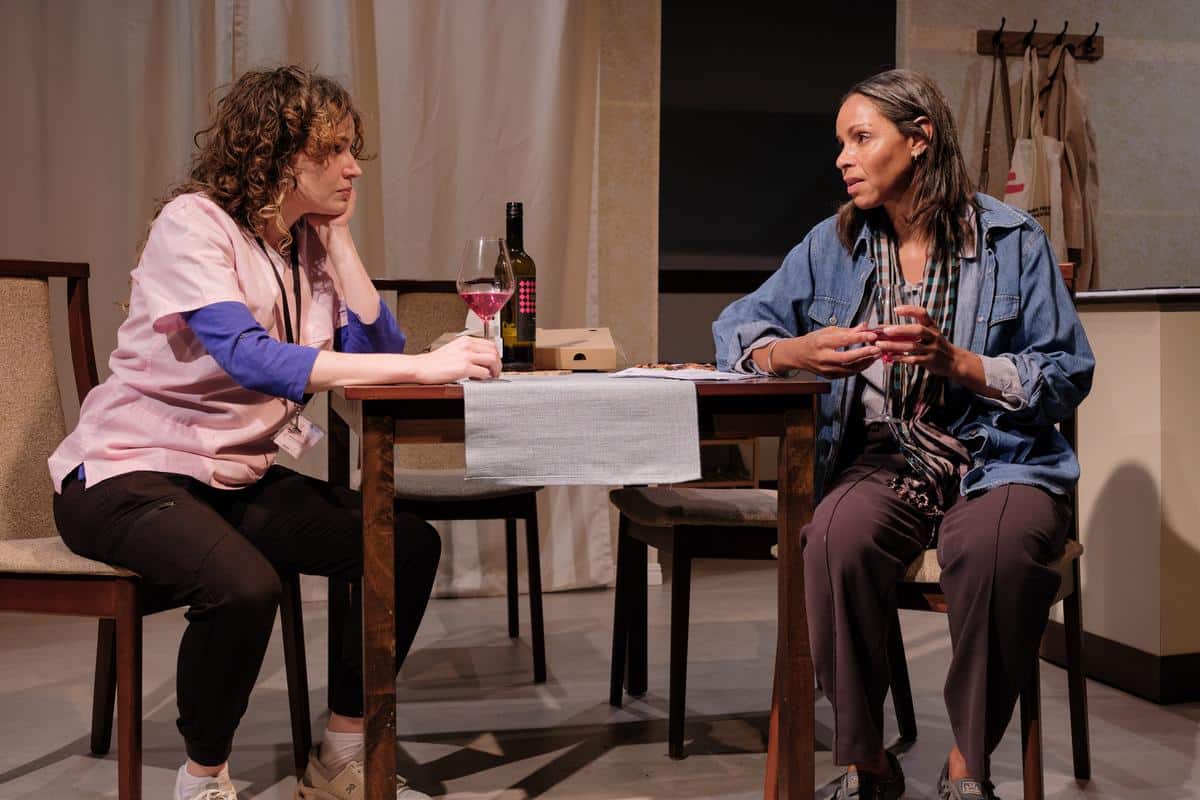
Emma Canalese has set this show in the warm and familiar home it deserves, one yellowed by years of adoration and care. One that the characters on stage are also deeply familiar with. Such, the threat of losing the home and those inside it becomes all the more raw and uncomfortable. As the piece progresses, the sense of belonging we feel in this quiet home becomes more and more disturbed – video and audio of protests and conversations merging in a way that creates a cacophony that we’re both threatened by, and desperately want to understand.
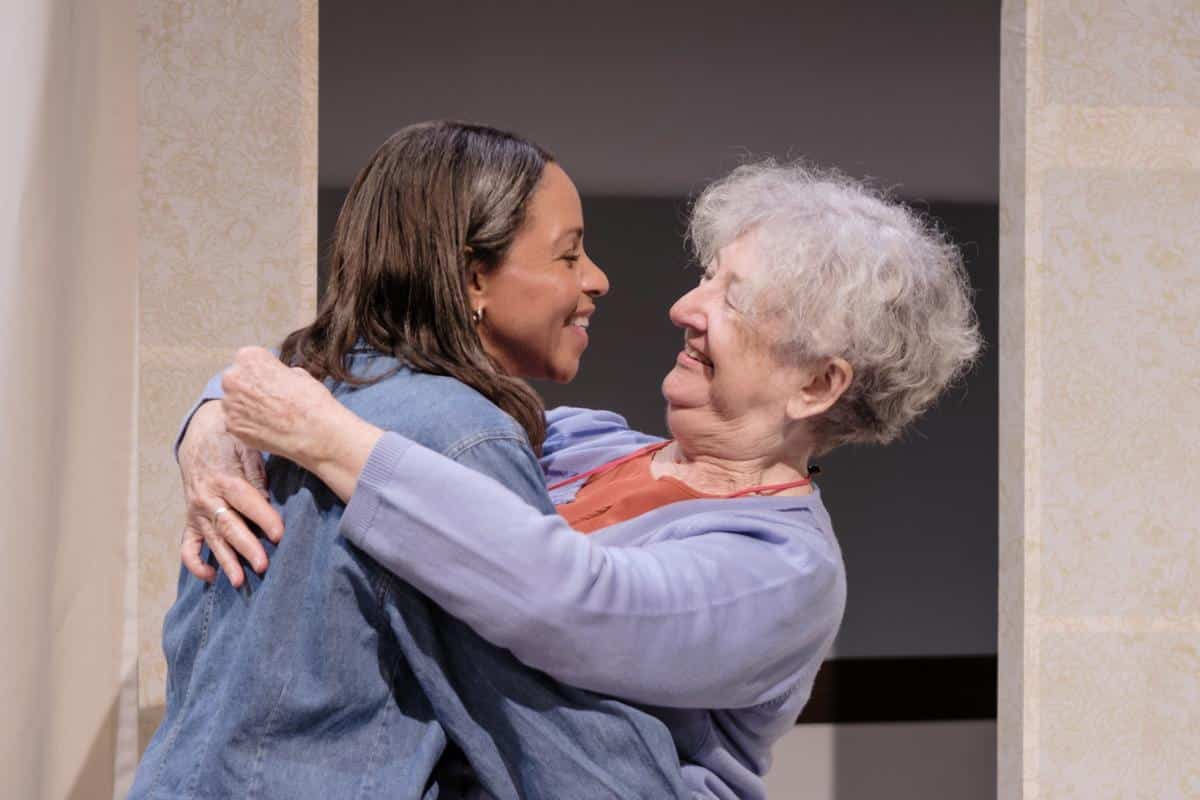
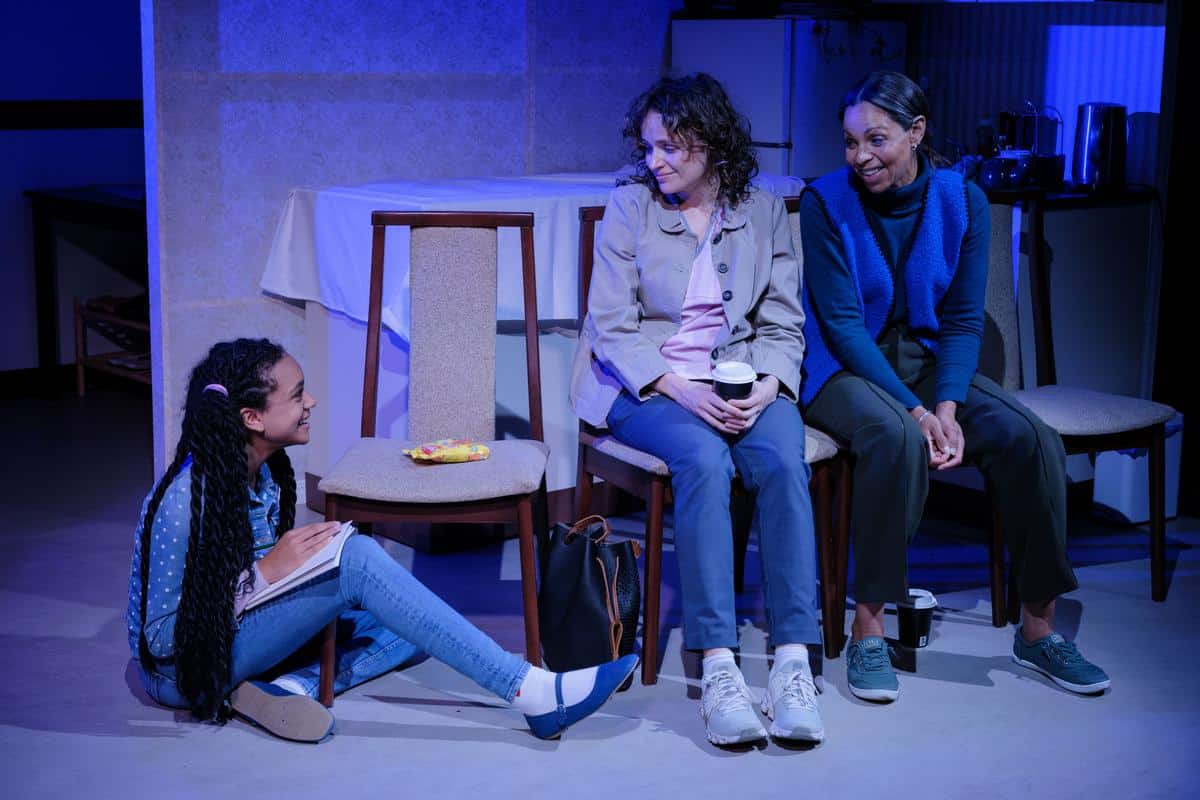
Annie Bryon delivers something that truly hits close to home with Esme. Maybe it’s the unending patience and devotion to the childlike wonder of Kasia, or maybe it’s the disquieting hysteria of an older person’s confusion. Either way, it’s difficult not to think of some of ours in our own lives. Bryon evolved spectacularly in the second half, particularly in the more subtly brutal moments. Fay Du Chateau in return gives us something quieter, smarter, but nevertheless slipping into a panic she can’t understand either, as the stability of her entire world begins to fall apart. Her physicality in gesture, and her willingness to play in the discomfort of the piece makes her performance really something special. Charlotte Salusinszky as Biata is a lovely empathetic,\ but realistic edge, bouncing off of Chateau in a way that humanizes and deepens both of them. Erika Ndibe brings a whimsicality that lifts the piece to its feet in a way it often needs, along with providing the quiet tragedy of not understanding why Es and Flo aren’t allowed to be open in their love for each other. Eloise Snape provides some truly impressive comedic work, and toes the line of insufferable and sympathetic with true finesse.
In a piece centered around relationships, it is only natural that this is where the production shines. All the cast have undeniable chemistry with one another, and their bonding allows the piece to focus the audience into the heartache of the micro of a dementia patient, and the macro of internalised homophobia. There are some brief blips of conviction and blocking, but in a piece as intimate as this one, where it almost feels like we’re voyeuristically spying into someone’s living room, these odd moments smooth over for the most part.
Familiar, and unforgivable, sympathetic, and pathetic; Es & Flo walks the tight-rope of a shame and desperation we as a modern queer collective feel off put attaching ourselves to, whilst demanding that we understand why. As the curtains close, I can say I was reminded all too honestly of the path forwards – especially as those who fought for our freedom begin to age out.
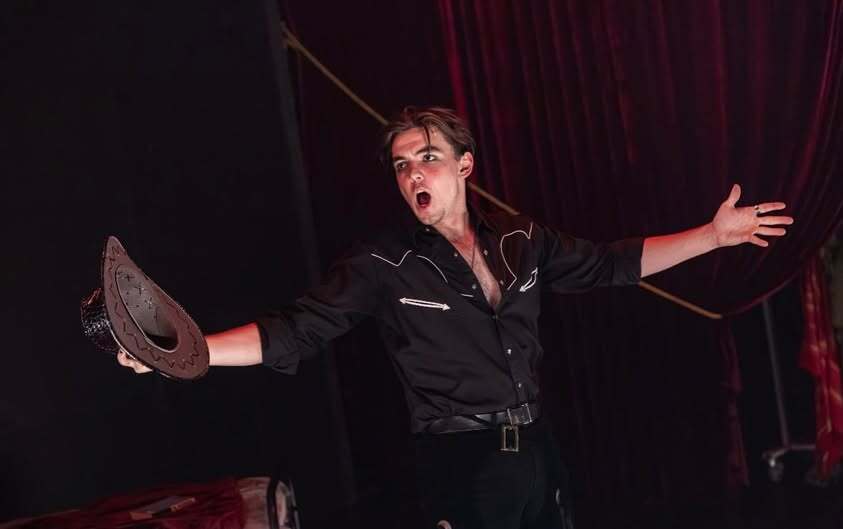
If the Sydney theatre scene’s obsession last year was clowns, this year it seems to be cowboys. But God’s Cowboy isn’t really about the wild west. Instead, this intimate, explosive play takes us much closer to home.
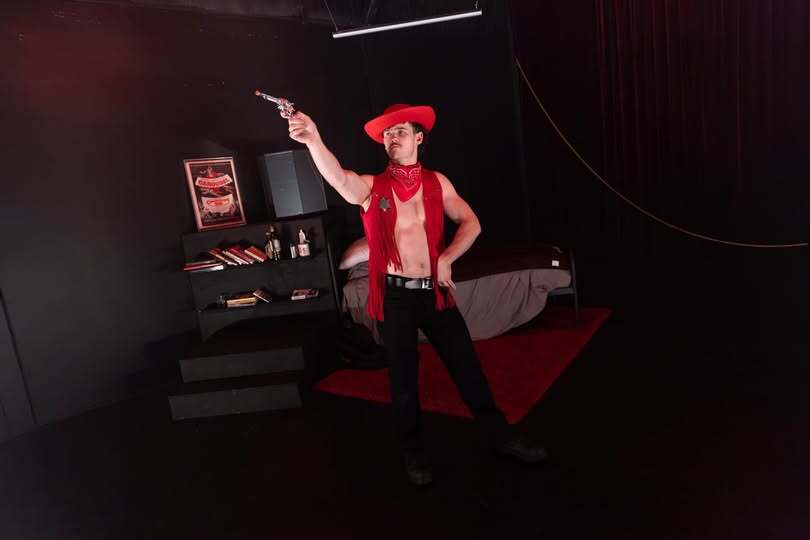
Peter (Nathaniel Savy) has been a performer for his entire life, particularly fond of movie musicals and old cowboy films. When he books a part in a show with his sister (Sophia Laurantus as Penny) he quickly finds his cowboy dreams are starting to come true in an entirely new way. Daniel, a very broken and very suave outlaw type has rolled into town to do the show, and although tormented by his sadistic ex boyfriend Demetrius, Peter and Daniel begin to attempt to explore what healing could look like with each other.
This play at its core is about unstable relationships. Queerness can often be trivialised, oversexualised or infantilised, never allowed to be as messy or complicated as heterosexual relationships are. In that respect, the play is refreshingly blunt about what trauma does to your relationships. The design of the show reflects this: black and red costuming, and staging never quite in bright, warm light.
The cast puts in honourable performances across the board. Max Fernandez is a charismatic performer, and although became demonstrative at points, shined in the more uncomfortable tragic parts of the show. Nathaniel Savy brought genuine queer humour into the text, and when he leaned into the absurdism of the world around him, he was a joy to watch. Sophia Laurantus is very likeable on stage, and had the strongest emotional range on stage, although her stage time was tragically short. Tate Wilkinson Alexander shone as the screwed up sleazebag, and although has a habit of leaning into a monotone delivery, when required, was often a scene stealer – especially in moments of stunt work or massive emotional delivery.
The weakest link in this show is unfortunately the text. Although Ella Morris (director) and her cast have put in clear effort across the board to create something interesting, the text dips into cliche often, and is unclear – especially through the first act. The strongest points were when the script fully leaned into how ridiculous it wanted to be, aided by the hopped up performances of the cast, and overall the second act was significantly stronger. Morris’s effective direction has clearly worked hard to soften some of the script’s weaker points, but it has required the cast to in many ways keep the show up by themselves.
God’s Cowboy is an interesting look into the darker side of queer relationships – an optimistic take on the idea that someone doesn’t have to be in your life forever for them to matter. In many ways, this is particularly important as scrutiny on the queer community comes to an all time high in decades, showing the world that even though perhaps not all queer relationships are perfect, they are as human and as important as everyone else’s.
The Pavilion Players have a specialty. And that specialty, very proudly, is murder mysteries. Easy to produce, easy to sell, and easy to follow, they are the classic choice for smaller theatres. Steve Rowe, however, in his production of Joseph Kesselring’s Arsenic and Old Lace takes that tired structure and turns it completely on its head, as well as pulling some of the most interesting performances I’ve seen in recent memory out of Sydney’s community theatre scene.
The production value at The Pavilion tends to be completely off the charts. Clearly this theatre has the stock to use and cash to burn as they create a lush and busy World War Two Americana household. Chris Lundie, Belinda Rowe, Steve Rowe and Mia Rowe have worked as a concentrated team to take us firmly into the world of this play, all the while giving the actors plenty to play with. This is not the minimalist world of inner-city Sydney. Steve Rowe understands the stylistic necessity of Kesselring’s writing, and dutifully follows it. Lighting and sound (James Winters and George Cartledge) , though less glamorous than their on stage crew counterparts, give us an immersive experience that doesn’t distract us from the onstage happenings – although both had brief moments of jumping cues.
The play follows the Brewster family, a lineage of genuine nutjobs as they navigate the territorial struggles of every family, although with slightly higher stakes. It’s this fact, and the moral questions the play quite cleverly asks, that takes this production proudly out of the world of its predecessors. Instead of being a whodunnit, we follow a whohasn’tbloodydunnit, which allows the black comedic aspects and psychological performances the cast is clearly ready and rearing to produce to shine.
And shine they did. Brett Watkins takes the stage as Mortimer Brewster, the closest thing to a protagonist in this show; and yet, Watkins both investigates the comedy and charisma of Mortimer, whilst allowing him to be a quiet but ever present sleazeball in the way he often seems to rally against. Watkins is an excellent performer, a strong physical comedian and an excellent reactor, taking his time on stage to fully explore the thoughts and emotions he works through in every moment. A particular favourite moment in this regard was watching him deal with the mere knowledge of a dead body in the room, and the Uta Hagan-esque almost three minutes of silent panic and exploration of the space Mortimer goes through as he figures out what to do. I was looking for slightly more weight behind some of his lines, especially as the stakes began to rise, but with the comedic tone of the piece, I’m more than happy to forgive it.
Kate Mannix was an utter standout. Delivering a performance that reminded me starkly of Sophie Thompson’s Monica Reed in National Theatre’s Present Laughter, she struck a truly capital balance between understated and sophisticated comedic performance and genuine emotional intelligence on stage. She also perhaps was the most believable performer in her grief and anger, exploring subtler ways to perform them whilst still acknowledging the sheer size of the theatre she’s in. Her ending became wonderfully satisfying in the knowledge that someone so delightful was going to get away with something so horrible. Truly, no notes.
Another stand-out of the night was Thomas Southwell as Jonathan Brewster. Meeting the very lanky, very shy actor in the foyer, and having watched him perform before, one wouldn’t expect Southwell to shine so brightly in such a strong and demanding character role. But Steve Rowe’s masterful direction and the magic of prosthetics utterly transformed Southwell into a grinning, violent, leering super-star of a character actor. Southwell’s vocal work was delicious, quite literally snarling and growling at the other actors on stage with him. His physical work was equally impressive, going from almost a Frankenstein’s Monster-esque lumber to an animalistic explosion of movement as he launched himself around the stage. Proudly embracing his jealous ambition and searing bloodlust, Southwell’s Jonathan created the stakes of the play almost singlehandedly. My advice to him in the foyer still stands here as I write, he should play parts like this for the rest of his life.
Jem Rowe was similarly enjoyable. With a history in character roles, Rowe leaned heavily into the stumbling, Germanic, comedic sidekick to Southwell’s brutality. However, one could easily see this role slipping into something slightly one note. To this, I commend Rowe. His work to keep the character sympathetic through his obvious discomfort in the level of violence being committed contrasting with his sycophantic loyalty to Jonathan combined into something addictively watchable. The two had excellent chemistry on stage, and his work improved in every scene he was in.
Margaret Olive as Martha Brewster was also very charming. Her comedic sensibilities and chemistry with her sister made her very entertaining to watch and root for. Both of the Brewster women were strong in their use of tempo, which made scenes between them very believable and interesting, although I was missing the vocal strength of her sister. Myles Burgin as Teddy Brewster showed an admirable commitment to the role, and had great instincts for slapstick – although his role didn’t allow him to explore much beyond this. Emma Lebeuf as Elaine Harper was very likeable, a strong female character in her own regard. Although I wanted a little more adult seduction from her, her chemistry with Watkins was very clear, and she leant into the style of the play successfully.
The ensemble gave entertaining performances across the board, and populated the room nicely. At times, this began to lean into caricature, but with the style and era, this must be blamed on the script rather than the actors themselves. The performances across the board may have been lifted by a stronger commitment to play to the objective rather than the comedy, and some actors struggled with comedic “traps” or the repetition of a bit to create laughter rather than strictly earn it. However, for what is admittedly a little bit of a weird play, the neuroticism of the family, the performances of the cast, the production value of the crew and the overall chemistry between the entire team makes this show infinitely likeable. The production sits at a strong intersection between inventive and nostalgic, and is a powerful start to the Pavilion Players’ 2026 season.
Grief is no new topic for the world of theatre. One of the most fundamental human experiences, it is endlessly relatable, never faltering in its supply of new material. Of course, because grief has been explored before, it requires some level of reinvention to allow it to be interesting — A Chinese Christmas in this regard, went above and beyond. In a 70-minute, yet deceptively thorough dissection of what it truly means not to mourn someone, but miss them, Director Monica Sayers and Writer/Lead Trent Foo hold our hands through a gentle exploration of how to reconnect with something larger than ourselves in our moments of destruction.
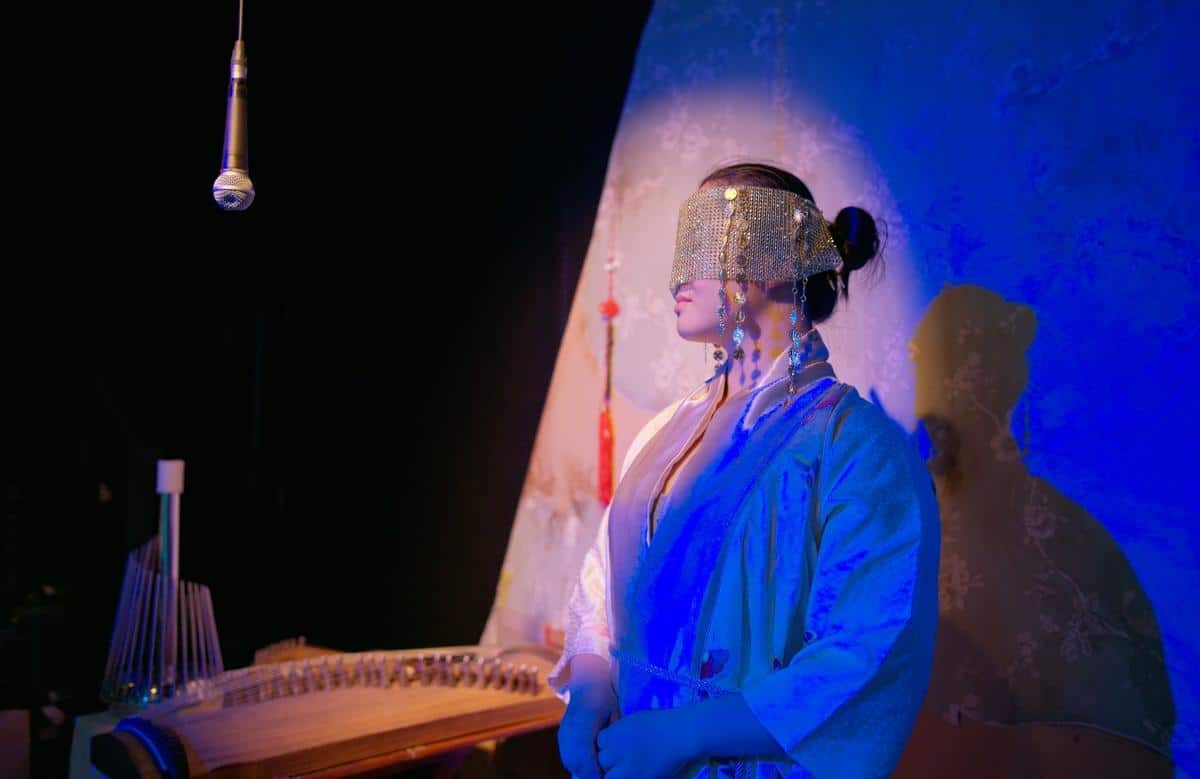
Set on the traverse stage of KXT Broadway, the audience enters into the slightly desolate warmth of an apartment. Cardboard boxes are scattered through the space, along with clutter that could or could not be entirely meaningless. Long lines of fibrous twine cut diagonal lines through the air, and natural fabrics are draped over chairs and lamps, cultivating a grounded and stylistic flair within the room. The hourglass was a particularly interesting touch, subtly elevating the stakes in a very grounded and practical way. The space is both carefully put together, in hanging lamps and the dangle of a microphone, and crucially dilapidated with the peeling wallpaper— setting the mood for our lead’s mental state. Much praise must go to Amy Lane here for her impeccable and considerate use of space. Further, her costume design for Lady Dai was also incredibly impressive, giving Jolin Jiang an almost inhuman energy with the shimmering gold over her eyes.
Production design continued to impress through lighting and sound; Jiang playing five or six instruments live through the show, which drew our attention back to the events on stage without ever becoming jarring. The use of colour and spotlighting from Cat Mai both elevated the moments of drama, and softened the piece into an almost dreamlike state when necessary. Cameron Smith’s sound design, along with Jiang as the composer seemed to almost communicate with both the moment, the emotion, and sometimes the characters themselves. Jiang’s work as a musician and composer, and also her physical work on stage, was so strong, in fact, I was almost left wishing the character she portrayed — Lady Dai — was an unspeaking role, as she created an untouchable mysticality around herself that was at times undercut by her less confident vocal work. However, I understood why the choice was made through the end reveal (which I won’t spoil). As a whole, the piece was incredibly beautiful, and production deserves many of the flowers in both matching and creating the emotional journey of the show. Between set, costume, lighting, and sound, the show moved aesthetically beyond the theatrical, settling into the cinematic.
Foo, in turn, gives us a spunky, naive, and energized portrayal of Heepa — a young man trying to bring his entire extended family together for Christmas. His physical work was very strong, clean movements and confidence through stunts created great moments of comedy and underlined his intentions well. His study of stage combat is very clear in this regard. In many ways, A Chinese Christmas functioned for the most part as a one-man show, and Foo effectively utilized this style to engage with his audience. Watching impassively, we were the ancestors coming to visit — always judging, never quite as helpful as he wanted us to be. His voice was clear and strong, and carried us through the show through his excitement. However, I would’ve liked to see him relax on stage, even only about 10-20% — as his energy manifested as a tendency to struggle with connecting with the words or the emotions, performing through them instead. This, although working for moments of comedy, left moments of grief falling slightly short. His performance was the most beautiful at its moments of stillness, slowness, and simplicity, especially in times of reflection. One of my favourite moments of the night in this regard was when the lights on the makeshift Christmas tree weren’t quite turning on, and we watched a very human awkwardness and frustration come out through humour.
Tiang Lim supports the show through her portrayal as PawPaw, the matriarch of this tiny family. Lim gave us a beautifully subtle study of the way that many of our older generations simultaneously ignore their emotions, whilst being swept up and ever affected by them. Although her vocal work leaned slightly into patterns, her work was so incredibly vulnerable that those flaws were easily ignored. Her scene with Foo in the car was particularly effective, both in her wisdom and sympathy, and the recorded monologue of her letter left the crowd very much misty-eyed. PawPaw, although not being quite human herself, was easily the most complexly human character of the show.
With such a common topic, it would be easy for A Chinese Christmas to lose the attention of its audience — but this show succeeds in leaps and bounds both in its cultural accessibility, and how it uses that cultural accessibility to draw in its audience. Although some of the emotional work did lean slightly demonstrative, and some of the connective tissue between moments was a little weak, Foo and Sayers have given us a deeply earnest exploration into loss that excites without excluding. It reminds us beautifully of the ways that we are loved, even if we cannot understand how that love is communicated. All the while, it simultaneously allows for those on stage, and us in the audience, to, as a collective, reach that final stage of grief: acceptance.