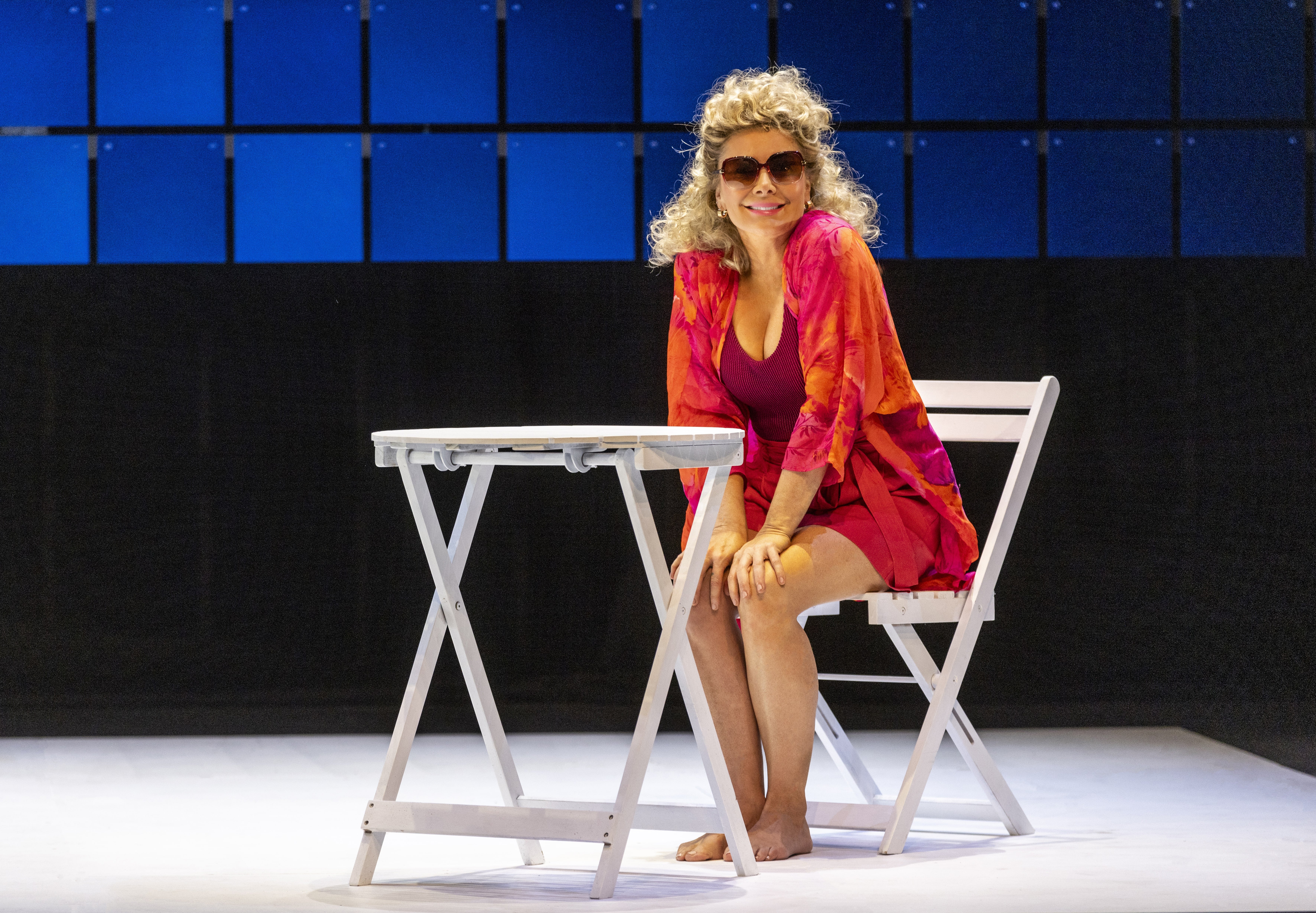
The joyous, life affirming comedy Shirley Valentine, starring leading lady of stage and screen Natalie Bassingthwaighte, opens in Sydney next week. Playing at Theatre Royal Sydney for one week only from 22-26 October, Natalie as Shirley Valentine has captivated audiences and critics alike, bringing Willy Russell’s iconic, heartwarming story to vibrant new life.
This beloved one-woman play tells the inspiring and hilarious story of Shirley, a middle-aged, working class Liverpool housewife stuck in a life of routine. Talking to her kitchen wall, she dreams of escape and wonders what happened to the adventurous girl she once was. When a friend invites her on a spontaneous holiday to Greece, Shirley takes a bold leap into the unknown. With humour, charm and grit, she rediscovers her passion for life and her sense of self. Will she return to her old ways, or will Shirley find a new life where she can finally be her true self?
Shirley Valentine is brought to life by acclaimed actress Natalie Bassingthwaighte. Known for her incredible versatility spanning film (Elvis), television (Neighbours, Underbelly, X-Factor) and stage (Chicago, Jagged Little Pill), Natalie’s portrayal promises to deliver a fresh, dynamic take on Shirley’s journey, capturing every laugh, tear and moment of courage.
Audiences and critics raved about the play and Bassingthwaighte’s performance in Melbourne and Adelaide: “An impressive and endearing performance that had the audience on its feet” – The Age “Deliciously funny, poignantly moving, inspiringly uplifting” – Simon Parris, Man in Chair “⭐⭐⭐⭐⭐Grab your girlfriends and make a night of it. You’ll leave the theatre laughing, inspired and maybe even planning your own adventure” – MelbourniseMe “⭐⭐⭐⭐⭐ An exceptional play, performed by an exceptional actor” – Impulse Gamer “Absolute gold. Don’t miss this stunning production” – Thescoop.au “Bassingthwaighte truly captivated with her superb portrayal. A phenomenal one-woman performance” – Thescoop.au “Genuinely moving” – Limelight
SYDNEY SEASON Venue: Theatre Royal Sydney Season: 22-26 October (one week only) Performance Times: Wed & Thurs 2pm and 7pm, Fri & Sat 7:30pm, Sat 2pm, Sun 1pm Prices: From $59.00 (Transaction fees apply)
BRISBANE SEASON Venue: Twelfth Night Theatre, Bowen Hills Season: 29 October– 8 November Performance Times: Wed & Thurs 2pm and 7pm, Fri & Sat 7:30pm, Sat 2pm, Sunday 3pm Prices: From $59 (Transaction fees apply)
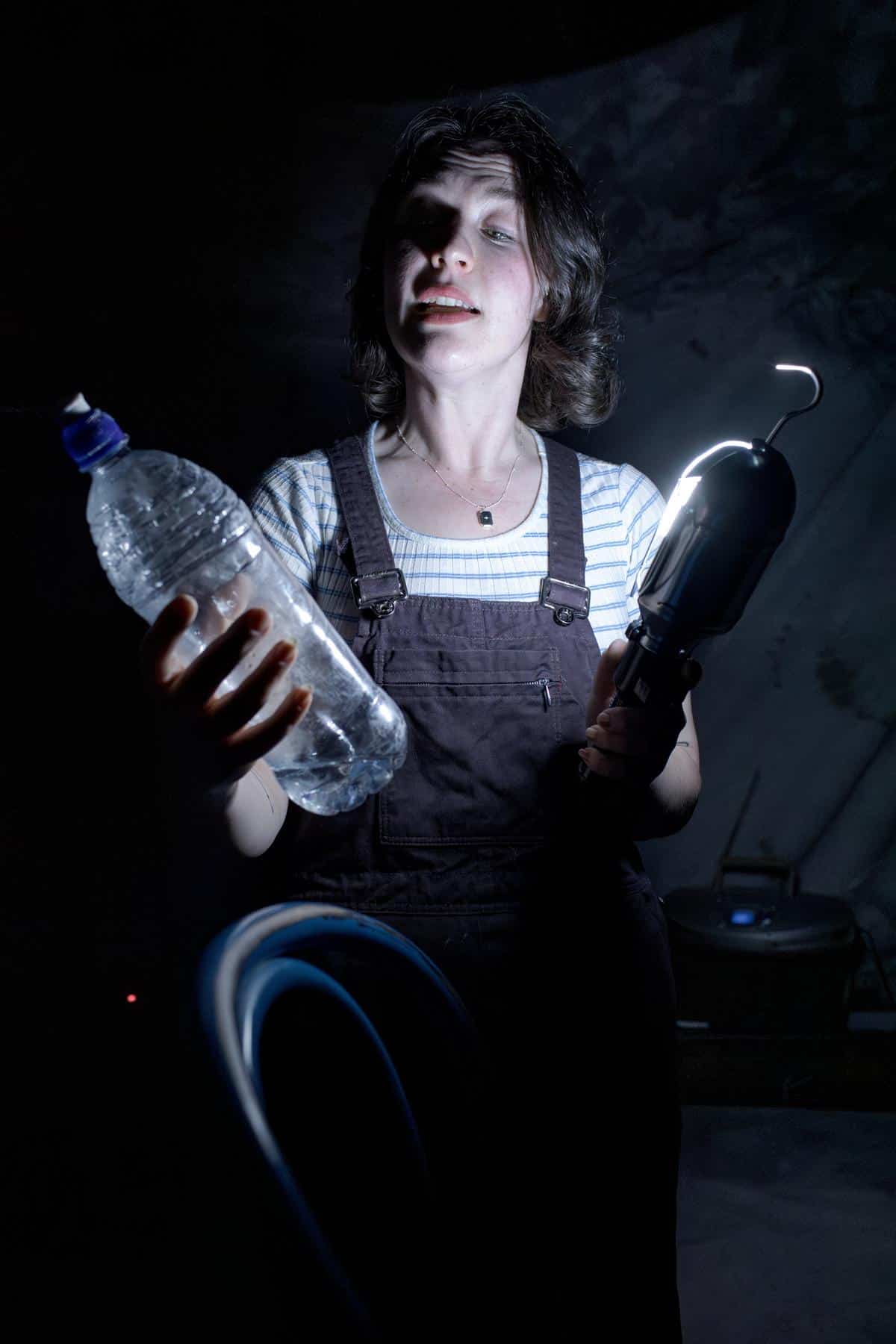
Theatre, generally, falls into one of two traps. Either it makes an interesting point, but makes you feel nothing, or it makes you cry and laugh and clap your hands, but it doesn’t actually mean anything. Lots of theatre does neither, and yet, Everything I Know About This Waterbottle is a rare case of finally nailing both. In a whip-smart fifty minute dissection of the absurdity of consumerism, writer Micheal Andrew Collins, director Violette Ayad and sole performer Ari Sgouros come together to produce something deeply thought-provoking whilst never letting up on the comedic reins. Indeed, the show is a masterclass in that old saying that comedy and tragedy are simply two sides of the same coin.
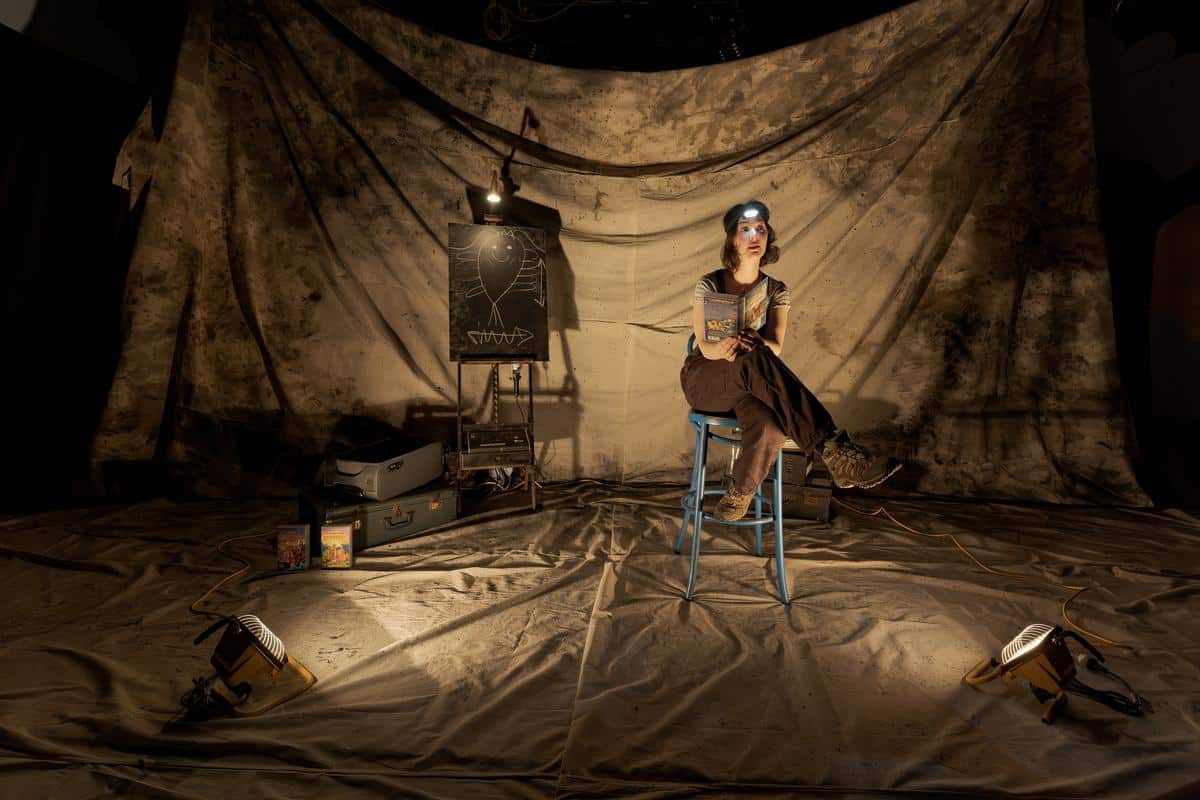
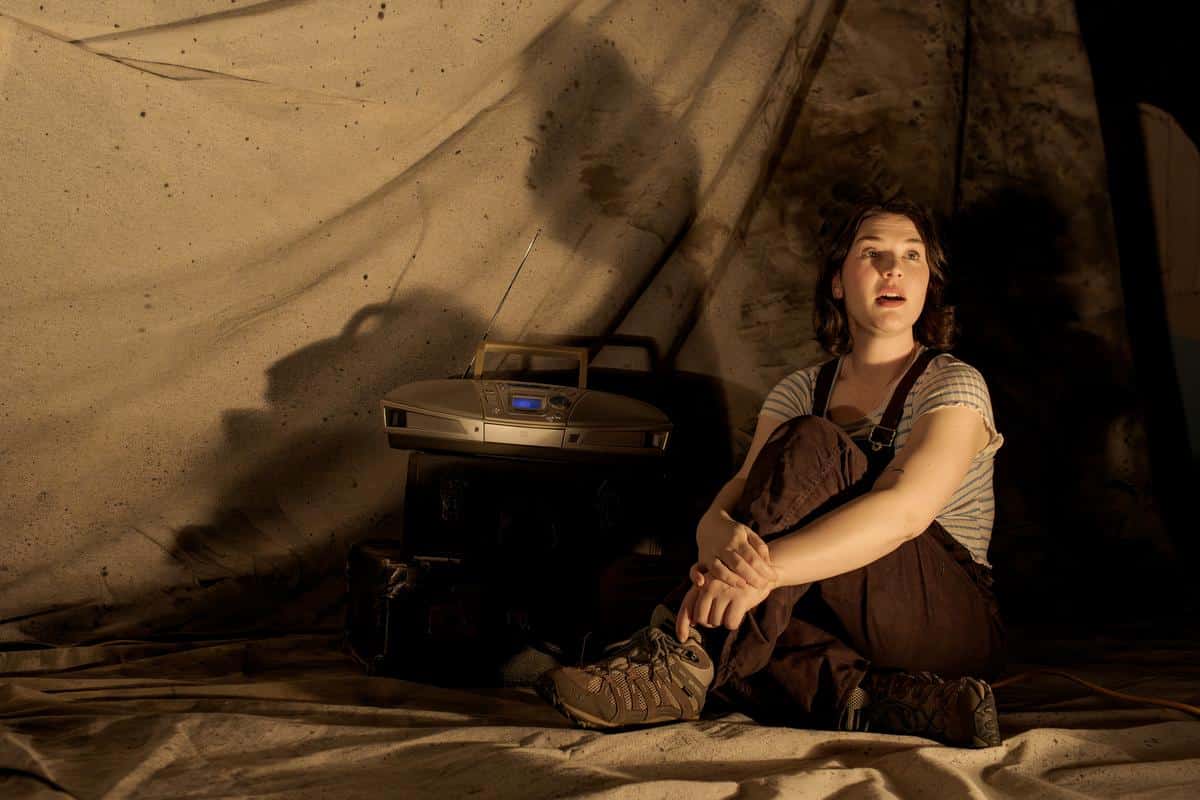
Old Fitz is already a miniscule theatre, and many of its productions peacock in this tiny space, forcing you to be a part of their world through sheer proximity. So I must admit I was initially rather perplexed at the show’s choice to literally cut the stage in half. Further, as a fan of diegetic light and sound, my eyes were drawn to the lighting controls and CD that both sat on stage, promising a further muddying of the lines between practitioner and character. Sound continued to impress through the ever-threatening build of rain in the background – Madeleine Picard blending the inner and outer world of the piece with flawless subtly. The canvas draped across the back wall gave the room a haphazard feeling, as if teetering on the edge of collapse. Needless to say, this feeling was replicated much beyond the set. The walls of the Old Fitz were decorated with fluffy clouds, and although this may not have been done specifically for the show on stage, it gave the room a rather avant garde feeling of the outdoors that I really enjoyed. Kudos in this aspect must go to lighting and set designer Morgan Moroney. As the lights dimmed, our sole performer joined us on stage, dropping off her raincoat (a lovely piece of foreshadowing) and leaning down to manually turn up the lights in the room. Sgouros then turned around with a direct address to the audience, setting the tone of the piece and introducing us to both our narrator, and our argument seamlessly.
A one man play is a significant undertaking, especially vocally, and especially for a piece like this that moves so quickly, so I was only the more impressed at Sgouros’s brilliant vocal performance. Her voice filled the space, constantly playing with rhythm, pitch, and tone in a way that allowed her to consistently make the most interesting choice – a valiant effort in a political piece that offers the trap of vocal patterns again and again. Indeed, the humour of the piece felt at least in the beginning as more of a stand up special than a play, which only speaks to the believability of Sgouros’s character work. Never was I convinced it was someone playing something, and not her on stage with us. The comedic work was once again improved by the crew’s careful consideration of comedic timing. In a theatrical landscape that relies so often on speed to create comedy and interest, finding a work not afraid to take their time is a joy. Also – I am an absolute sucker for prop comedy, which was sprinkled throughout the piece delightfully.
Once again I must return to a cardinal rule that defined this piece, comedy and tragedy being two sides of the same coin. The coin, in this piece, was focus. Sgouros was utterly and completely in the zone for her entire performance, and we as the audience couldn’t help but be sucked in with her. It was then this focus that allowed her emotions to shift on a dime. Moment to moment the storytelling shaped her entire being, and not once did her bouts of stress or tragedy feel unearned, even as they were unearthed and satirized moments later. This was commendable again when she faced real-time technical problems, which she adapted to in the moment with seamless humour – and then solved! As a viewer, we felt her intensity in every moment, and we, with her, walked the knife edge between losing it (positively) and losing it (negatively).
Admittedly, I was a little cynical of the show’s premise. Much of climate change theatre boils down to “capitalism is bad and so are boomers and so are you”, leaving you with nothing but an unhelpful sense of guilt as you leave, and an odd, disjointed anger at “the man”. This, again, was batted away by this show team. Everything I Know About This Water Bottle reminds us that yes, we may recycle, and yes, we may reduce our plastic waste, but in matter of fact, the systems and companies around us are so large and so almost-untouchable, that no matter the moral high we may feel by thinking we’re helping, we never really are. In a truly horrifying way, the show reintroduced us to the nihilistic reality of modern day capitalism, and in doing so revealed its core thesis: “the real cost of things”. The real cost of things became a throughline that shaped everything in its path. The real human cost, the real environmental cost, the real emotional cost, the real financial cost. No matter where you looked, no one was telling you the truth about how much was not acknowledged, and then allowed to be ignored for the sake of consumerism. I particularly enjoyed the BP callout for their invention of the “carbon footprint”, and the unloading of climate responsibility onto the individual. This message of our lack of control was interwoven with tiny moments of overwhelm and discomfort, removing the carrot of comedy from us just long enough to recognise how bad it truly is, before giving it right back to keep us constantly, addictively hooked.
As the piece built to its final high, it was revealed to us that we are post-apocalyptic. The long-awaited, ever-warned-about climate disaster has finally stopped crushing people we pretend don’t exist, and it has come for us. In this moment, the piece had one final decision to make, to recognise consumerism being bad, and leaving us with the flat-soda taste of holier-than-thou in our mouths, or to once again reconnect with reality. We got our answer in a deeply touching moment of our main character with an infant child they were asked to take care of, and in doing so, the recognition of the human instinct to protect and provide no matter what. The emotional core of climate change began to unfurl, we want things to change, but we feel useless. We want to be better, but we feel good when we get to have things and give them to others whenever we feel the instinct to. And through this final thread of the argument, the play finished on a gorgeous moment of connection between our main character and their older brother, and the conclusion that we will ultimately save each other, no matter the state of the world around us.
Everything I Know About This Water Bottle shines in every aspect, creating both an intelligent and sympathetic argument, and simultaneously creating emotional highs and lows that feel earned and respectful. Ari Sgouros takes us through the piece with masterful comedic and emotional technique, and the script does everything it can to support her. Truly, my only note is that when she walked too close to us in the audience, we didn’t get quite as much light on her face as I would’ve liked. From production to the stage, this piece is an A Plus example of not just political theatre, but theatre itself.
Sallyanne Scotton Moonga has delivered an innovative adaptation of Jane Austen’s Northanger Abbey to Warners Bay Theatre.
Sallyanne, the writer/director expertly produced an original play based on Northanger Abbey with a sagacious amalgamation of The Mysteries Of Udolpho. She has created an ingenious addition of the female protagonist from Mysteries Of Udolpho, Emily St Aubert–essentially an imaginary character seen and spoken to by the main Northanger Abbey character, Catherine Morland. Catherine Morland has become so completely consumed in her Mysteries Of Udolpho novels that she has conjured Emily St Aubert to help guide and encourage her in her day to day life and dramas.
The main character Catherine Morland was played by Isabella O’Brien who delivered a phenomenal performance. Isabella beautifully captured the essence of Jane Austen in her role and transported the audience into the British Regency era. Catherine has an easy listening clear tone that perfectly executed the challenging period dialogue.
Lilly Dougherty burst onto the stage as the energetic and zany Emily St Aubert. Her vivacious and dynamic presence infused the performance with wonderful comedy delivered through an incredible array of dramatic expressions.
Tracey Gordon cleverly doubled as both Mrs Allen and Mrs Morland. Tracy’s acting was flawless, providing utmost authenticity to both of her characters. Alongside Tracy was Peter Vernon who played her husband Mr Allen as well as General Tilney. A wonderful feat by Peter who accomplished a fabulous portrayal of two very contrasting characters: Mr Allen, a sincere and devoted husband, versus General Tilney, stiff, uncompassionate and domineering. With dominating stage presence and an immaculate British accent, Peter Vernon’s presence was a highlight throughout.
Catherine Morland’s dear friends Isabella Thorpe and Eleanor Tilney were both portrayed by Jamahla Barron. Jamahla displayed admirable skill in her smooth transitions between her roles and showed great dedication to her characters.
A charming performance by Joel Latham who delivered the roles of Henry Tilney and James Morland. Joel was ever fast in his commitment to his characters and gave a solid performance.
Will Cesista was charismatic and entertaining in his roles of John Thorpe and Captain Tilney. He showed great devotion and diversity throughout and in particular I enjoyed his comedic carriage scene with Catherine Morland.
The Costumes by Peta-Elliotte Green were perfectly appropriate to the era accompanied by the ladies’ gorgeous hair styles by Ralf Jorg. Ralf has once again dazzled the audience with his creative brilliance.
The play featured original music composed by Rob Scotton which provided a pleasing background accompaniment. The sound effects were also skillfully and appropriately utilised throughout the performance.
The use of Shadow Puppetry by Ricky Moonga and Sallyanne Scotton Moonga was an enjoyable addition and provided some light hearted comedy. It was unique, playful and pertinent to the show’s content and period.
The Lighting Design by Lyndon Buckley was fitting to the moments of mystery and eeriness and then bright and bold for the vivacious scenes. In particular the candles and lanterns strewn about the stage set a pleasant ambience.
Sallyanne Scotton Moonga’s creative retelling of Jane Austen’s Northanger Abbey is immensely entertaining and remains perfectly attuned to the style of Jane Austen. By masterfully breathing fresh new life into this lesser-known classic novel, Sallyanne and her incredibly talented cast have delivered a thoroughly enjoyable and memorable performance.
Backbone Youth Arts sets the stage for Horseplay, a rollicking and provocative piece centreing on a Melbourne Cup Race Day gone awry, where a chance encounter in a staff break room between a waiter and two misguided punters delves into a morally ambiguous exploration of blurred lines between good and bad, life and death – and even person and horse.
Horseplay is perfectly aligned with Backbone’s raison d’être – to amplify the voices of curious, untamed and experimental young thinkers and artists; The play’s program notes much of the script and work was built using structured improvisation, in addition to the text of playwright Nathaniel Crossinggum, contextualizing the fresh and contemporary perspective of the script. Led by Director Jordon Riley, this singular and exciting work is brought to brilliant life by a talented group of cast and creatives alike.
Onstage, Edith Malcomson offers sweet naivety as Georgie, shining brightest in her character’s lighter, comedic moments. While a providing a very proficient overall performance, I consider she has further potential to impact her characters more vulnerable moments – i.e., the line “I’m not a revolutionary – I just want to be normal”, could perhaps benefit from greater introspection drawing the audience into her, rather than delivering the sentiment as squarely toward us. Stella Peterson is an effective Pony, competently canvassing a complex character’s duplicity and idealism. I consider Peterson also shows their best work during comedic scenes; They briefly branch into a different character, satirizing the middle-class’s indifference to climate catastrophe to hilarious perfection. As we learn, there is far more at stake for Pony than having their work break interrupted by Georgie and Harry; I wonder whether some added urgency and further hints as to their assumed identity could have elevated their role – and tapped into another potentially comedic aspect of the script even further – without belying the enigmatic secrecy intended for Pony.
Tenielle Plunkett brings compelling gravitas as the Commentator, combining striking physical presence, commanding diction and vocal projection and foreboding intensity. Their characterization feels almost sinister or nihilistic – somehow reminiscent of Malcolm McDowell in A Clockwork Orange – but this is such a well-modulated choice for sharing a world-weary perspective, unable to ignore or euphemize injustice. Henry Solomon as Harry is my standout, with impeccable comedic instincts and a natural, comfortable presence – whether embodying a human or equine character. While Harry is a flawed character, Solomon harnesses likability from the rogue – when not being literally harnessed himself!
Overall, Horseplay gallops through it’s one hour duration – keeping the audience enthralled throughout. The puppetry, set, sound and lighting all provide features of note. While there are a couple of moments where transitions in the story may have lacked clarity i.e., the reveal of Pony’s identity and their motivation for the shooting – such criticism is minor. Horseplay is creative theatre chaos with a conscience, and enormous potential to be developed as a full-length play, that could give the ambitious story breathing room which is not easily accommodated in just one act. The passion for diverse, accessible theatre is evident here – as much as the audience’s love for every facet of Horseplay was throughout the play – deservedly punctuated by a rapturous standing ovation at the end of opening night’s performance.