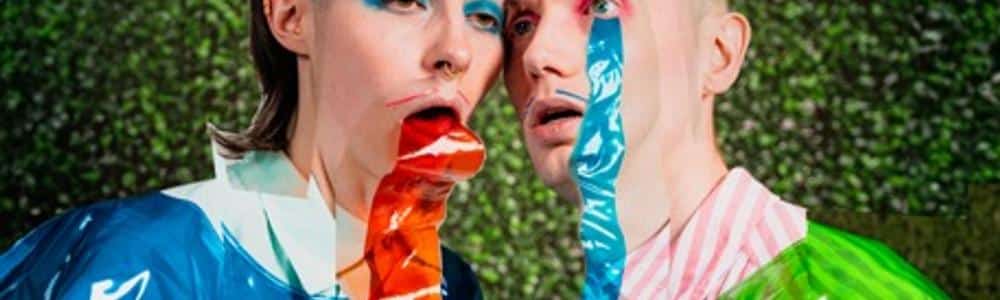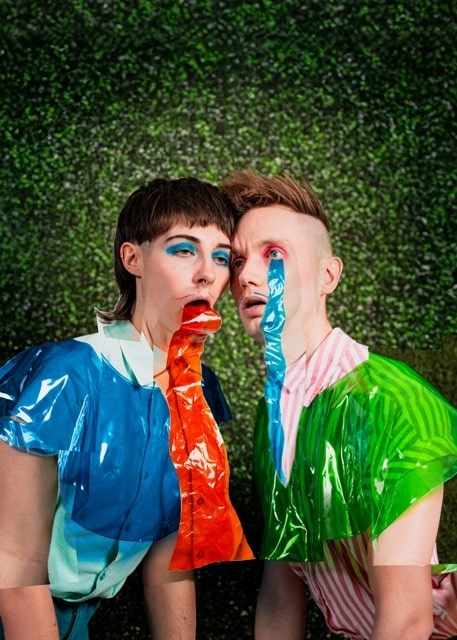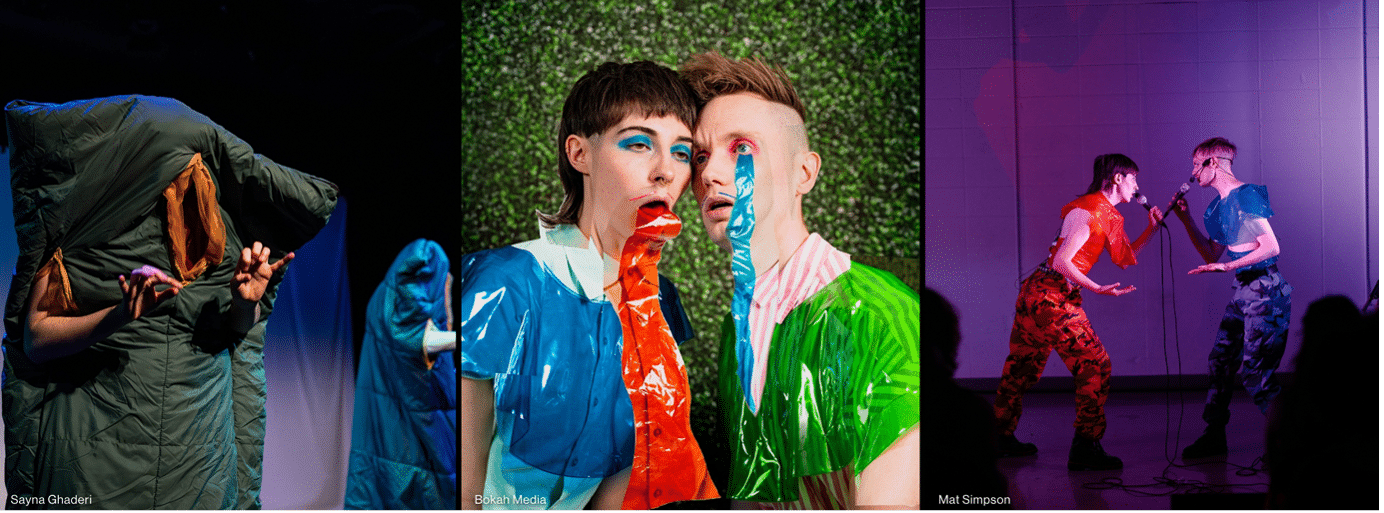
One would not be out of place saying, WTF Rosie Roulette, writer and director of Pokélesque, performing 24-28 Feb 2026 at Ackland Street Theatre. What goes on in that fierce silly nerd head of yours?
Pokélesque tells the tale of a young trainer, wanting to be the best, beginning their pocket mon journey. Lucy May Knight’s star shines brightly as the young trainer. Their quick wit and improv reactions are hilariously fun. Adam White is equally matched as the Rival. There was no censoring of the rival’s name volunteered by the audience unlike the game. This was the beginning stages of the shocks and excitement ahead. Various stages of undress mean this is not a kid’s show.
We are cleverly welcomed, with the audience lights on, to three pink eared acapella singers, with words slightly changed for the Pocket monster theme, as people take their seats. As the lights dim and the story starts, we are taken on a weird psychedelic trip. The Professor, Darin Casler, cleverly comforts us for the road ahead. That road included fight scenes where we the audience clapped along and roared laughing.
There was MX Lucy Furr, whose stunning performance as Lickitung in hot pink tongue boa and pink sequined cap which made them a vagina in certain poses and strip teasing pocket mon. Rosie Roulette dazzled us with her beautiful version of “Never Enough”, what an exceptionally multi-talented weirdo. Sy Quinn’s performance in multiple roles with strange unrecognisable accents and many hat changes brought well deserved cheers and whoops from the audience every time they came on stage and played up directly with the audience.
Driving and begging for reactions seamlessly within the storyline. Rasputtin as Mr. Mime was a highlight. Their mimed strip tease was comically sensual and had audience members catching and returning their imaginary clothes with glee. The fabulous dancing Theresa Problem and Izzy Inyette play the villainous team Red Rockets. Were there a couple of sound issues and a troublesome microphone on opening night? Sure, but this talented crew added it to the interaction with us the audience. Improv and a non-existent fourth wall included us at every turn of this parody style play.
This all-inclusive, minus kids, show really is one for the pocket monster fans with many hidden and some not so hidden Pokemon puns. However, no prior knowledge is needed. Get along to the mischievous, totally camp, frivolous Pokélesque. Presented by GEEK OUT Nerdlesque. You will have a great time.
There’s something rather intimate about being invited to a dress rehearsal of a show. The creatives are milling around you buzzing in nervous excitement. The show is still in bits and pieces on the floor, not yet solid. The world they’ve created is in its teenagehood — not infant in its conceptualism, but not yet fully grown. You feel much like a wildlife photographer, sitting, observing, noticing, but still distinctly on the outside; our presence as critics is both cruelly invasive and fundamentally necessary. In The Presence of Light was my first dress rehearsal invitation, and it offered me entirely new parts of the critic’s experience. Principally, I got to feel how the show was actively coming together around me, and I got to ask a little about what I was walking into.
Spark Sanders-Robinson, creative-lead and the only live speaking (and singing) voice says, when I confess to her I have no experience writing for opera, that this experience is “opera for the uninformed” — that is, it is an operatic experience for those who don’t want to be spoken down to, but instead connected with. She tells me the experience is a deliberation of love, an exploration of what it is in its truest form, instead it being trapped within the bonds of the human experience.
“It’s about death,” she says, then, when Mia Rashid, their dancer prompts, “is it about death?” she responds, “no. It’s about love.” I am, admittedly, prepared for the experience to be completely incomprehensible after this conversation. I have never been so glad to be proven right.
We are tucked into the M2 Gallery in Surry Hills — an itty bitty space, unconventional, echoey, with what almost looks like a frame surrounding the elevated platform this team is using as a stage. The “stage” is bare, ‘cept for a white sheet at the back. Robinson wears a flowy, airy, blue wrap dress — which, with Rashid’s simple white tulle, almost shapeless dress, creates an eerie dreamlike atmosphere, allowing them to become one with the space around them. The space itself is generally unsupportive, and I look up to the ceiling to see what they will do with lighting, because there’s certainly no view-blocking from-home lights milling about. On the floor, there sits a singular projector, surrounded by indistinguishable frames I don’t yet understand. Nathaniel Kong joins us in the room, sits behind the piano.
I ask, upon finding out that Robinson and Rashid will be the only two interacting on stage: “is it a two-hander?” Robinson responds, “kinda a two-hander. Unless you count the piano as a third character.”
We begin.
Recorded responses from what must be over ten or fifteen people fill the room with their overlapping responses, talking about what it is that they love. Although each answer is interesting and beautiful, we cannot catch a single one as they become jumbled and chaotic. Robinson takes the stage and the glow of her projector light snaps on as she begins to talk to the audience (me and their photographer, mind you) about what she defines as love. Or rather, how difficult she finds love to define. She leaves us on a rumination about the use of defining it at all, and the lights go out. Rashid replaces her on stage, taking us through the first of many classical pieces of music in the show. Her movements are wide and grounded, translating the impossible hugeness of love, what it is as a force of nature. Then, as she connects to its fragility and its grief, they go miniscule and wineglass-thin in turn.
Robinson is generally well-known for her use and manipulation of light, no different in this production. Indeed, what makes this light work so interesting across Robinson’s catalogue is the matter in which it interacts with itself, as well as the people on stage. As Rashid becomes something more human, she catches and releases the light in her hand, and love goes from being something that possesses and consumes her, to something akin to hope, a slight glimmer. Different frames of colour over the projector take us from softer yellows, to bright, high-contrast whites that throw sharp, dangerous shadows behind Robinson. Then, as our dancer rejoins us, she is bathed in a pink light that makes her almost inhuman. It is at this moment I understand the deliberation about the piano. Kong and Rashid seem to not just legitimately communicate, but have entire conversations through the call and response of music and dance. Later, when Robinson’s mezzo-soprano rings out through the almost-empty room, I remember this relationship in its more traditional form as the opera and the orchestra interact, representing entire sections through these two individuals.
As a production, I cannot tell you that there was an overlapping narrative to this piece. Rather, it functioned as a series of images, more performance art or a film sequence than a piece of theatre. In one moment, shadow puppets creep over the projector, two faces in profile, then meet in the middle for a kiss. Rashid collapses in between them, bathed in, yet shadowed by their love. To that point, the piece doesn’t attempt to ask or answer something, it invites you to feel the full scope of an emotive experience in all its beauty and wickedness. The performers are all viscerally facing something through their chosen art form, and the size of the space as well as the passion of their performances makes the whole experience incredibly intimate. In Rashid’s rare moments of pause, we can hear the heaving of her breath. In between Robinson’s clear notes, we can feel the sound still bouncing around the room. The body-ness of it all provides us with the raw erotic lens of their conversation.
In a technique I’ve certainly never seen before, a glass bowl is placed over the projector, and Robinson and Rashid take turns dripping water, oil, and ink into it, throwing curling and whispering colour across the stage, bleeding and changing the light. As both performers are in white or almost-white, these moments of colours stain not just the background, but them as well. In one particularly effective moment, an explosion of purples appear across Robinson’s body on stage, as ink is dripped into the centre of the bowl.
In many ways, our fourth character is the continued reappearance of the voices. Although jumbled and confusing through the beginning, they spread out and become clearer. We listen to them talk about their lived experience of love, of grief, of heartbreak, of redemption, of life. This tether of realism affirms the path of images we tiptoe through, as well as providing an edge of human vulnerability to the piece that can sometimes escape a performer.
Although I was invited to the dress rehearsal, I must briefly play the part of the wicked critic and remind the world that no art can be perfect. Indeed, the performance as a whole was brilliant, and my only moments of nitpicking are as follows. Robinson, despite being an incredible mezzo-soprano and having strong monologues, has moments of struggling to sit in her body and relaxing. This, when compared with how viscerally one must be in their body as a dancer, is thrown into rather sharp contrast next to Rashid. Further, each of the three performers had moments of sneaking worried glances at one another, which although can be understood as working through the anxieties and uncertainties of dress rehearsal, manifested as drops in concentration through the show. However, other than this, I truly cannot fault anything else. The light work was inspired and beautifully done; Robinson’s performance both as an actor and a singer was beautiful;, Rashid took my breath away as a dancer; and Kong brought old music to new light through his work on the piano. The last moments of the show, a Joni Mitchell cover, floated through the more conceptual work of the rest of the piece and touched base with the audience, giving us a tether to hold onto even as the stage swan with an iris of pink spinning light.
In a topic so broad and difficult to fathom such as love, sometimes connecting to the conceptual and visual serves the explorative process more than the grounded and naturalistic ever could. In The Presence of Light shows its audience that the emotional experience is not a logical one, but a visual and physical one, and if we can embrace letting go of our need to understand, we, ironically, come much closer to knowing what that emotion truly is. The team, in this tucked away gallery, have in a way presented something that matched my early anxieties of being incomprehensible. But then, can’t we say the same thing about love itself?
Glitter Martini have brought Absolute Trash down from the Gold Coast for a short run at the Sydney Fringe, following sparkly five-star reviews at the Adelaide Fringe.
We live in a world surrounded by trash. Bin juice, trash pandas, floating garbage islands, and the toxic waste dump that passes for social media. When was the last time you said that your life is a dumpster fire? (Confession: last Wednesday for me.)
Absolute Trash gleefully up-cycles our garbage mountain planet with eye-popping circus, wacky comedy and bawdy cabaret.
It’s nice the get the word bawdy out of the house. It’s usually stuck at home doing debauched crochet while the sexier words like saucy and spicy get invited out to play.
If you want to, you can take it easy, sit back and watch, but part of the joy of a Glitter Martini show is their love of playing with their audience. You are invited to share your trashiest stories by text at the start of the show.
Director and performer, Darcie Rae, loves creating a real feeling of connection between the audience and performers. She has fashioned a joyous audience-driven, interactive experience that uses comedy to disarm you as it seductively draws you into the show.
Natrasha Binit, the Duchess of Debauchery, the Queen of Trash, is your incomparable compère for the night. They’re taller than Sesame Street’s Oscar the Grouch but they share his love of trash and trashy things, with a green plastic wig and a Chanel little black bin bag dress.
Trent Charles, as Natrasha, is the beautiful mutant lovechild of Cara Delevingne and a Monster High doll. You know, in a good way.
Tangly contortionist Bendy Elle spends the show upside down, in the air, inside out and tied up in knots. While smiling impishly.
It’s not every night that nimble and sculpted aerial artists like Miss Amy May and Darcie Rae take to hoops and trapeze, sharing a stage with puppet bin chickens.
I will go to my grave remembering the look of sheer disbelief on an audience member’s guide dog’s face as it stared up at two puppet bin chickens dancing, with squeaky rubber chickens, to Burt Bacharach, ably puppeteered by Charlie Love in platform PVC boots.
That is a sentence I never thought I’d write. And the rubber chicken can-can is a weird, wild and wonderful thing that you need to experience in the flesh.
Absolute Trash ticks all your sustainable boxes in a consensual way you weren’t expecting.
Glitter Martini’s Absolute Trash is part of the Sydney Fringe, playing at Fool’s Paradise, The Bunker, Entertainment Quarter until 21 September
Twenty Million Thousand Leagues Under The Sea Rating
★★★★★
Click if you liked this article
2
To say this show is just a theatre performance would be simplistic. Twenty Million Thousand Leagues Under the Sea by Pummel Squad cannot be boxed into just one category. Presented onstage by creators and performers Harry McGee and Cooper Donald McDonald, together with sound designer and composer Yanto Shortis, the show is a lively explosion of creativity—a brilliant blend of comedy, live-action illustration, and music, all brought to life with quirky narration and the classic overhead projector (OHP)!
The three performers tell the story of Rasthomas Bulge, an ordinary fellow with an extraordinary name, represented in 2D illustration in various poses, depending on the storyline. He’s drawn in 2D but at times is represented by larger than life 3D narrators, who voice his thoughts. At other times, his thoughts are cleverly interspersed and gently made known, projected onto a screen. Combining shadow puppetry with stencils and rolling overlays, along with narration and acting, the creators move beyond the ordinary to present the story in the most original way possible.
Rasthomas is a car salesman with a bushy moustache. He is drawn with three curly springs of hair sprouting from his head, bright eyes and a snappy suit. As the audience is being seated, his creators are sketching him to life on the overhead projector bit by bit. It was fun watching Rasthomas become himself, and it felt like we were getting an art lesson as the lines morphed into a cartoon man.
He’s got a steady job, a steady social life, (albeit with a shady school friend, drawn to “look bad, and is worse on the inside”) and a steady, ordinary life with his family. At the heart of the story is Rasthomas, feeling unsatisfied with this steady life. He is clearly experiencing a mid-life crisis where he feels that there’s something missing. After meeting and selling a sportscar to a man who surprisingly looks a lot like him, Rasthomas goes in search of adventure.
Following Rasthomas to literally the ends of the Earth and sky, the audience is entertained with stories of him travelling from the depths of the ocean to the moon and back. In a nod to the novel Twenty Thousand Leagues Under the Sea written by Jules Verne, there’s danger, daring escapes, sea monsters and even a bit of Casablanca cleverly woven in that ties right back to his wife. He realises after he has stepped out of his own shadow, that his ordinary life is something to be treasured, and perhaps looking at things from a different perspective brings acceptance.
Along with the lo-fi music and an almost continuous sound design accompaniment to the show, musician Yanto came out from his music station at the side to take centre stage. Standing in front of the screen, he sang an original song with his banjo ukulele as the projection rolled along, with the drawn buildings floating past with song. The audience loved it!
A memorable moment for me was one where we were introduced to Rasthomas’ four sons, drawn in lines, their portraits smiling. Their names were announced and revealed, read aloud as a list, with the first three son’s names rhyming, culminating with the youngest son being named Rasthomas Junior, which made me laugh as it was so silly. It was these witty bits of comedy, seamlessly woven in and delivered at surprising moments throughout the show, that gave the show a comedic charm which I thought was reminiscent of Roald Dahl.
Twenty Million Thousand Leagues Under the Sea was a 50-minute performance that seemed at times to be an improv. However, the Pummel Squad team cleverly crafted their skills to only make it seem this way, involving tag teaming the precise placement and flipping of stencils on the OHP, and quick delivery of quips and cheeky lines. Part of the 2025 Sydney Fringe Festival and already an award-winning show, this is one quick-draw scribby art combo comedy show (I did say it was hard to categorise it!) which will capture your sense of humour and your heart. Don’t miss this truly unique performance—there’s nothing else like it!
Season: 10- 13 September (matinee and evening performance on Saturday 13 September)
Run time: 50 minutes
Venue: New Theatre, 542 King St Newtown
Tickets: www.sydneyfringe.com/events/twenty-million-thousand-leagues-under-the-sea