Speaking In Tongues

Speaking In Tongues

Speaking In Tongues Rating

★★★★★

Click if you liked this article

Last night I had the honour of watching celebrated and local playwright Andrew Bovell’s Speaking In Tongues at the State Theatre Centre for Black Swan Theatre Company. Directed by local theatre actor and director Humphrey Bower, this well known play (which some of you might also remember as the screen play under the name Lantana) was very successful back in the 90’s early 2000’s. I was interested to see if the play would resonate today and how audiences would respond.

This psychological thriller tells of 9 middle aged characters and how their lives interweave and clash – keeping you on the edge of your seat, guessing what is coming next. It explores the themes of betrayal, growing apart, emptiness and relationships as a middle age couple. With an audience demographic of those who were mostly middle age in the 90’s – I think Black Swan have chosen well for their audience and with the knowing laughs that were rolling, it was clearly resonated.

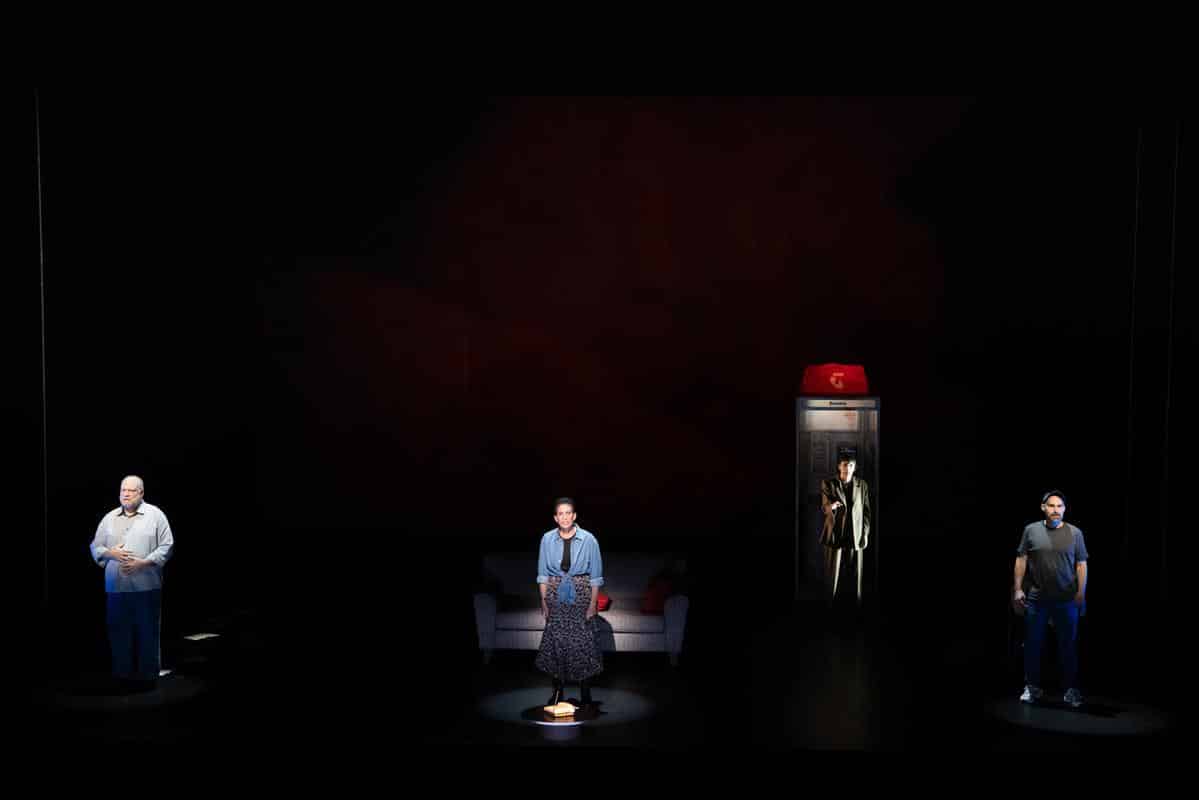
The set itself was stark and somewhat noir – a little like the play itself. I would have liked to see some more innovation with the set and costuming but also understand that maybe this play, originally mounted at Sydney’s intimate Griffin Theatre in 1998 is much better suited to a studio or small stage performance. It sometimes felt like the actors were lost on the vast stage, with minimal set and I wondered if a more complex set design could have helped with this. What I did love from the set design though, was the iconic Telstra phone box which immediately took you back to the 90’s and what it was like to live through that era – a vast difference to the technology today.
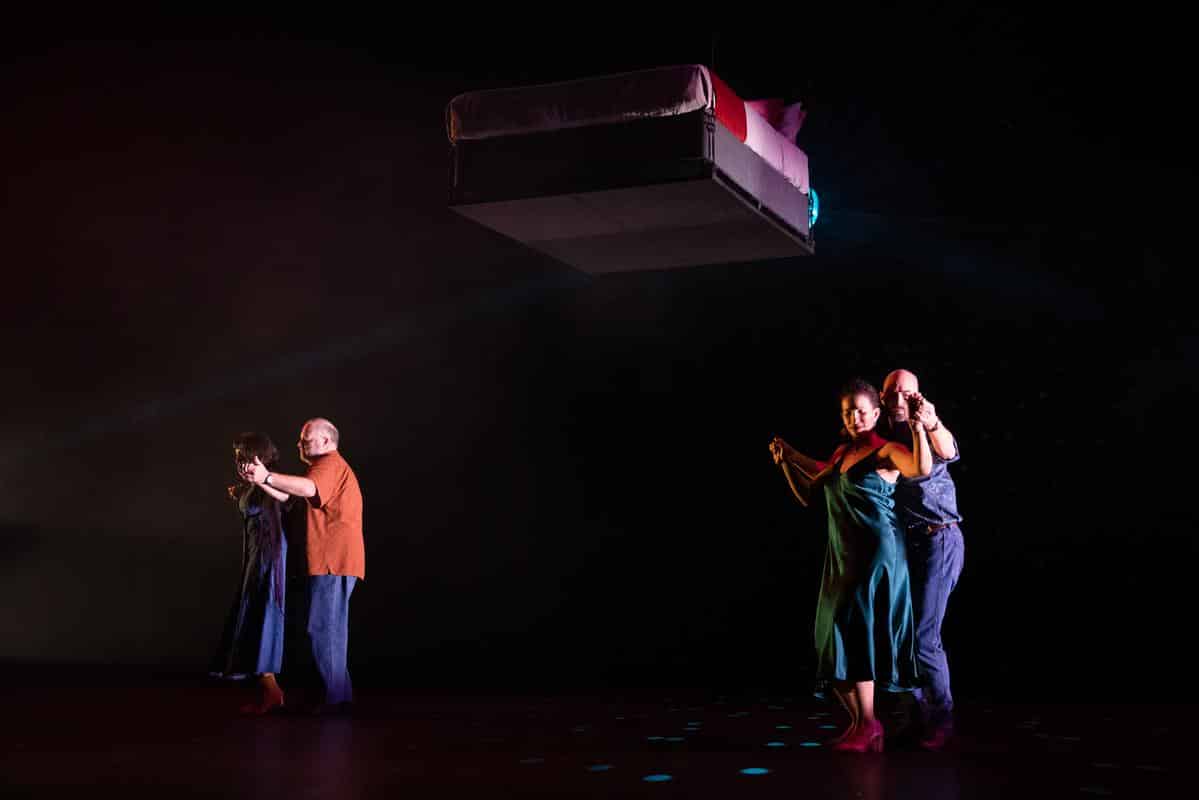
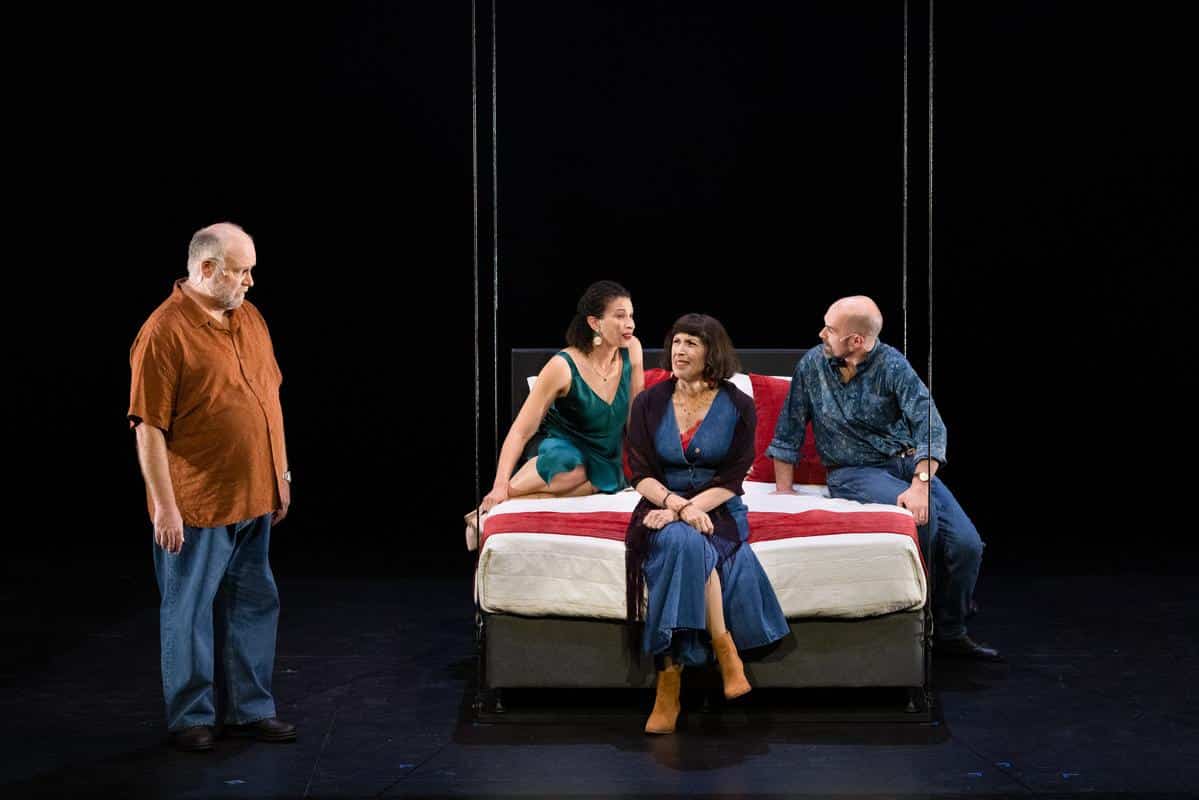


The cast of four who are all WA actors, were a superb ensemble and the stand out performance should go to Matt Edgerton for his seamless shape shifting of his 3 characters in which he was able to delineate so well. They all felt so distinct, real and I especially loved his portrayal of the character of Nick in which he uncovered great depth. Catherine Moore was suitably cast and although she seemed to have a slip up on a line – she handled it like a true professional with the help of Edgerton. Alexandria Steffensen delivered an incredibly naturalistic and nuanced performance and I loved the confidence she chose to give her characters – it was refreshing to see a confident middle age woman portrayed on stage!

Lastly Luke Hewitt who is a stalwart of professional theatre in WA, delivered a solid performance which was undoubtably likeable, relatable and personable – probably why he keeps getting cast again and again. I did feel that some of the cast were mismatched at times and I felt a lack of connection between the characters. Some may say this is the point of the play – how well do you really know someone despite spending your life with them? I would argue though, that lifelong partners undoubtably know each other inside out and have deep connection and knowing despite the fact that they make not want to acknowledge or display that.

Ultimately what is brilliant about this play and why it is an Australian classic is that it gets you thinking about life, relationship and what it all means. Its not purely entertainment (although it delivers on this too) but a vehicle for reflection, change and critical thinking.

I highly recommend jumping on this show before it closes as it’s rare that you get to see such a prolific and talented writer like Bovell, paired with such a brilliant cast. I am very grateful to Black Swan that they make WA writers and Australian stories a priority! Speaking In Tongues closes September 14th.

To book tickets to Speaking In Tongues, please visit https://blackswantheatre.com.au/season-2025/speaking-in-tongues.

Photographer: Daniel J Grant Photography

Spread the word on your favourite platform!

The Real History of The Fairytalers

Fairytalers

Fairytalers Rating

★★★★★

Click if you liked this article

6

Once upon a time, four fabulous French femmes invented the fairy tale. Not the Grimms. Not Disney. The Fairytalers is a high-energy, history-reclaiming joyride now showing at the Meat Market, and it’s everything your glittery, story-loving heart desires. This whirlwind of a show resurrects the nearly-forgotten lives of Charlotte, Catherine, Marie, and Henriette. The original “Conteuses Précieuses”, who spun tales of ogres and enchanted creatures while battling very real societal monsters of their own: convents, towers, scandal, and patriarchy. Writer and director Ellis Austin Finnie takes these women out of the dusty archives and drops them smack bang into the spotlight, where they absolutely belong.

The concept is simple but striking: the women, now deceased, are deeply unimpressed that the Brothers Grimm got all the credit. They’re trying to uncover any mention of themselves in the modern world. What follows is a meta-theatrical, heartfelt, and hilarious retelling of their legacies, peppered with outrageous storytelling, shadow puppetry, paper crowns, and plenty of fourth-wall-breaking sass.

The cast? Divine.
• Emily Farrell is a scene-stealing delight as the flamboyant and witty Catherine D’Aulnoy.
• Janine Kwok brings warmth and cheek to the quietly passionate Marie L’Heritier.
• Olivia Morison’s performance as Henriette de Murat is grounded and graceful, laced with steely elegance.
• Daisy Valerio is luminous as Charlotte-Rose de Caumont de La Force, commanding both comedy and heartbreak with ease.


The minimalist set by Fiona MacDonald is cleverly functional and the cast shift the pieces around like magical stagehands, transforming spaces with ease and energy. MacDonald’s costume work also shimmers with imagination, nodding to both period aesthetics and playful theatricality.

The lighting and sound design (by Ashleigh Basham and Justin Heaton) enhance the fantastical atmosphere without overpowering the performances. The shadow puppetry sequences, tales told in flickering silhouette on a screen, are especially enchanting and add a lush visual layer that adds to the whimsy.

But beyond the sparkle, this show lands an emotional punch. It’s a celebration of the women who used stories as a means of survival and resistance when they had no other power. It asks: Is it better to be remembered by name, or by the impact you made, even if your name is lost?

By the end of the 90-minute journey, you’ll not only know their names, but you’ll want to write them in glitter across the sky.

An irreverent, intelligent, and emotionally rich love letter to the women who birthed fairy tales. Funny, fierce, and just the right amount of feminist rage wrapped in a velvet ribbon. Go see it. And bring a friend who still thinks the Grimms were first.

To book tickets to Fairytalers, please visit https://www.ellisaustinfinnie.com.au/fairytalers.

Photographer: Freya Valerio

Spread the word on your favourite platform!

The Machine Stops

The Machine Stops

The Machine Stops Rating

★★★★★

Click if you liked this article

1

‘THE MACHINE STOPS’
Stage Play adapted by Briony Dunn from the short story by E.M. FORSTER.
Playing at TheatreWorks, St Kilda from 23rd – 30th August, 2025.

All fans of dystopian novels marvel at the predictions George Orwell made in his 1949 novel, ‘1984’ with many of the tech ideas proving to be true today.

E.M. Forster’s short sci fi story, ‘The Machine Stops’, from 1909, did the same thing way before Orwell did, and was then republished in 1928, translated into 10 languages and voted one of the best novellas up to 1965. During this time, the electric shaver, the television and landing on the moon all seemed sci fi to the masses.

In 2025, our modern-day debate heats up on whether Artificial Intelligence (AI) will destroy humanity and there are strong arguments on both sides, but there’s no denying AI systems that surpass human intelligence, or misalign with human values, could potentially lead to disaster.

Briony Dunn, Head of Writing/Directing and Stage Management at COLLARTS, has adapted Forster’s story for today’s stage, directed it, and co-designed the set for this Theatre Works production, along with Set Designers, Betty Auhi and Niklas Pajanti. Pajanti also designed the lighting, whick pulsates creatively, synchronising with the mood throughout the script, strikingly and is both ominous and futuristic.


The story is set in a world where humanity lives underground and relies on a giant machine to provide its needs. It predicts technologies similar to instant messaging and the internet. Forster pointed to the technology itself as the ultimate controlling force.

Both the set and the lighting are innovative and represent well the way the story would have played out in 1909 – or 1928 – and the way we may see an underground world today. The set imposes from the start, floor to ceiling metallic pillars – not quite to the floor – representing the control of the machine and symbolising its instant messaging, its regulatory power over its subjects, with its geometrical sequence on stage, columns lined in order, 4 x 4 presenting the boundaries humans live within, in a secular way. Only a single chair to the right breaks the sequence on stage.

We are introduced to a mother, Vashti, from the shadows backstage, moving slowly towards the light, which I felt could have been more powerful if done in much less time.

Mary Helen Sassman plays Vashti, Kuno’s mother, however they live on opposite sides of the world, both literally and emotionally.

Dunn’s play also realises this point drastically, focusing on the mother and the son, a juxtoposition without physical connection – at first.

Slick screen projections display grey communication between Vashti and Kuno, similar to our “Face-time”.

In Forster’s story, Vashti is content with her life, producing and endlessly discussing second-hand ‘ideas’ and using her work to avoid real in-person time with friends. Shades of social anxiety during Covid came to mind. Fascinatingly, this prediction from over a century ago has become true of some people today, who take clickbait and three-second sound bites from social media as their truth and real news.

In Briony Dunn’s stage play, Vashti is seen to contrast between happiness and habitual loyalty to the machine with a soul destroying, maniacal loneliness that Sassman portrays too well, almost as if she’s become part of the machine herself.

Kuno, played by Patrick Livesey, returns to his mother (and us) with the raw truth – quite refreshingly. Livesey’s performance had the energy of Richard Burton in Gielgud’s 1964 Hamlet, especially with his delivery of this soliloquy…

“We created the Machine, to do our will, but we cannot make it do our will now. It has robbed us of the sense of space and of the sense of touch, it has blurred every human relation and narrowed down love to a carnal act, it has paralyzed our bodies and our wills, and now it compels us to worship it.”

I look forward to seeing Livesey’s future performances.

A particularly clever scene when the machine finally stops and Vashti can no longer press buttons to satisfy her every need, shows Sassman’s Vashti spiraling desperately out of control.

Dunn’s ending is as Forster wrote and her adaptation is just as successful in providing a warning to humanity that its connection to the natural world is what truly matters.

To book tickets to The Machine Stops, please visit https://www.theatreworks.org.au/2025/the-machine-stops.

Photographer: Hannah Jennings

Spread the word on your favourite platform!

Dance Nation: A Provocative and Adrenaline-Driven Dramedy

Dance Nation

Dance Nation Rating

★★★★★

Click if you liked this article

3

Brisbane’s West End is pulsating as a capacity crowd converge upon Metro Arts Centre for Dance Nation, the latest offering from THAT Production Company. How apt, in an area known for its vibrant, multicultural and artistic atmosphere, we are treated to such multifaceted and exhilarating production, which deftly fuses theatre and dance into drama and comedy. Dance Nation follows a teenage dance troupe who aim for bright lights and competitive glory, while negotiating the complexities of young friendship, ambition and self-negation – equally embodying hilarity, hope and even some horror in the process.

The plot centres around a group of mostly female 13 years-old dancers, preparing for a big contest – plied with pressure on their path to success and recognition. However, the competition does not start under the bright lights of centre stage; The dancers must first endure their team’s own internal casting and rehearsal process and preparations – balancing personal ambition against loyalty and obligation to others as they vie for a principal part, bearing pangs of guilt and envy respectively from those chosen – and those not, as friendships hang in the balance.

Notable tension arises dancers Amina and Zuzu, who are both friends and competitors within their team, pitted against each other by Dance Teacher, and arguable tormenter, Pat. Dance Teacher Pat’s presence is un-nurturing, and we feel concern for these young girls (and Luke) for the tough, borderline-abusive discipline he imparts on them – and for his unsupervised access to this young, mostly female team – wondering what else he might be capable of or encourage.


Two of the other girls, Connie and Ashley, experience a more overt experience as targets from misplaced, inappropriate male gaze – from an adult stranger they encounter while awaiting their ride home from practice. While all of these young characters show general bravado, sass and the typical curiosity about sexuality that begins around their age, we watch uneasily how these 13-year-old girls are perceived, rather than protected. We observe Zuzu as her attention is not toward the safer, age-appropriate object of affection – Morgan Francis’s sweet, sincere Luke – toward a far older man who exerts coercive control and manipulation against a group of pre-teens – namely, Dance Teacher Pat, played with conviction by Cameron Hurry.

While touching on darker themes, Dance Nation succeeds by avoiding any gratuity or monotony – and each of the ensemble and supporting dancers bring a dynamic layer to the story. Along with the more dramatic themes, notably exemplified by Jeandra St James, bringing soulful grit and trepidation as Amina, Carla Haynes with calm charisma and dignity as Zuzu, and Thea Roveanu’s contradicting yet truthful blend of vulnerability and aggressive self-protection as Ashlee – there are many hilarious comedic moments, in addition to sincere, affirming and visually stunning ones – which create many of the show’s highlights. Johanna Lyon is a particular standout as Sophia, with superb timing and creative, uninhibited comedic delivery. Aurelie Roque makes her numerous smaller roles big, with instinctive dexterity and playfulness. Jessica Veurman gives a versatile, grounded performance as supportive, quietly assured Maeve, while Janaki Gerard shines with fluid and graceful dance and charming expression as Connie.

All of the performers bring polished energy to an engrossing, balanced script. It takes a lot of preparation to look so effortless, executing creative, complex choreography with seamless energy, in addition to fine delivery of dialogue. The hard work pays off beautifully in Dance Nation, undoubtedly enabled through the efforts of THAT Production Company’s talented Creative Team, led by Director Timothy Wynn. In summary, Dance Nation is a provocative and adrenaline-driven dramedy, where every distinct aspect blends into a textured and highly entertaining whole. The full gamut of human emotion is traversed with humour and unnerving honesty, further punctuated by captivating movement, lighting and sound. Highly recommended.

To book tickets to Dance Nation , please visit https://www.metroarts.com.au/event/dance-nation/.

Photographer: Kenn Santos

Spread the word on your favourite platform!

Subscribe to What's The Show

Reviews, show news and what is on, straight to your inbox.