The multiple award-winning producer LPD Productions is delighted to announce the cast for its upcoming production of How to Succeed in Business Without Really Trying, opening at the Hayes Theatre on 28 August. Tickets are on sale now at hayestheatre.com.au.
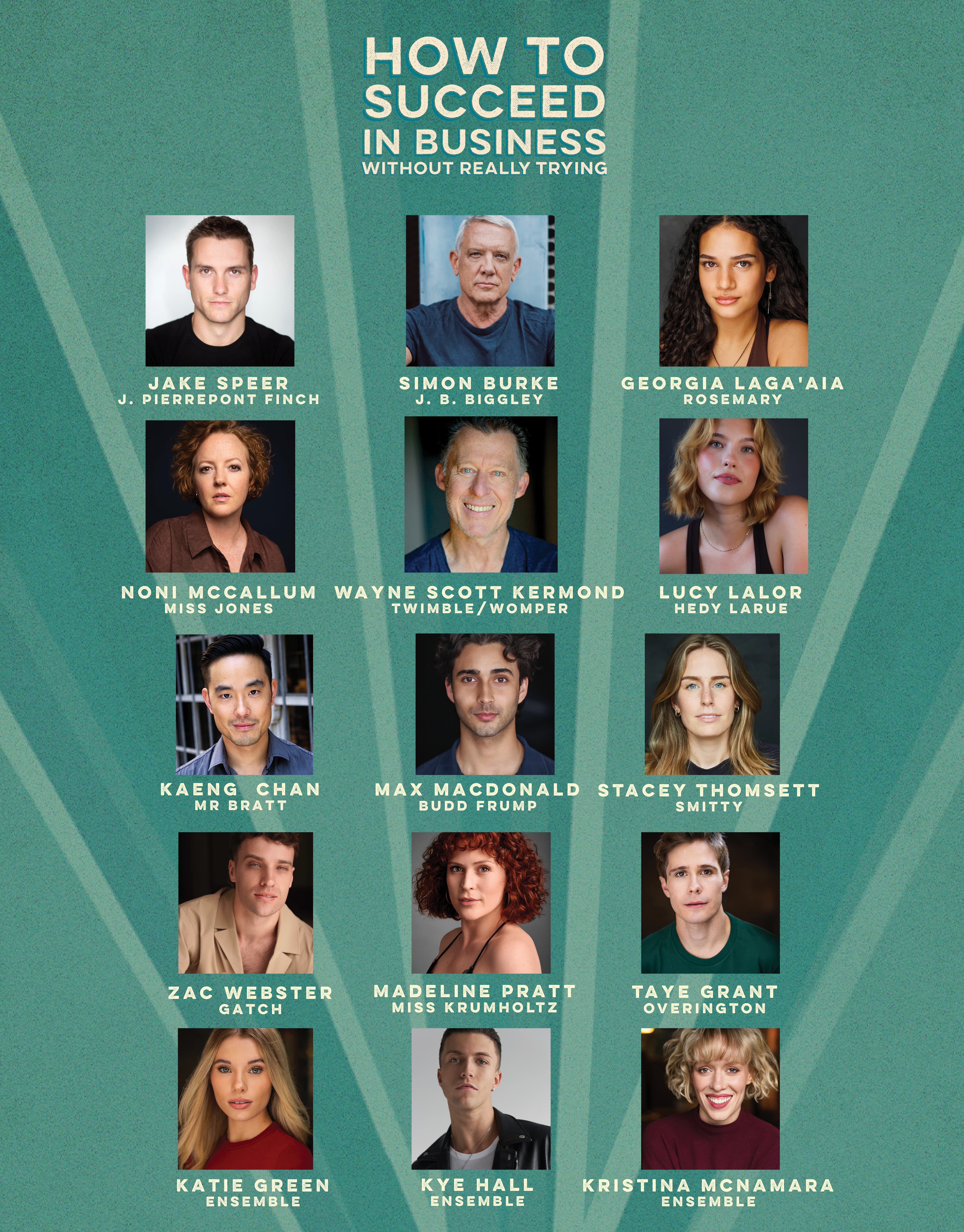
Award-winning director Cameron Mitchell reunites the leading men from his production of Catch Me If You Can. Leading the company is Jake Speer as the ambitious and resourceful J. Pierrepont Finch, opposite Simon Burke as company president J.B. Biggley. They are joined by Georgia Laga’aia as Rosemary Pilkington and Lucy Lalor as Hedy LaRue.
Supporting cast includes Wayne Scott Kermond (Mr. Twimble/Mr. Womper), Max Macdonald (Budd Frump), Stacey Thomsett (Smitty), Noni McCallum (Miss Jones), Kaeng Chan (Mr. Bratt), Madeline Pratt (Miss Krumholtz), Taye Grant (Mr. Overington), and Zachary Webster (Mr. Gatch; also Assistant Choreographer). Ensemble members are Katie Green, Kye Hall and Kristina McNamara (also Assistant Director).
How to Succeed in Business Without Really Trying follows the rise of J. Pierrepont Finch from window washer to executive and features classic songs including I Believe in You, Brotherhood of Man and The Company Way. Score by Frank Loesser; book by Abe Burrows, Jack Weinstock and Willie Gilbert.
Creative team: Producer LPD Productions; Director and Choreographer Cameron Mitchell; Musical Supervisor Damon Wade; Musical Director Kimberley Gilbert; Set Designer Domonic Foffani; Costume Designer Christine Mutton; Lighting Designer Peter Rubie; Associate Producer Kelsi Boyden; Assistant Director Kristina McNamara; Assistant Choreographer Zachary Webster.
Season details: Hayes Theatre Co, 19 Greenknowe Ave, Potts Point. Season runs 28 August to 27 September. Times: Wed–Sat 7.30pm; Thurs 1pm; Sat 1.30pm; Sun 2pm. Prices: Previews from $75; In season Adult from $84; Concession from $75. Bookings: www.hayestheatre.com.au | (02) 8065 7337.
Making brilliant live theatre for small children is tricky, but Monkey Baa make it look easy.
A review of “Where is the Green Sheep?” at The Coliseum Theatre, Rooty Hill.
Small children are the best audiences in the world but also toughest. They don’t clap politely. They don’t pretend to enjoy themselves if they’re not having fun. They will just get up and wander off if they are bored. There was no danger of that during Monkey Baa’s Where is the Green Sheep?
“Where is the Green Sheep?” is a beloved picture book, a modern classic created by Mem Fox and Judy Horacek.
So, how do you adapt a treasured children’s picture book into an immersive visual theatre experience?
You’ve got to think about the size of the stage and the size of your audience. The Coliseum is a very big stage, and the stalls were crowded with hundreds of tiny children, slightly bigger children, and their grown-ups. That means you’ve got to fill that space with wonders. Think big!
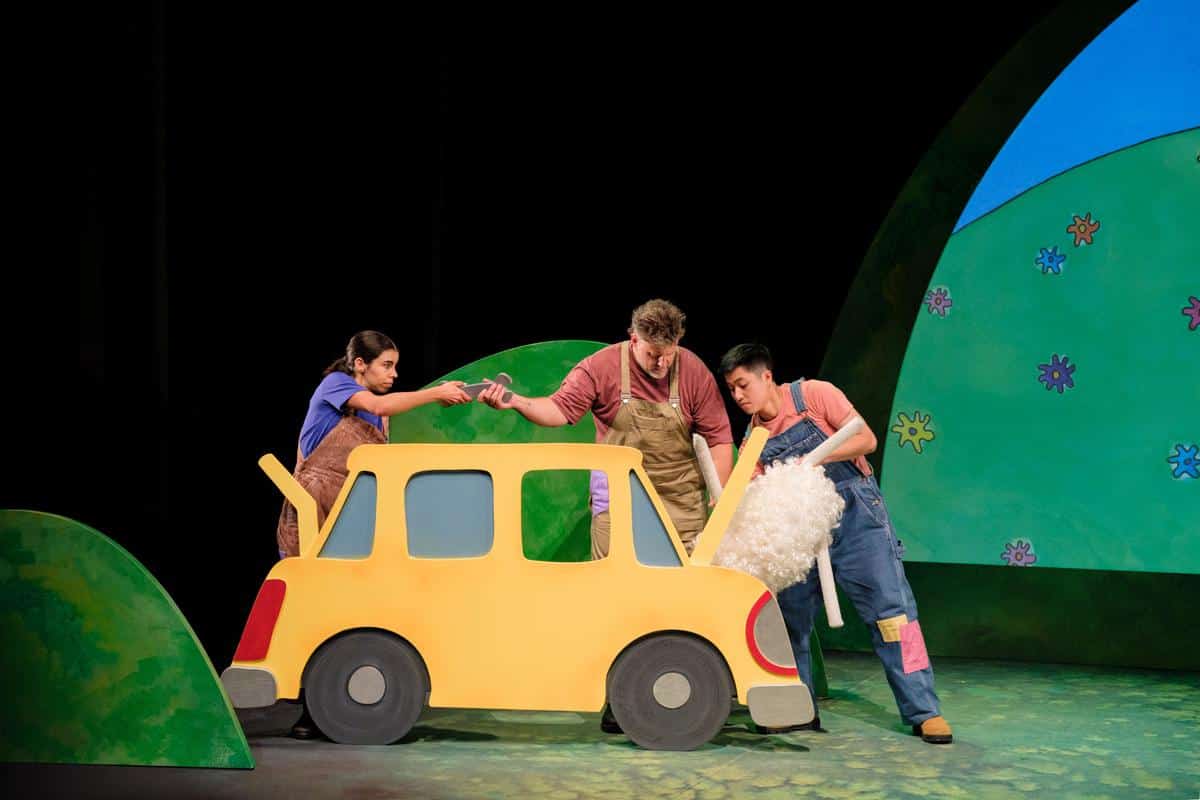
You’ve also got to work out how you’re going to make the audio work. Monkey Baa wisely decided not to mic up any of their performers. Each of the three performers got to focus on puppeteering, dancing, movement and miming. The audio throughout is a bouncy mix of sparkly original music and lines read aloud by children from Bankstown West Public School.
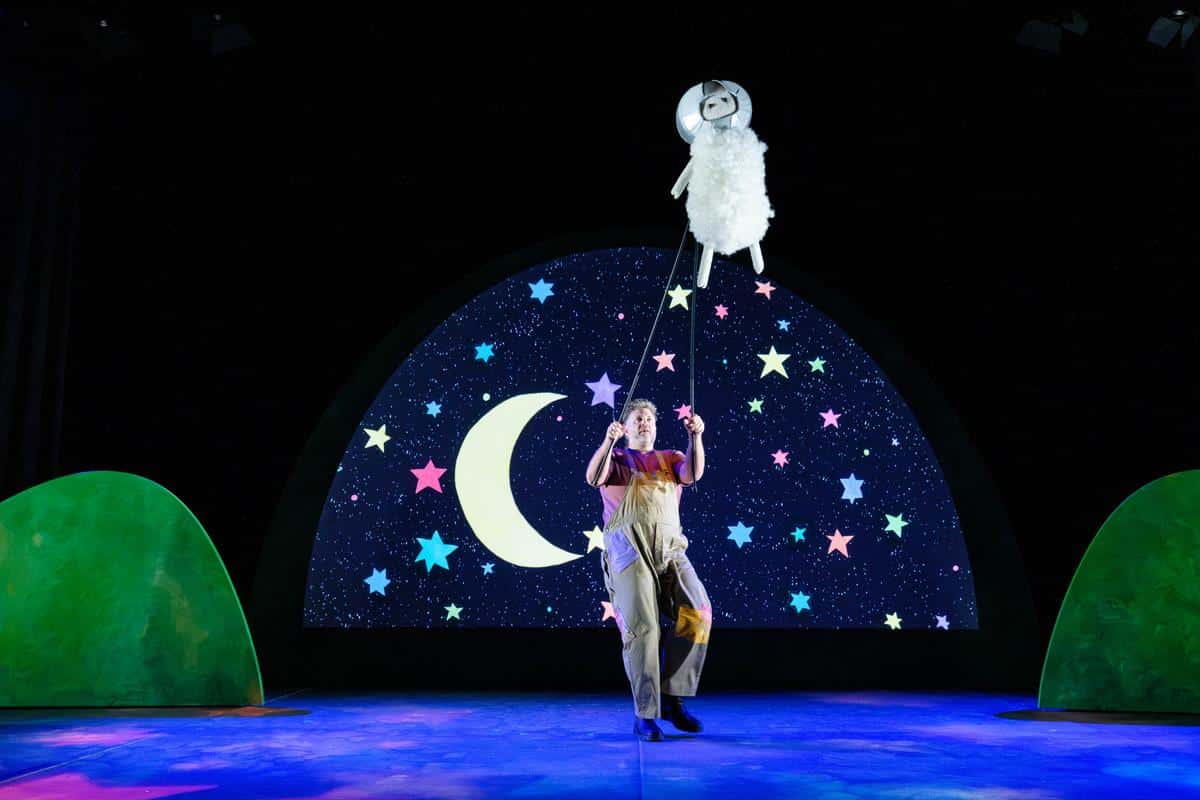
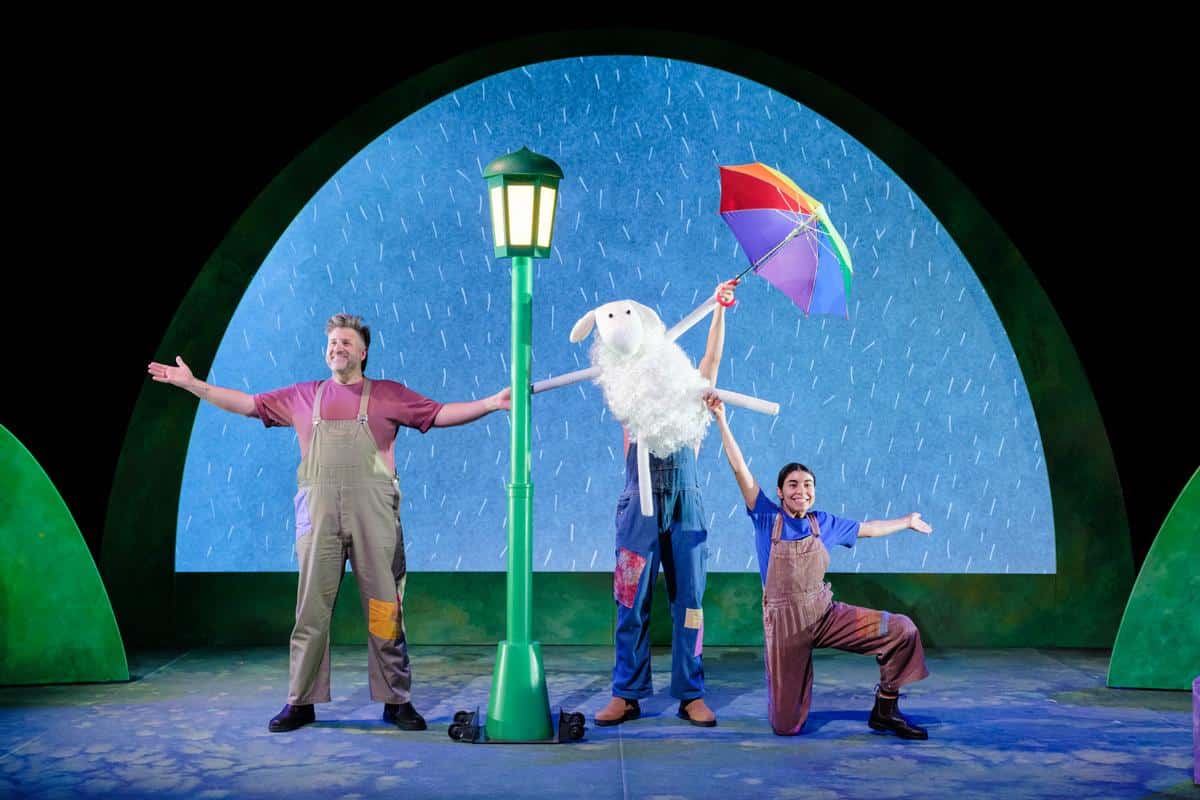
The stage is a lovely green field with round hills and a big arched screen in a hill for projected animations. Colourful props are carried or rolled on and off stage throughout the show.
The big projection screen is a mixed blessing. Sometimes the interaction of the screen and puppets works brilliantly, for example with animated splashes for water for the Bath Sheep.
But it was interesting to watch and listen to the reactions of the children in the audience. Their response switched dramatically between animations projected on the screen and live puppetry on the stage. An animated sheep flying across the screen was watched, like it was a movie in the cinema or an animated show on the TV or a phone. No interaction. Just consuming it like filmed media. The reaction to the real live puppet sheep and live performers was completely different. Happy shouts and interaction, clapping and giggling. The difference was obvious from my seat in the audience.
The animated projections added something beautiful when they enhanced the live puppetry. A live sheep puppet flying a kite on screen. The moon and starry night sky. Rain falling. The interior of the circus tent. This brought the scenery alive. But an animation of a sheep? It’s no longer alive and real.
This was most striking with the Near Sheep and the Far Sheep. The Near Sheep was fully projected on screen, duplicating the pages of the picture book, but with the book, when the Near Sheep fills the page, it does look like that sheep is near to the reader. On the big screen on stage that sheep became the Gigantic Sheep, scaling up bigger and bigger until it filled the whole screen, looming over the three performers like Sheep-zilla.
In comparison the simple effect of the Far Sheep being taken off stage by a puppeteer and up the aisles to the back of the audience in the stalls brought whoops of laughter and instant understanding. The Far Sheep was far away from the people on the stage.
The sheep puppets, made by Kay Yasugi, are fabulous. Big, soft and squishy with some sparkles in their wool that catch the light. The three performers, Ebony Tucker, Michael Ho and Paul Grabovac, are absolutely world class.
Highlights? The Bath Sheep, the Rain Sheep and the Far Sheep.
The simplicity of a performer blowing bubbles was met with a huge cheer of ‘bubbles!’ from everyone and the Bath Sheep, splashing and being dried with a towel had the audience in stitches.
The Rain Sheep is beautiful and colourful, dancing around a lamppost and opening an umbrella, in a woolly tribute to Gene Kelly in “Singing in the Rain.”
Knitted hats off to everyone at Monkey Baa, with special mentions to director and writer for the stage Eva Di Cesare, and puppetry director Kailah Cabanas.
Monkey Baa’s adaptation of “Where is the Green Sheep?” is an absolute delight that everyone will love.
Monkey Baa’s “Where is the Green Sheep?” is touring New South Wales, Tasmania and the ACT. https://www.monkeybaa.com.au/shows/where-is-the-green-sheep
The Complete Works of Jane Austen (Abridged) Rating
★★★★★
Click if you liked this article
It was a fast forward and rewind enacted synopsis of Jane Austen’s plays from go to woe on the opening night. The audience was in for a charming, funny and rapid view of Austen’s women and men outlining the stupidity of Regency society through to pointing out that for most women of that era, it was ‘marriage or poverty’. Definitely read at least a couple of her novels for her ironic view and wonderful language on family and economic values. Best of all, the play is about real sisterhood and friendship through trials, tribulations and at times love and hope.
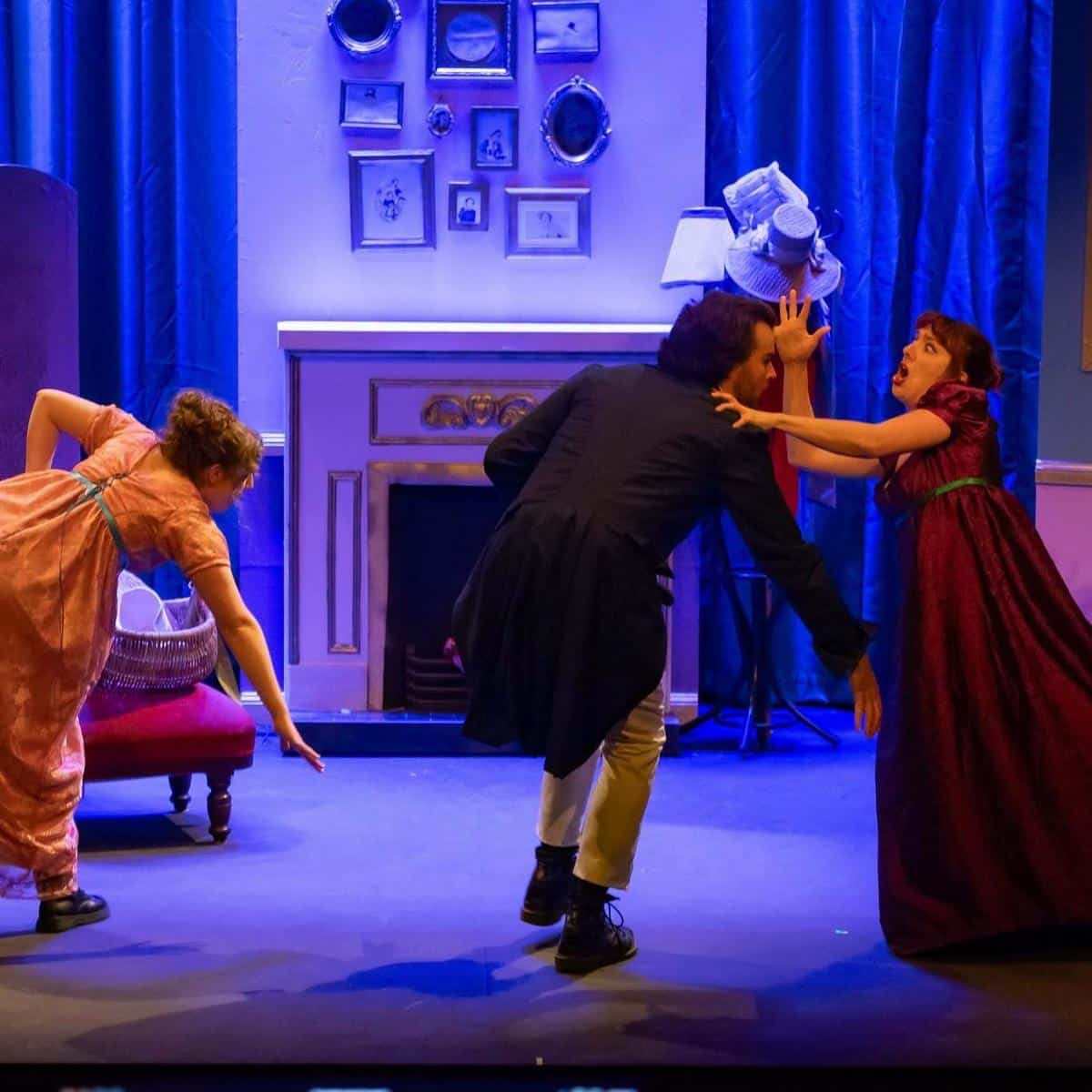
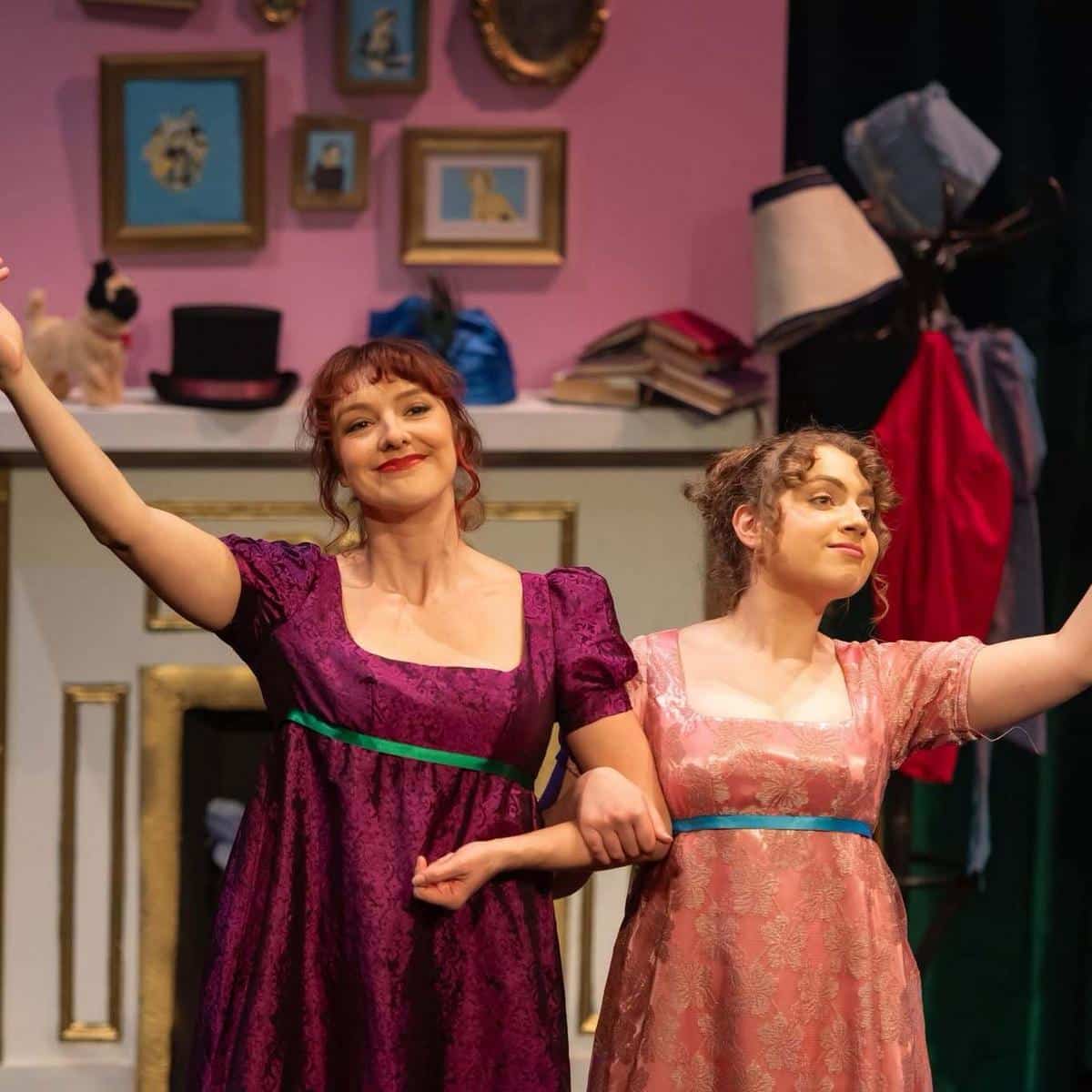
The set was a cartoon version of a Regency living room with the obligatory chaise lounge. Heidi Jilwan and Georgia Britt set the scene, breaking the ‘fourth wall’ and addressing the audience. Wearing Empire style dresses, bonnets and hairstyles they set to debating which was the best novel. As the audience settled, the immediate problem of a missing leading man was solved by a willing replacement actor ‘from the audience’.
Enter the actor, Peter Hoekstra-Bass, who quickly highlighted that he didn’t have a clue about Austen’s work but ‘needed the gig’. This was wonderful for any audience members who equally hadn’t had any information or who had only watched the television series, Bridgeton.
The ensemble had a great natural chemistry as if they were all best friends. Each actor portrayed different characters in the book with asides to what their modern personality really thought.
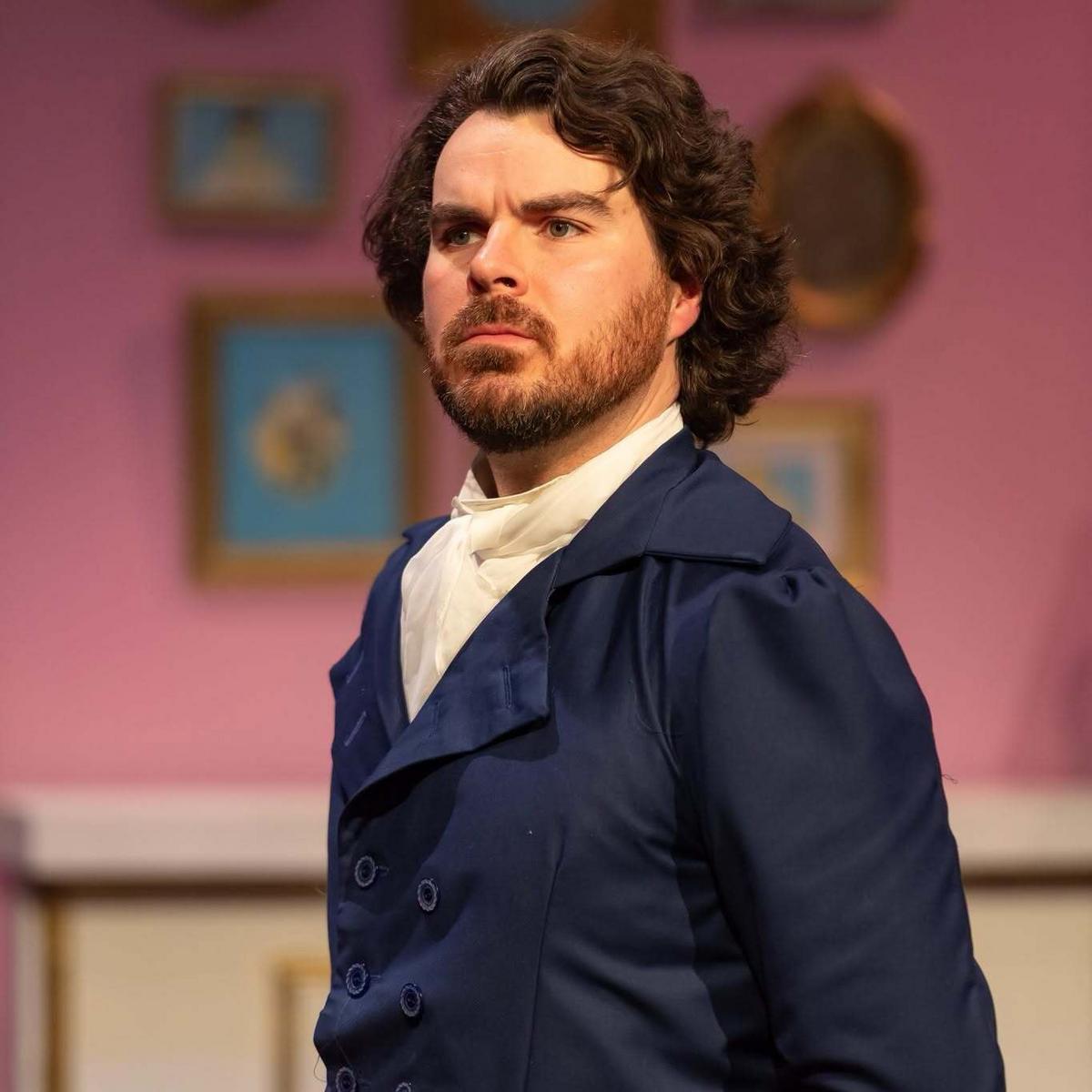
Bonnets and top hats were used to depict new characters and each actor changed style and attitude depending on the book. Peter was at times, convincingly dashing as Darcy or painful as a parson clumsily professing love. Both Heidi and Georgia were witty, ditzy and lovestruck as each female character came alive with explanations to Peter why women reacted to the wrong man at the wrong time and how long self-reflection takes before they realise with whom they should be in love. Peter was both wonderfully bewildered and superb when putting on a hat altered his persona and posture.
Heidi and Georgia were convincing as best friends who were trying to understand Austen’s view of women, marriage and what choices they could or couldn’t make.
Through Ali Bendall’s tight direction, the messages and wit of Austen came out quickly as each farce, family and affair were rapidly thrown out to the audience to make of it what they would and adding modernisms and comparisons to modern love and female issues. This could be frustrating at times with clunky text and perhaps breaking the fourth wall too often. The audience laughed and clapped as the cast pushed us along to make sense of it all and it really didn’t matter anyway as Austen herself, through the character of Charlotte Lucas in Pride and Prejudice, said, “We are all fools in love.”
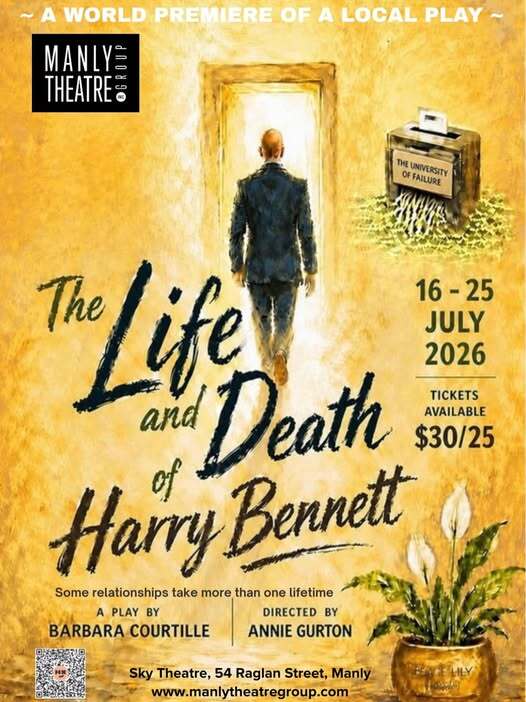
A review of “The Life and Death of Harry Bennett” at The Sky Theatre, Manly.
Play Title: The Life and Death of Harry Bennett Playwright: Barbara Courtille Director: Annie Gurton Venue: The Sky Theatre, Manly. My Rating: ⭐⭐⭐ / 5
“The Life and Death of Harry Bennett”, by local playwright Barbara Courtille, tells the story of Harry Bennett, a celebrated investigative journalist who has spent his life trying to be the best by telling the personal stories of others. A strange encounter leads him to having to face his own story as he finds himself being led through the unknown by unsympathetic mystical beings. Whilst he is being encouraged to complete the unfinished business of a lifetime, this production provides the audience with a surreal and humorous look into the world of the beyond and the true meaning of life. On walking into the endearingly traditional proscenium-arched theatre, one is struck by the Manly Theatre Group’s professionalism, creativity, and community warmth. Relaxation and anticipation begin immediately.
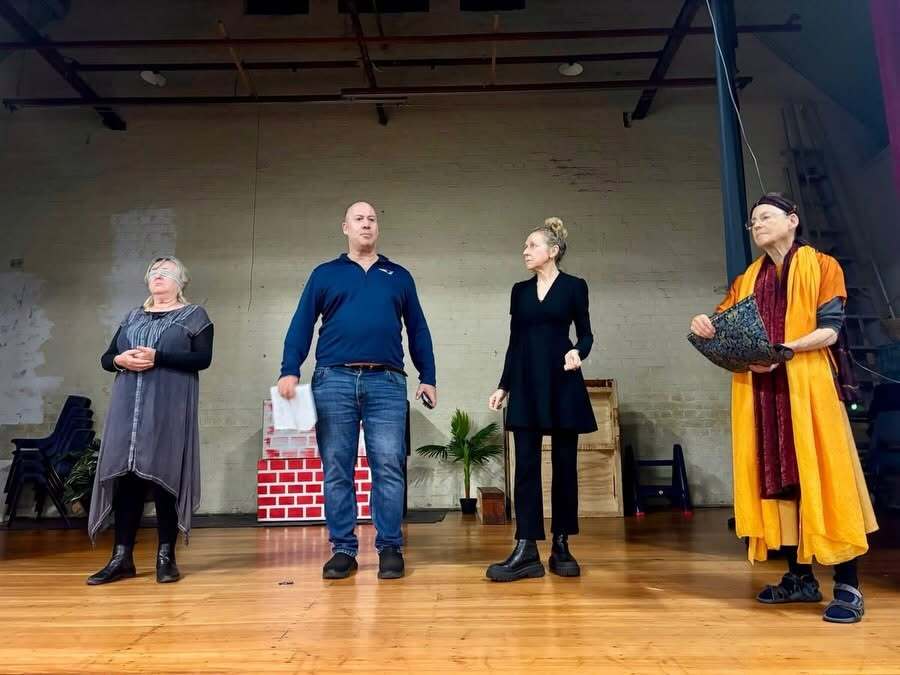
Professor Plimpt, played by Phillipa Coleman and Harry Bennett played by John Cross, opened the play with immersive energy and flare. Phillipa held us with her character believability and presence, and John’s commitment to role was top notch. The strength of this opening scene engaged and delighted the audience and set the tone for the unfolding of this amusing and complex tale. The Mother, Plants, Automaton and Yoga Teachers played by Liz, John, Dharma, Maureen, Sophia and Jessica, embodied their roles with presence, nuance and commitment. Working as a cohesive unit the story’s complexities unfolded through the focus of each player in their role.
The stage of this glorious little theatre was utilised to great visual effect to create a minimal set that was successfully ambitious, fitting the space as well as the theme of the story. The strong, artistic, surreality of this story was creatively emulated through the costuming (or lack there of!) and prop design which was a delight to encounter for each character and scene; respectful nod to the designer and creator of the giant shredder and other seemingly impossible visual creations. Whether being surprised by the entrance of a fruity bike, empathising the need for tumeric-coconut chai over a speedy entrance into work or wondering at the prowess with which each performer wrangled their numerous and often bulky props the fullness of the creative design of “The Life and Death of Harry Bennett” will delight your interest.
One must also note the lighting and sound design which immersed the audience in the strangeness and clarity of this quirky tale.
Overall, this production is a viewing that will make you laugh and wonder. It is perfect for fans of comedy and the surreal and will leave you thinking about how one chooses to live their life, remind us that overwatering plants can be fatal and that maybe OH&S really is a necessity to manage life’s risks.