The Last Witch

The Last Witch

The Last Witch Rating

Click if you liked this article

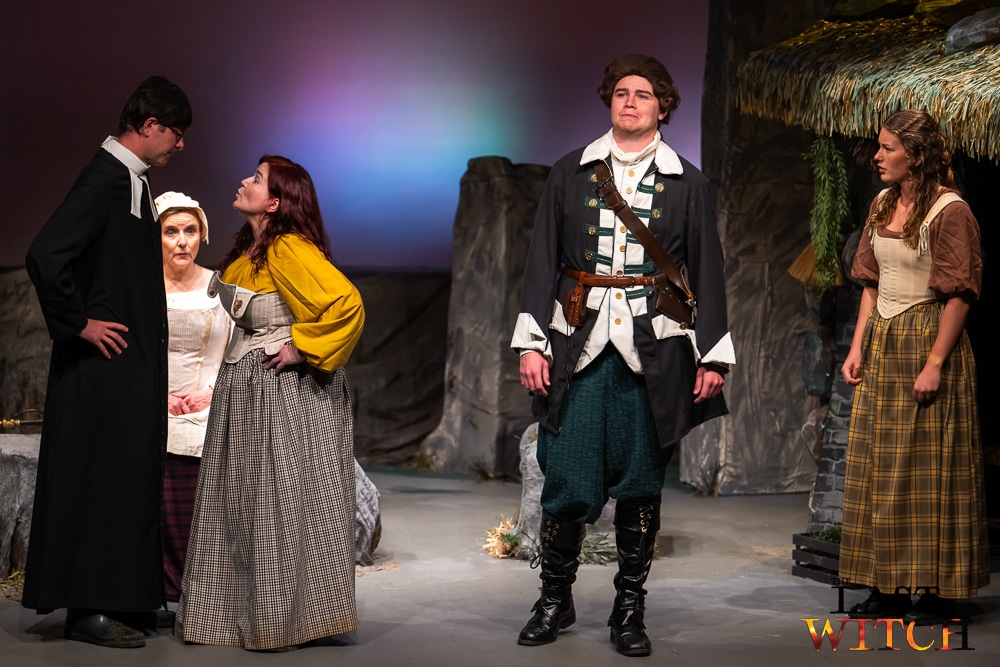
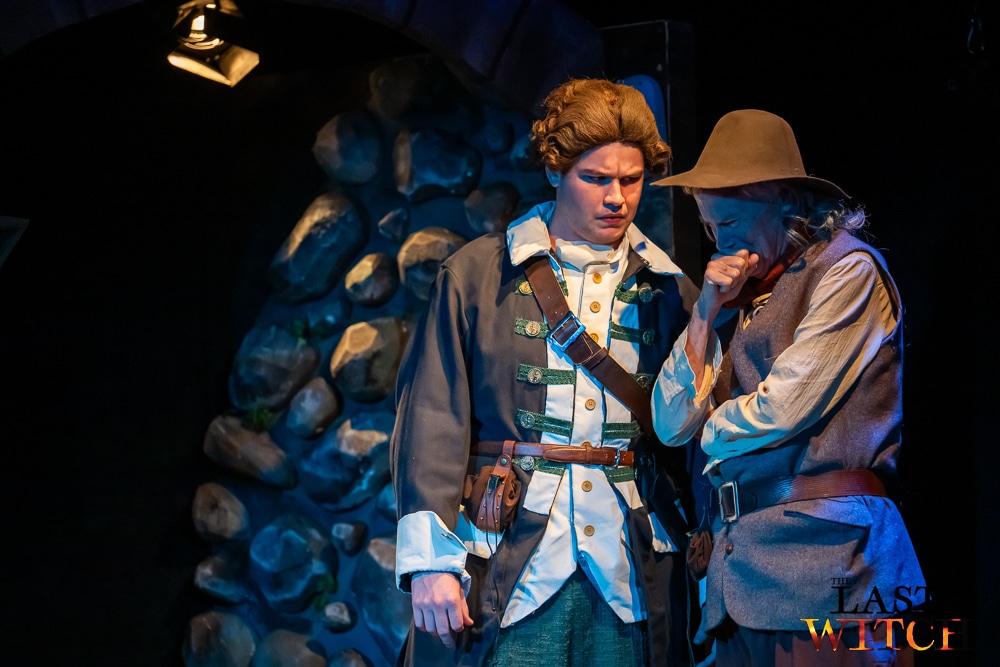
A compelling blend of historical fact and supernatural mystery, Rona Munro’s The Last Witch is a fictionalised account of the last woman to be officially burned for witchcraft in Scotland. Through the fiery clashes between Janet Horne (Paula Searle) and Dornoch’s spiteful new sheriff Captain Ross (Toby Rowe), The Castle Hill Players’ rendition of The Last Witch explores the dynamics of social power between men and women in the 18th century and presents a cautionary tale of what happens when two equally intemperate people with the power to cause harm refuse to back down.

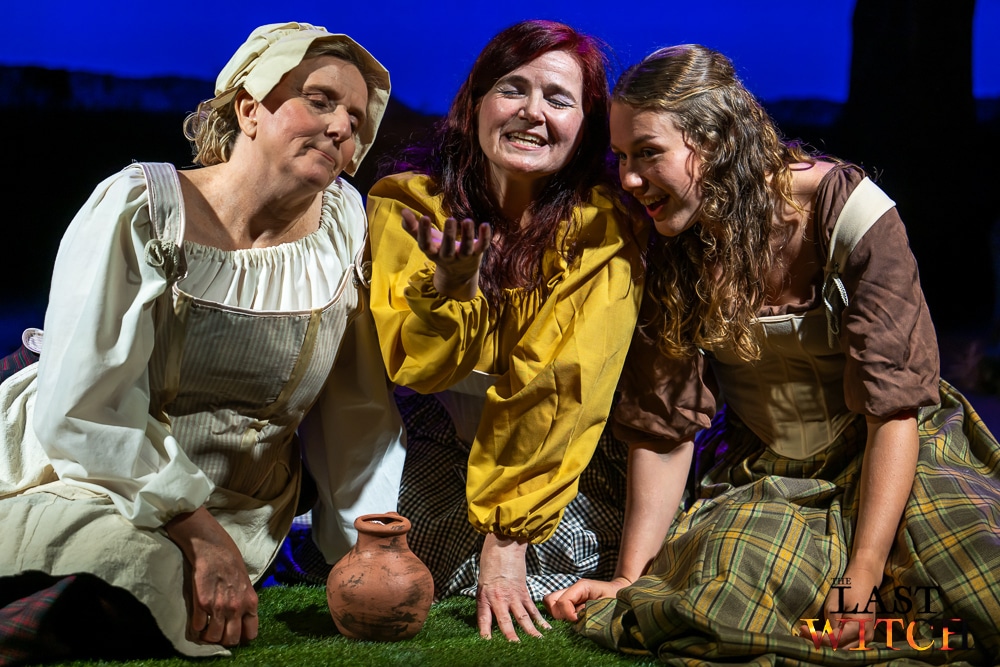
Paula Searle is an electric presence onstage, capturing Janet as both woman and myth through stunning monologues and sometimes shocking interactions with other characters. She has two brilliant moments in Act I that I believe summarise her character; when Captain Ross first visits her cottage to investigate, she easily gains the upper hand in their conversation and evades his questions, acting as though she is about to deny the accusations. She then offers to read his palm and divine his past, a blatant act of witchcraft and a ridiculous escalation of the situation. Later on, in a lovely but misguided moment of emotional connection, Janet comforts Helen and her friend/neighbour Elspeth Begg (Penny Johnson) in their hunger by drugging them with a hallucinogenic herb to make them believe they have access to food. I loved this little show of Janet’s strange ways of caring, and I also loved the (perhaps accidental) nod to a popular Salem witch trials theory.
Janet’s constant contradictions make it almost impossible for the audience to form a solid opinion on her. Is she really a witch? Is she even really all that much smarter than the daughter she derides? Perhaps only Janet could give a definitive answer.


The play’s opening night brought a stunning set design of sprawling grass and weathered stone structures, polishing off the scenes with a perfect use of lighting and sound alongside an admirable commitment to Scottish accents. I particularly enjoyed the slow shifting of an aurora borealis as Janet cast her opening spells, the orange glow of the stones underneath Janet’s stake, and the simplicity of spotlights becoming a full moon for Janet’s daughter Helen (Chloe Overeem) to take her own first steps into magic.

Hidden beneath the sordid tales of seduction, ego, and the haunting presence of what could be the Devil himself, The Last Witch is a simple story of the enduring strength of everyday women. The male characters pop in and out of scenes, delivering powerful sweeping statements that completely change the lives of Janet, Helen, and Elspeth, but the relationships forged from powerlessness between these three women ultimately become powerful enough to stop Captain Ross’ path for vengeance and end the cycle of violence before it sweeps beyond Janet.

To book tickets to The Last Witch, please visit https://paviliontheatre.org.au/the-last-witch/.

Photographer: Chris Lundie

Spread the word on your favourite platform!

The Graduate

The Graduate

The Graduate Rating

Click if you liked this article

3

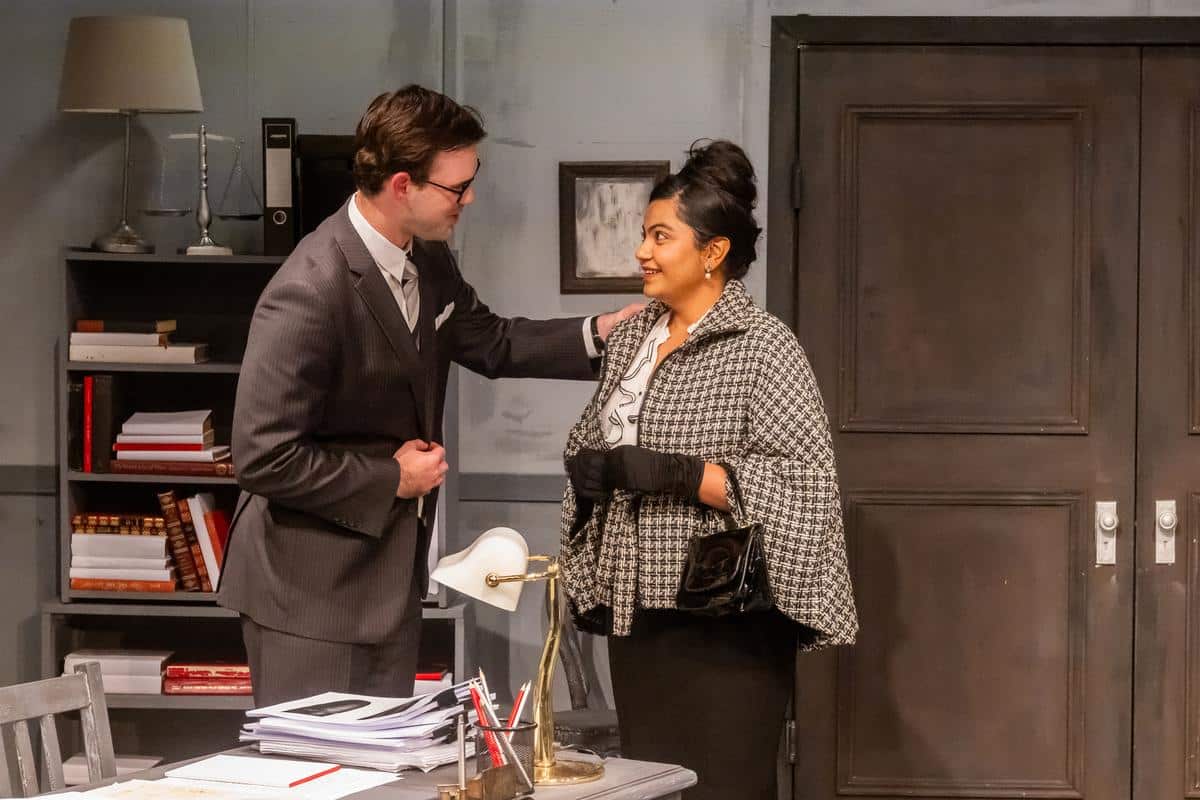
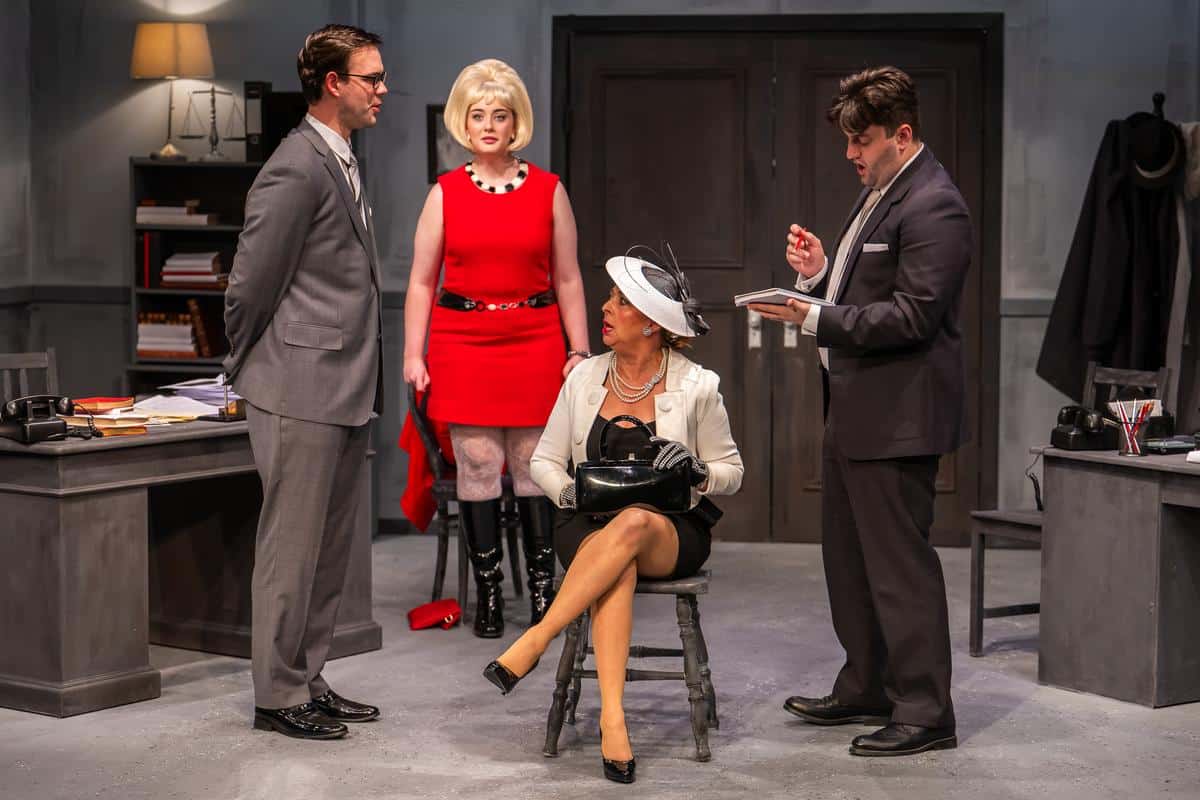
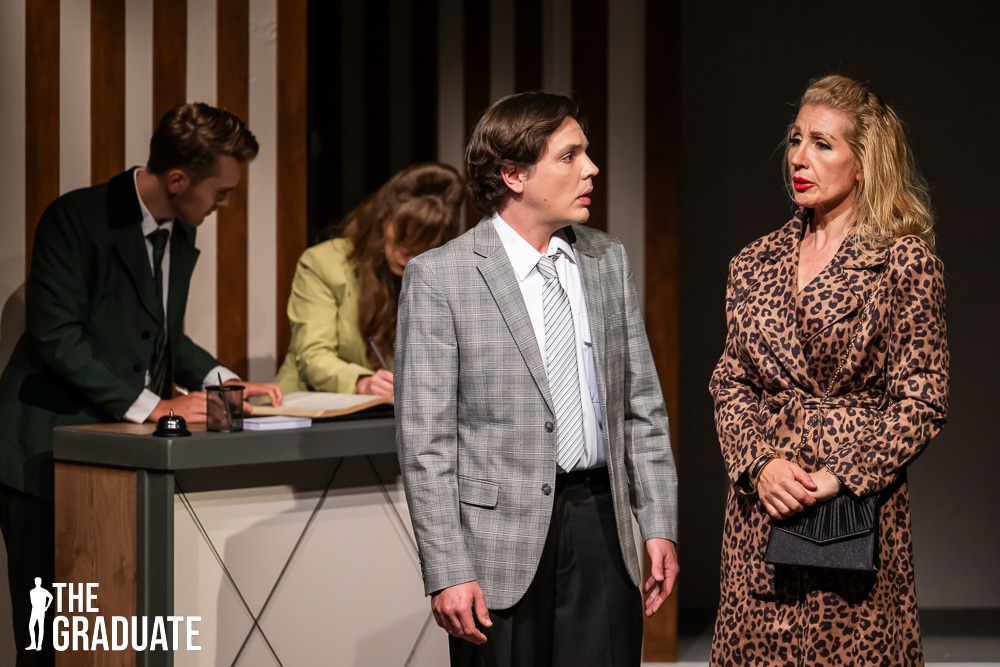
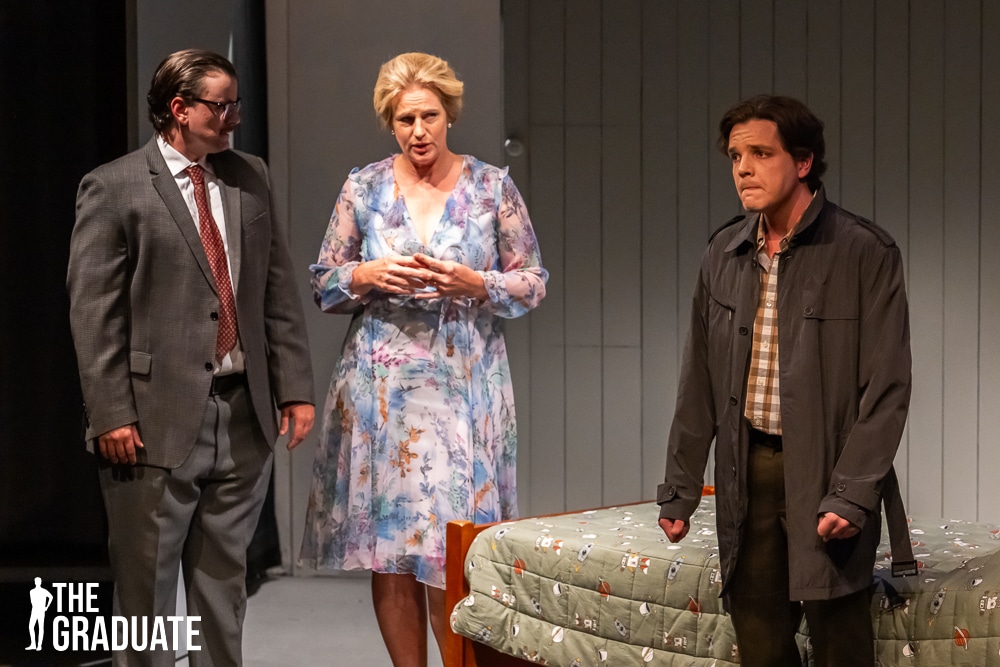
A comedic stage adaptation of the infamous coming-of-age story, The Graduate follows wide-eyed and woefully awkward Benjamin Braddock (Mitch Doran) as his Beat Generation ennui clashes with the exacting and often contradictory expectations of the adults around him. His search for meaning spirals out of control when he is lured into a disastrous age-gap affair with Mrs Robinson (Margareta Moir), “the most attractive of all [my] parents’ friends,” going from bad to worse when he instead falls in love with Mrs Robinson’s daughter, Elaine (Brooke Salisbury).

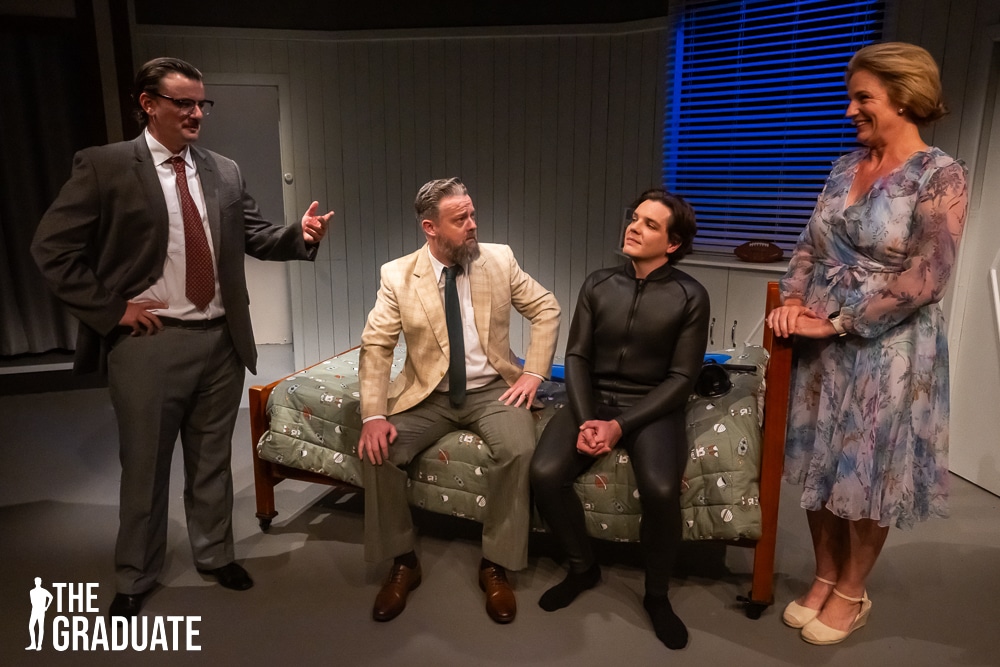
The production opens with a striking scene that sets the tone for the rest of the show; a young man, Benjamin, sits on what is clearly his childhood bed in a full wetsuit and snorkelling kit, breathing heavily into the snorkel as sounds of a party echo in the distance. His father, Mr. Braddock (Brendon Stone) enters and demands that Benjamin parade downstairs in the wetsuit so that all his work friends can admire the expensive graduation gift, creating an immediate and hilarious contrast between childhood and adulthood.

The wetsuit is more than just a fantastic opening joke. The costuming in this production has been carefully curated to visually demonstrate the show’s themes. Each character has been assigned a colour palette, serving as constant reminders of the power imbalances that drive the narrative. Mrs. Robinson is always seen in striking reds and glamorous blacks with pops of leopard print and glittering diamonds, while Elaine’s youth and innocence is highlighted by her palette of crisp white and classic blue with moments of green. Benjamin’s bumbling nature is demonstrated by his ill-fitting brown suit jackets, contrasting terribly with the converse shoes he dons that make him seem even younger.


The sets and lighting for this production are incredible. The stage transforms into multiple bedrooms with lush blankets and headboards, historically accurate furniture, and windows with intense orangey/yellow sunlight streaming through, alongside a hotel lobby complete with a lift, a strip club, a psychiatrist’s office, and a church. Benjamin spends his time onstage stumbling between these sets and flopping onto these beds, never resting for more than a few moments before another character comes barging into his space to command or manipulate.

I also particularly enjoyed watching the relationship between Mrs. Robinson and Elaine develop on-stage. Moir and Salisbury were able to present brief flickers of similarity between mother and daughter (beyond the obvious shared boyfriend) that shone through their notable differences, adding an interesting layer of complexity to an otherwise farcical story.

The Graduate presents the prickly awkwardness of young adulthood, showcasing Ben and Elaine’s fumbling attempts at playacting as adults despite knowing nothing of life beyond a school routine. The Castle Hill Players have taken a 1960’s fable and wonderfully applied it to a 21st-century audience, lifting a timeless and universally relatable experience of one’s early 20s from an American suburbia at the height of its conformist culture. Whether reminiscing on early adulthood or currently experiencing it, The Graduate has something for everyone.

Please be advised that this production contains partial nudity and adult themes.

To book tickets to The Graduate, please visit https://paviliontheatre.org.au/the-graduate/.

Spread the word on your favourite platform!

Elderberry and Eulogies: Arsenic and Old Lace at The Pavilion

Arsenic and Old Lace

Arsenic and Old Lace Rating

Click if you liked this article

The Pavilion Players have a specialty. And that specialty, very proudly, is murder mysteries. Easy to produce, easy to sell, and easy to follow, they are the classic choice for smaller theatres. Steve Rowe, however, in his production of Joseph Kesselring’s Arsenic and Old Lace takes that tired structure and turns it completely on its head, as well as pulling some of the most interesting performances I’ve seen in recent memory out of Sydney’s community theatre scene.

The production value at The Pavilion tends to be completely off the charts. Clearly this theatre has the stock to use and cash to burn as they create a lush and busy World War Two Americana household. Chris Lundie, Belinda Rowe, Steve Rowe and Mia Rowe have worked as a concentrated team to take us firmly into the world of this play, all the while giving the actors plenty to play with. This is not the minimalist world of inner-city Sydney. Steve Rowe understands the stylistic necessity of Kesselring’s writing, and dutifully follows it. Lighting and sound (James Winters and George Cartledge) , though less glamorous than their on stage crew counterparts, give us an immersive experience that doesn’t distract us from the onstage happenings – although both had brief moments of jumping cues.

The play follows the Brewster family, a lineage of genuine nutjobs as they navigate the territorial struggles of every family, although with slightly higher stakes. It’s this fact, and the moral questions the play quite cleverly asks, that takes this production proudly out of the world of its predecessors. Instead of being a whodunnit, we follow a whohasn’tbloodydunnit, which allows the black comedic aspects and psychological performances the cast is clearly ready and rearing to produce to shine.

And shine they did. Brett Watkins takes the stage as Mortimer Brewster, the closest thing to a protagonist in this show; and yet, Watkins both investigates the comedy and charisma of Mortimer, whilst allowing him to be a quiet but ever present sleazeball in the way he often seems to rally against. Watkins is an excellent performer, a strong physical comedian and an excellent reactor, taking his time on stage to fully explore the thoughts and emotions he works through in every moment. A particular favourite moment in this regard was watching him deal with the mere knowledge of a dead body in the room, and the Uta Hagan-esque almost three minutes of silent panic and exploration of the space Mortimer goes through as he figures out what to do. I was looking for slightly more weight behind some of his lines, especially as the stakes began to rise, but with the comedic tone of the piece, I’m more than happy to forgive it.

Kate Mannix was an utter standout. Delivering a performance that reminded me starkly of Sophie Thompson’s Monica Reed in National Theatre’s Present Laughter, she struck a truly capital balance between understated and sophisticated comedic performance and genuine emotional intelligence on stage. She also perhaps was the most believable performer in her grief and anger, exploring subtler ways to perform them whilst still acknowledging the sheer size of the theatre she’s in. Her ending became wonderfully satisfying in the knowledge that someone so delightful was going to get away with something so horrible. Truly, no notes.


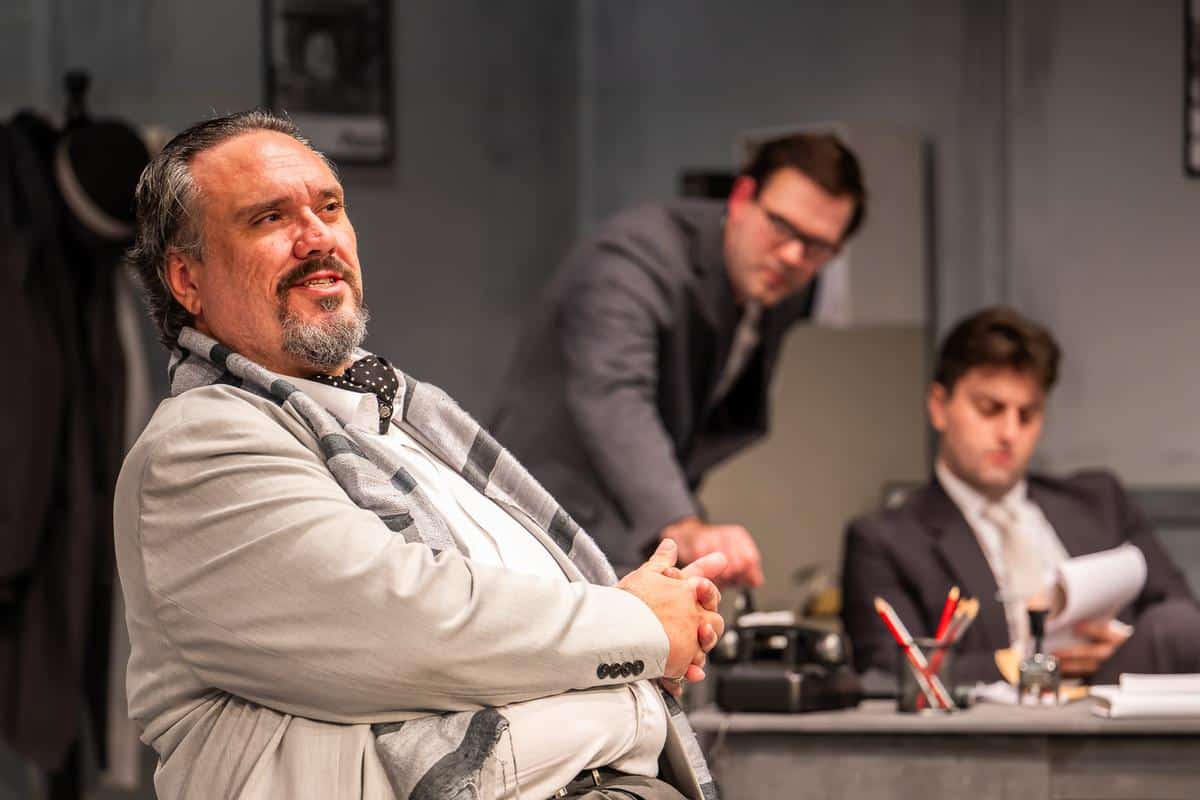
Another stand-out of the night was Thomas Southwell as Jonathan Brewster. Meeting the very lanky, very shy actor in the foyer, and having watched him perform before, one wouldn’t expect Southwell to shine so brightly in such a strong and demanding character role. But Steve Rowe’s masterful direction and the magic of prosthetics utterly transformed Southwell into a grinning, violent, leering super-star of a character actor. Southwell’s vocal work was delicious, quite literally snarling and growling at the other actors on stage with him. His physical work was equally impressive, going from almost a Frankenstein’s Monster-esque lumber to an animalistic explosion of movement as he launched himself around the stage. Proudly embracing his jealous ambition and searing bloodlust, Southwell’s Jonathan created the stakes of the play almost singlehandedly. My advice to him in the foyer still stands here as I write, he should play parts like this for the rest of his life.

Jem Rowe was similarly enjoyable. With a history in character roles, Rowe leaned heavily into the stumbling, Germanic, comedic sidekick to Southwell’s brutality. However, one could easily see this role slipping into something slightly one note. To this, I commend Rowe. His work to keep the character sympathetic through his obvious discomfort in the level of violence being committed contrasting with his sycophantic loyalty to Jonathan combined into something addictively watchable. The two had excellent chemistry on stage, and his work improved in every scene he was in.

Margaret Olive as Martha Brewster was also very charming. Her comedic sensibilities and chemistry with her sister made her very entertaining to watch and root for. Both of the Brewster women were strong in their use of tempo, which made scenes between them very believable and interesting, although I was missing the vocal strength of her sister. Myles Burgin as Teddy Brewster showed an admirable commitment to the role, and had great instincts for slapstick – although his role didn’t allow him to explore much beyond this. Emma Lebeuf as Elaine Harper was very likeable, a strong female character in her own regard. Although I wanted a little more adult seduction from her, her chemistry with Watkins was very clear, and she leant into the style of the play successfully.

The ensemble gave entertaining performances across the board, and populated the room nicely. At times, this began to lean into caricature, but with the style and era, this must be blamed on the script rather than the actors themselves. The performances across the board may have been lifted by a stronger commitment to play to the objective rather than the comedy, and some actors struggled with comedic “traps” or the repetition of a bit to create laughter rather than strictly earn it. However, for what is admittedly a little bit of a weird play, the neuroticism of the family, the performances of the cast, the production value of the crew and the overall chemistry between the entire team makes this show infinitely likeable. The production sits at a strong intersection between inventive and nostalgic, and is a powerful start to the Pavilion Players’ 2026 season.

To book tickets to Arsenic and Old Lace, please visit https://paviliontheatre.org.au/arsenic-and-old-lace/.

Photographer: Chris Lundie

Spread the word on your favourite platform!

Sultry, Sticky, Smoky: Sherlock Holmes And The Adventure Of The Elusive Ear

Sherlock Holmes And The Adventure Of The Elusive Ear

Sherlock Holmes And The Adventure Of The Elusive Ear Rating

Click if you liked this article

2

For a book series that came out in the very late 1800s, Sherlock Holmes has not yet failed to capture the minds of the public. Something about that wise-cracking, pipe-smoking, genius detective can’t help but keep his audience on the edges of their seats. And yet, much like Shakespeare, Sherlock runs the very real risk of being done to death. The character has been adapted, and adapted again, and again, and again, well over twenty-five thousand times. So what makes the Pavilion Players production of Sherlock unique? One simple, and yet deceptively elusive reason for the average Sherlock production. It’s funny.

The name of the game for director Paul Sztelma was stylistic cohesion. The script, in its rawest form, doesn’t offer a whole lot in terms of emotional growth or nuanced performance – and if the performances and production value weren’t presented in a very specific way, the audience would’ve eventually noticed. In a less competent team, this would’ve been an all too easy pitfall to trip into. But Sztelma fundamentally understands what he can and cannot do with the script, and so, does not ask his cast and crew to move his audience emotionally. Instead, Sherlock Holmes and the Adventure of the Elusive Ear, presents us with a kitschy, high-camp production more similar to Noel Coward’s Present Laughter than BBC’s dark and gritty Sherlock. By heartily embracing the style of the play, the production evades both the boredom of its audience, and my usual questions as a critic: “What’s the point of the show?” Does it matter? “What was the journey of the characters?” Who cares? The point, put simply, is that it’s good fun to watch.

The other defining choice that this production makes, once again setting it apart from its peers in private detective-ing, is that this production is… hot. It’s not unusual for Sherlock adaptations to make the character borderline asexual, so obsessed with cracking cases that he never really has the time to be human, nor debase himself with such pitiful things as impulses. But Sztelma’s production, and subsequently his entire cast, remind us sharply that these are all smart, obsessive and attractive people locked into an apartment for months at a time, often drunk or high. Which can only mean one thing. By allowing for the sensuality of the characters, Sztelma also allows the cast to explore their relationships on stage beyond the superficial. Although the show is built for fast-paced comedy, when scrutinized closer, it was clear that the characters did have legitimate history with one another, and we could see it behind every one of their interactions.


These two things combined into more than the class act performances on stage. Upon curtains opening, we were presented with the maximalist wonderland set-building of Abby Bishop and Sztelma. Dark burgundy red walls littered with trinkets and easter-egg props worked as a collective to transport us into the style and world of the piece. It also did much of the work in grounding the production, giving us a tether to reality that the cast could not do lest they break that delicate stylistic framework. Production continued to impress, with James Winter’s lighting design supporting the work happening on stage without committing the sin of being distracting, and Chris Harriot and Sztelma’s (the guy did everything) sound design nailing both being light, crisp accents and rock and roll needle drops when required. Costumes by Annette Snars and Jennifer Hurst elevated the piece once more, whilst joining the set in grounding the piece in reality.

Thinking back on this show, and specifically its performances, my mind is drawn much to the 1985 movie Clue, in its shared performance principle of unabashed commitment to character. Standouts of the night in this regard were Brendon Stone’s John Watson, who was both a brilliant physical comedian and retained the dry humour and littered emotional outbursts necessary for an English comedy, and Ben Pobjie’s Oscar Wilde, who gave us a fabulously homoerotic, Tim Curry-esque, pretentious, sensuous performance that stole many a scene for the better. Ben Wheeler’s Sherlock Holmes was delightfully foolish, which made his glimmering moments of intelligence all the more enjoyable, but I was looking for him to relax into the style of the show here and there. Nicole Hardwood’s Irene Adler was a sharp wit undercutting the fat of the egos of the men around her, an impressive badass from start to finish, although I would’ve been interested in seeing her work through each thought slightly more. Oscar Baird’s Vincent Van Gogh was wonderfully neurotic, and his commitment to flinging his body across the stage was something that both impressed and terrified me slightly – I only wished for moments of vocal dynamic shifts, to explore the different ways he could explore that neuroticism. Holky Bramble as Marie Chartier presented an entertaining and seductive antagonist, and was a lovely folly to Irene Adler, though would’ve benefitted from a more intimidating edge, especially as the daughter to one of the most famous villains in written history. As a cast, all six were virtuosos of comedic timing and playing to the benefit of the text, without needing to overperform the comedy – a rare skill set. The fight choreography was fast-paced and fun, not necessarily adrenaline-inducing but I don’t believe it had to be. Across the board, all actors were also fantastic at keeping themselves busy on stage, and never was my eye drawn to someone who was standing on stage zoning out. On a script level, Adler and Chartier’s moments of feminist uprising were a little benign, especially as Adler did almost all the domestic work in the text, and yet I can’t fault the production for that – for this I must point fingers at the original writer David MacGregor. Although, perhaps seeing some more moments of admiration or solidarity between the two women would’ve eased this marginally.

As an entity, Sherlock Holmes and the Adventure of the Elusive Ear proves the importance of stylistic commitment, and in some ways makes the argument that if you understand the limitations of your script, you can almost entirely negate them. Earning its place in other camp theatrical comedies like Clue and The Play That Goes Wrong, this production thrives as a masterclass of comedy and what leaning into the dirty and foolish can do for a production. Sztelma has met the challenge of Sherlock’s time in the sun, and although has not broken open the character in some earth-shattering way, in many ways he’s done something harder – he’s allowed him to continue being enjoyable.

To book tickets to Sherlock Holmes And The Adventure Of The Elusive Ear, please visit https://paviliontheatre.org.au/holmes-and-the-elusive-ear/.

Spread the word on your favourite platform!