Savages: Drama Below The Decks

Savages

Savages Rating

★★★★★

Click if you liked this article

2

When a dramatically-drawn stage, set impressively as a stark deck of a cruise ship is cast in blue lighting, with unnerving music pounding from the speakers, I know I have arrived immediately in an undercurrent of something I can’t quite put my finger on. A backward feeling descending on my conscience; that once this cruise ship sets sail, there is nowhere I can escape from.

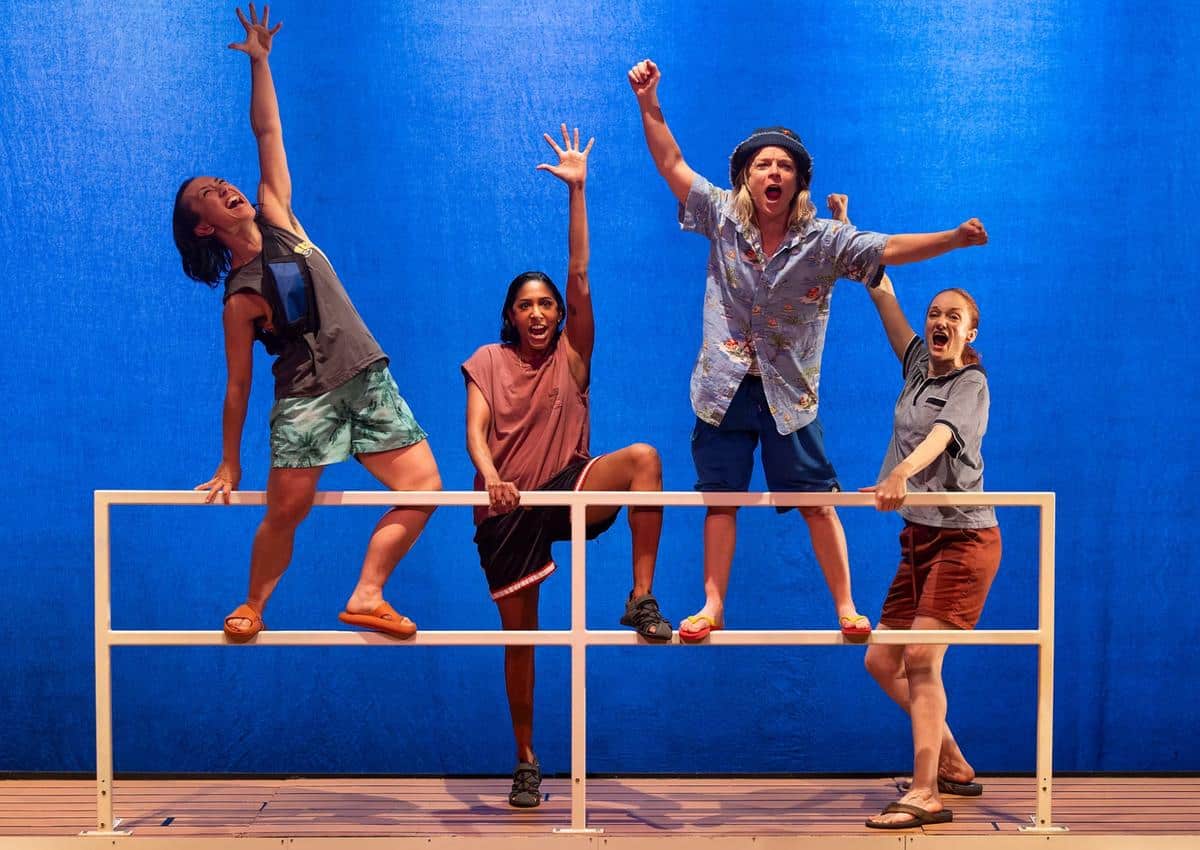
For this feeling of unbreathable submersion is Patricia Cornelius’ brilliant reimagined work, Savages, a play about four men immersed in tight mate-ship, climbing aboard a cruise and leaving their worries behind – heading off on ‘a holiday of a lifetime’, not yet knowing how their yearning for liberation will slowly spill out of control and descend into a night of chaos.

Thirteen years after this play originally took the stage, the decision to cast this show with women and non-binary people takes this piece to a whole other level, particularly where we currently sit with toxic masculinity and misogyny. How, in 2026, we still hear of men, particularly those ranking in high positions, still feeling entitled to disrespect women. How women still have to be guarded, even on cruise ships. Where there may lie a toxic breeding ground of expectation, ire, and unfathomable disrespect when it comes to our gender.

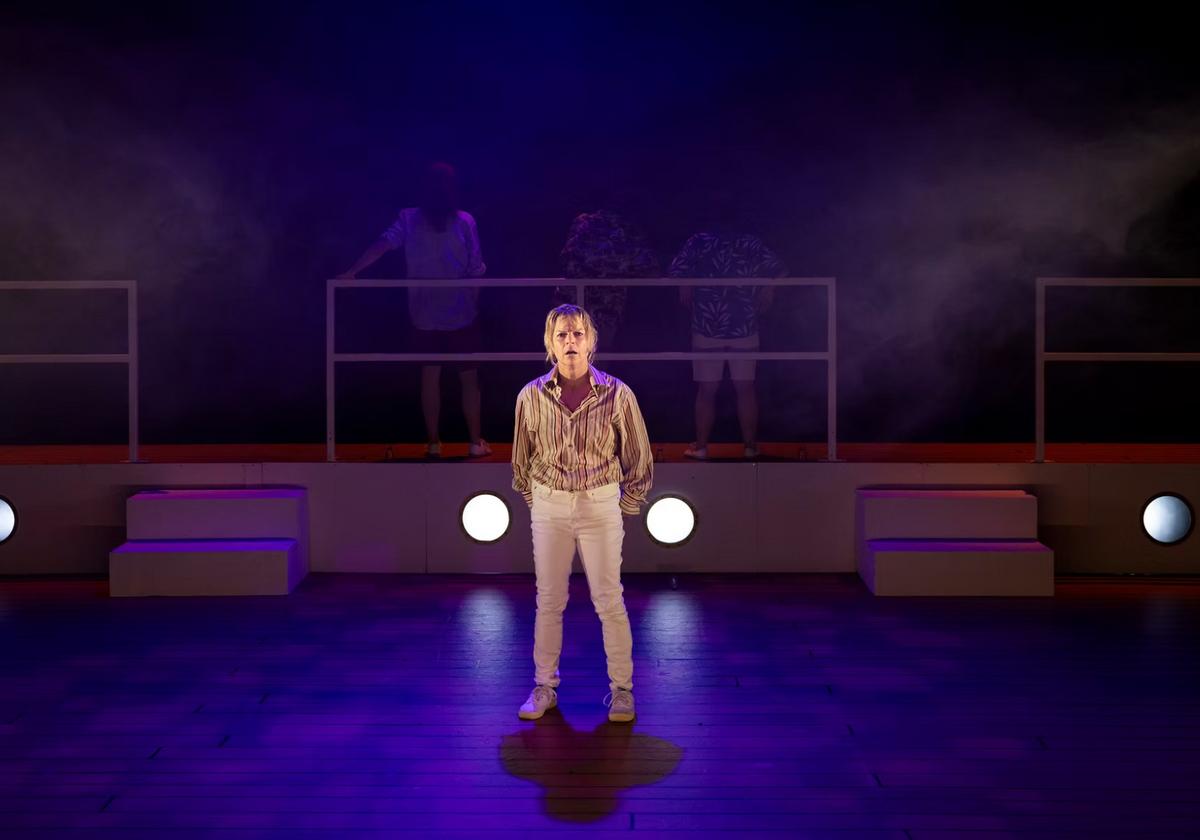
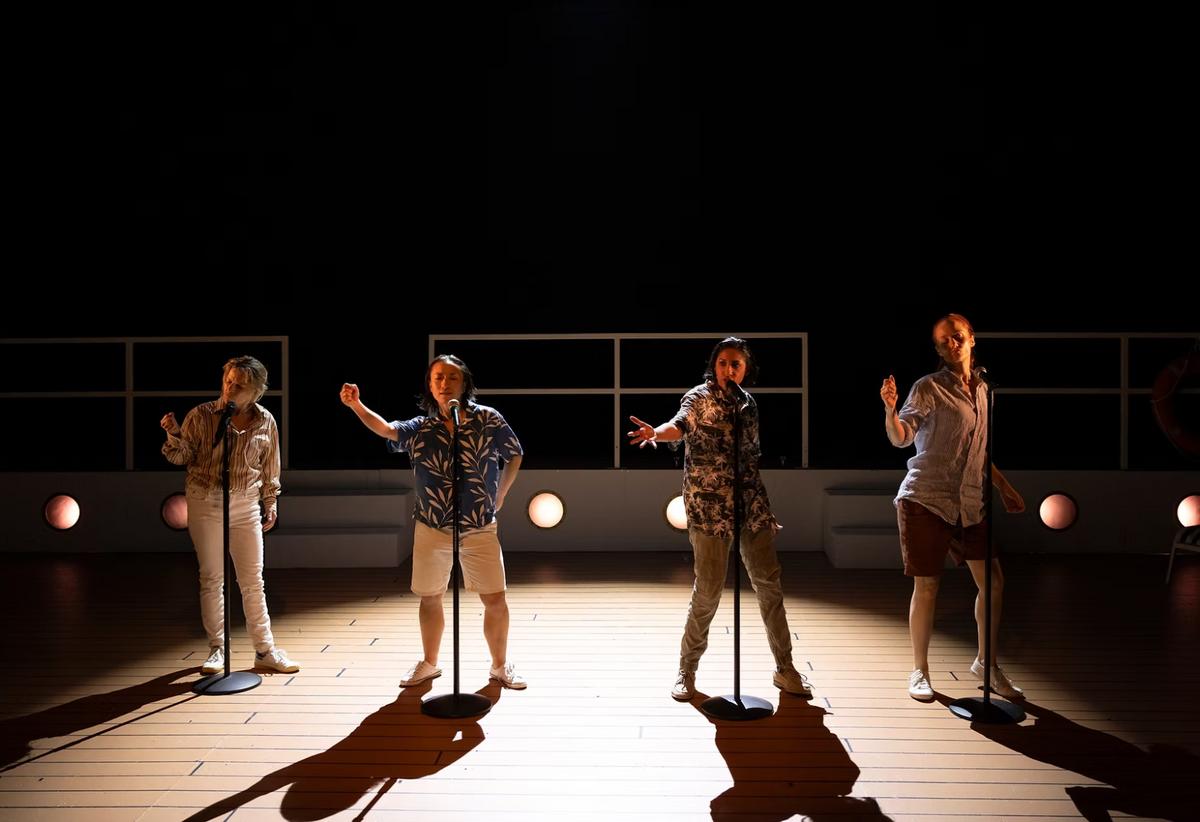
To examine the seemingly complex wiring of savage behaviour in 2026, Cornelius and the show’s director, Kitan Petkovski, thought to cast four incredibly agile women and non-binary actors, who symbolically leave their identities behind at the dock. Who immediately transform into four male characters with great humour, precise physicalities, and emotional complexities; exposing how underneath bravado and immoral behaviour, may lie simmering undercurrents of sadness and depression. Keen to liberate themselves from these emotional waves, these men continue to fight their way through: choosing pure self-satisfaction over what is morally right.


The cast all do a brilliant job of taking on their individual roles. Nicci Wilks is the humorous pick of choice, playing Runt with great comedic timing, delivering the performance of an Aussie bloke with a growl and groan, giving as much as he gets.

But AYA, delivers the level of acting not seen in years. Conveying the despicable character such as Rabbit is no easy feat, and AYA takes it to an expansive level – blending low-brow waywardness with complex pathos and vulnerability. For AYA is the epitome of what I would define as a gifted vessel, for any trued-and-true storyteller.

The set and lighting, both designed by Bianca Pardo and Harrie Hogan respectively, is novel and innovative. Minimal, clean, and with very few props, this set is paired beautifully with the tones of light weaving in and out through the show – symbolising a ‘sea of emotions’, setting the tone of each character’s mood— spotlighting the colour blue for sadness and depressive thoughts; red for anger and aggression; and even the colour pink, celebrating women.

The key to great writing, especially in the case of Patricia Cornelius, is in the simplicity of her language, how so few words can mean so much. How, in much of the play, it sounded sung, like poetry. A call to arms perhaps, in light of what women are still struggling with.

Thankfully, by its rousing end, we see beams of pink light shining through the cracks of toxic culture, a stark vision of hope – in highlighting the vulnerabilities all genders share. That sometimes they can rule our lives in the most harmful of ways. That only time will tell – when old ideas of women will disappear and re-emerge triumphantly. Where entitled misogyny will be a thing of the past.

To book tickets to Savages, please visit https://www.theatreworks.org.au/2026/savages.

Photographer: Pia Johnson

Spread the word on your favourite platform!

Big Religion: A Divine Tale of Saints, Sinners & Disco Dance Winners

Big Religion

Big Religion Rating

★★★★★

Click if you liked this article

5

In an ever-changing world, there may be times where we feel the need more for meaning in our lives. More purpose. More direction. For this reason? We may turn to religion for salvation. To steady our belief systems. To set our minds at ease. Some for spiritual reasons. And others? For personal reasons.

The ‘Big-ness’ of religion cannot be underestimated, and often pondered. Is it channelled through divinity, and drummed into us via institutional structures and educational systems? Or can there be a simpler way: through the universal language of heart-to-heart connection?

Which begs another question for the curious-minded: Is the idea of inner connection to source or spirit linear or abstract? Is there a rigid system for it only, or is that a fallacy we have come to accept as true?

The show, Big Religion, written and directed by Maddi Formosa, seeks to explore these very same themes, albeit through a fun, theatrical realm of holy zaniness. Where we, the audience, begin our madcap ride in a 360 degree theatre-in-the-round, outlined with big cross-shaped black stage, save for two black blocks that are used for seating. A wall behind the stage is used as a guide (via a projection lens) to guide us scene-by-scene with cheeky gothic script and humorous titles to keep the audience amused, engaged (and not asking too many questions!).


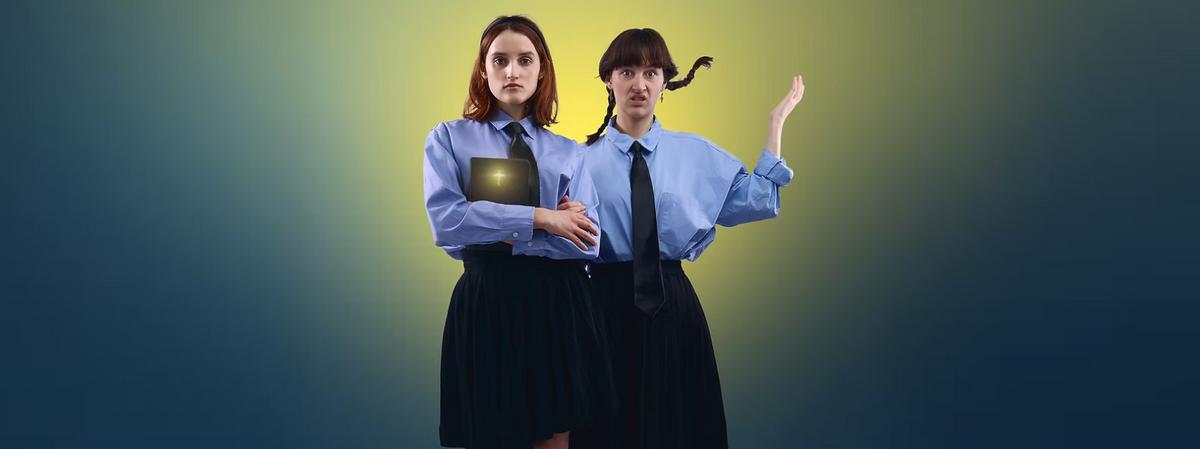
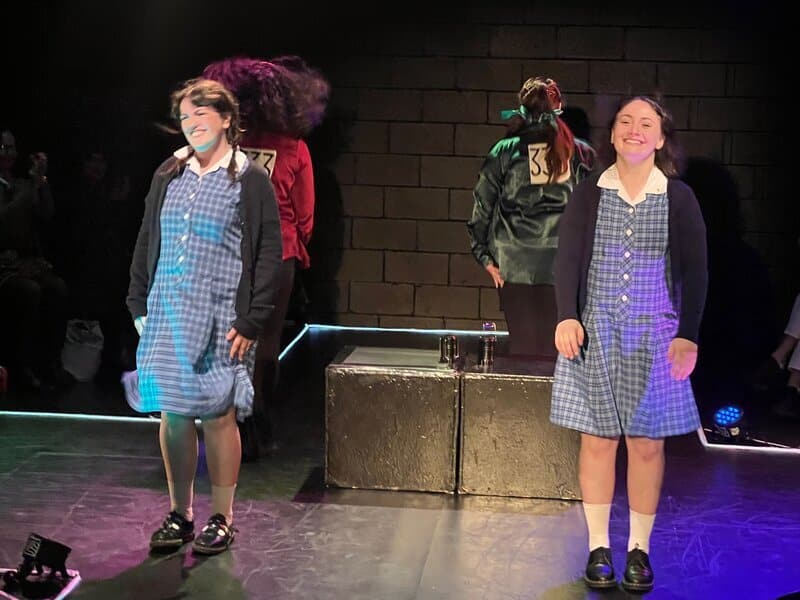
And so, under the guise and space of a huge cross, we staunchly sit under the so-called eyes of the Almighty, along with two feisty and largely frustrated 14-year-old catholic schoolgirls: rebellious rebel Jan, divinely played by Caitlin McCallig, who is railing against the institution she is chained under. Desperate to stand for something important within her school’s strict sacred walls of religo mumbo-jumbo, she chooses attention-seeking promiscuity as the answer, as that is where she places her worth in the world.

Her best-friend Dav? Is the opposite, scholarly and more subservient to her environment, gorgeously played by Gabrielle Ward. For Dav seeks to endure harsh, corporal punitive methods on purpose, as that is all she thinks she is worth. Indeed, both of these girls, the play’s heroines, are seeking some sort of salvation, and some refuge, even if they don’t fully understand why.

Meanwhile, things are also happening in the heavenly, spiritual realm as well. A co-worker-turned-love-story in fact, between naive ‘Being’, played by Megan Scolyer-Gray, a curiously-minded angel, with a dangerous and stubborn ability to ‘think’, who has been assigned observation work on earth, and ‘Also being’, a professional and highly dutiful Angel, awarded a second chance to observe life on earth, and played to a ‘T’, basked in brilliant subtlety, by Jett Chudleigh.

This way, Formosa takes us one step further, and seeks to also challenge our thoughts about heavenly helpers, known as angels, and what challenges they also must face in the line of ‘heavenly duty’, which brings another interesting parody to ‘Big Religion’, especially when the feisty schoolgirls and innocent angels meet, and the story unfolds in an hilarious yet tender way, full of surprises on every corner.

In all, this is a heartwarming must-see tale with a fantastic cast of characters. Where we learn what it means to be both earthly and divine. Where ultimately, we rediscover where true salvation may be found for us all— via the ‘BIG-ness’ of soulful connections.

To book tickets to Big Religion, please visit https://www.theatreworks.org.au/2026/big-religion.

Spread the word on your favourite platform!

Like A Bird Who Longs To Fly: A Woman’s Road To Freedom

The Deplorables

The Deplorables Rating

★★★★★

Click if you liked this article

5

In today’s world, what does it mean to be free? Is it a feeling of liberation from the rules that society dictates, or is it a fire of truth within us that refuses to simmer down?

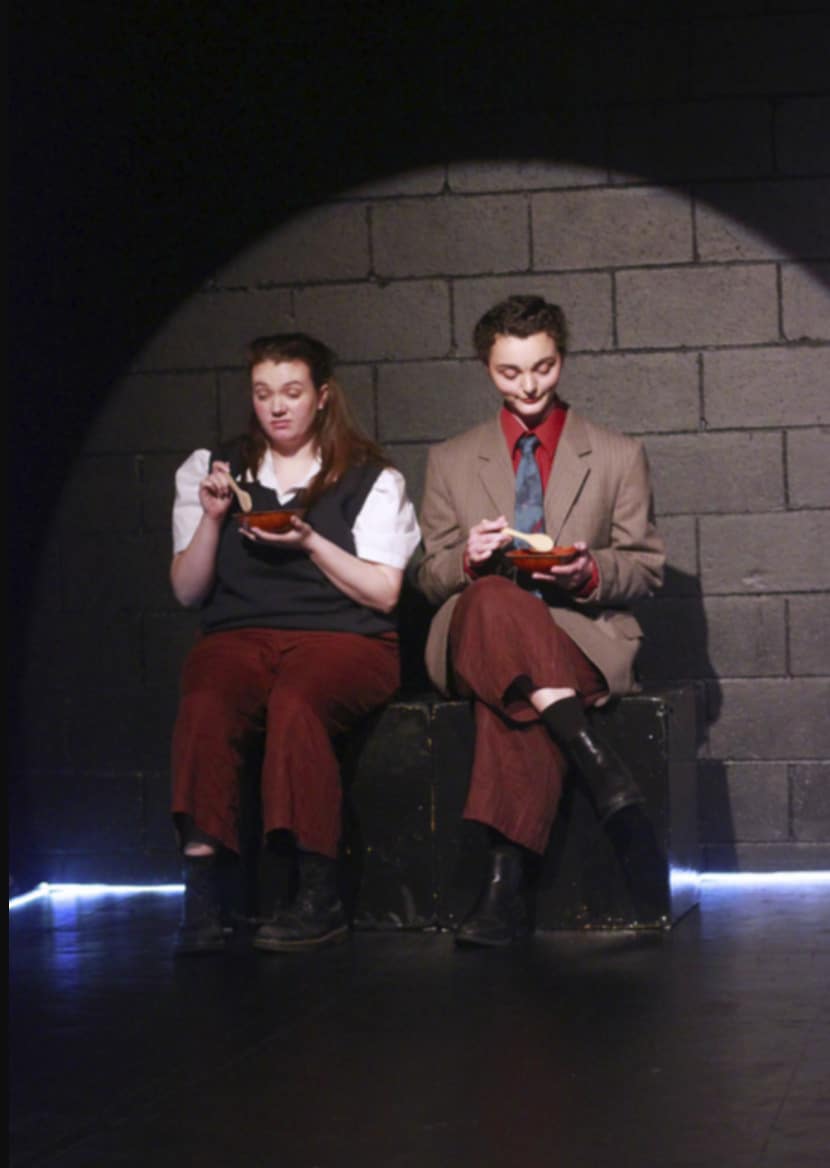
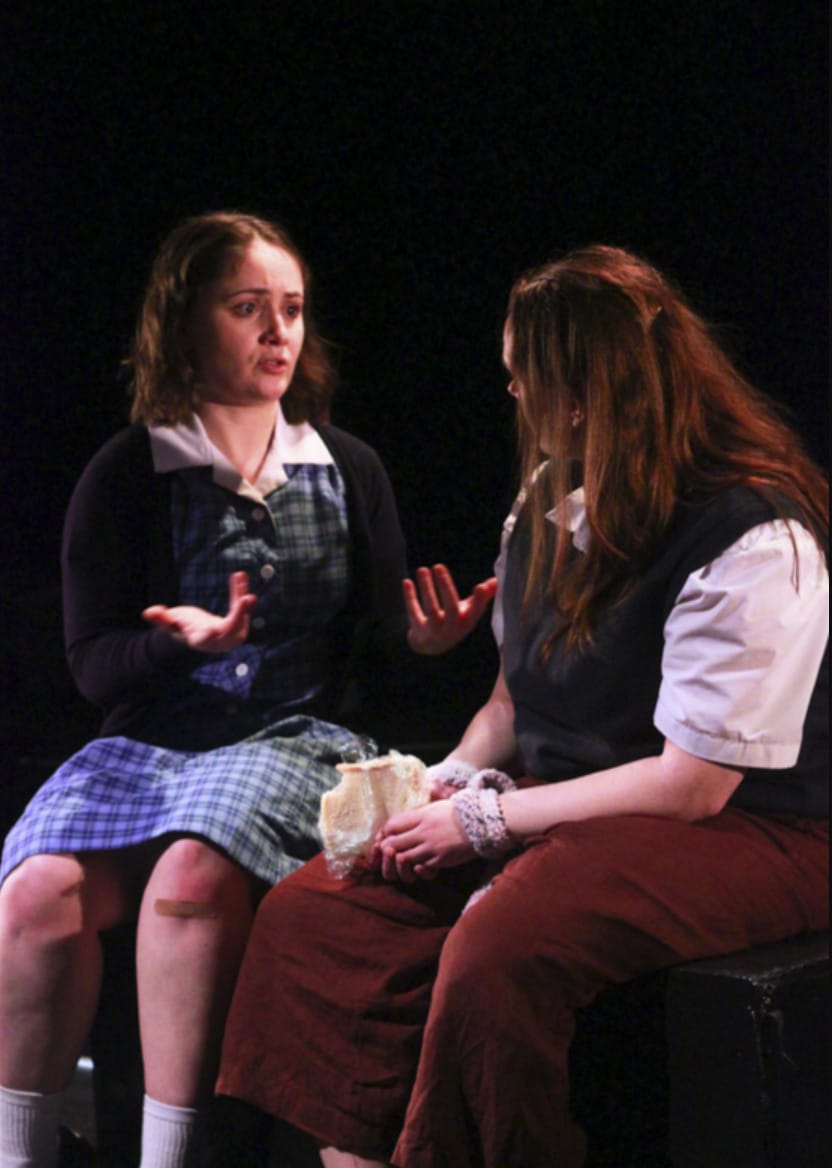
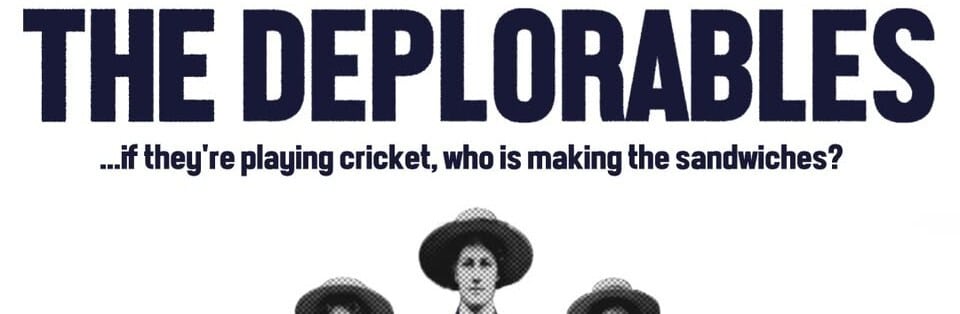
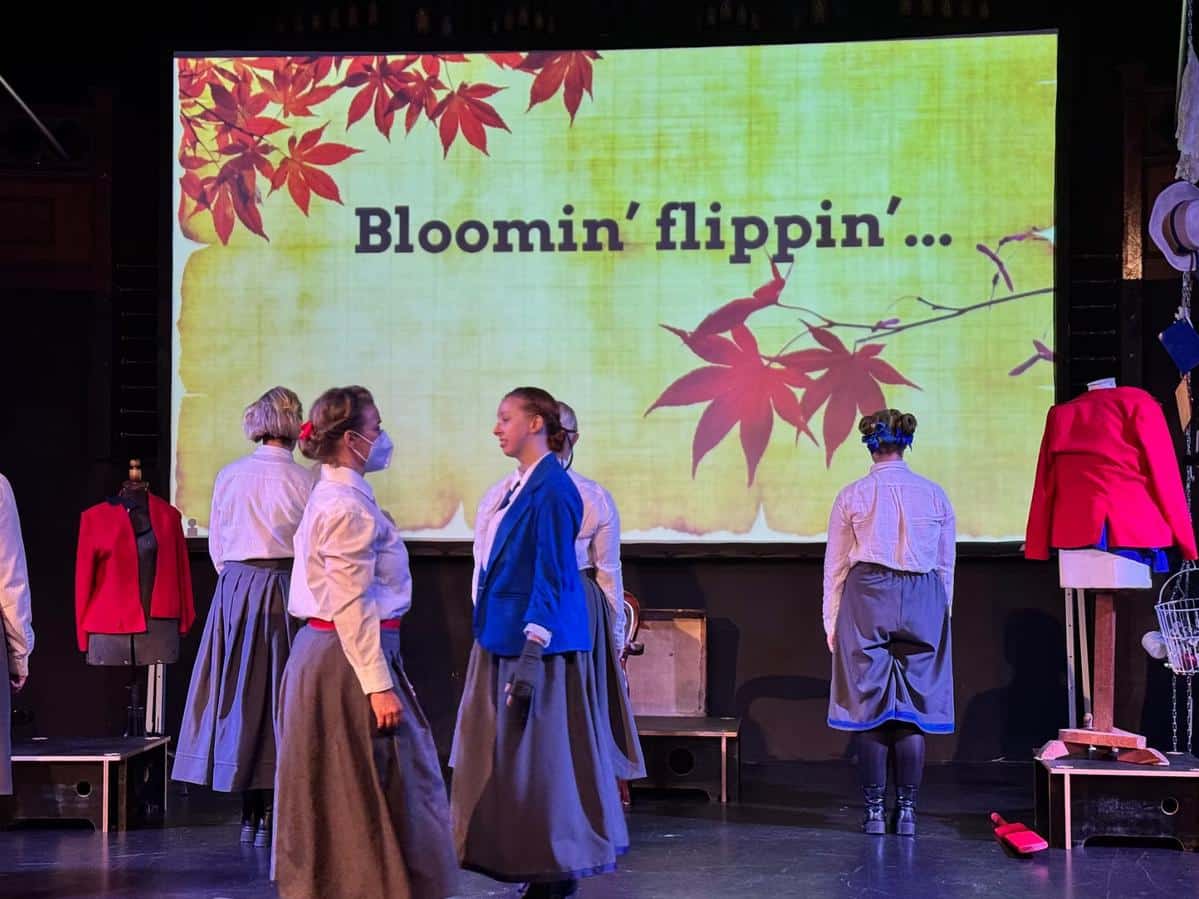
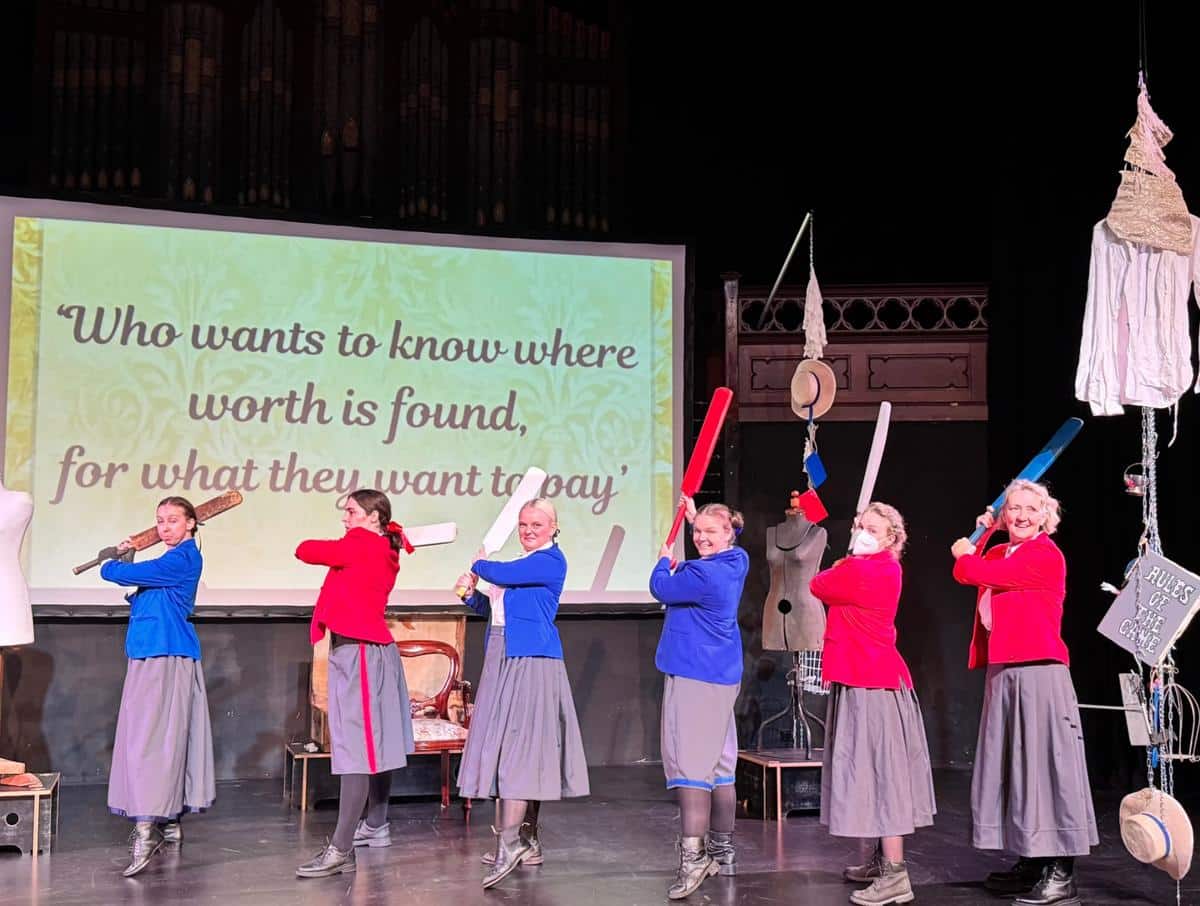
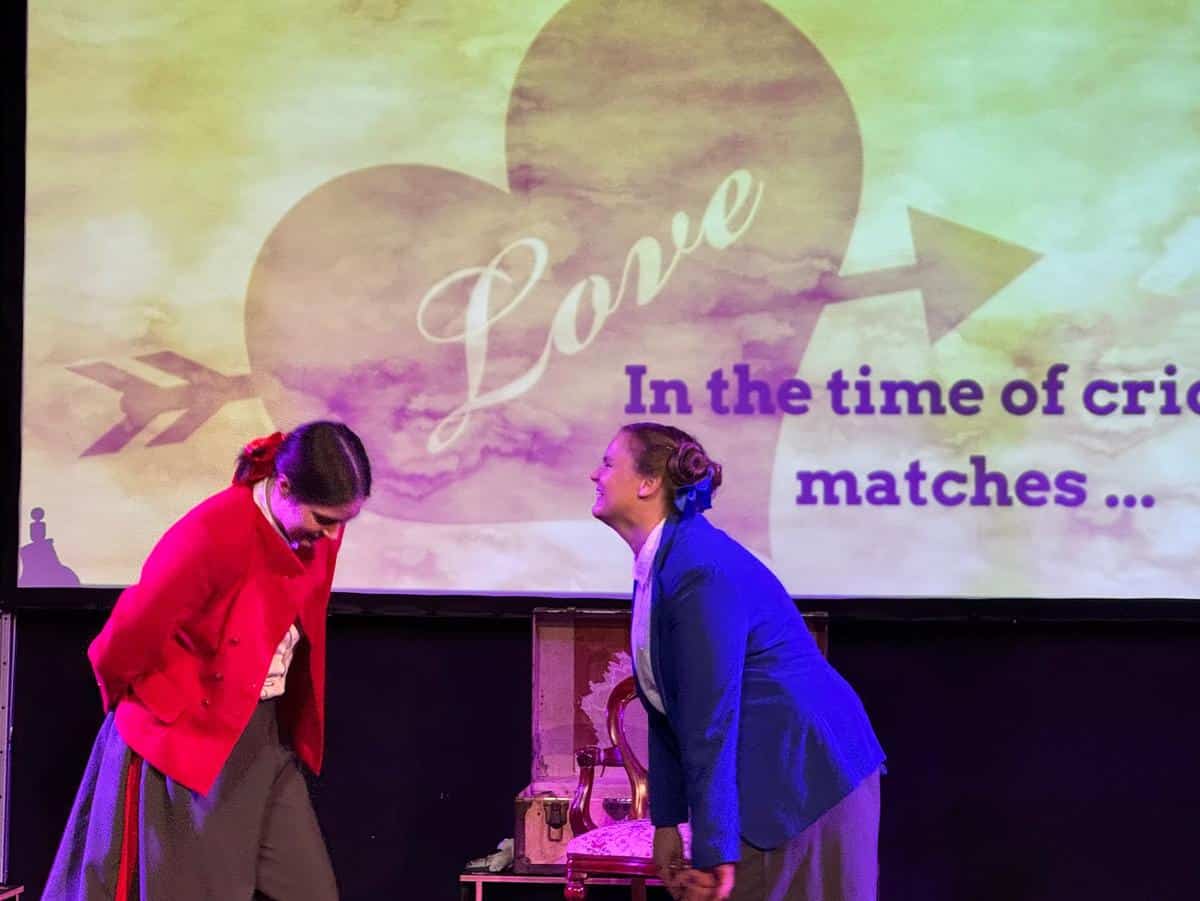
Marking a 2-year benchmark, ‘The Deplorables’, an award-winning production by female-led regional theatre company Skin of our Teeth Productions, marks its final inning at Theatre Works with empowered pride and pure, theatrical joy. Where in a span of 70 minutes, the audience is fully immersed into a no-holds-barred historical tale of female bravery and resilience set in 1874 in Bendigo, where an all-women’s cricket charity match takes place to great communal acclaim with lots of money raised and 22 women praised for their sporting prowess.

As they celebrate their joy and liberation, chaos and backlash ensue – when the press declares that these women are ‘Deplorable’ for playing a male-dominated game, and should instead ‘know their place’ and ‘stay home’. As the story unfolds, we experience the courage and resilience these women face – to fight for their sense of freedom: to be who they are without limitation.


Written and directed by Christine Davey, and composed and choreographed by the very multi-talented
 Tess Parker, this heart-warming story begins with a minimal yet highly-symbolic set framed around this 19th-century period. Four descending pillars of chains cleverly embellished with stage props used throughout, in particular; a hand-held 19th-century moustache to depict the male-roles. Birds resting in cages near signs that say ‘Rules Of The Game’. Red and blue uniformed blazers displayed on sewing bodices marking the juxtaposition of identity; of the changing roles that are budding in that society. A curvy armchair depicting a feminine world in which they must sit quietly. While behind, in a trunk marked with the word ‘Hope’ – colourful cricket bats rest in anticipation – hoping to get a game, or perhaps hoping that society changes its tune.

Blending engaging Australian music and striking physical movement, this delightful, quick-witted, show consists of six highly-talented women who bring commitment to their roles with immense energy and enthusiasm; each bringing different layers to tell this courageous tale.

Marie-Claire Tchernomoroff stuns as Barbara Rae with such tender emotion, immediately connecting to the audience with dreams – of achieving more than just sitting still. Of harbouring a secret wish: to fly freely like the bird she tenderly holds in her hands, away from its stilted cage. Danae Reid as Miss Gerber and Aeonie Ostik-Smith as Katie Petrie bring the musical comedy elements of this show to new heights, with beautiful, heartfelt singing and added flavour, displaying their loving relationship with subtle sensitivity. But Tess Parker, stepping into the role of Miss Murdoch? Absolutely steals the show. With her ball of blazing comedic energy, she combines the exact ingredients of humour, storytelling and sass that engaged me thoroughly. Tess Parker managed to entangle me into a world of a 19th-century woman, who despite her limitations, continued to fight for momentary joys – in humour and in sadness. For in watching her, I too was able to embody the feeling of inner-sovereignty, in a world that perhaps even today, seeks to halt the path of what it truly means to be free, for all of us.

To book tickets to ‘The Deplorables’, please visit
 https://www.theatreworks.org.au/2026/the-deplorables

Photographer: Mary Steuten

Spread the word on your favourite platform!

William Shakespeare’s Reservoir Dogs

William Shakespeare's Reservoir Dogs

William Shakespeare’s Reservoir Dogs Rating

★★★★★

Click if you liked this article

4

To quickly address the obvious question: no, you don’t need to have seen Reservoir Dogs to enjoy this show…but it does help. I went to see this show with a friend who had never seen Tarantino’s film, and I hadn’t watched it since 2021, though I brushed up on it before writing this review. We also sat next to someone who had clearly seen the movie recently and was laughing at every gag. So, regardless of your exposure to Shakespeare or Tarantino, you’re in for a great time. The Ghostlight League’s adaptation is a charming, witty show performed by a cast full of chemistry.

The writer (Steven Hopley) and director (Rob Lloyd) are clearly aware of the tropes they’re adopting and use them to create a rich and layered world. A ‘bardcore’ band plays covers of the original soundtrack, the staging is sparse and the cast is genderbent – it’s ‘hyper Shakespearean’ and proud of it, heightening its conventions for laughs while still entirely ‘committing to the bit’. The script mostly sticks to the original structure and meaning of the film’s dialogue, which makes it fun to hear how Tarantino’s macho banter gets reworded into poetry, with a few real Shakespeare quotes thrown in as easter eggs. The only moments that seemed out of place were some of the more violent scenes; it would be hard and somewhat inappropriate to be just as bloody as the film, but I couldn’t help feeling that some moments could have been gorier and more visceral rather than being played for laughs. Despite this, the intensity, rhythm and borderline homoeroticism of the original story feel right at home in the world of Shakespeare, which is a huge credit to the ambition and skill of the team who married these two distinct styles.


Both film and stage show depend on the rapport of their ensemble cast, and the Theatreworks production really stuck the landing with their actors. Many have worked together before in other companies such as Scary Goats Theatre, and there isn’t a weak link among them. Some highlights include the fraught and physical bond between Sir Orange (Elysia Janssen) and Sir White (Cassandra Hart), Seon Williams’ deft delivery of ‘Elizabethan’ English as Sir Pink, and Corey Glamuzina’s portrayal of Sir Blonde, an effortlessly slimy psychopath. While occasionally some of the English accents made lines harder to parse, the strong physical acting across the board made it easy to get sucked into the story, and every character felt multi-dimensional, no matter how many or few lines they got.

While this adaptation successfully showed the similarities between Shakepeare and Tarantino as storytellers, there’s one key difference at its heart: while Shakespeare mostly wrote about those with legitimized state power (royals, nobles, merchants etc.), Reservoir Dogs lives in the criminal underworld. The slight twist to the play’s ending shows an awareness of this theme and lays bare the potential of adaptations like these. William Shakespeare’s Reservoir Dogs is definitely a novelty and a fun night out, but it also stands on its own as a captivating tragicomedy about power, trust and the blurry lines between ‘good’ and ‘bad’ guys. It’s an ambitious show that has set my own personal standards very high for what adaptations of Shakespeare should be, and I look forward to seeing what this creative team does next, whatever influences they may pull from.

To book tickets to William Shakespeare’s Reservoir Dogs, please visit https://www.theatreworks.org.au/2026/william-shakespeares-reservoir-dogs.

Spread the word on your favourite platform!

Subscribe to What's The Show

Reviews, show news and what is on, straight to your inbox.