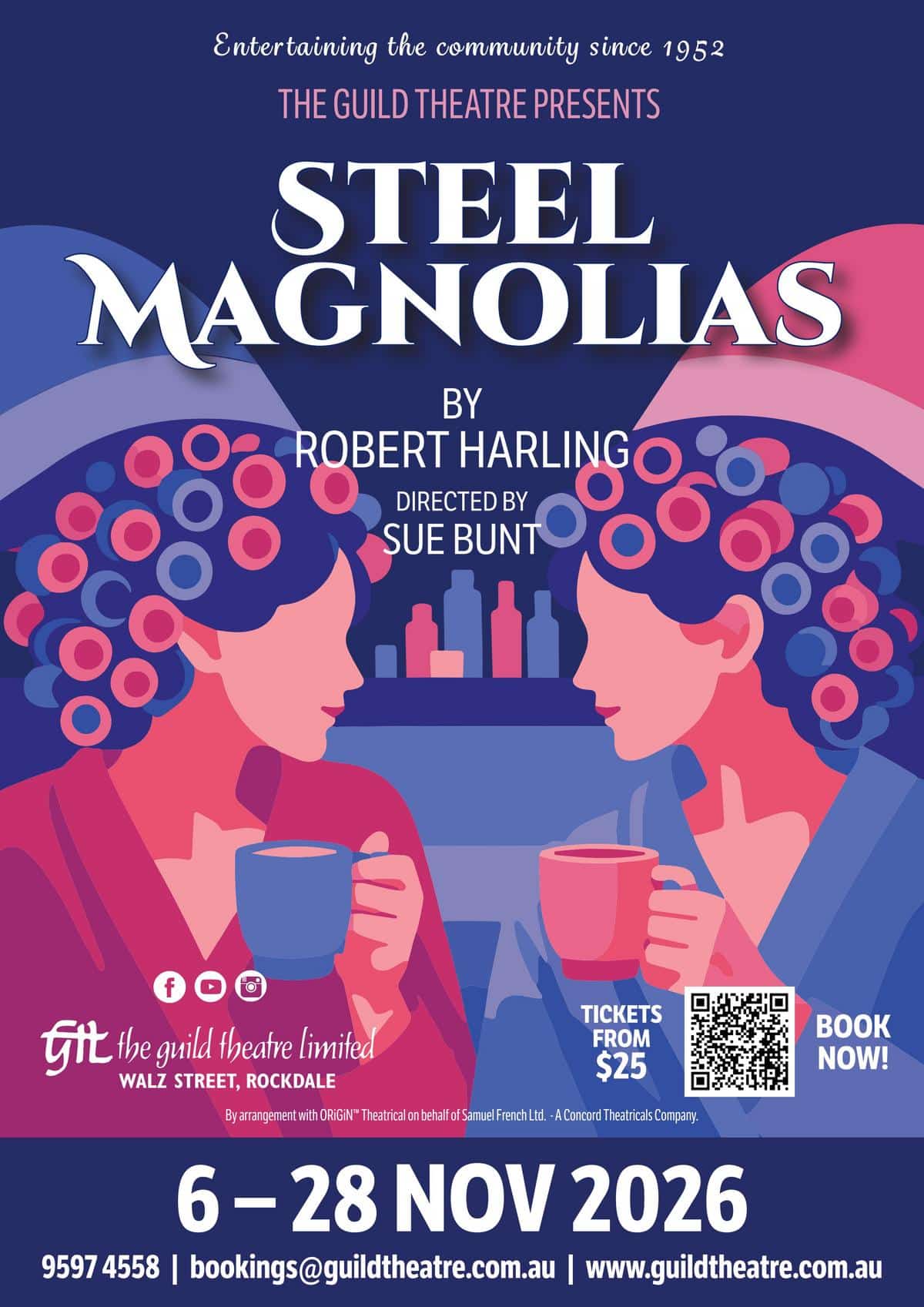
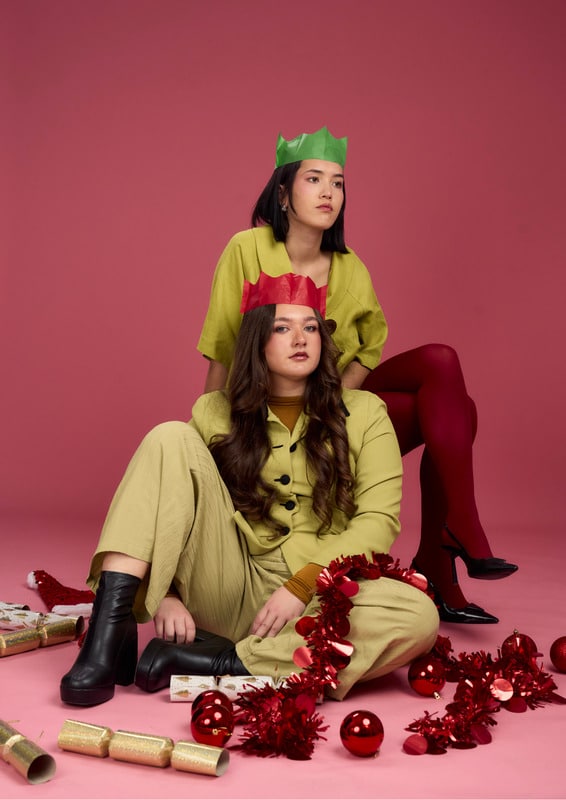
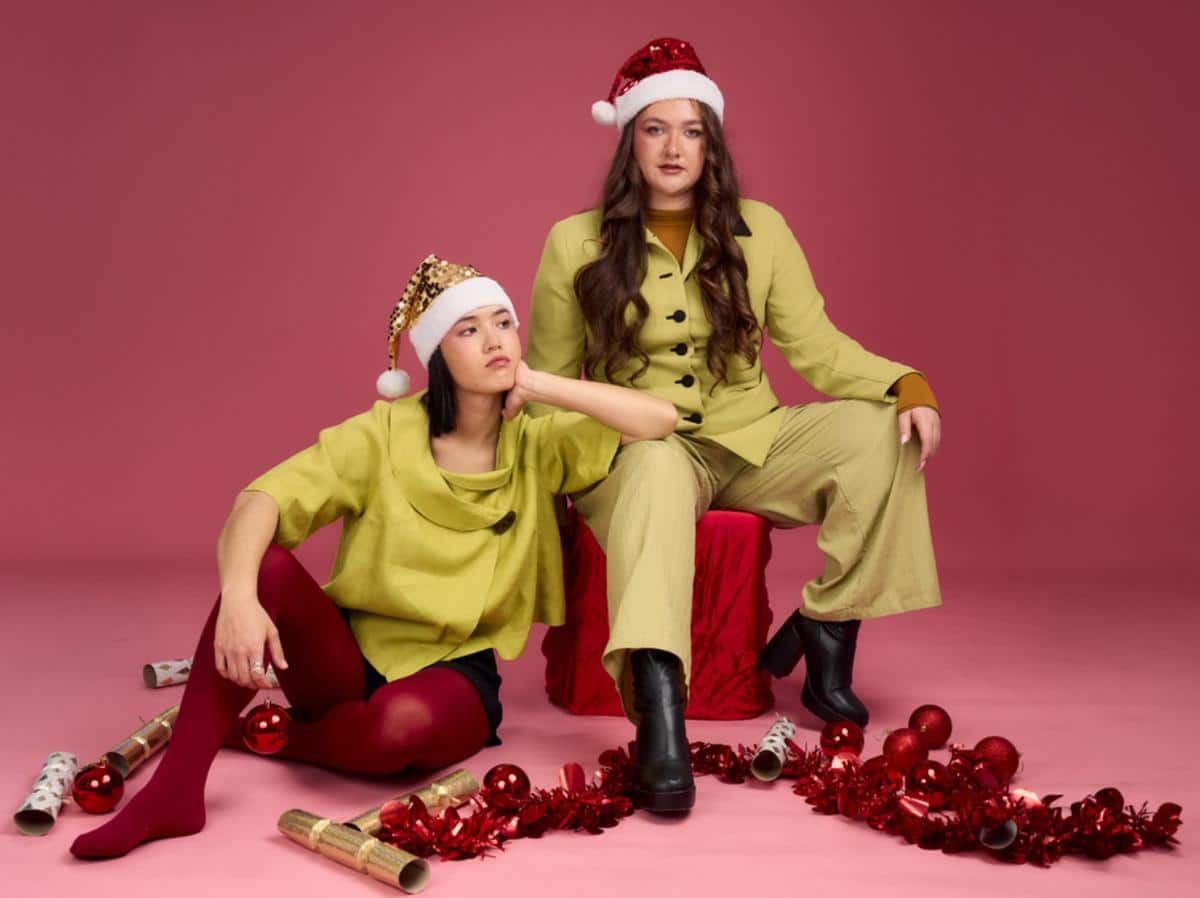
In the welcoming surrounds of a small-town Louisiana beauty salon, six spirited women share laughter, heartache and the enduring bonds of friendship. The Guild Theatre Rockdale presents Steel Magnolias, a much-loved comedy-drama that will have you laughing through your tears.
About The Show – Steel Magnolias
What is this show about?
A delightful comedy/drama about the bond between a group of Southern Women in Louisiana.
In the warmth of a small-town Louisiana beauty salon, six strong-willed women gather to share laughter, secrets, and heartache. Steel Magnolias is a funny and moving celebration of friendship resilience, and the bonds that carry us through life’s joys and sorrows. With quick wit, sharp humour, and moments that will leave you misty-eyed, this timeless classic reminds us that strength can be delicate – and as enduring – as a magnolia blossom
How would you describe this show to someone who has never seen anything like it before?
The show is very moving and takes you for a rollercoaster ride of emotions. You will find yourself smiling, laughing and relating to the characters. There is also some sadness.
Who is this show for? Who is going to have the time of their life?
The show is for everyone … but perfect for a girls night out.
What do you want the audience to feel in the final moment?
An acknowledgement of the power of female friendship.
Our thanks to the team at The Guild Theatre Rockdale. For those seeking a moving theatrical experience, whether for a girls’ night out or simply to celebrate the enduring strength found in connection, tickets can be reserved at the Guild Theatre website.
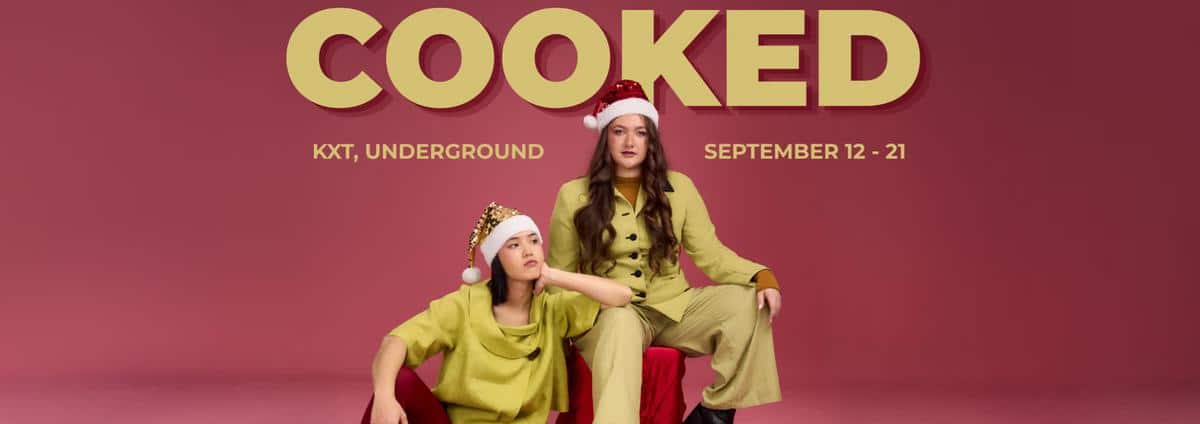
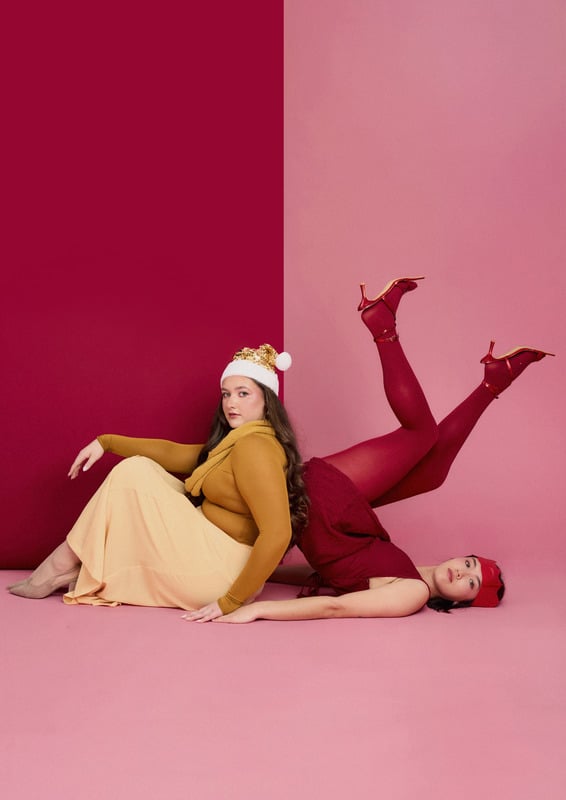
Cooked by Angel Duggan and Lana Page
At KXT on Broadway Downstairs
Creative Team
Director: Laura Jackson
Writer/Performer: Angel Duggan
Writer/Performer: Lana Page
Performer: Sally Evans
Lighting and Sound Designer: Sansona Trinh
Costume, Set and Props Design: Sam Hollingshead
Producers: Angel Duggan and Lana Page
I feel a lot of hard work went into this production but I’m not sure if it was cooked, more like half baked.
“Christmas this year is “cooked.” Logan’s world is tested when her mum starts to come home late, disappears, and acts ‘off’. She looks to her best friend Jean for support, however a new boyfriend – the kind that you have a ‘funny feeling’ about – begins to test their friendship. Full of vaping, Tn’s, Kookai, and ‘woo woo energy’, these women navigate their insecurities, judgements and some hard truths about each other.
Christmas is fucked but maybe New Years will be better?”
We never heard about New Years funnily enough. A lot like the ending, where we didn’t really get a conclusion.
The play tries to dabble with some heavy hitting themes about alcoholism, depression and domestic violence but nothing really hits the mark. I thought I’d be coming out of this play crying but instead felt rather empty. This could have been the playwright’s intension.
I understand why actors start writing their own work so they can create opportunities for themselves and others but sometimes as playwrights, actors are too close to the material, so they don’t quite get there and connect. A lot of sections of the play seemed over rehearsed and not in the moment. There was a lot of playing to the balcony and not the people in front of you, which made it feel really disconnected. Perhaps the show needs to be workshopped more. Opening the play with some super out of tune singing was a choice!
This was their second show in a short run at BXT on Broadway downstairs. I wonder if some of the issues I saw were to do with the classic second show slump.
The space downstairs is tiny, it could do with some slightly raked seating, as sight lines are a problem unless you are in the front row. The speakers are deafening; the high volume is not needed for such a small space. They were so distracting throughout the entire play and so many moments were destroyed because of this. Like the seats upstairs, these are just as uncomfortable. It was lucky the play was only 55 minutes long. Take a cushion with you.
Sally Evans performance as Mum was quite the standout. She craftily balanced quirky comedy, melodrama and very dramatic scenes with ease.
It is lovely to see a full house with so many people supporting live theatre.
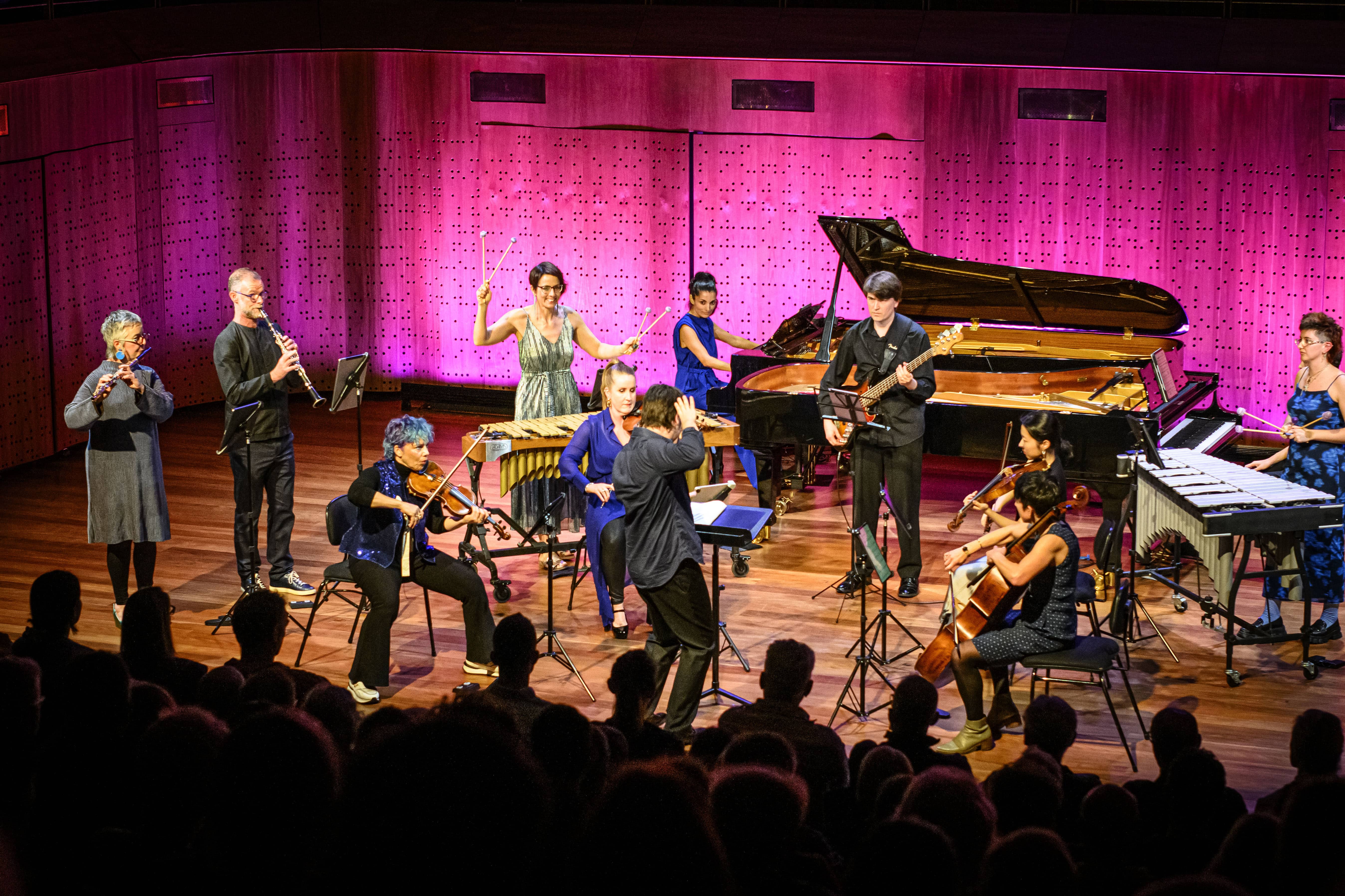
Following this concert I think the Vibraphone is my new favourite instrument. Think tubular bells mixed with a glass harp for the purest sound in an orchestra. As a tribute to Steve Reich who was influenced by Back to Coltrane and master of this instrument, the Ensemble Offspring offered a technically brilliant afternoon of sound. The self-effacing key speaker Claire Edwardes outlined the program and the ensemble’s history and love of Reich’s compositions and technical difficulty. She even wondered out loud why they had chosen some difficult pieces!
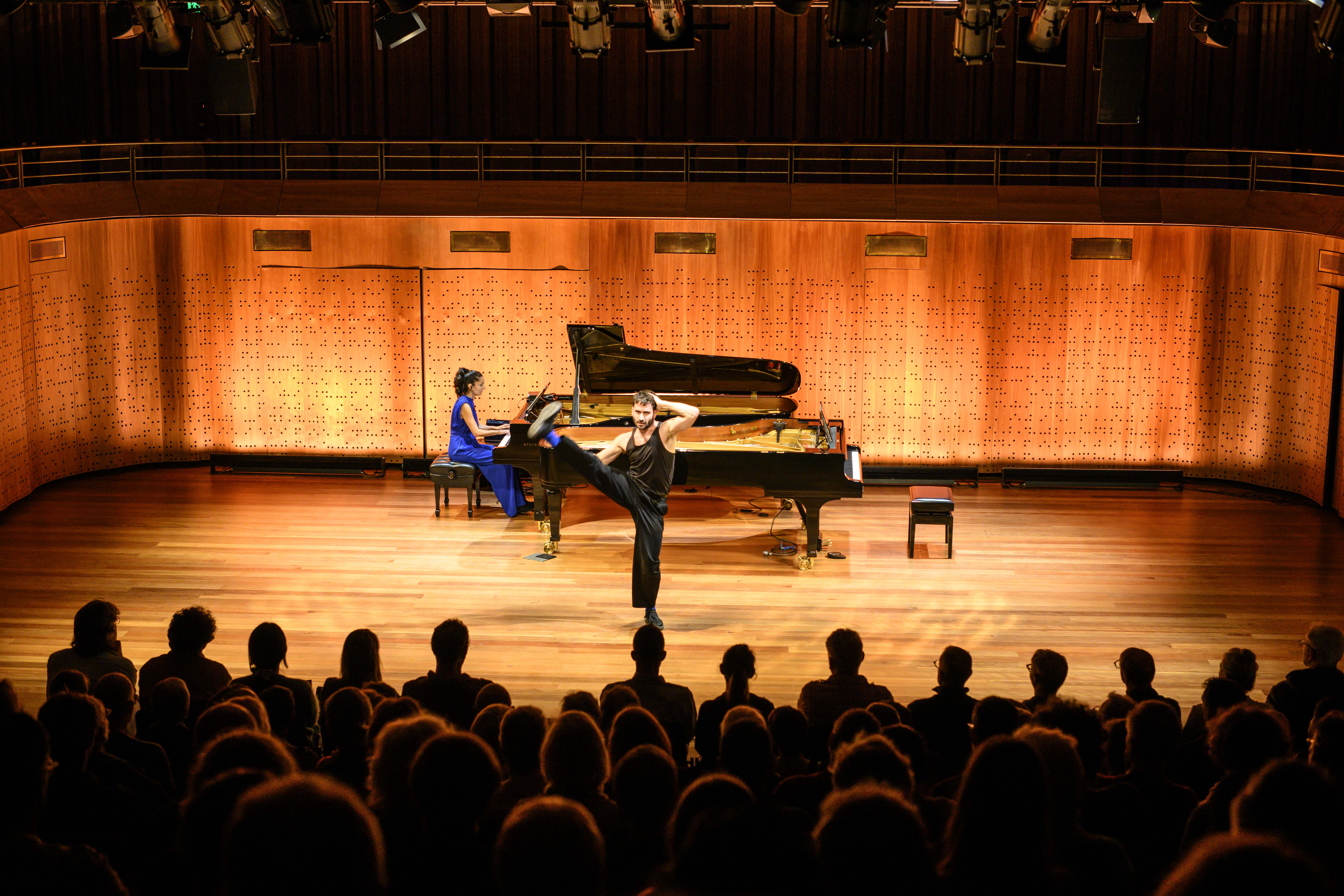
First up, Richard Cilli and Claire Edwardes strode on with metronomes and, accompanied by the amazing pianist Gabi Sultana, their body percussion and ballet melded sound, rhythm and the piano providing a surprising pulse. ‘Metronomes’, offered Reich’s classic phrasing of repeat, review and revise. The bodies moved in time matching the metronomes as they were out of sync and then in-sync as if they were a piece of separate music. It was compelling in its fluidity.
Richard then stepped forward and with fluid balletic dexterity presented a conversation with a silent partner as if the beat, piano and his movements were debating with another to get some response regardless. Gabi pushed the piano as if it were vibrating to the music whilst her fingers ran across the notes mastering the difficult phrasing.
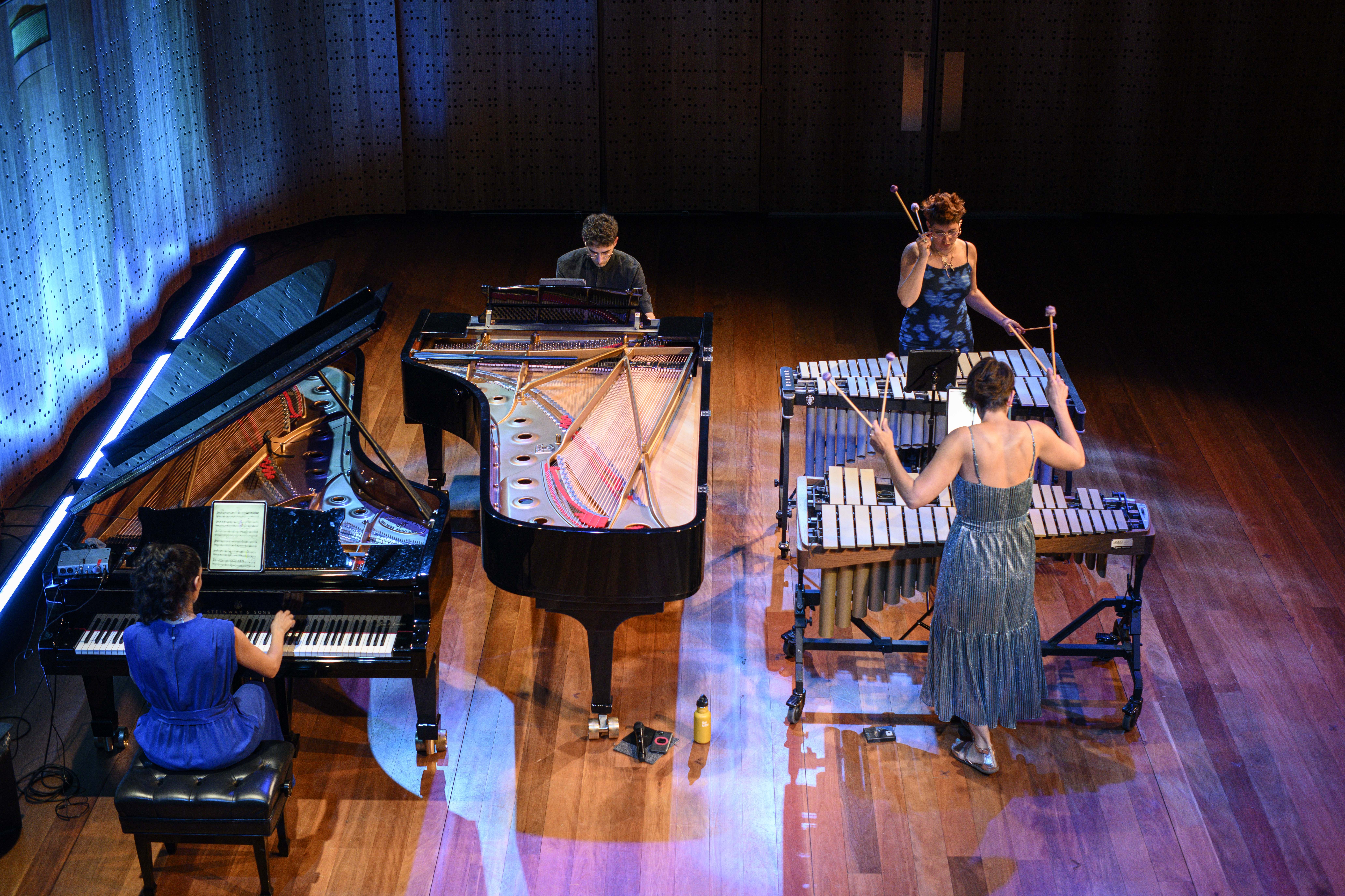
Next we had the famous piece, Quartet from 2013, which featured two vibraphones and two pianos – just in case! The nimble dexterity and clarity of sound was beautiful and the pace was fast and furious. Lots of counter questions and answers between all four performers as they delved into the complex harmonies and difficult twists of hands and instruments to match the rhythm, fast, slow, fast and then faster. It was amazing to watch the ballet of fingers using the mallets as if playing four keyboards on one instrument and the precision of the timing was everything.
The finale of the whole ensemble added a bass guitar, flute, clarinet, violins, viola and cello which circled the pianos and vibraphones. Radio Rewire from 2012, is a piece not for the fainthearted. With shards of Radioheads’ Everything in Its Right Place and Jigsaw Falling Into Place, Reich offers a throwback to older composers using pre-existing music to weave in to their own variations on a theme. The piece moved back and forward in speed and finalised in a massive pure sound leaving the audience stunned by the sheer technical brilliance and the complex phrasing as variations were weaving around from each performer. The performance culminated in a cacophony of dynamic sound.
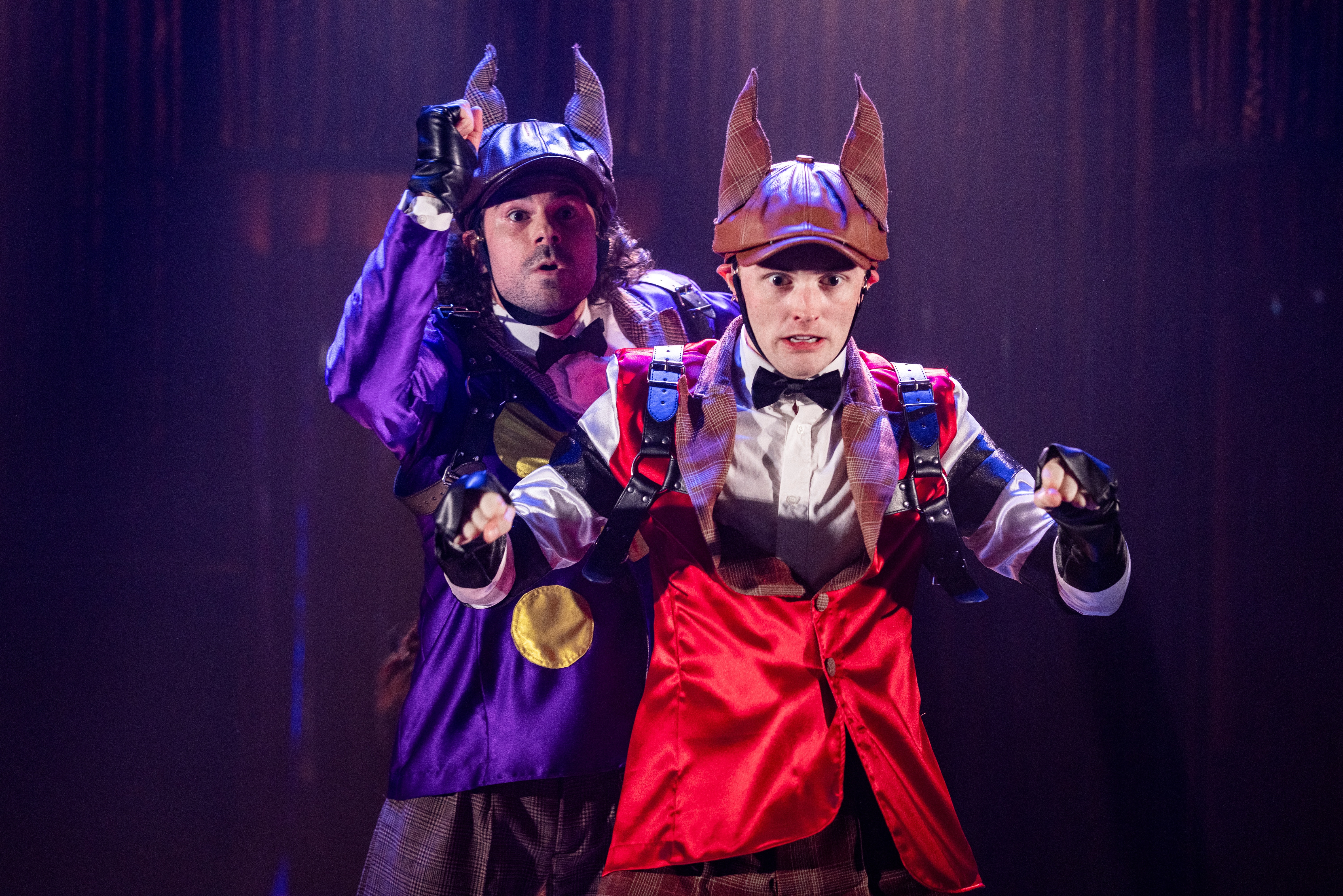
Hayes Theatre Co is thrilled to announce the award-winning sold-out hit of 2025, Phar Lap: The Electro-Swing Musical, will return in 2027. This new Australian musical with the biggest heart returns to Sydney in an expanded, unbridled production playing at Carriageworks, before a national tour including a season at Melbourne Theatre Company, Merrigong Theatre Company, Geelong Arts Centre, The Art House Wyong, and many more.
A gangly Kiwi racehorse. A trainer down on his luck. A nation ready to believe in a long-shot. Phar Lap: The Electro-Swing Musical is the rags-to-riches story that galloped into history, reimagined with heart, wit and a toe-tapping electro-swing score. The road isn’t easy – there are gambling scandals, double-crosses, an attempted shooting and a career-threatening addiction to sugar. It’s high stakes, high drama and highly historically accurate.
Phar Lap boasts an irresistible electro-swing score by Steven Kramer, with inspirations from Duke Ellington to Daft Punk. Brassy, lively and retro – these songs will take you from the race course to the rave hall.
It was an unprecedented sold-out hit at Hayes in 2025, and now Phar Lap gallops back to Sydney, again starring New Zealand born but Australian claimed triple threat Joel Granger (Guys and Dolls, The Book of Mormon) as the titular hero.
Winner of three 2025 Sydney Theatre Awards including Best Production of a Musical, Best Direction of a Musical (Sheridan Harbridge) and Best Performance in a Leading Role in a Musical (Joel Granger), Phar Lap swaps horse shoes for tap shoes celebrating Australia’s big-hearted equine hero.
★★★★★ “Phar Lap is everything you’d expect from the Hayes – irreverent, funny, slightly chaotic – but the elegant story-telling, lovable characters and electric performances take it to the next level.” – Sydney Morning Herald ★★★★★ “Dazzlingly clever.” – Stage Noise ★★★★☆ “Likely to gallop into Australian musical theatre history … an odds-on favourite to sell out as soon as it leaves the starting gates.” – Limelight ★★★★☆ “Steven Kramer delivers a remarkable trifecta: great music, sharp lyrics, and an outrageously bonkers book to match.” – Cultural Binge
“Phar Lap is a really special show – it’s funny, it’s clever, it’s undeniably unique – and truly deserving of the praise it’s received as a new Australian classic. Audiences at our Hayes season were genuinely bowled over by this energetic, irreverent telling of a story that’s so deeply ingrained in our collective culture – so it’s very exciting that many more people will now have the chance to see it.” – Richard Carroll and Victoria Falconer, Artistic Directors, Hayes Theatre Co.
Pop the champagne, harness up and get ready for a wild ride. Phar Lap: The Electro-Swing Musical is the show that will stop the nation in 2027!
PHAR LAP: THE ELECTRO-SWING MUSICAL
Book, Music and Lyrics by Steven Kramer
Director: Sheridan Harbridge
Musical Supervisor: David Gardos
Musical Director: David Youings
Choreographer: Ellen Simpson
Set Designer: Hailley Hunt
Costume Designer: Mason Browne
Lighting Designer: Trent Suidgeest
Sound Designer: Liam Roche
Arranger and Orchestrator: Jack Earle
Orchestrator and Track Producer: Steve Toulmin
Starring Joel Granger
SEASON DETAILS Venue: Carriageworks, 245 Wilson St, Eveleigh Season: 8 July – 8 August 2027 Times: Tues 6.30pm, Wed-Sat 7.30pm, Wed & Sat 2pm, Sun 5pm Price: From $94 Adult, $84 Concession/Group, $79 Under 35 Bookings: www.hayestheatre.com.au | (02) 8065 7337 TICKETS ON SALE NOW FROM https://hayestheatre.com.au/event/phar-lap-2027-carriageworks/
Spread the word on your favourite platform!
Subscribe to What's The Show
Reviews, show news and what is on, straight to your inbox.