Ghosts of Christmas Past: A Chinese Christmas at KXT

A Chinese Christmas

A Chinese Christmas Rating

★★★★★

Click if you liked this article

Grief is no new topic for the world of theatre. One of the most fundamental human experiences, it is endlessly relatable, never faltering in its supply of new material. Of course, because grief has been explored before, it requires some level of reinvention to allow it to be interesting — A Chinese Christmas in this regard, went above and beyond. In a 70-minute, yet deceptively thorough dissection of what it truly means not to mourn someone, but miss them, Director Monica Sayers and Writer/Lead Trent Foo hold our hands through a gentle exploration of how to reconnect with something larger than ourselves in our moments of destruction.

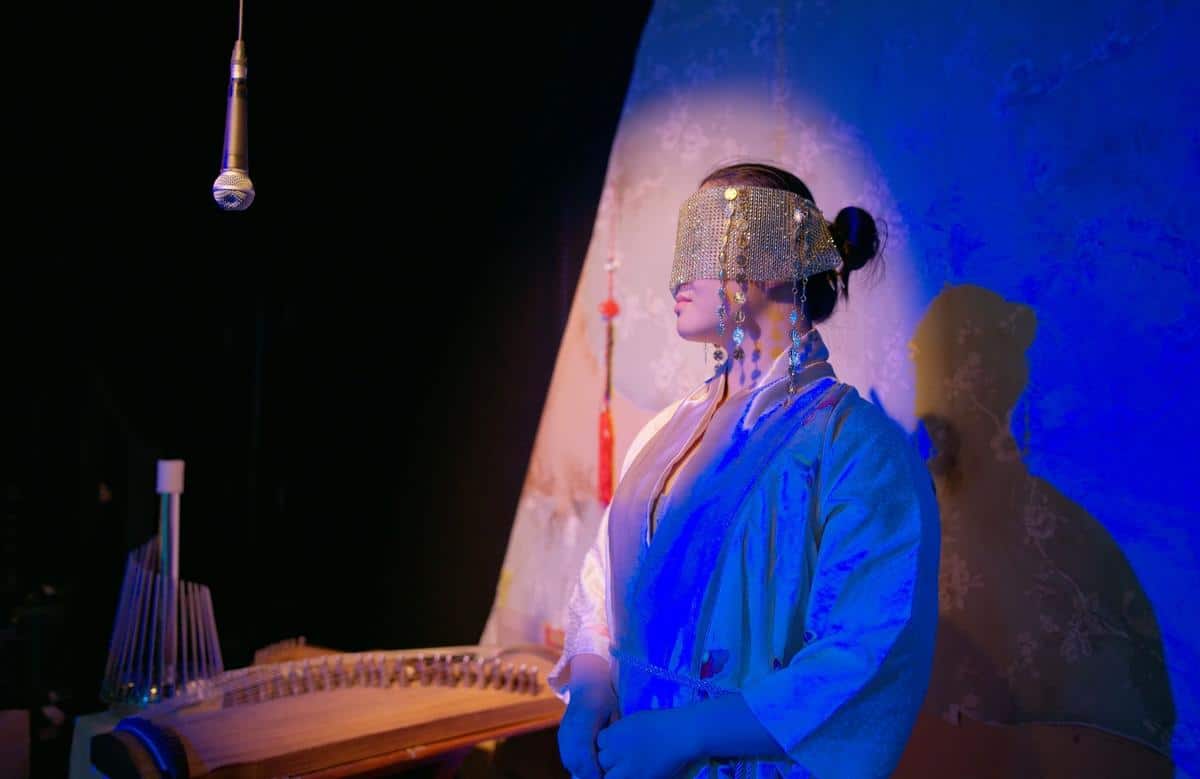
Set on the traverse stage of KXT Broadway, the audience enters into the slightly desolate warmth of an apartment. Cardboard boxes are scattered through the space, along with clutter that could or could not be entirely meaningless. Long lines of fibrous twine cut diagonal lines through the air, and natural fabrics are draped over chairs and lamps, cultivating a grounded and stylistic flair within the room. The hourglass was a particularly interesting touch, subtly elevating the stakes in a very grounded and practical way. The space is both carefully put together, in hanging lamps and the dangle of a microphone, and crucially dilapidated with the peeling wallpaper— setting the mood for our lead’s mental state. Much praise must go to Amy Lane here for her impeccable and considerate use of space. Further, her costume design for Lady Dai was also incredibly impressive, giving Jolin Jiang an almost inhuman energy with the shimmering gold over her eyes.

Production design continued to impress through lighting and sound; Jiang playing five or six instruments live through the show, which drew our attention back to the events on stage without ever becoming jarring. The use of colour and spotlighting from Cat Mai both elevated the moments of drama, and softened the piece into an almost dreamlike state when necessary. Cameron Smith’s sound design, along with Jiang as the composer seemed to almost communicate with both the moment, the emotion, and sometimes the characters themselves. Jiang’s work as a musician and composer, and also her physical work on stage, was so strong, in fact, I was almost left wishing the character she portrayed — Lady Dai — was an unspeaking role, as she created an untouchable mysticality around herself that was at times undercut by her less confident vocal work. However, I understood why the choice was made through the end reveal (which I won’t spoil). As a whole, the piece was incredibly beautiful, and production deserves many of the flowers in both matching and creating the emotional journey of the show. Between set, costume, lighting, and sound, the show moved aesthetically beyond the theatrical, settling into the cinematic.


Foo, in turn, gives us a spunky, naive, and energized portrayal of Heepa — a young man trying to bring his entire extended family together for Christmas. His physical work was very strong, clean movements and confidence through stunts created great moments of comedy and underlined his intentions well. His study of stage combat is very clear in this regard. In many ways, A Chinese Christmas functioned for the most part as a one-man show, and Foo effectively utilized this style to engage with his audience. Watching impassively, we were the ancestors coming to visit — always judging, never quite as helpful as he wanted us to be. His voice was clear and strong, and carried us through the show through his excitement. However, I would’ve liked to see him relax on stage, even only about 10-20% — as his energy manifested as a tendency to struggle with connecting with the words or the emotions, performing through them instead. This, although working for moments of comedy, left moments of grief falling slightly short. His performance was the most beautiful at its moments of stillness, slowness, and simplicity, especially in times of reflection. One of my favourite moments of the night in this regard was when the lights on the makeshift Christmas tree weren’t quite turning on, and we watched a very human awkwardness and frustration come out through humour.

Tiang Lim supports the show through her portrayal as PawPaw, the matriarch of this tiny family. Lim gave us a beautifully subtle study of the way that many of our older generations simultaneously ignore their emotions, whilst being swept up and ever affected by them. Although her vocal work leaned slightly into patterns, her work was so incredibly vulnerable that those flaws were easily ignored. Her scene with Foo in the car was particularly effective, both in her wisdom and sympathy, and the recorded monologue of her letter left the crowd very much misty-eyed. PawPaw, although not being quite human herself, was easily the most complexly human character of the show.

With such a common topic, it would be easy for A Chinese Christmas to lose the attention of its audience — but this show succeeds in leaps and bounds both in its cultural accessibility, and how it uses that cultural accessibility to draw in its audience. Although some of the emotional work did lean slightly demonstrative, and some of the connective tissue between moments was a little weak, Foo and Sayers have given us a deeply earnest exploration into loss that excites without excluding. It reminds us beautifully of the ways that we are loved, even if we cannot understand how that love is communicated. All the while, it simultaneously allows for those on stage, and us in the audience, to, as a collective, reach that final stage of grief: acceptance.

To book tickets to A Chinese Christmas, please visit https://www.kingsxtheatre.com/a-chinese-christmas.

Photographer: Robert Miniter

Spread the word on your favourite platform!

About The Production - Dear Son

Feature-Dear Son

Today, we had the pleasure of speaking with the talented team behind Dear Son, a deeply moving stage adaptation directed by Isaac Drandic. Prepare to be captivated by a blend of courageous storytelling and emotional depth as these letters flow beautifully on stage.

About Dear Son

What is this Production about?

The show Dear Son, is based on the book called Dear Son by Thomas Mayo. It's a show that's been adapted into a stage play written by John Harvey and Isaac Drandic, and directed by Isaac Drandic. Thomas Mayo invited 13 Aboriginal & Torres Strait Islander men, including himself, to write a letter to their sons and fathers.

In the show, we have 5 men, actors on stage and we bring these letters to life.

What’s challenging about bringing this script to life?

One of the challenges was making sure we honour all the letters in a theatrical structure of storytelling. They are so personal and powerful that we worked really hard to take care of and share the bravery of these courageous men and us creatives in production as fathers and sons. And through the whole process it's been an honour to be a apart of and healing personally as a father and son.

Why did you want to be involved in this production?

I've been apart of the first workshop and read the book and always wanted to work with Isaac as a director. We've worked together on Romeo & Juliet many moons ago hahaha, I think it was 2008 STC production as actors, but it was well overdue. And also, as an indigenous storyteller, I feel it's my responsibility to be apart of this production when it was offered.


What will the audience be thinking about in the car as they drive home after this show?

They will be thinking about all the men in their lives.

What’s going to surprise people about this show?

How much they are connected to these stories.

How is this production bringing something new to this story?

You will see 5 men on stage on a beautiful set having a yarn, and when I say yarn, I mean deep yarn. With the letters flowing through us.

Where can patrons purchase tickets to this production?

To book tickets to Dear Son, please visit https://belvoir.com.au/productions/dear-son/.

Thank you so much for sharing your insights and passion with us. Wishing you all the best as you bring the heartfelt stories of Dear Son to the stage, and may your performance move audiences far and wide. Break a leg!

Other production interviews can be viewed in our About The Production Series.

Spread the word on your favourite platform!

Much Ado About Nothing

Much Ado About Nothing

Much Ado About Nothing Rating

★★★★★

Click if you liked this article

1

This Much Ado About Nothing is set on the South Coast in the week before Christmas, and the choice is not cosmetic. From the moment Don Pedro, Claudio and Benedick enter wheeling a battered esky, the world is established: this is a family gathering, loud, sunburnt, faintly daggy, and thick with history. The cicadas hum, So Fresh Summer Hits blare, and the audience—seated in the round, sometimes beside the actors themselves—is folded directly into the social fabric of the play.

The production leans into deliberate dagginess. Costumes are bright, mundane, occasionally ugly. The set is minimal: a Christmas tree, a party table, a CD player, tinsel slung over exits. Popular music and unpolished dancing create the feeling of a real holiday gathering rather than a theatrical abstraction. In a space this small, there is nowhere to hide—and the production knows it.

Theo Rule’s Benedick is an Australian bloke we recognise instantly. His loud vows of eternal bachelorhood are funny because they’re defensive, half-brag and half-shield. What makes the performance quietly impressive is the vulnerability Rule allows in. As Benedick overhears that Beatrice may love him, the change is gradual, almost reluctant. Armour loosens in stages. Pauses lengthen. Hope creeps in. By the time Benedick acts, his earnestness feels earned, not performative.

Madison Chippendale, who also directs the production, gives Beatrice a different kind of armour. Her wit reads as learned self-protection, shaped by disappointment rather than disdain. When she overhears Benedick’s supposed love, curiosity flickers—but caution holds the line. Her later demand that he prove himself lands not as cruelty but principle. That insistence becomes the moral spine of the play, aligning directly with Benedick’s decision to believe Hero when others will not.


Andrea Magpulong’s Hero emerges slowly, but when she speaks there is no ignoring her. That restraint makes the wedding scene genuinely shocking. In such close quarters, Claudio’s public shaming feels brutally intimate. James Papadakis plays Claudio as someone painfully familiar: good-natured, not too bright, easily led. His cruelty comes not from malice but weakness, which makes it harder to excuse.

James Yeargain’s doubling of Don Pedro and Don John is smartly executed, though the production’s trimmed structure means Don John’s plot is never fully resolved. This Much Ado prioritises emotional truth over narrative closure, and that trade-off is visible.

The true heart of the production lies in the Beatrice and Benedick scenes. Calling it “chemistry” is inadequate. What plays is collision—two guarded people meeting at force. Love doesn’t bloom here; it crashes.

There is something quietly principled in these choices. Shakespeare did not write for high culture; he wrote for crowded rooms, for people eating, drinking, laughing, and sometimes being cruel to one another. Chippendale’s direction understands this instinctively. By embracing the familiar — the bad taste, the pop music, the awkward dancing, the Christmas rituals everyone recognises — the play is returned to its natural habitat. In this exposed, communal space, the language doesn’t arrive as something precious, but as something overheard. And that is where it belongs.

To book tickets to Much Ado About Nothing, please visit https://www.trybooking.com/events/landing/1493684.

Photographer: Jamie Simmons

Spread the word on your favourite platform!

Brilliantly Emotive - Born on a Thursday at Old Fitz Theatre

Born On A Thursday

Born On A Thursday Rating

★★★★★

Click if you liked this article

1

Every family is different and unique; there’s no such thing as a cookie-cutter ‘perfect family’. What we can hope for in our own families, are harmonious and happy relationships. Born on a Thursday is a heartrending peeling back of the tough exterior of a mother/ daughter relationship and the deep complications that can arise in a family unit. Presented by New Ghosts Theatre at the Old Fitz Theatre, and written by Australian playwright Jack Kearney, Born on a Thursday had me hanging on to every word these characters spoke.

April (Sofia Nolan), a ballerina who had been working abroad in Denmark for some time, returns home to Western Sydney to see her Mum and younger brother. Her mum Ingrid (Sharon Millerchip) greets her with open hostility. She is a tough woman and has her own reasons for freezing April out with sharply worded barbs and icy stares. It’s uncomfortable to watch, so I imagine that being on the receiving end, April feels it deeply. Millerchips’ portrayal of an overworked, stressed mother - harbouring resentment towards her daughter and ultimately revealing her own vulnerability - demonstrates her talent as a performer.

Isaac (Owen Hasluck) has a brain injury from a sporting incident. He is a young adult and highly dependent on his mum. Isaac is on the cusp of needing independence and feeling the frustration of being unable to communicate easily. The initial introduction onstage of Isaac was powerful. Hasluck portrays Issacs’ disability with heart wrenching accuracy with his mannerisms and muddled speech that manages to capture the depth of his character. Two scenes where he has a ‘meltdown’, one with his mum and the other with his sister, brought tears to my eyes and I am sure others in the audience felt the emotion too.

April’s reason for coming home is slowly disclosed over four seasons as the audience witness building feelings of guilt and responsibility. Nolan fully embodied her character, guiding the audience through her journey into her inner demons and the way to healing her raw pain.


Howard was played by James Lugton, Ingrid’s affable neighbour. His friendship to the family brought stability and the relationship is explored through his interactions with Ingrid, Isaac and April. Lugton’s portrayal of Howard was done with realistic characterisation, particularly in the tender moments, showing Howard’s heart of gold.

Although there are serious scenes in the play, there are also parts which were lighter. Ingrid's friend Estelle (Deborah Galanos), a gregarious extroverted woman, brought humour (and wine!) to the stage and showed that our support network of best friends can be family too.

Sound designer Sam Cheng’s music, particularly when indicating the seasonal period when the months on the calendar on the wall were being flipped up, added to the thoughtful ponderance of change. Costume designer Rita Naidu and set designer Soham Apte grounded the characters to the time period of 1998 - 1999, with a kitchen straight out of the late 90’s – I even think I owned a stove and tea towels exactly like the ones that were on set! The set was impressive by having a tap with running water. Being an avid tea lover, I certainly appreciated the cuppa always being offered between characters, and especially Howard’s turning of the teapot ritual before he poured out the tea. The working stove where April made pancakes added the perfect 4D experience and the smell of freshly made pancakes wafting out to the audience was divine! It showed that during these simple rituals of everyday life, big conversations can happen during these times.

Director Lucy Clements has brought together a cohesive team that successfully treads the fine balance that’s needed when presenting a play dealing with mental health illness, domestic violence and traumatic brain injury. Born on a Thursday is a raw and impactful play that explores family, the true priorities in life, and the need to be seen and loved for who you truly are—both by yourself and by those who care for you. I highly recommend it to gain a glimpse into the lives of ordinary people with layered lives. Book your ticket and watch Born on a Thursday in one of Sydney’s most tiny and intimate theatres – the Old Fitz!

Season run: 28 November – 21 December 2025
Run Time: 2 hours 25 minutes with a 15 minute interval
Theatre: Old Fitz Theatre 129 Dowling Street Woolloomooloo
Tickets: www.oldfitztheatre.com.au/born-on-a-thursday

To book tickets to Born On A Thursday, please visit https://www.oldfitztheatre.com.au/born-on-a-thursday.

Photographer: Phil Erbacher

Spread the word on your favourite platform!

Subscribe to What's The Show

Reviews, show news and what is on, straight to your inbox.