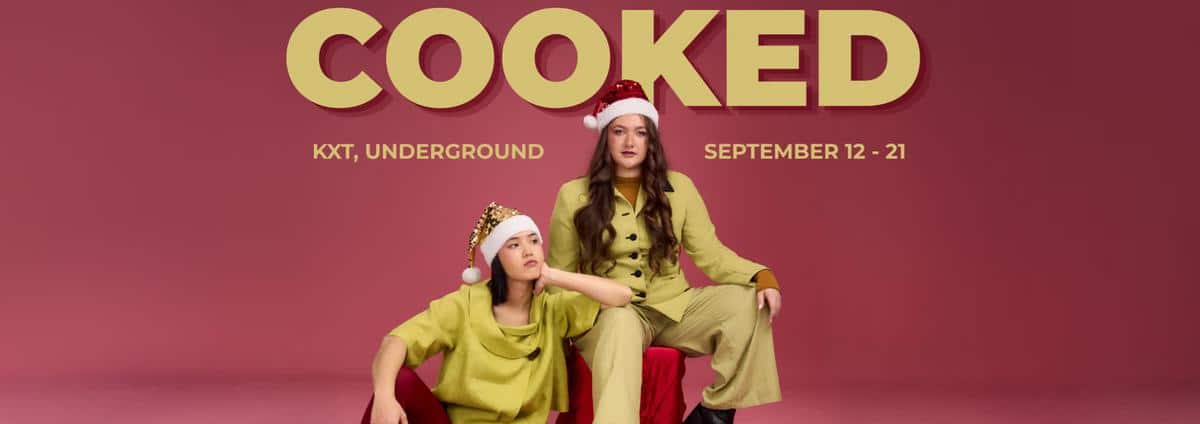
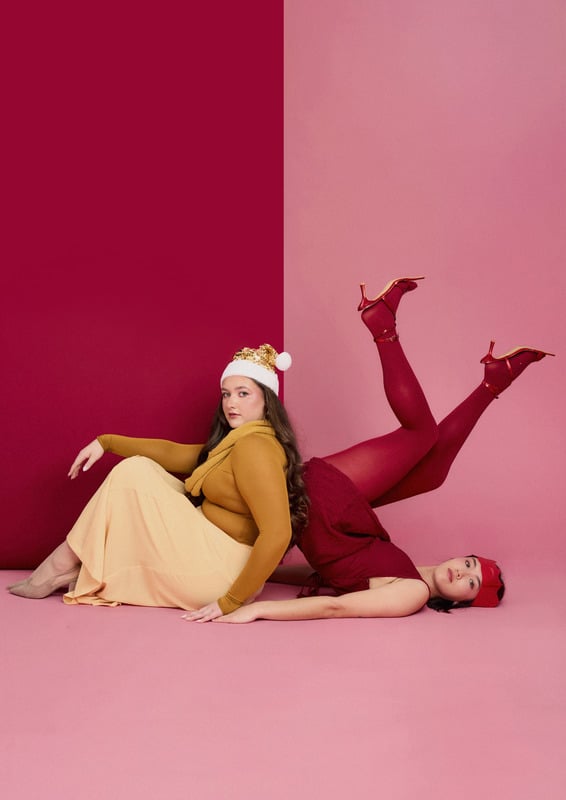
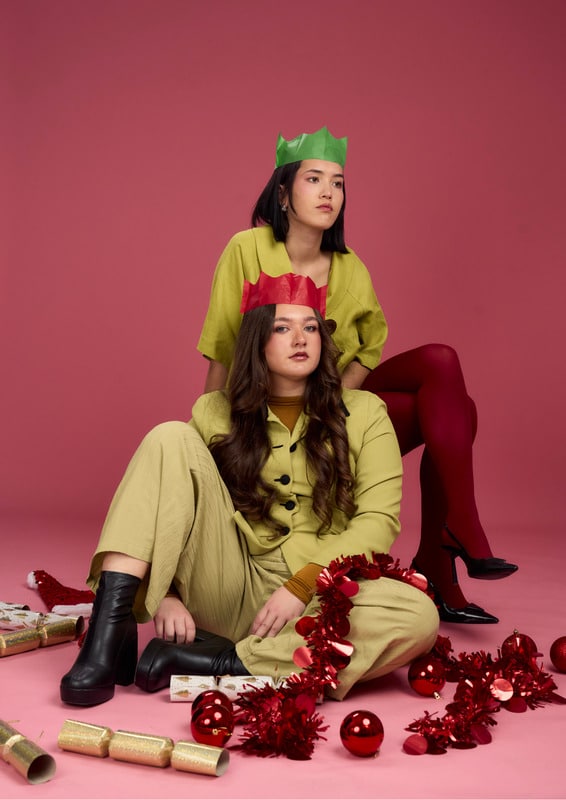
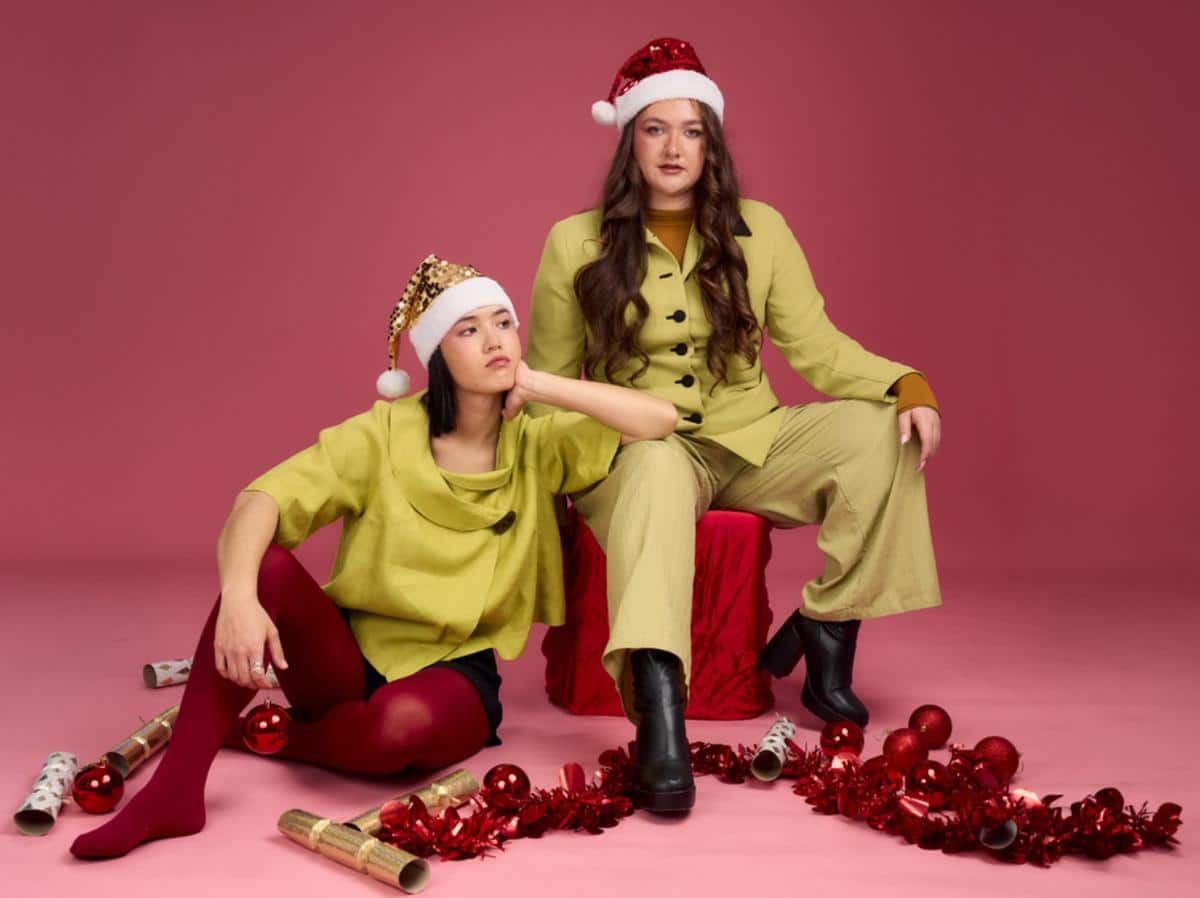
Cooked by Angel Duggan and Lana Page
At KXT on Broadway Downstairs
Creative Team
Director: Laura Jackson
Writer/Performer: Angel Duggan
Writer/Performer: Lana Page
Performer: Sally Evans
Lighting and Sound Designer: Sansona Trinh
Costume, Set and Props Design: Sam Hollingshead
Producers: Angel Duggan and Lana Page
I feel a lot of hard work went into this production but I’m not sure if it was cooked, more like half baked.
“Christmas this year is “cooked.” Logan’s world is tested when her mum starts to come home late, disappears, and acts ‘off’. She looks to her best friend Jean for support, however a new boyfriend – the kind that you have a ‘funny feeling’ about – begins to test their friendship. Full of vaping, Tn’s, Kookai, and ‘woo woo energy’, these women navigate their insecurities, judgements and some hard truths about each other.
Christmas is fucked but maybe New Years will be better?”
We never heard about New Years funnily enough. A lot like the ending, where we didn’t really get a conclusion.
The play tries to dabble with some heavy hitting themes about alcoholism, depression and domestic violence but nothing really hits the mark. I thought I’d be coming out of this play crying but instead felt rather empty. This could have been the playwright’s intension.
I understand why actors start writing their own work so they can create opportunities for themselves and others but sometimes as playwrights, actors are too close to the material, so they don’t quite get there and connect. A lot of sections of the play seemed over rehearsed and not in the moment. There was a lot of playing to the balcony and not the people in front of you, which made it feel really disconnected. Perhaps the show needs to be workshopped more. Opening the play with some super out of tune singing was a choice!
This was their second show in a short run at BXT on Broadway downstairs. I wonder if some of the issues I saw were to do with the classic second show slump.
The space downstairs is tiny, it could do with some slightly raked seating, as sight lines are a problem unless you are in the front row. The speakers are deafening; the high volume is not needed for such a small space. They were so distracting throughout the entire play and so many moments were destroyed because of this. Like the seats upstairs, these are just as uncomfortable. It was lucky the play was only 55 minutes long. Take a cushion with you.
Sally Evans performance as Mum was quite the standout. She craftily balanced quirky comedy, melodrama and very dramatic scenes with ease.
It is lovely to see a full house with so many people supporting live theatre.
Grief is no new topic for the world of theatre. One of the most fundamental human experiences, it is endlessly relatable, never faltering in its supply of new material. Of course, because grief has been explored before, it requires some level of reinvention to allow it to be interesting — A Chinese Christmas in this regard, went above and beyond. In a 70-minute, yet deceptively thorough dissection of what it truly means not to mourn someone, but miss them, Director Monica Sayers and Writer/Lead Trent Foo hold our hands through a gentle exploration of how to reconnect with something larger than ourselves in our moments of destruction.
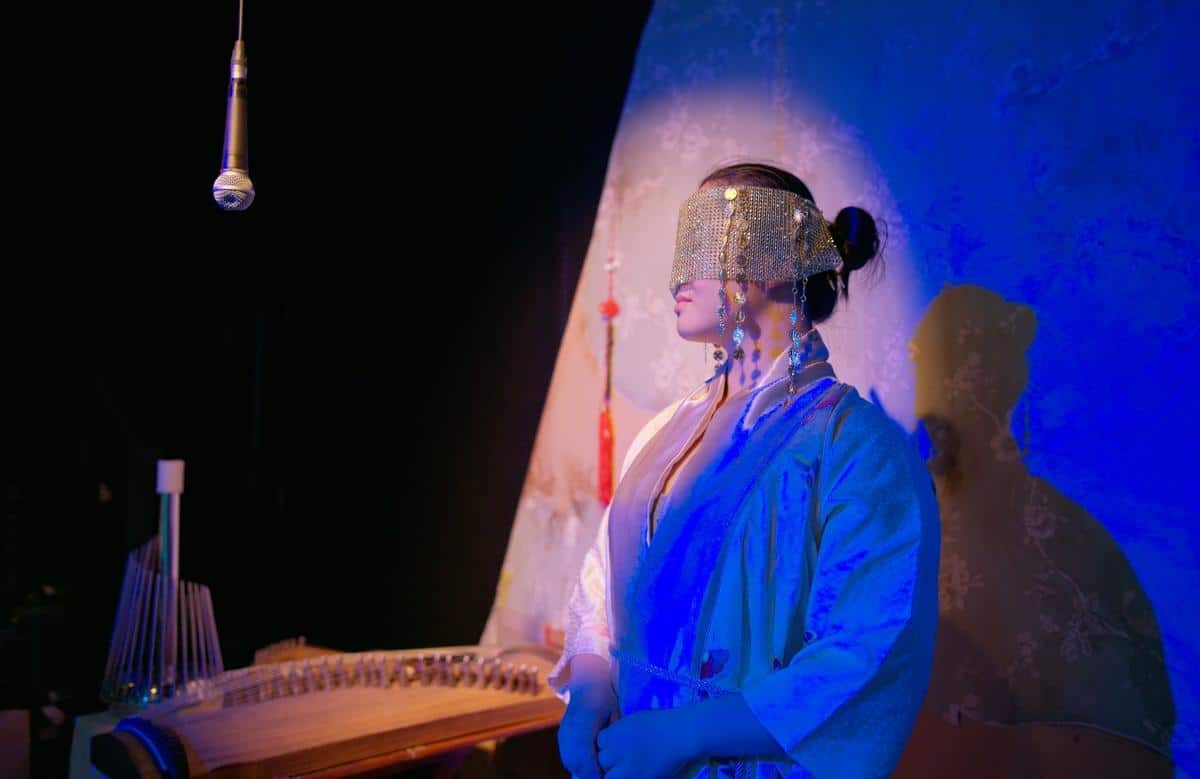
Set on the traverse stage of KXT Broadway, the audience enters into the slightly desolate warmth of an apartment. Cardboard boxes are scattered through the space, along with clutter that could or could not be entirely meaningless. Long lines of fibrous twine cut diagonal lines through the air, and natural fabrics are draped over chairs and lamps, cultivating a grounded and stylistic flair within the room. The hourglass was a particularly interesting touch, subtly elevating the stakes in a very grounded and practical way. The space is both carefully put together, in hanging lamps and the dangle of a microphone, and crucially dilapidated with the peeling wallpaper— setting the mood for our lead’s mental state. Much praise must go to Amy Lane here for her impeccable and considerate use of space. Further, her costume design for Lady Dai was also incredibly impressive, giving Jolin Jiang an almost inhuman energy with the shimmering gold over her eyes.
Production design continued to impress through lighting and sound; Jiang playing five or six instruments live through the show, which drew our attention back to the events on stage without ever becoming jarring. The use of colour and spotlighting from Cat Mai both elevated the moments of drama, and softened the piece into an almost dreamlike state when necessary. Cameron Smith’s sound design, along with Jiang as the composer seemed to almost communicate with both the moment, the emotion, and sometimes the characters themselves. Jiang’s work as a musician and composer, and also her physical work on stage, was so strong, in fact, I was almost left wishing the character she portrayed — Lady Dai — was an unspeaking role, as she created an untouchable mysticality around herself that was at times undercut by her less confident vocal work. However, I understood why the choice was made through the end reveal (which I won’t spoil). As a whole, the piece was incredibly beautiful, and production deserves many of the flowers in both matching and creating the emotional journey of the show. Between set, costume, lighting, and sound, the show moved aesthetically beyond the theatrical, settling into the cinematic.
Foo, in turn, gives us a spunky, naive, and energized portrayal of Heepa — a young man trying to bring his entire extended family together for Christmas. His physical work was very strong, clean movements and confidence through stunts created great moments of comedy and underlined his intentions well. His study of stage combat is very clear in this regard. In many ways, A Chinese Christmas functioned for the most part as a one-man show, and Foo effectively utilized this style to engage with his audience. Watching impassively, we were the ancestors coming to visit — always judging, never quite as helpful as he wanted us to be. His voice was clear and strong, and carried us through the show through his excitement. However, I would’ve liked to see him relax on stage, even only about 10-20% — as his energy manifested as a tendency to struggle with connecting with the words or the emotions, performing through them instead. This, although working for moments of comedy, left moments of grief falling slightly short. His performance was the most beautiful at its moments of stillness, slowness, and simplicity, especially in times of reflection. One of my favourite moments of the night in this regard was when the lights on the makeshift Christmas tree weren’t quite turning on, and we watched a very human awkwardness and frustration come out through humour.
Tiang Lim supports the show through her portrayal as PawPaw, the matriarch of this tiny family. Lim gave us a beautifully subtle study of the way that many of our older generations simultaneously ignore their emotions, whilst being swept up and ever affected by them. Although her vocal work leaned slightly into patterns, her work was so incredibly vulnerable that those flaws were easily ignored. Her scene with Foo in the car was particularly effective, both in her wisdom and sympathy, and the recorded monologue of her letter left the crowd very much misty-eyed. PawPaw, although not being quite human herself, was easily the most complexly human character of the show.
With such a common topic, it would be easy for A Chinese Christmas to lose the attention of its audience — but this show succeeds in leaps and bounds both in its cultural accessibility, and how it uses that cultural accessibility to draw in its audience. Although some of the emotional work did lean slightly demonstrative, and some of the connective tissue between moments was a little weak, Foo and Sayers have given us a deeply earnest exploration into loss that excites without excluding. It reminds us beautifully of the ways that we are loved, even if we cannot understand how that love is communicated. All the while, it simultaneously allows for those on stage, and us in the audience, to, as a collective, reach that final stage of grief: acceptance.
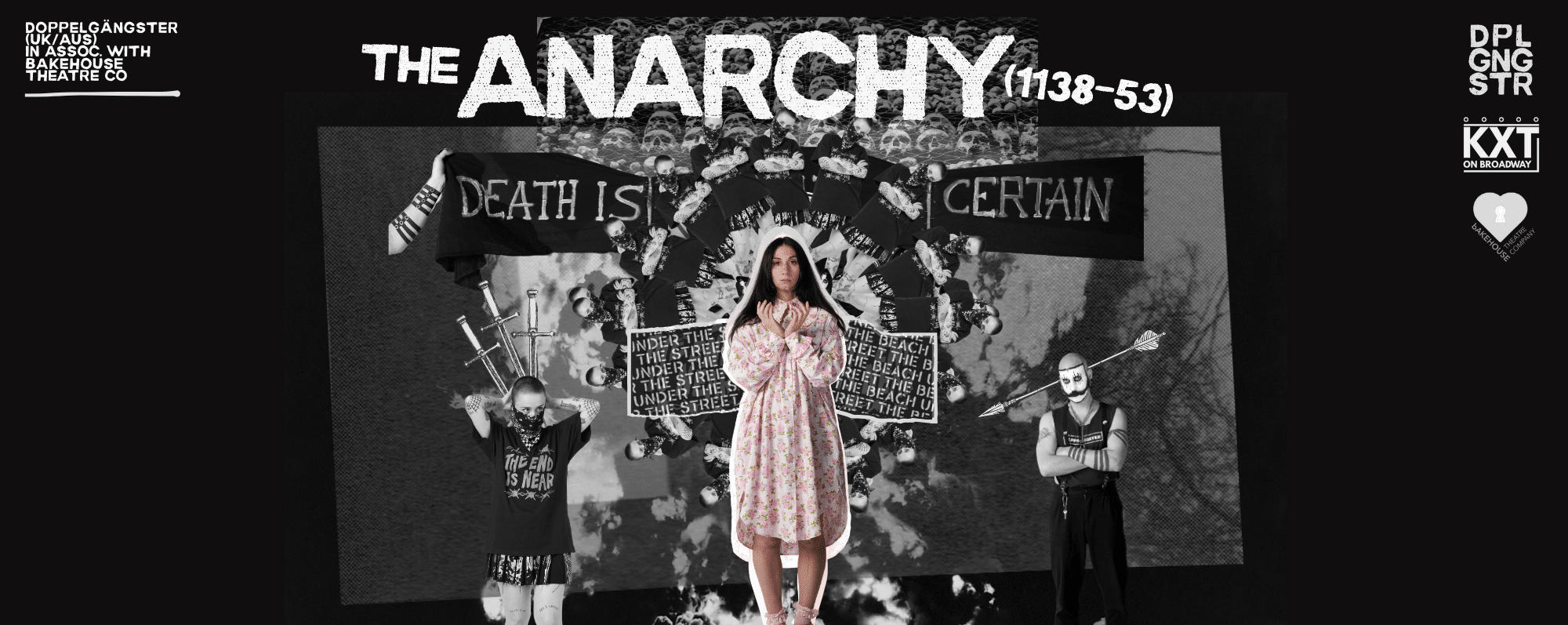
The Anarchy 1138-53, presented in KXT on Broadway, is like walking into a narrated RPG walkthrough that spans levels of anarchy, death and destruction!
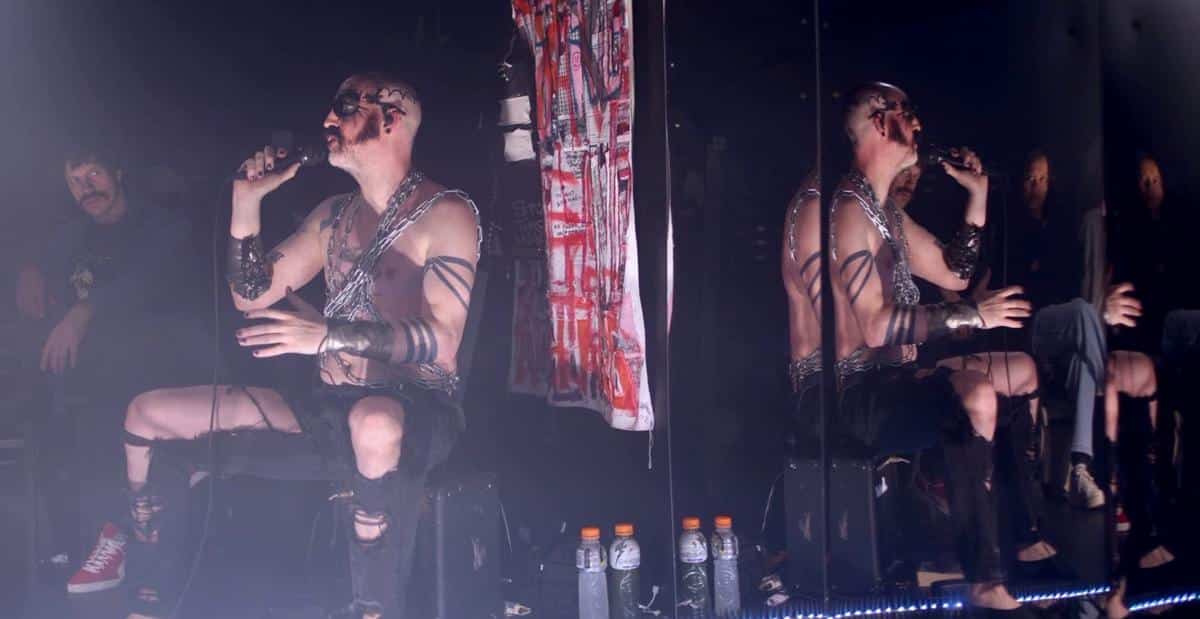
The stage is a mirrored walkway where the mirror is at once a reflection in water as you travel through the oceans on an imaginary boat before becoming the beach where you are shipwrecked, as enemies swoop in, dragons fly and various characters aim to destroy you.
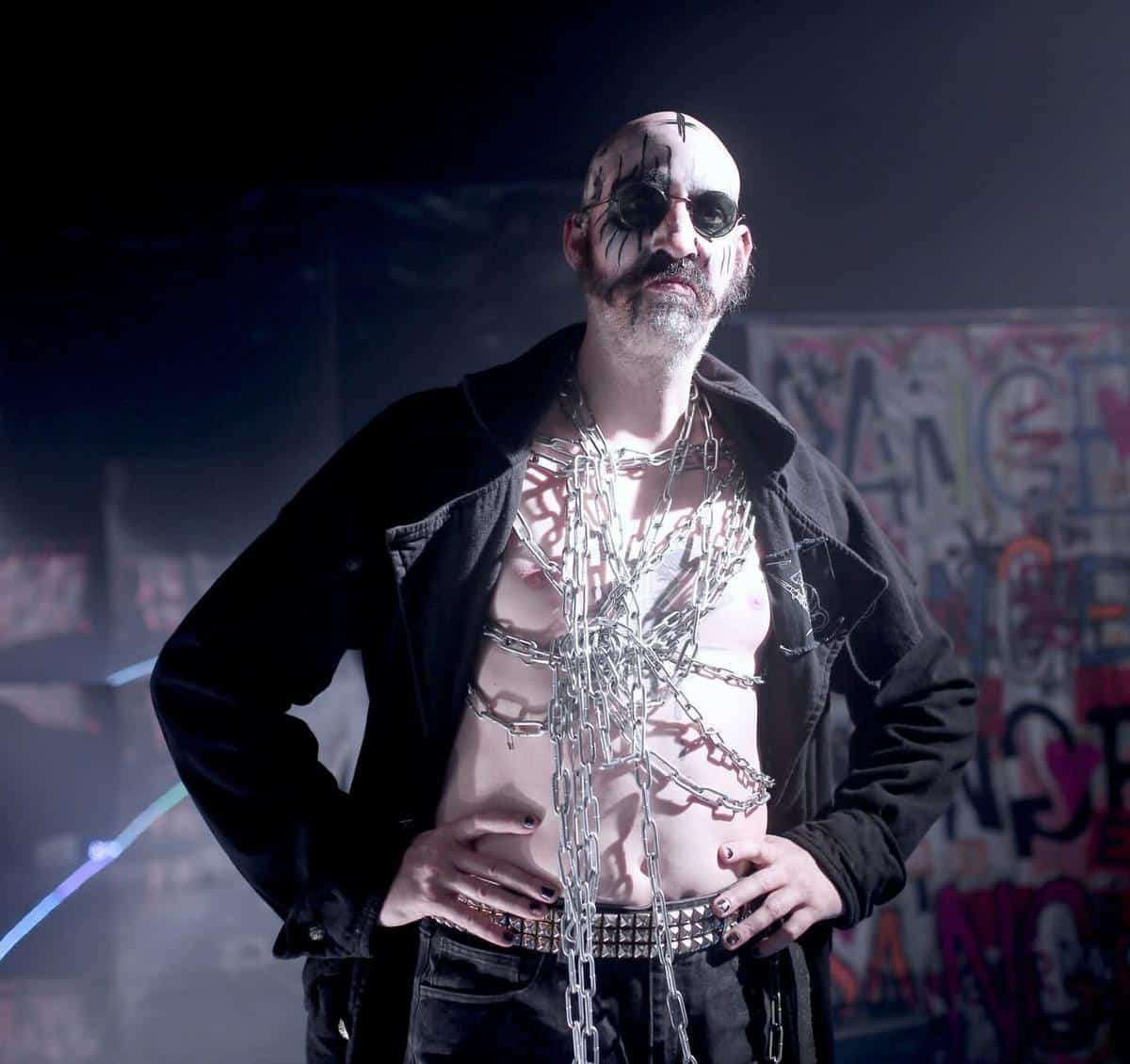
The imaginary RPG campaign you find yourself in is set in Britain, or another dystopia where anarchy prevails and suffering is a plenty – this is the ‘Crossworlds Universe’, narrated by two hyper-verbal guides whose stamina is as relentless as their script.
While in regular theatre productions the actors play out the scenes, in this play it is mostly just narrated, with moments of re-enactment and audience interaction being a much needed respite from the tyranny of the spoken words that flow out of both actors at astronomical speed.
As the story progresses you from the ‘tutorial’ and through the myriad of ‘levels’, it becomes one level too many, and this 135 minute no interval play, begins to resemble a notoriously long boss fight—technically impressive but emotionally numbing.
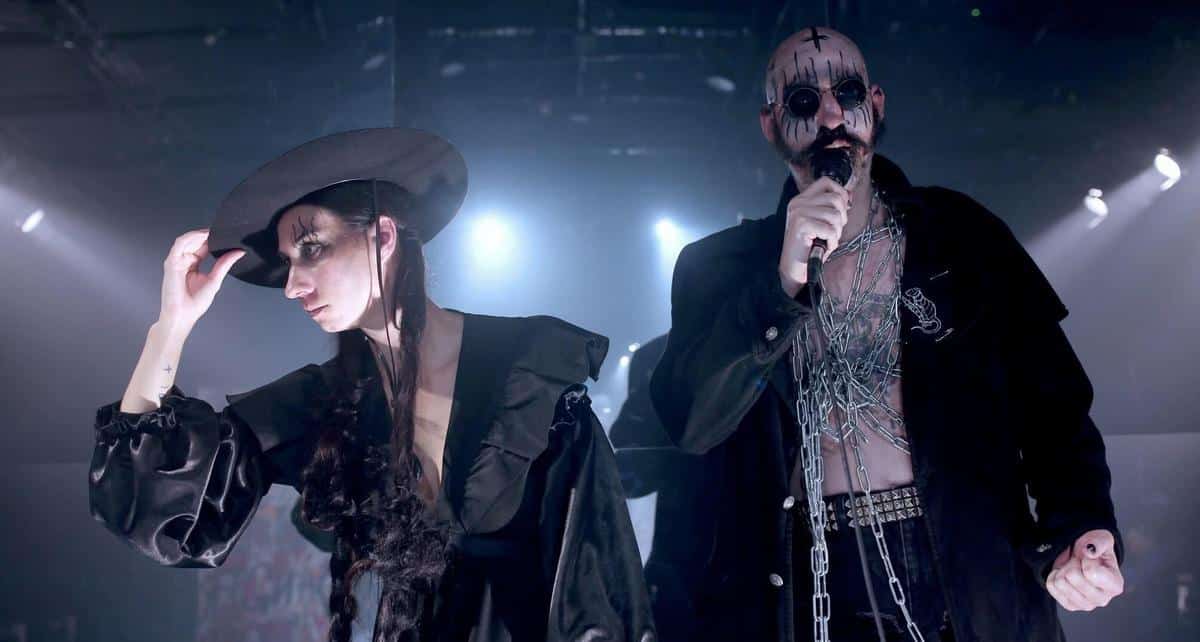
Though the dark, punk world the play creates is intriguing and the production is inventive and daring, the overall experience is somewhat languished and the script feels a little too self indulgent.
Sometimes some levels are best left sans walkthrough, for the gamer to navigate, even if that means dying and respawning a few times.