The Social Ladder

The Social Ladder

The Social Ladder Rating

★★★★★

Click if you liked this article

9

At its world premiere, The Social Ladder found an impeccably apt home at the Ensemble Theatre—the country’s longest continuously running professional theatre company—perched in rarified Kirribilli, with Sydney Harbour shimmering outside like an accessory quietly signaling old money. One could hardly imagine a more socially literate setting for a play so exquisitely preoccupied with rank, aspiration, and the fragile choreography of belonging.

Penned by David Williamson AO—Australia’s grand maütre of social satire, whose canon includes such drawing-room dissections as Emerald City and Don’s Party—this latest work turns its incisive gaze toward status itself: how it is curated, performed, and so desperately desired. Williamson’s dialogue is once again sharp as cut crystal, producing laughter that curdles almost immediately into recognition.

In an age of relentless social visibility, where curated online selves often eclipse private truths, The Social Ladder feels not merely timely but almost uncomfortably current. The premise is elegantly contained: three couples, six agendas, one dinner party designed as a social audition. At its centre is Katie (Mandy Bishop), a woman of unmistakable ambition and unmistakably non-elite origins. Hailing from resolutely middle-class Engadine, her accent alone threatens to betray her aspirations, yet she is convinced—fervently—that her talents merit elevation.

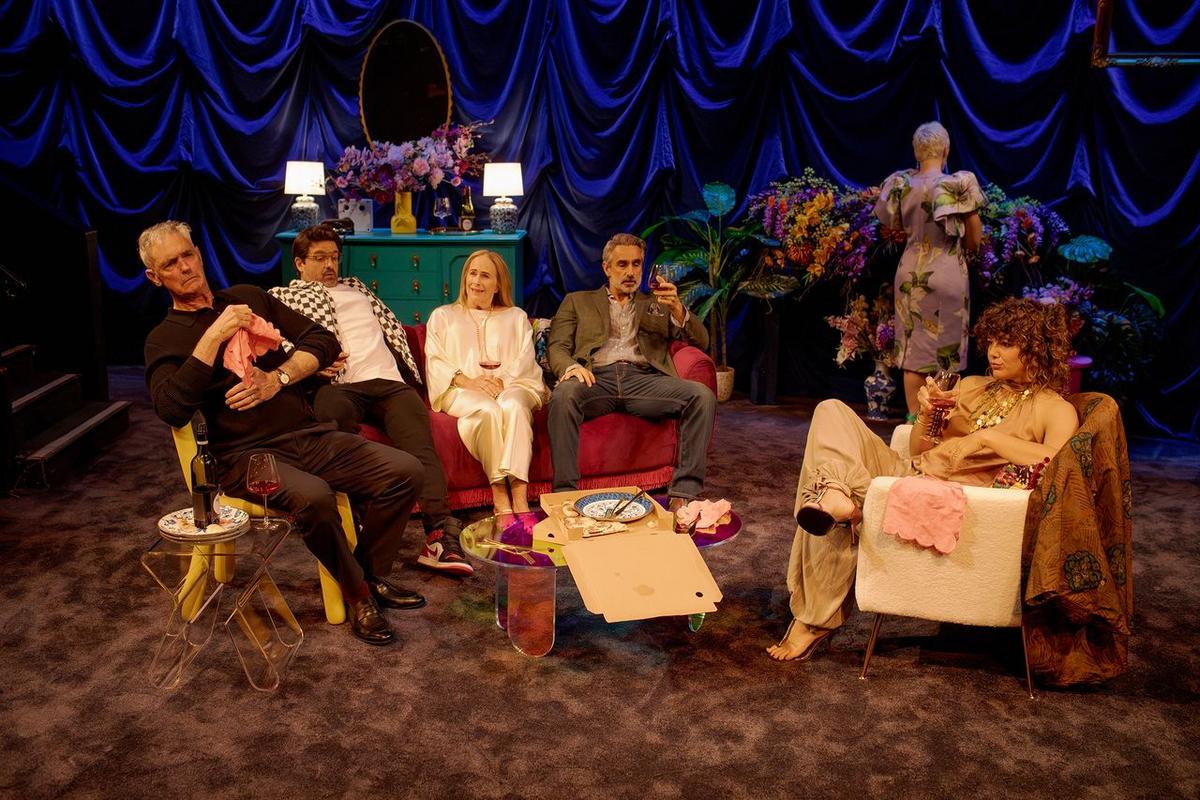


Her chosen ladder rung arrives in the form of Sydney power couple Charles (Andrew McFarlane) and Catherine Mallory (Sarah Chadwick), art-collecting, influence-wielding exemplars of cultural capital. A few fleeting schoolyard encounters with Catherine ignite Katie’s belief that proximity might equal access. Thus, the dinner is conceived: not a gathering, but a campaign.

No expense is spared. Catering is outsourced, furniture rented, and even an “artistic masterpiece” hired to telegraph taste. Appearances, after all, are everything. To soften the social calculus, Katie also invites her neighbours—old friends, Ben (Matt Minto), a once-promising film industry figure now professionally becalmed, and Laura (Jo Downing), a dance teacher whose achievements lack the requisite sheen. Their invitation is both olive branch and afterthought.

Naturally, the evening implodes. The food never arrives, the wine order is forgotten, and the borrowed artwork is revealed—mortifyingly—to belong to the very guests meant to be impressed. As façades fracture, civility gives way to desperation, deceit, and the ignominy of cheap wine and takeaway pizza.

The staging is slyly symbolic: three chandeliers ascending in grandeur, empty picture frames lining the walls, furniture beautiful but uncomfortable—an elegant visual shorthand for hollow status and performative taste. Performances across the board are finely tuned, creating the uncanny sensation of eavesdropping on a private catastrophe.

By the final unraveling—replete with secrets, betrayals, humiliations, and small redemptions—the audience is left laughing, wincing, and quietly auditing their own social manoeuvres. One exits the theatre not just entertained, but unsettled, pondering the price paid for a seat at the high-end table—and whether it was ever worth it.

To book tickets to The Social Ladder, please visit https://www.ensemble.com.au/shows/the-social-ladder/.

Photographer: Phil Erbacher

Spread the word on your favourite platform!

Red Herrings and Sinister Secrets - Agatha Christie’s The Murder of Roger Ackroyd

The Murder of Roger Ackroyd

The Murder of Roger Ackroyd Rating

★★★★★

Click if you liked this article

1

Agatha Christie was a prolific author, one of most well-known novelists in history. (In fact, she is considered the third best-selling author of all time, behind William Shakespeare and the Bible) Her 66 detective and 14 short story books have sold over 2 billion copies.

When What’s the Show sent me to review “The Murder of Roger Ackroyd”, I was looking forward to seeing the performance. Adapted by Philip Grecian, directed by Ali Bendall and presented by the Genesian Theatre Company, the play delivered a performance that would make Agatha Christie smile. It was a great choice to have as the first Agatha Christie play in 2026 at their new home in Rozelle.

The Murder of Roger Ackroyd is a play with a large cast. There are fourteen characters played by thirteen people. The first act of the show was dialogue heavy and had me playing catchup with Who’s Who. By the intermission though, I had a grasp on the relationships between the characters. The layout and design of the program was one of the most gorgeous I have seen - well done to the graphic designer. There was a Murder Mystery Bingo page for fun, a list of Possible Suspects and their role, and a Suspects / Motives Evidence Board which helped consolidate the characters for me during the intermission.

The play centres on Dr. James Sheppard (Nathan Moss), a local doctor in the quaint English village of King’s Abbot. He narrates the events surrounding the startling murder of the affluent Roger Ackroyd. A neighbour, known to Dr Sheppard’s sister Caroline (Roslyn Hicks) for throwing marrow over the fence, is the renowned Belgian sleuth Hercule Poirot (Peter David Allison). The famous detective known for his sharp mind and methodical approach becomes entangled in this mystery, even though he is retired. Through clever questioning and careful observation, Poirot works to reveal the real story beneath the surface, interviewing possible suspects and employing his “little grey cells” as he likes to put it, to lead the audience in a suspense-filled classic play.


Director Ali Bendall had the daunting task of creating a set with many different locations, and she successfully brought them all to the stage clearly with the use of lighting (Lighting Design by Cian Byrne) props (including a real antique Dictaphone) and variations in using the whole front theatre space. The cast were dynamically moving, including below the stage, in front and to the sides of the audience. The effect of this surprisingly brought the audience close to the action and encompassed us, making us feel a part of the story. Ali was also the Sound Designer and the ominous, dark music during the scene changes added to the whole atmosphere of mystery and threatening going-ons.

The script had some very witty moments throughout the show. Peter shone as bow tie wearing Poirot, the character delivering many lines and play on words which had us laughing. “The game is afeet!” “Hercule Poirot knows!” Roslyn as Caroline, the village gossip, held the audience from the beginning, her cheeky confidence as she bantered with her brother about all the happenings in the village was very funny. She is forgiven when she says, “I don’t pry things out of people!” indignantly, and then proceeds to ask personal questions to another character, indeed prying! John Parker (Peter Hoekstra-Bass) played The Butler who found the murdered Roger Ackroyd. On request from Poirot, his re-enactment with Ackroyd’s niece Flora Ackroyd (Jen Manoogian) was played with great over-enthusiasm, so much so that I thought, “John Parker has just discovered what he wants to do after he finishes his employment as a butler - acting!”

The cast and their British accents were impressive. Combined with Susan Carveth’s costume design, they put just the right emphasis on reeling the audience in and making us wonder who amongst these group of people was responsible for Roger Ackroyd’s death. Particularly during the second act, the red herrings were scattered everywhere, clues were looked for by me, and this became part of the game. It’s typical of an Agatha Christie novel - twisty, sinister secrets revealed slowly, blackmail, with a great ending. I won’t spoil the whodunnit, but when you see this play, (and you definitely should!), look out for the murderer’s pace and delivery – kudos to that actor, and to the whole cast.

The Murder of Roger Ackroyd is playing 16 January – 28 February 2026 at the Genesian Theatre. 2B Gordon Street, Rozelle.
Run Time: 2 hours 30 minutes (including a 20-minute interval)
Tickets: www.genesiantheatre.com.au/events/the-murder-of-roger-ackroyd

To book tickets to The Murder of Roger Ackroyd, please visit https://genesiantheatre.com.au/events/the-murder-of-roger-ackroyd/.

Photographer: Anthony Burns

Spread the word on your favourite platform!

Danny And The Deep Blue Sea

Danny And The Deep Blue Sea

Danny And The Deep Blue Sea Rating

★★★★★

Click if you liked this article

6

Danny And The Deep Blue Sea in one word is a hurricane. It is a force of nature to be reckoned with. Set in the 1980s in the Bronx, it follows the two characters of Danny and Roberta fiercely played by JK Kazzi and Jacqui Purvis. I mean this is a masterclass on acting. You truly believed every word they were saying. Honestly two of the best performances I have seen in recent memory. Their raw unfiltered emotion, and explosive dialogue masterfully written by John Patrick Shanley. This is no holds barred dialogue at its grittiest.

We follow the Characters of Danny and Roberta from a chance meeting at a bar and the encounters that follow are a whirlwind of violence and tenderness. I do issue a warning that this play has mature themes including violence from both parties, and does mention sexual abuse and there is also use of coarse language.

The direction of this play by Nigel Turner-Carroll is very clever, using every inch of the stage as an interactive landscape absolutely delights. There is a very well thought out scene change that doesn’t break the tension of the play which is very hard to do.


At the heart of this play is two very dysfunctional people that come across very unlikable at the beginning but then throughout the course of the play you will begin to think and ponder that absolutely everyone is deserving of love and kindness, no matter their flaws.

The audience gave this play a standing ovation, and rightly so. Everything worked, from the accents, to the acting, the lighting and great use of the stage.

The Old Fitz is an intimate venue perfect for this type of play.

Theatre at it’s absolute best should leave the audience changed in some way. This play left a mark on me and gave me an insight into a world that is foreign to me. I left the theatre actually having more empathy for people that live a different life to myself, and I think that is a true testament to everyone involved in this production.

This play is a thought provoking hurricane that takes you on a roller coaster of emotion, that will ultimately leave you changed after witnessing it.

A very big congratulations to all involved and I don’t think you can ask much more of a theatre experience.

To book tickets to Danny And The Deep Blue Sea, please visit https://www.oldfitztheatre.com.au/danny-and-the-deep-blue-sea-1.

Photographer: Tony Davison

Spread the word on your favourite platform!

Those Life Changing Three Little Words - Elanora Players

Three Little Words

Three Little Words Rating

★★★★★

Click if you liked this article

1

Australian Playwright Joanna Murray-Smith’s choice of “Three Little Words” for a title about two couples’ friendship is an interesting one. Initially I assumed that those three little words alluded to “I Love You”. However by the end of the play I realised that those three little words could be interpreted as to whatever the audience thinks – and this was a very clever prelude to a witty script performed by four engaging actors from the Elanora Players.

Tess (Tracey Keene) and Curtis (Paul Sheldon) have invited their long-time besties for dinner on their 20-year anniversary. After reminiscing good naturedly about the many good times and the way they met, Tess and Curtis announce a bombshell in the form of three little words, “We’re Splitting Up”. Bonnie (Karen Oughtred) and her partner Annie (Chantal Harrison) are disbelieving and shocked. The shaking up of what they thought was an unbreakable bond between the four friends sets off a split between all of them, and we are witness to the devastation that unravels.

Tess wants to explore her own identity, apart from being a daughter, wife and mother and yearns for something other than domesticity. She is highly critical of Curtis’ occupation as a teacher (“overqualified and underpaid”) and is constantly irritated by her husband’s habits. Tess is a self-centred woman who desperately wants out of the marriage to see what she could evolve into. She believes that Curtis will be there for her afterward. Tracey portrayed Tess’ selfish character that was quite unlikeable very successfully to the audience.

Initially I found myself feeling sorry for downtrodden Curtis, with his gentle manner and complacency. However, his immediate behaviour following the separation sparks some controversy, as Paul effectively expands his character's complexity by swiftly entering the dating scene to be with a significantly younger woman. His actions suggest that an amicable separation might be unlikely, and his pointed, hurtful remarks towards Tess diminish my sympathy for him.


The split is a catalyst for Annie, a masseuse and Bonnie, a high-end art dealer, to suddenly explore their own relationship. Bonnie’s warm and younger partner Annie, who feels Bonnie’s condescending words deeply, was played with a sweet, quiet strength by Chantal.

Karen’s character Bonnie had a mix of forthrightness and vulnerability. Kudos to Karen who held the stage with convincing conviction – Bonnie was a standout character to me.

There’s a recurring reference to and even a custody battle for Tess and Curtis’ tantalus, a wooden lockable stand, which holds whiskey and is inaccessible without a key, to keep it safe from children or from servants in the old days. This heirloom is a gentle representative of how Tess feels, alluding to the Greek myth of Tantalus, who was eternally tempted by food and water just out of reach.

Director Kerrie King’s set was simple and effective, showing two living rooms side by side, their own spaces represented and separated by the use of different coloured walls and furniture. Lighting designer Wayne Chee and Lighting Operator Thomas Van der Plaat highlighted the rooms and characters well, bringing attention to where it was needed. Sound Design and Operator Walter Opdam’s choice of music brought the right atmosphere to the play, especially with his choices of songs such as George Michael’s “Freedom” as Tess was dancing and singing on the couch, and a song I’d never heard about IKEA as Tess attempted (and failed) to put together something from IKEA, after boasting to her friends that she never wanted to have anything personal again!

“Three Little Words” is a portrait of the aftermath of a breakup, of how the dissolving of one couple’s marriage affects their friends unexpectantly. How the dynamics of situations change in ways that are unpredictable because we are human. It is certainly a thought-provoking play, but not a play that is completely sad. In parts yes, but this clever script was laden with so many light moments sprinkled in, delivered by the characters’ wry and quick dialogues which made me and the audience laugh often, and quite a lot!

I loved the Elanora Players’ production of Three Little Words! Perhaps those Three Little Words from the title may have been “I See You” or Annie’s wisdom of “It’s About Kindness”. Or maybe it is meant to mean something else altogether; the audience can make up their own minds and there is creative beauty leaving it like that.

“Three Little Words” run time: approximately 90 minutes, with a 20 minute interval
Jan 9 – Jan 17 2026 at North Narrabeen Community Centre, 2-10 Woorarra Avenue, North Narrabeen
www.elanoraplayers.com.au

To book tickets to Three Little Words, please visit https://elanoraplayers.com.au/.

Spread the word on your favourite platform!

Subscribe to What's The Show

Reviews, show news and what is on, straight to your inbox.