Ghosts of Christmas Past: A Chinese Christmas at KXT

A Chinese Christmas

A Chinese Christmas Rating

★★★★★

Click if you liked this article

Grief is no new topic for the world of theatre. One of the most fundamental human experiences, it is endlessly relatable, never faltering in its supply of new material. Of course, because grief has been explored before, it requires some level of reinvention to allow it to be interesting — A Chinese Christmas in this regard, went above and beyond. In a 70-minute, yet deceptively thorough dissection of what it truly means not to mourn someone, but miss them, Director Monica Sayers and Writer/Lead Trent Foo hold our hands through a gentle exploration of how to reconnect with something larger than ourselves in our moments of destruction.

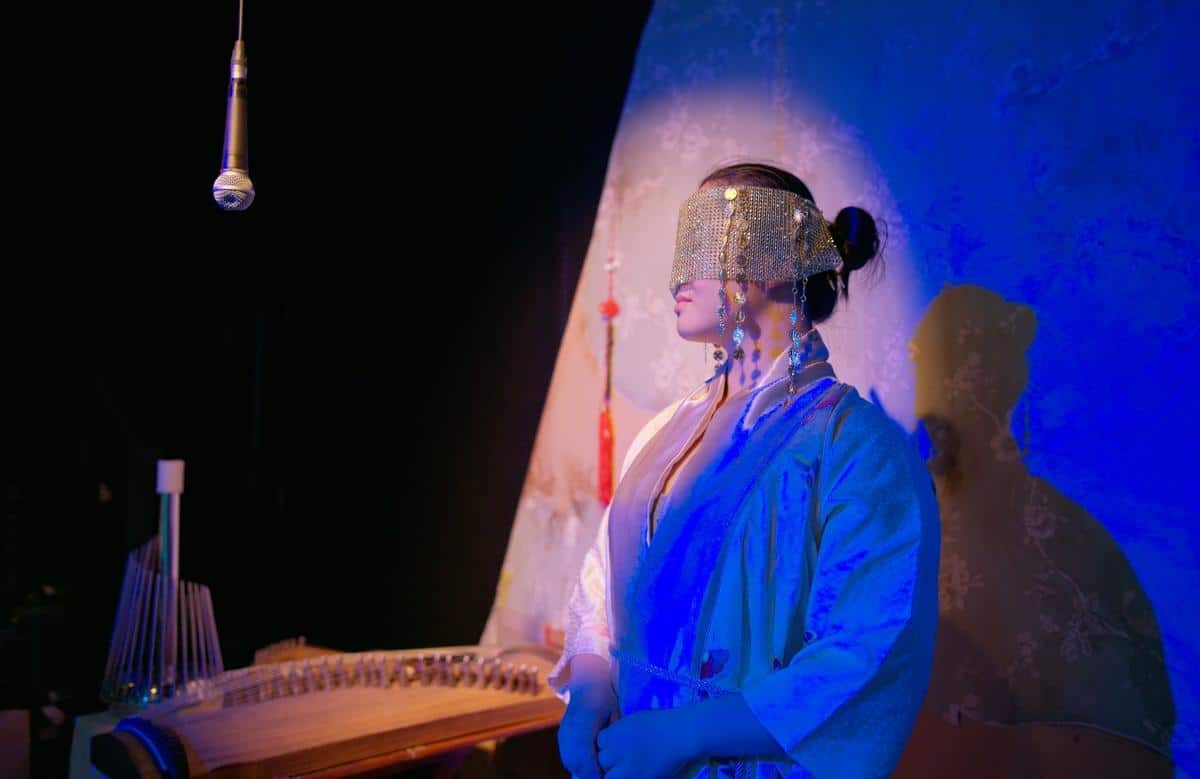
Set on the traverse stage of KXT Broadway, the audience enters into the slightly desolate warmth of an apartment. Cardboard boxes are scattered through the space, along with clutter that could or could not be entirely meaningless. Long lines of fibrous twine cut diagonal lines through the air, and natural fabrics are draped over chairs and lamps, cultivating a grounded and stylistic flair within the room. The hourglass was a particularly interesting touch, subtly elevating the stakes in a very grounded and practical way. The space is both carefully put together, in hanging lamps and the dangle of a microphone, and crucially dilapidated with the peeling wallpaper— setting the mood for our lead’s mental state. Much praise must go to Amy Lane here for her impeccable and considerate use of space. Further, her costume design for Lady Dai was also incredibly impressive, giving Jolin Jiang an almost inhuman energy with the shimmering gold over her eyes.

Production design continued to impress through lighting and sound; Jiang playing five or six instruments live through the show, which drew our attention back to the events on stage without ever becoming jarring. The use of colour and spotlighting from Cat Mai both elevated the moments of drama, and softened the piece into an almost dreamlike state when necessary. Cameron Smith’s sound design, along with Jiang as the composer seemed to almost communicate with both the moment, the emotion, and sometimes the characters themselves. Jiang’s work as a musician and composer, and also her physical work on stage, was so strong, in fact, I was almost left wishing the character she portrayed — Lady Dai — was an unspeaking role, as she created an untouchable mysticality around herself that was at times undercut by her less confident vocal work. However, I understood why the choice was made through the end reveal (which I won’t spoil). As a whole, the piece was incredibly beautiful, and production deserves many of the flowers in both matching and creating the emotional journey of the show. Between set, costume, lighting, and sound, the show moved aesthetically beyond the theatrical, settling into the cinematic.


Foo, in turn, gives us a spunky, naive, and energized portrayal of Heepa — a young man trying to bring his entire extended family together for Christmas. His physical work was very strong, clean movements and confidence through stunts created great moments of comedy and underlined his intentions well. His study of stage combat is very clear in this regard. In many ways, A Chinese Christmas functioned for the most part as a one-man show, and Foo effectively utilized this style to engage with his audience. Watching impassively, we were the ancestors coming to visit — always judging, never quite as helpful as he wanted us to be. His voice was clear and strong, and carried us through the show through his excitement. However, I would’ve liked to see him relax on stage, even only about 10-20% — as his energy manifested as a tendency to struggle with connecting with the words or the emotions, performing through them instead. This, although working for moments of comedy, left moments of grief falling slightly short. His performance was the most beautiful at its moments of stillness, slowness, and simplicity, especially in times of reflection. One of my favourite moments of the night in this regard was when the lights on the makeshift Christmas tree weren’t quite turning on, and we watched a very human awkwardness and frustration come out through humour.

Tiang Lim supports the show through her portrayal as PawPaw, the matriarch of this tiny family. Lim gave us a beautifully subtle study of the way that many of our older generations simultaneously ignore their emotions, whilst being swept up and ever affected by them. Although her vocal work leaned slightly into patterns, her work was so incredibly vulnerable that those flaws were easily ignored. Her scene with Foo in the car was particularly effective, both in her wisdom and sympathy, and the recorded monologue of her letter left the crowd very much misty-eyed. PawPaw, although not being quite human herself, was easily the most complexly human character of the show.

With such a common topic, it would be easy for A Chinese Christmas to lose the attention of its audience — but this show succeeds in leaps and bounds both in its cultural accessibility, and how it uses that cultural accessibility to draw in its audience. Although some of the emotional work did lean slightly demonstrative, and some of the connective tissue between moments was a little weak, Foo and Sayers have given us a deeply earnest exploration into loss that excites without excluding. It reminds us beautifully of the ways that we are loved, even if we cannot understand how that love is communicated. All the while, it simultaneously allows for those on stage, and us in the audience, to, as a collective, reach that final stage of grief: acceptance.

To book tickets to A Chinese Christmas, please visit https://www.kingsxtheatre.com/a-chinese-christmas.

Photographer: Robert Miniter

Spread the word on your favourite platform!

A Twist Of Fate Christmas Special

A Twist Of Fate

A Twist Of Fate Rating

★★★★★

Click if you liked this article

2

T’was the night of Scary Goats Theatre’s A Twist Of Fate Christmas special. All through the Motley Bauhaus cellar, such a merry and full audience was stirring that you wouldn’t have guessed that the company only kicked into gear roughly a year ago. Having seen a past Twist Of Fate season in May, I understood the format and was keen to see more: a series of four short plays inspired by The Twilight Zone and centred around a devastating twist. After only half a year, I was delighted to see that the company has further honed a unique brand of camp, engrossing indie horror with a pool of talented writers and actors.

The night opened with Emily Morey’s play ‘Naughty Nicholas’, in which a little boy is threatened with ‘no Christmas’ after setting fire to the family Christmas tree. He decides to build his own robotic Santa to wreak vengeance on those written on his personal naughty list. The physical acting from all cast members, from the ‘children’ to the janky mechanical Santa, was delightful. While some of the fighting between the main character and his sister felt a bit rushed, it wasn’t enough to detract from the story. I found myself wondering if the boy’s character was too unsympathetic, but luckily, it turned out his abominable Santa had similar concerns…

The second play, ‘Prisoners of the Season’ (written by Lore Burns) opens on four soldiers tied up by the wrists and neck with no memory of who or where they are. It was easy to guess the twist, but the fun came from watching the characters slowly figure it out. Once again, the physical acting was a highlight, and the ensemble’s sense of comedic timing was immaculate. Some of the actors had false moustaches that came loose, but the way the performers leant into and improvised around that gaffe was downright impressive and had the audience on their side in a heartbeat.

‘Office Party’ by Richard Mealey takes place at a Christmas celebration in an office that just so happens to be run by the offspring of the Christmas demon Krampus. As a holiday treat, he tempts Dylan, the office dogsbody, to punish a coworker who almost definitely killed someone for fun. This play was my favourite in terms of its writing and direction. It signalled a darker turn as we saw commentary on toxic masculinity and what is deemed as acceptable in corporate environments. The context and stakes were revealed in a gradual and satisfying way, there’s some fun puppeteering when ‘Krampus’ appears in the story, and the set and sound design were used very effectively to create a creepy build to an eerie ending that left me wanting more.


The final play, ‘Nineteen Eighty Clause’, was directed and written by Chloe Towan, who also emcees the Twist Of Fate series. A bunch of Christmas elves work tirelessly yet happily in Santa’s factory until one worker, Jangles, becomes so sleep-deprived that she starts hallucinating. This leads her to discover – with the help of a rogue elf named Sparky – that everyone in the workshop has been brainwashed into working for Santa, who turns out to be a cartoonishly cruel gangster. The corporate satire here is much more pointed and turned on the audience as we are made to question our own consumption habits around the holiday season. The romantic chemistry between Sparky and Jangles felt a bit contrived, but as the play itself points out with a fakeout ending: it’s Christmas, and a bit of positivity is sometimes needed to get us through the dark times. Overall, the social commentary is sharp while still having an optimistic message.

After five seasons of A Twist Of Fate and two Melbourne Fringe shows this year, this Christmas edition of Scary Goats’ most popular series felt like a well-deserved victory lap. Chloe Towan and her collaborators showed how they have earned their stripes by consistently creating tongue-in-cheek horror that pushes the constraints of indie theatre spaces without bursting the envelope. I cannot wait to see what they do next year, and I’ll certainly be looking forward to more than a few twists in their shows.

To book tickets to A Twist Of Fate, please visit https://www.eventfinda.com.au/2025/a-twist-of-fate-christmas-special/melbourne/carlton.

Spread the word on your favourite platform!

TWO

TWO

TWO Rating

★★★★★

Click if you liked this article

Melbourne’s queer theatre scene is growing bolder and more joyful with every passing year. However, with widespread acceptance and marketability, there is always a risk of falling into complacency. As a trans playwright, I’m well aware of this ‘tolerance trap’, so I was excited to see a new play with a protagonist as grey in their morality as they are in their gender presentation. Add themes of queer family dynamics and the societal treatment of AFAB bodies into the mix, and you have a recipe for a fascinating comedy. The execution of Two, directed and written by Artemis Muñoz, however, left much to be desired in terms of the writing, set design, and performances.

Two’s protagonist, Kit (Sienna Macalister), is polyamorous, non-binary and newly pregnant. Excited as they are to be a parent, they quickly grow sick of people’s questions about their baby’s gender/sex/genitals. During a particularly tense get-together, they lie to their mother (Rebecca Morton) and announce that they are having twins, a boy and a girl. This temporarily fields uncomfortable conversations with Kit’s family, but strains relations with their partners (Vasi Devi and Marz Cooper) and creates further issues once the (singular) child is born. Will Kit’s family, chosen and biological, survive the fallout?

When creating such an esoteric plotline, there’s a tricky balance between getting your themes across and not lecturing your audience. Unfortunately, I felt that Two fell off the latter side of that tightrope, especially when it came to Kit’s frustration with their mother. It often felt as if the script was insisting that we dislike the mother through prolonged rants from Kit, instead of letting the audience infer ways in which her microaggressions impacted her child. This didactic writing extended to other scenes that fell into a predictable pattern: someone makes an offensive comment, Kit calls them out, they double down, Kit gives them a scolding.


The staging also didn’t help with character connection because the space felt too wide. By using various side set pieces along with an expanding central frame, the actors felt so physically distant from the audience that it was hard to connect with their intimate scenes. The blocking often seemed stiff and aimless, with characters stuck standing around in scenes they didn’t fully belong in and a lack of opportunities for the actors to make eye contact with each other. A more closed-off stage and further opportunities to sit in moments of silence would have made it easier to connect with characters who are, on paper, fascinating.

Two still has moments where it lives up to the premise’s promise, especially after Kit’s child is born. The scene where Kit gives birth was a visceral showcase of Macalister’s acting, using a luminous ball as a stand-in for the baby was a beautiful symbolic choice, and there was a greater sense of emotional weight as certain character arcs wrapped up. The play’s penultimate scene with Kit and their mother was one of the only times when the mother felt fully sympathetic. It truly seemed that she didn’t fully understand the weight of her actions and that she had the potential to do better. It also brought home a more complex message about ‘cutting off’ loved ones: it isn’t easy on anyone and it’s never anybody’s first choice, but it can still promote the possibility of change.

Two is a play with many interesting things to say that needs further confidence in saying them. The writing comes across as lecturing at points, which could be mitigated by further drafting and less nervousness in the performances. I also think a smaller, more intimate venue would benefit the cast and audience. I would be interested in seeing a future production, and if the premise of the show resonates with you then you may enjoy it in its current form, but it could reach many more people with further polish.

To book tickets to TWO, please visit https://www.theatreworks.org.au/2025/two.

Spread the word on your favourite platform!

Love Actually? The Musical Parody is All I Want For Christmas

Love Actually? The Musical Parody

Love Actually? The Musical Parody Rating

★★★★★

Click if you liked this article

Twinkling lights and Christmas tunes greet you as you weave your way through the theatre. Humming along to Feliz Navidad after posing for a photo op like you are debuting the red carpet, you finally get comfortable in your seat. Front row or humble rear seats, the site leaves you breathless:

Before wide-eyed and smiling patrons, the stage transports you into the heart of the iconic Christmas rom-com. Love or despise the characters, storylines and actors that make Love Actually a Christmas special, the contagious cheer and excitement elicited from the reminiscent depiction of the Christmas school concert is contagious. Christmas trees, tinsel, lights, presents and two doors that hold the keys to the exploration of notable characters and questionable notions of love ensures a night to remember.

Comprised of an ensemble of six talented actors that emulate the subtle mannerisms of the renowned actors of the film, it feels as if Hugh Grant, Bill Nighy, Emma Thompson, Kiera Knightley, Colin Firth, Chiwetel Ejiofor and the late Alan Rickman have materialised. William Kasper, Nicole Kaminski, Benjamin Hambley, Dylan Hodge, Stephanie Beza and Ashton Simpson launch the audience into a whirlwind of emotions – humour, surprise and happiness. If parody is a new venture for attendees, then Love Actually? The Musical Parody is the place to be. Clever and vulgarly quick-witted, the musical production takes flight in throwing subtle shade at actor’s for their notorious rom-com lineage and their not-so romantic antics, while featuring their more iconic roles in popular culture to enhance the absurdity of their character’s dilemmas.


The outrageous and belly-laugh-inducing antics continue throughout the musical production through catchy, original songs that act as a throwback to iconic music of the 2000s, as well as the not-so-subtle innuendo associated with the beloved characters and iconic moments. Although humour and jokes carry the show from start to finish, the parody production offers the audience a chance to reflect on the crucial question guiding the show – is this love, actually? While watching the characters fumble through unrequited and requited love, barriers in language and culture, or searching for ‘love’ abroad, the audience explores what love actually means – rather than accepting the definition presented by the film’s glamorous stars and flashing lights we were told to believe all those years ago.

Love Actually? The Musical Parody is bold, hilarious and is sure to make you leave the theatre with laughter trailing behind you. Regardless of your perceptions of the original film, the exploration of the staple Christmas movie is sure to make your thoughts and opinions of the storyline feel validated.

Think professing your love to your best friend’s wife through a cardboard montage is a tad creepy?

Maybe you are not the only one.

Should Emma Thompson have been granted justice after Joni Michell’s CD greeted her trembling grin, rather than a beautiful necklace she believed was her Christmas gift?

Perhaps you should attend to find out.

To book tickets to Love Actually? The Musical Parody, please visit https://loveactuallymusicalparody.com/.

Spread the word on your favourite platform!

Subscribe to What's The Show

Reviews, show news and what is on, straight to your inbox.