Holy Fool

Holy Fool

Holy Fool Rating

★★★★★

Click if you liked this article

1

Holy Fool follows the story of Francis of Assisi (Fabio Motta) as he lives a complex turbulent life. Despite the title, I found the character of Francis to be a Holy Gentleman rather than fool, although sometimes Motta’s impressive adlib ability to engage the audience in silly and fun ways did err on the side of fool. Directed by Giovanni Fusetti, Holy Fool shared a consistently strong optimistic message, that human actions are powerful and can impact the natural world, and that our hero, Saint Francis, can and did make a difference.

Given the nature of the high rate of audience interaction for Holy Fool, the composition of the audience is important to the story Motta and Fusetti are telling. The evening I saw the show the audience was full of people speaking Italian, including a priest directly to my right! The audience already wanted Francis to succeed, and Motta made it easy to root for him. Throughout the show Motta encouraged the audience to energise and support Francis on his arduous journey.


Fusetti and Motta boldly choreographed and enacted an in-depth depiction of war in a one man show. It was daring. Throughout the show Motta transformed into different characters, the God father, the pope, Francis’ own father. Motta was entertaining and enthusiastically embodied each character in unique and exciting way. Motta embodied drama, danger, and offensiveness with only one man on stage. Motta expertly pivots Francis’ life purpose of glory and notability to caring for the poor, and is thus labelled a ‘Holy Fool’. In pursuit of caring for the poor Francis asks the audiences to give up their worldly possessions. In a hilarious and silly turn of events Francis donates all the audience members belongings to a ‘poor’ person in the front row. Motta was playful, and continued to thoughtfully interact with the audience throughout the show.

Francis asked “who would I be if I stripped all that defined me?” This came during his distinct turn towards helping the poor, where Francis aimed to become an “instrument of peace.” The shift in tone for the show was mirrored by the atmosphere within the audience, as the crowd sufficiently bought into the ideas of the show’s new thesis. Francis preached caring for others, caring for animals, and caring for nature. He emboldened the audience to follow his lead, and charismatically preached his newfound beliefs. He was earnest in his plead for care and connection. The style of physical comedy and audience interaction lead to the climax of the show where Francis sincerely asked the audience to commit to his new ideas and values, and then simply scooted away. The audience did affirm their commitment to the Holy Fool.

To book tickets to Holy Fool, please visit https://www.theatreworks.org.au/2026/holy-fool.

Photographer: Darren Gill

Spread the word on your favourite platform!

Savages: Drama Below The Decks

Savages

Savages Rating

★★★★★

Click if you liked this article

2

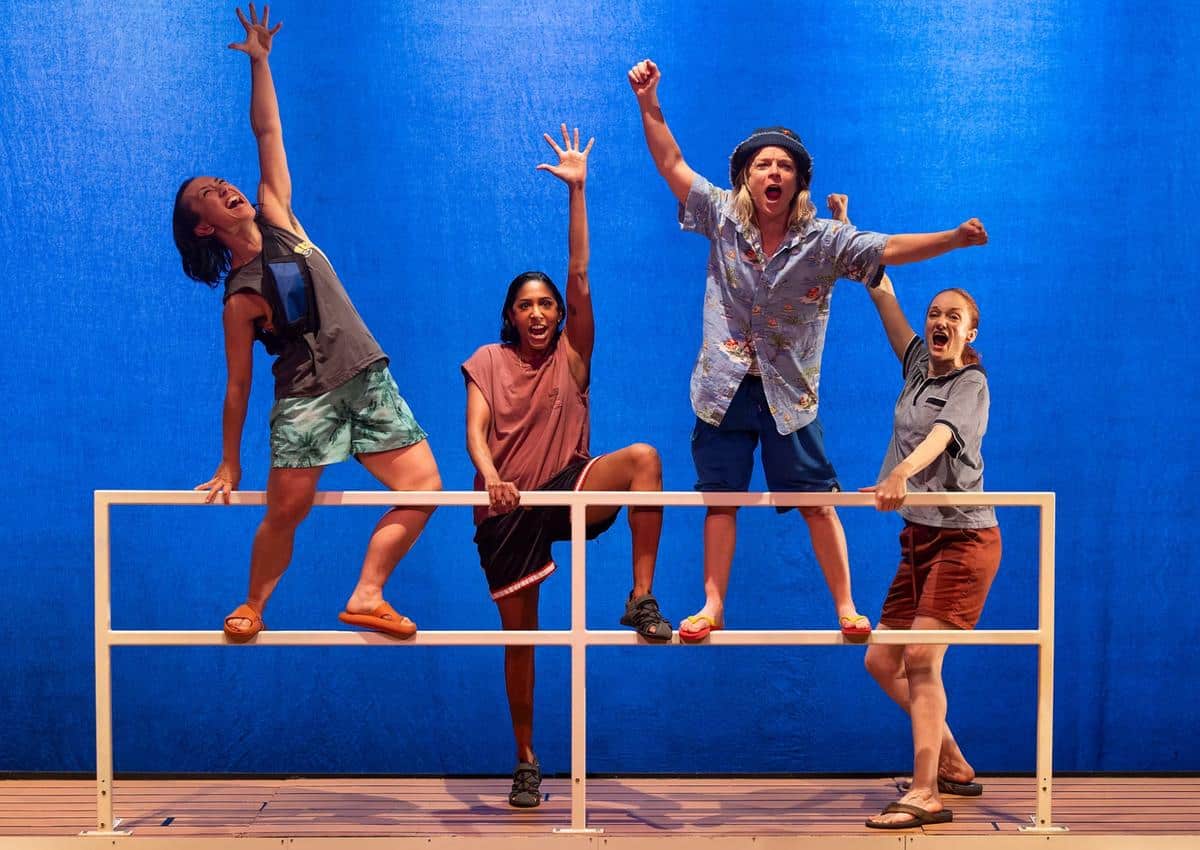
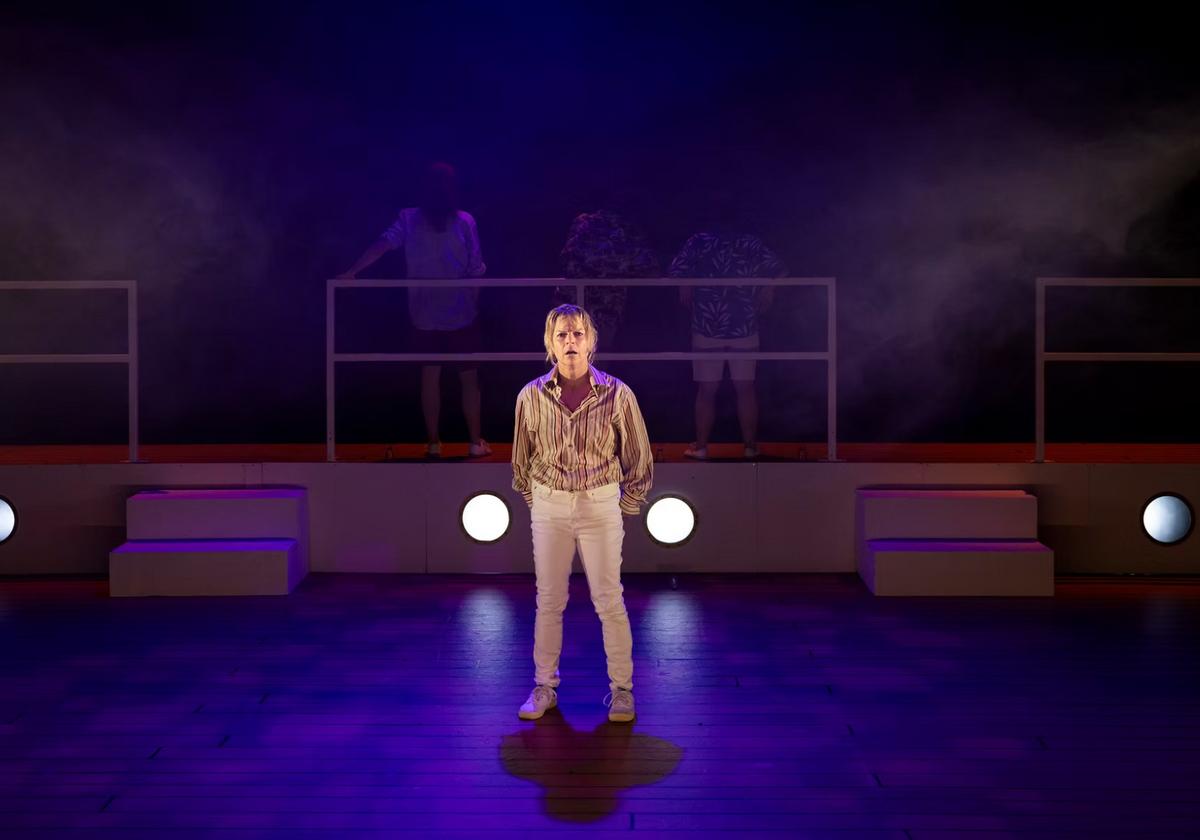
When a dramatically-drawn stage, set impressively as a stark deck of a cruise ship is cast in blue lighting, with unnerving music pounding from the speakers, I know I have arrived immediately in an undercurrent of something I can’t quite put my finger on. A backward feeling descending on my conscience; that once this cruise ship sets sail, there is nowhere I can escape from.

For this feeling of unbreathable submersion is Patricia Cornelius’ brilliant reimagined work, Savages, a play about four men immersed in tight mate-ship, climbing aboard a cruise and leaving their worries behind – heading off on ‘a holiday of a lifetime’, not yet knowing how their yearning for liberation will slowly spill out of control and descend into a night of chaos.

Thirteen years after this play originally took the stage, the decision to cast this show with women and non-binary people takes this piece to a whole other level, particularly where we currently sit with toxic masculinity and misogyny. How, in 2026, we still hear of men, particularly those ranking in high positions, still feeling entitled to disrespect women. How women still have to be guarded, even on cruise ships. Where there may lie a toxic breeding ground of expectation, ire, and unfathomable disrespect when it comes to our gender.

To examine the seemingly complex wiring of savage behaviour in 2026, Cornelius and the show’s director, Kitan Petkovski, thought to cast four incredibly agile women and non-binary actors, who symbolically leave their identities behind at the dock. Who immediately transform into four male characters with great humour, precise physicalities, and emotional complexities; exposing how underneath bravado and immoral behaviour, may lie simmering undercurrents of sadness and depression. Keen to liberate themselves from these emotional waves, these men continue to fight their way through: choosing pure self-satisfaction over what is morally right.


The cast all do a brilliant job of taking on their individual roles. Nicci Wilks is the humorous pick of choice, playing Runt with great comedic timing, delivering the performance of an Aussie bloke with a growl and groan, giving as much as he gets.

But AYA, delivers the level of acting not seen in years. Conveying the despicable character such as Rabbit is no easy feat, and AYA takes it to an expansive level – blending low-brow waywardness with complex pathos and vulnerability. For AYA is the epitome of what I would define as a gifted vessel, for any trued-and-true storyteller.

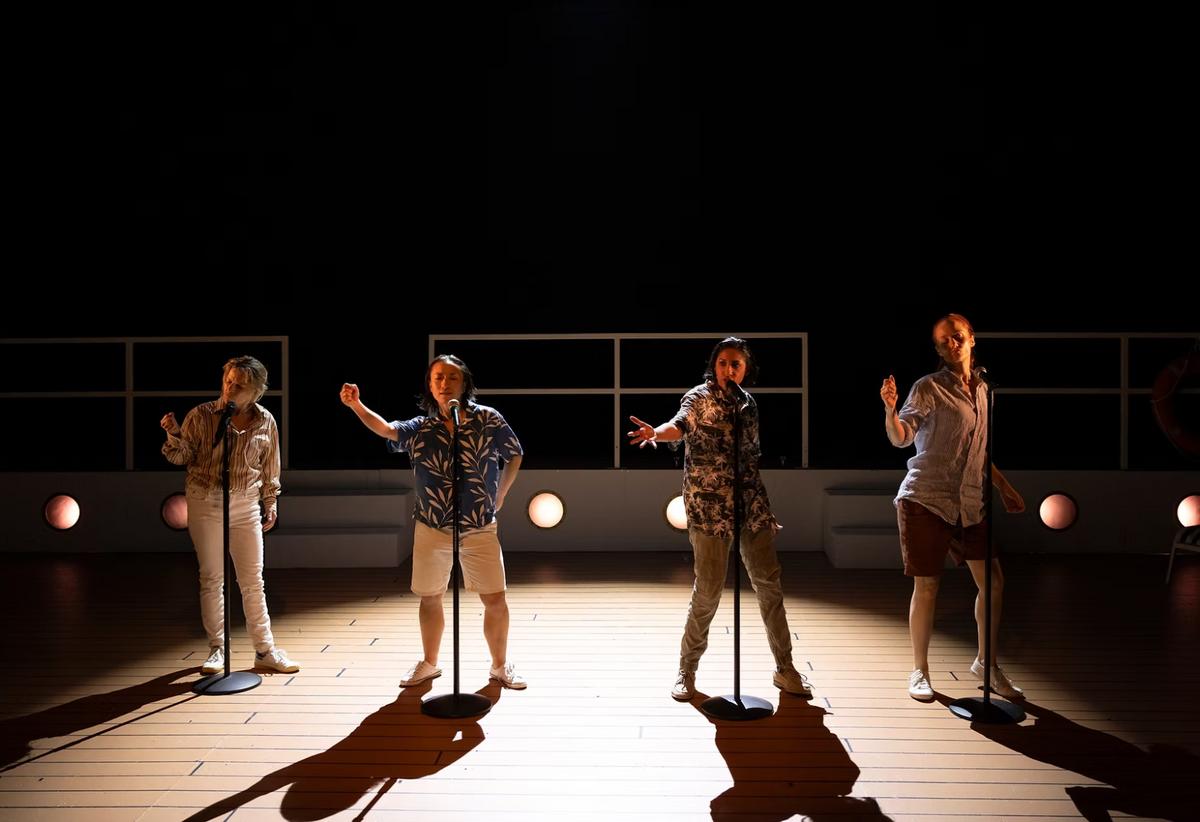
The set and lighting, both designed by Bianca Pardo and Harrie Hogan respectively, is novel and innovative. Minimal, clean, and with very few props, this set is paired beautifully with the tones of light weaving in and out through the show – symbolising a ‘sea of emotions’, setting the tone of each character’s mood— spotlighting the colour blue for sadness and depressive thoughts; red for anger and aggression; and even the colour pink, celebrating women.

The key to great writing, especially in the case of Patricia Cornelius, is in the simplicity of her language, how so few words can mean so much. How, in much of the play, it sounded sung, like poetry. A call to arms perhaps, in light of what women are still struggling with.

Thankfully, by its rousing end, we see beams of pink light shining through the cracks of toxic culture, a stark vision of hope – in highlighting the vulnerabilities all genders share. That sometimes they can rule our lives in the most harmful of ways. That only time will tell – when old ideas of women will disappear and re-emerge triumphantly. Where entitled misogyny will be a thing of the past.

To book tickets to Savages, please visit https://www.theatreworks.org.au/2026/savages.

Photographer: Pia Johnson

Spread the word on your favourite platform!

The Irreducible

The Irreducible

The Irreducible Rating

★★★★★

Click if you liked this article

3

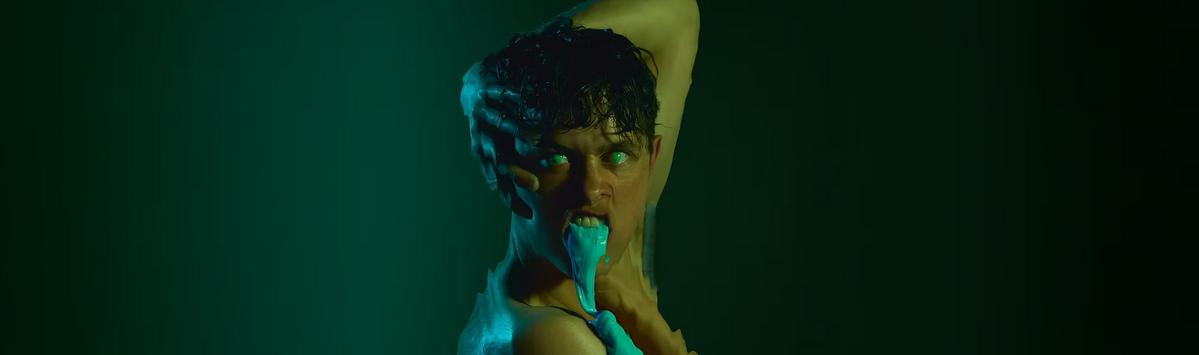
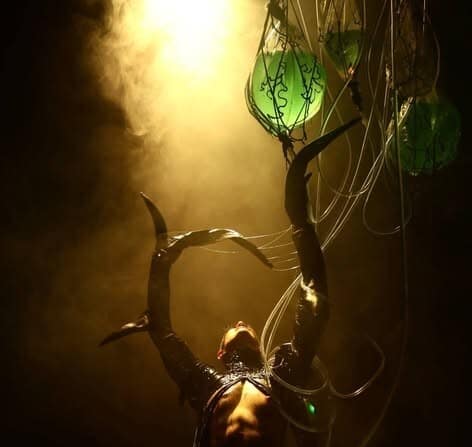
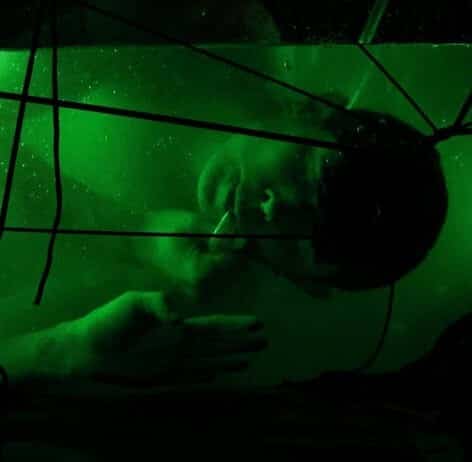
After The Irreducible’s curtain call, I’m pretty sure I wasn’t the only one who stayed seated for a few more minutes, processing what on earth (or beyond it) I’d just watched. The promotional images – a contorted androgynous figure dripping in goo and digital warping – convey more of what the show is than anything I could describe. It’s fifty minutes of…that. And somehow, so much more.

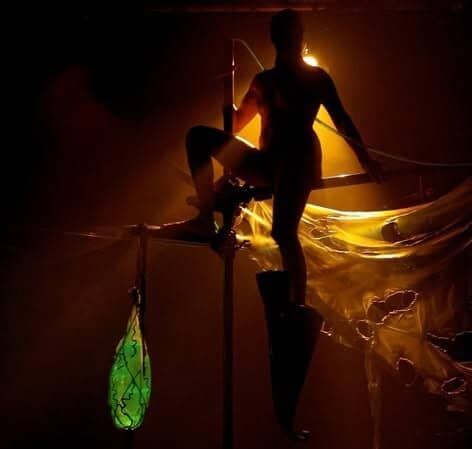
The Irreducible is the brainchild of Cohan, creative director of Blank Space Productions and the show’s director, set designer and sole performer. From the moment the audience walks in, Cohan is surrounded by precarious black beams bathed in green light, some of which support bags and vats of transparent goo. In the best way possible, it looks like the set of an Alien knockoff. Cohan, naked except for a full-face balaclava and a large triangular boot on one foot, explores the space. Without dialogue, context, or even facial expressions for most of the show, what we are left with is an androgynous body navigating a familiarly alien world.

Cohan’s prowess as a physical performer is undeniable; their confidence in climbing the set and the variety in their movements is marvellous to behold. There is also a loose sense of storytelling as we see their creature gradually gain mastery over their environment and unveil more unexpected surprises in the set. There was a sense at some points of the creature moving to hit their marks rather than ending up naturally in certain spots, and the ending felt contrived to get Cohan offstage, but this wasn’t enough to break the methodical pacing. The worldbuilding is complemented by fantastic tech design, with a jarringly glitchy surround-sound score, beautiful use of lighting and the wonderful effect of projections on Cohan’s pale naked skin. The Irreducible may be strange and slow-paced, but it’s never boring, and the climax is well-worth the subtle build-up (hint: a lot of goo is involved).


But what’s the point of it all? The queerness is undeniable, as the show revolves around a nude non-binary body and many set pieces and moments could be seen as an homage to camp low-budget horror. Theatre Works bills The Irreducible as “[an investigation of] the boundaries between the queer body, the self and object”, and there’s definitely a thrilling contrast between the natural nudity and movements of the central character and the industrial environment it finds itself in. I was personally reminded of the many connections scholars and artists have made between queerness and body horror, as those who feel alienated from their bodies choose to embrace what society deems as monstrous. Once Cohan’s face becomes visible, there is a sublime ecstasy in their expressions that feels both frightening and enticing. The show is called ‘The Irreducible’, which provokes the question: what parts of our experiences can’t be reduced? The body? The self? Feelings of alienation? The world around us? Perhaps all of the above, or anything else you can think of.

Regardless of what you take from it, The Irreducible is a thematically rich show with a lot to admire if not fear. It’s one of those artworks that’s something of a Rorschach test: what you see in it and how you respond may say more about you than the performance itself. All I can say is what I saw, which was an arresting celebration of queer monstrosity. Come for the spectacle, stay for the depth, and take as much time as you need to sit with it all afterwards.

To book tickets to The Irreducible, please visit https://www.theatreworks.org.au/2026/the-irreducible.

Photographer: Dan Rabin

Spread the word on your favourite platform!

Blood Wedding: Picking at a Scab Until it Bleeds

Blood Wedding

Blood Wedding Rating

★★★★★

Click if you liked this article

4

Bloody and haunting, Blood Wedding is a tale of star-crossed lovers, and the carnage that begets their ill-fated romance. This play is chilling, a glimpse into the isolation in the wake of war and how pain and jealousy can amalgamate into complete and total hatred.

Blood Wedding is an exceptionally well written story, riddled with characters each in a unique state of hurt, so much so that, despite the fore-shadowing of the play’s title, it’s still shocking and saddening to see the final confrontation play out. Director Deborah Leiser-Moore brings the script to life by highlighting this pain and isolation through an attention to motion and the physical division of the set. Key scenes take place without dialogue, with the character’s emotion expressed solely through the body. The play concludes with a bloody fight, played out as if in slow motion, each strike by the male leads aching as they fight for their final act of honour. Creative choices like this allowed the audience to hurt with these characters and crawl under their skin to feel their pain in these titular moments.

JMC presents some striking talent in this production, particularly Mia Connoli and Teresa Giansiracusa. I connected the most with these two characters and was blown away by how much each character wore their hearts on their sleeves. Mia Connoli as leonardo’s Wife has a beautiful voice, and her vocals added a beautiful haunt of mystery as the plot reveals itself. Teresa Giansiracusa as the Bride was heartbreaking as the lead, presenting a palpable inner conflict, especially during her monologue she performs in the bath, the morning of her wedding day. Dion Zapantis as Leonardo Felix was also fully committed, and brought an electric physicality to his performance.


My favourite part of the show was the soundscape. Aside from a few more upbeat songs breaking up the tragedy of the performance, the score was a series of evocative, echoing vocals that really dig into your chest. At the start of the wedding scene, these were incredibly powerful, especially watching as each actor flowed silently between the mixed emotions of the wedding. These vocals sprinkle through the show and despite the warm lighting, evoke a cold atmosphere and a fascinating juxtaposition.

I loved the staging choices; the elevation of Teresa Giansiracusa’s character at the beginning, high and unattainable, but feeling severed and alone. I loved how Mia Connoli’s character stayed predominately in the dark, shadowed beneath the platform suspending Giansiracusa and her baby, at the back in the deepest pocket of the stage, long forgotten by Leonardo Felix. Tess Lynch Steele as Mother manning the front corner of the stage with her brutal onion station, mourning the loss of her son and husband but expressing it only through a wish for further bloodshed. The set feels unfinished and raw, complimenting the story and working in favour of the show, allowing the performances and physicality to be what shines through.

Blood Wedding is a show that picks at a wound until it bleeds; a stubborn, yet brutal portrait of masculinity under the patriarchy and its collateral damage.

To book tickets to Blood Wedding, please visit https://www.theatreworks.org.au/2025/blood-wedding.

Spread the word on your favourite platform!

Subscribe to What's The Show

Reviews, show news and what is on, straight to your inbox.