The Irreducible

The Irreducible

The Irreducible Rating

Click if you liked this article

3

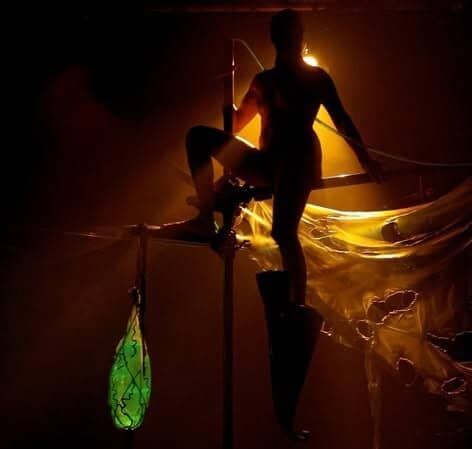
After The Irreducible’s curtain call, I’m pretty sure I wasn’t the only one who stayed seated for a few more minutes, processing what on earth (or beyond it) I’d just watched. The promotional images – a contorted androgynous figure dripping in goo and digital warping – convey more of what the show is than anything I could describe. It’s fifty minutes of…that. And somehow, so much more.

The Irreducible is the brainchild of Cohan, creative director of Blank Space Productions and the show’s director, set designer and sole performer. From the moment the audience walks in, Cohan is surrounded by precarious black beams bathed in green light, some of which support bags and vats of transparent goo. In the best way possible, it looks like the set of an Alien knockoff. Cohan, naked except for a full-face balaclava and a large triangular boot on one foot, explores the space. Without dialogue, context, or even facial expressions for most of the show, what we are left with is an androgynous body navigating a familiarly alien world.

Cohan’s prowess as a physical performer is undeniable; their confidence in climbing the set and the variety in their movements is marvellous to behold. There is also a loose sense of storytelling as we see their creature gradually gain mastery over their environment and unveil more unexpected surprises in the set. There was a sense at some points of the creature moving to hit their marks rather than ending up naturally in certain spots, and the ending felt contrived to get Cohan offstage, but this wasn’t enough to break the methodical pacing. The worldbuilding is complemented by fantastic tech design, with a jarringly glitchy surround-sound score, beautiful use of lighting and the wonderful effect of projections on Cohan’s pale naked skin. The Irreducible may be strange and slow-paced, but it’s never boring, and the climax is well-worth the subtle build-up (hint: a lot of goo is involved).
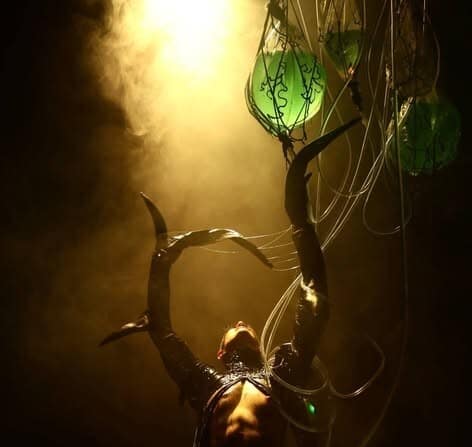
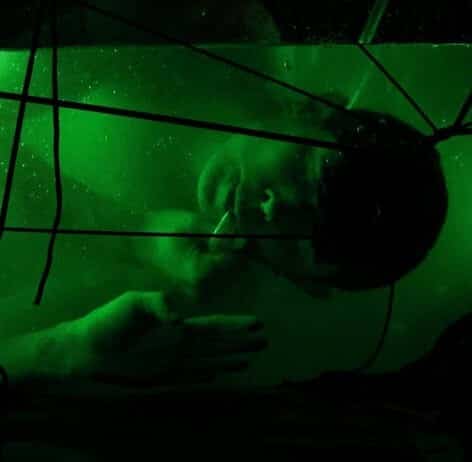


But what’s the point of it all? The queerness is undeniable, as the show revolves around a nude non-binary body and many set pieces and moments could be seen as an homage to camp low-budget horror. Theatre Works bills The Irreducible as “[an investigation of] the boundaries between the queer body, the self and object”, and there’s definitely a thrilling contrast between the natural nudity and movements of the central character and the industrial environment it finds itself in. I was personally reminded of the many connections scholars and artists have made between queerness and body horror, as those who feel alienated from their bodies choose to embrace what society deems as monstrous. Once Cohan’s face becomes visible, there is a sublime ecstasy in their expressions that feels both frightening and enticing. The show is called ‘The Irreducible’, which provokes the question: what parts of our experiences can’t be reduced? The body? The self? Feelings of alienation? The world around us? Perhaps all of the above, or anything else you can think of.

Regardless of what you take from it, The Irreducible is a thematically rich show with a lot to admire if not fear. It’s one of those artworks that’s something of a Rorschach test: what you see in it and how you respond may say more about you than the performance itself. All I can say is what I saw, which was an arresting celebration of queer monstrosity. Come for the spectacle, stay for the depth, and take as much time as you need to sit with it all afterwards.

To book tickets to The Irreducible, please visit https://www.theatreworks.org.au/2026/the-irreducible.

Photographer: Dan Rabin

Spread the word on your favourite platform!

Blackpill: Redux

Blackpill: Redux

Blackpill: Redux Rating

Click if you liked this article

2

How can the internet be depicted in other art forms? Many directors and writers across various mediums have tried to showcase the intangible world that most of us live our lives in. Unfortunately, there’s a lot of ways in which these kinds of stories can go wrong; a lack of empathy for particular communities, overly complicated visual metaphors, a reliance on outdated memes and references – the list goes on.

Blackpill: Redux avoids all these pitfalls. This remounting of the 2025 Theatreworks/Paracosm show, written and directed by Chris Patrick Hansen, combines razor-sharp writing, bleak stage design and intricately unnerving performances to create a scintillating dissection of incel culture and the men who fall into its black holes.

Eli (Oliver Tapp) is a self-admitted loser who’s been fired from his job for reasons he is suspiciously cagey about. He’s stuck with no money, no family or friends he can confide in, a desire to make something of his life and a lot of time to spend on his phone. If you’re familiar with stories about ‘the alt-right pipeline’, ‘the manosphere’ and ‘incels’, you can probably see where this train is going. If you aren’t, you can witness his journey from fitness gurus to ‘edgy’ Instagram group chats to voice calls discussing sexual fantasies and male loneliness, down and down and down. Either way, just like a trainwreck, you won’t be able to look away.


It’s clear that Hansen has done an unenviable amount of research into these corners of the internet. It’s all very well to gawk at and shame the flagrant misogyny on display, but Blackpill: Redux goes several steps further by showing in detail how an ‘everyman’ can be seduced by promises of community, justice and self-improvement. There’s a looming loneliness in almost every character, and the grooming mechanisms they practice and fall for (often at the same time) are so clear yet well-paced enough to be believably enticing. The ending (without spoiling it) in particular guides the audience into understanding these men and empathizing with their emotions, without excusing his actions and the damage they’ve caused.

The set is a grey box of platforms dominated by a hexagonal screen and LED-lit wire fragments hanging from the ceiling. It looks like an abandoned spacecraft, and when text and images are shown on the screen, they are devoured by glitchy rotting. The sound design is booming and abrasive, creating a frightening, gloomy and expansive world. At the same time, one of the best things about Blackpill: Redux is that it doesn’t take itself too seriously. The dozen-strong cast are all incredible physical actors and this is often played for laughs, with ridiculous movement sequences depicting common internet memes, cliches in Hugh Grant movies and the stereotypes Eli learns to project onto the people in his life. This show has a very dark sense of humour and knows exactly how to wield it, often making references to internet culture that feel ‘of a time’ but not stuck in an outdated moment.

I’m fascinated that a show about something as nebulous and complicated as online indoctrination could be this physical and raw. The amount of heart, intelligence, wit and pathos in it is incredible to behold, and I couldn’t recommend it more. Check it out while you still can – you’ll be thinking and talking about it for a long time afterwards.

To book tickets to Blackpill: Redux, please visit https://www.theatreworks.org.au/2026/blackpill-redux.

Photographer: Sarah Clarke

Spread the word on your favourite platform!

The Machine Stops

The Machine Stops

The Machine Stops Rating

Click if you liked this article

1

‘THE MACHINE STOPS’
Stage Play adapted by Briony Dunn from the short story by E.M. FORSTER.
Playing at TheatreWorks, St Kilda from 23rd – 30th August, 2025.

All fans of dystopian novels marvel at the predictions George Orwell made in his 1949 novel, ‘1984’ with many of the tech ideas proving to be true today.

E.M. Forster’s short sci fi story, ‘The Machine Stops’, from 1909, did the same thing way before Orwell did, and was then republished in 1928, translated into 10 languages and voted one of the best novellas up to 1965. During this time, the electric shaver, the television and landing on the moon all seemed sci fi to the masses.

In 2025, our modern-day debate heats up on whether Artificial Intelligence (AI) will destroy humanity and there are strong arguments on both sides, but there’s no denying AI systems that surpass human intelligence, or misalign with human values, could potentially lead to disaster.

Briony Dunn, Head of Writing/Directing and Stage Management at COLLARTS, has adapted Forster’s story for today’s stage, directed it, and co-designed the set for this Theatre Works production, along with Set Designers, Betty Auhi and Niklas Pajanti. Pajanti also designed the lighting, whick pulsates creatively, synchronising with the mood throughout the script, strikingly and is both ominous and futuristic.


The story is set in a world where humanity lives underground and relies on a giant machine to provide its needs. It predicts technologies similar to instant messaging and the internet. Forster pointed to the technology itself as the ultimate controlling force.

Both the set and the lighting are innovative and represent well the way the story would have played out in 1909 – or 1928 – and the way we may see an underground world today. The set imposes from the start, floor to ceiling metallic pillars – not quite to the floor – representing the control of the machine and symbolising its instant messaging, its regulatory power over its subjects, with its geometrical sequence on stage, columns lined in order, 4 x 4 presenting the boundaries humans live within, in a secular way. Only a single chair to the right breaks the sequence on stage.

We are introduced to a mother, Vashti, from the shadows backstage, moving slowly towards the light, which I felt could have been more powerful if done in much less time.

Mary Helen Sassman plays Vashti, Kuno’s mother, however they live on opposite sides of the world, both literally and emotionally.

Dunn’s play also realises this point drastically, focusing on the mother and the son, a juxtoposition without physical connection – at first.

Slick screen projections display grey communication between Vashti and Kuno, similar to our “Face-time”.

In Forster’s story, Vashti is content with her life, producing and endlessly discussing second-hand ‘ideas’ and using her work to avoid real in-person time with friends. Shades of social anxiety during Covid came to mind. Fascinatingly, this prediction from over a century ago has become true of some people today, who take clickbait and three-second sound bites from social media as their truth and real news.

In Briony Dunn’s stage play, Vashti is seen to contrast between happiness and habitual loyalty to the machine with a soul destroying, maniacal loneliness that Sassman portrays too well, almost as if she’s become part of the machine herself.

Kuno, played by Patrick Livesey, returns to his mother (and us) with the raw truth – quite refreshingly. Livesey’s performance had the energy of Richard Burton in Gielgud’s 1964 Hamlet, especially with his delivery of this soliloquy…

“We created the Machine, to do our will, but we cannot make it do our will now. It has robbed us of the sense of space and of the sense of touch, it has blurred every human relation and narrowed down love to a carnal act, it has paralyzed our bodies and our wills, and now it compels us to worship it.”

I look forward to seeing Livesey’s future performances.

A particularly clever scene when the machine finally stops and Vashti can no longer press buttons to satisfy her every need, shows Sassman’s Vashti spiraling desperately out of control.

Dunn’s ending is as Forster wrote and her adaptation is just as successful in providing a warning to humanity that its connection to the natural world is what truly matters.

To book tickets to The Machine Stops, please visit https://www.theatreworks.org.au/2025/the-machine-stops.

Photographer: Hannah Jennings

Spread the word on your favourite platform!