1 in 7 and The Audition Helpers

Two New Australian Plays (1 in 7 | The Audition Helpers)

Two New Australian Plays (1 in 7 | The Audition Helpers) Rating

Click if you liked this article

6

1 in 7

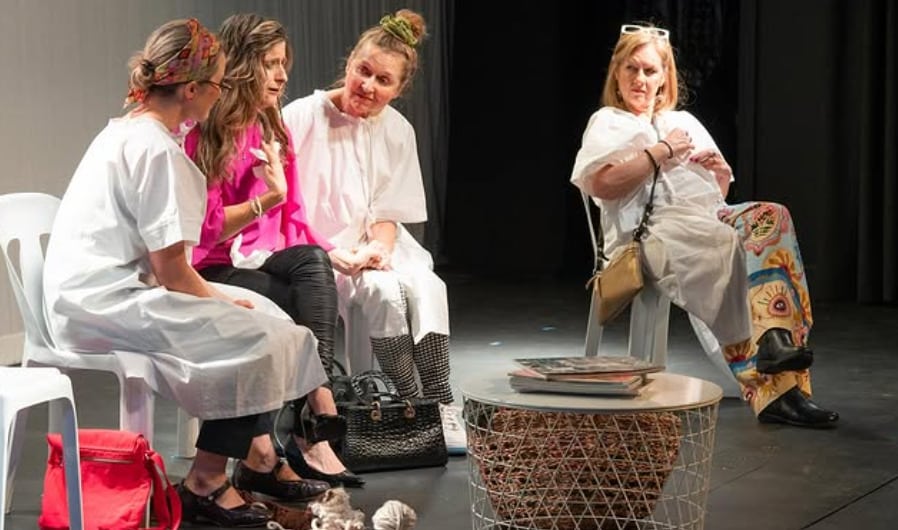
Waiting rooms, particularly those of the medical variety, can be emotionally fraught places. People sit waiting for information, test results, that may possibly change their lives forever. Vivien Thomas in her first one-act play for Manly Theatre Group has chosen a hospital waiting room as the setting for an ensemble piece that focuses on a confronting statistic: one in seven Australian women will be diagnosed with breast cancer at some point in their lifetime.

While an ensemble piece, much of the focus is on the character Tina, who we soon learn can be abrupt at times. In the first few minutes of the play, Tina clashes with the clinic counsellor (played by Ella Green), finding the professional’s demeanour too cool for her liking. It is clear that Tina is very stressed; she has been called back to the clinic because of a shadow on her mammogram. She’s a busy mother, evidenced by the phone calls she receives in the waiting room from her children asking ‘where’s my wetsuit?’ and ‘what’s for lunch?’ Tina, like so many other women, doesn’t have time for cancer; too much depends on her being well.

Early on in 1 in 7, tears flow. Alongside Tina in the waiting room, is a woman distraught at the thought that her sister, who has left the room to receive her results, may have cancer. The other waiting women rally around her providing comfort in her moment of need. When her sister emerges, the news is good: she does not have cancer. After the pair leaves, the other women reflect on whether it is better to put on a brave face or to cry, letting out the distress one feels obliged to contain. It’s a question that runs through the play. How do we deal with our emotions when confronted with our mortality?

Thomas has created a group of characters that anyone might expect to meet in any waiting room in Australia. Tina, played by Trish Donoghue, is a gutsy, salt of the earth Australian mum who is prone to rants about the cost of living and climate change. Liz Jewell plays Joan who has just retired. She and her husband have booked a trip of a lifetime to Europe. Will cancer upend her neatly planned future? Particularly poignant is Karen Pattinson as Mrs Collins. Her bombastic behaviour in the waiting room is a cover for a woman who is deeply distressed. She demands her test results, saying she does not have time to wait. We are again reminded of the life pressures so many women juggle each day. As Tina says: Be kind. We don’t ever really know what another person is going through.

Manly Theatre Group’s Artistic Director Kathleen Walker, Vivien Thomas and the cast have done a great job in producing a performance that is highly topical and emotionally moving. Like a memento mori, the play is a reminder of how fragile and precious our lives are. We are reminded to support each other in our darkest moments, reaching out rather than retreating into the straitjacket of stoicism. The play is also a timely reminder of how stretched so many Australian women are by caring for others. Let’s remember to care for them too.


The Audition Helpers

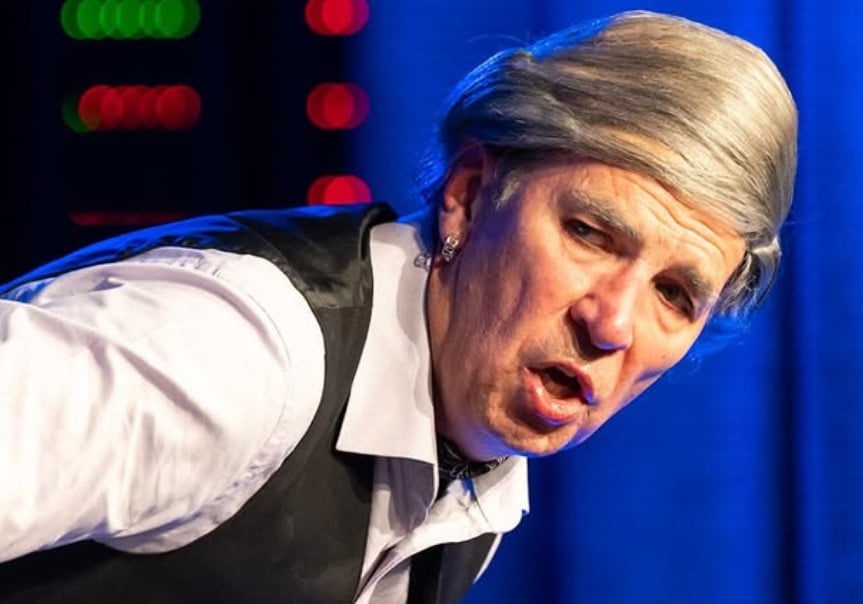
Carlin Hurdis’ one-act play is a very tongue in cheek comedy that captures the back stage bitchiness of an amateur theatre group. Auditions are being held for a production of The Hound of the Baskervilles. Two unnamed ‘helpers’ stand in a room coordinating the audition process. The helpers soon reveal themselves to be jaded, ‘never-been’ actors; both are on the wrong side of fifty, now relegated to behind the scene roles. Their dialogue is peppered with catty attacks masking the insecurity that so much of the acting world breeds.

The Audition Helpers might be described as meta-theatre. Certainly theatrical allusions are in plentiful supply throughout the piece. The helpers name-drop like there is no tomorrow, passive aggressively competing with each other as to who knows who in the world of (amateur) theatre. Particularly amusing is one auditionee’s choice to perform a monologue from Edward Albee’s satire The Goat—cue off-colour jokes about goats.

The cast clearly relish their roles in a particularly self-reflexive way. Both Gregory J. Thorsby and Frank Byrne capture the desperation of two over the hill actors determined not to be discarded. Their behind the scenes machinations lead to a particularly amusing (and sneaky) denouement. Alisan Smotlak is suitably over the top as the director who is clueless about what her helpers are getting up to. Danny Nercessian plays camp and goth perfectly doubling up as two very different auditionees. John Corrigan and Elaine de Jagger show great comedy chops also.

Hopefully we will see more of Carlin Hurdis’ clever work in the near future!

To book tickets to Two New Australian Plays (1 in 7 | The Audition Helpers), please visit https://events.humanitix.com/manly-theatre-group-presents-1-in-7-and-the-audition-helpers.

Photographer: Neil Thompson Rees

Spread the word on your favourite platform!

Sincere Apologies

Sincere Apologies

Sincere Apologies Rating

Click if you liked this article

0

Sorry, Apologies, My Bad… There are myriad ways to express regret when one has stuffed up. These are some of the expressions I pondered as an audience member of Bondi Festival’s show Sincere Apologies. Billed as an interactive experience, I will admit I felt a small degree of trepidation in attending; however, curiosity got the better of me and I found myself perched on a fold out chair on a very chilly July evening in the Seagull Room at Bondi Pavilion. The circular arrangement of chairs around strategically placed microphones created an Alcoholics Anonymous-esque atmosphere, as if we were all there to lay bare our deepest regrets.

After a delayed start, the essence of the show started to make sense. Like children at a birthday party, a brown envelope was passed around from chair to chair. When the music stopped, an audience member read aloud instructions to everyone present. Fifty envelopes were to be distributed among the audience. Unfortunately on the night I attended, the audience was quite small. This meant we doubled (or tripled) up on envelopes. This is a show that definitely works more effectively with a full audience.

Based on an original concept by Roslyn Oades and David Williams, the show’s writers Dan Koop, Jamie Lewis and David Williams, have created what proves to be an incredibly reflective and enriching experience. Within each envelope was an apology ranging from the very famous (does anyone remember Kanye West’s social media apology to Taylor Swift after his MTV awards rant?) through to the very personal (an excerpt from an email to Dan Koop’s mother apologising for his decision not to have children). Within the three envelopes I was assigned was an official apology from Eddie McGuire to Adam Goodes in 2013 when he compared the AFL player to ‘King Kong’; another featured part of the apology of a Japanese son apologising to Chinese people for his father’s war crimes. There were even stage directions to bow (deeply) after I recited the apology.


Themes of racism, environmental degradation and social justice run strongly throughout the apologies curated by Koop, Lewis and Williams for Sincere Apologies. At a time when deadly flash floods and heat waves seem to be fast becoming the norm, re-hearing apologies such as the one offered by the Exxon Valdez captain after the infamous 1989 oil spill was a reminder of how little we seem to have learnt from the past and perhaps, how little apologies mean when they are not made sincerely.

The culmination of the hour-long show proved to be quite moving; indeed, I would say even, disturbing. We are invited, through imaginary apologies, to speculate on the state of the world in fifty or even one hundred years time; a state that is pretty dystopian if we continue to live as negligently as we do now. I truly felt a sense of regret as I returned into the cold night, walking past the now dark Bondi Beach, that those imagined future scenarios may very well come true.

Sincere Apologies is a timely reminder that apologies matter and we must make them sincerely and genuinely, whether to those we love or to whole generations of people whose lives will never be the same. It is only when we are truly sorry that we can change the future.

To book tickets to Sincere Apologies, please visit https://www.bondifestival.com.au/event/sincere-apologies/.

Photographer: Mark Gambino

Spread the word on your favourite platform!

Koreaboo: Showing Now At The Belvoir Theatre

Koreaboo

Koreaboo Rating

Click if you liked this article

1

Koreaboo (Griffin Theatre Company), now playing at Downstairs Belvoir is actor and playwright Michelle Lim Davidson’s story of being a Korean Australian adoptee. But as Lim Davidson states in her playwright’s notes in the program, Koreaboo is not just her story; it is the story of so many international adoptees who have found themselves growing up caught between two cultures, perhaps always grappling with the unanswered questions: ‘Who am I?’ and ‘Where do I belong?’

The intimate space of the Downstairs Theatre at Belvoir is perfect for the cramped, fluorescent-lit convenience store or ‘mart’ in which most of the play’s action takes place. Hannah (Lim Davidson) arrives, straight off a flight from Sydney, at her biological mother, Umma’s, mart during a sweltering Korean summer. It’s soon revealed they’ve had contact before but this time Hannah has high expectations for her visit – she wants to finally connect with her Umma, and she desperately wants some answers to her long-held questions about her Korean family.

Umma, played delightfully by Heather Jeong, smiles sweetly, but her apparent cuteness belies a stubborn determination to avoid her past at all costs. Her life is firmly situated in the present, stacking ramen cups, fixing a pesky fridge light and tending to her colourful collection of garden gnomes. Umma would rather Hannah had never turned up on her neatly swept doorstep. And she doesn’t hesitate to take any opportunity to remind Hannah of this.

Michelle Lim Davidson is a gifted comedic actor, and in writing Koreaboo, she has wisely used comedy to portray a heartbreaking story. Rather than making her story glib, however, the humour serves to help us connect with the pathos of the situation, avoiding melodramatic cliches that other stories of reuniting with lost relatives might fall into. Initially appearing to be an odd couple, it soon becomes clear Hannah and Umma both share a love of performing.

Hannah tries to impress Umma with a rendition of her winning ‘All That Jazz’ number for the Lake Macquarie Eisteddfod 12 years category, but Umma is scathing: ‘Your mother let you wear a sequinned leotard at 12?’ Umma who is obsessed with the talent show Star Power (think Australia’s Got Talent K-style) lives out her own unfulfilled dreams through the contestants on screen. The reality show becomes a point of connection for the two: What if Hannah can revive her long-dormant stage skills and win Star Power? Would Umma finally accept her then?

K-pop culture infuses Koreaboo. Umma randomly quotes from K-pop songs and is obsessed with the eerily pretty Korean pop star, Suga. In fact, the term ‘Koreaboo’ (far from just a cute sounding name as I initially thought), is slang for a non-Korean person who is infatuated with Korean culture, especially K-pop and K-dramas. But, it’s not applied in a complimentary way. Is Hannah a ‘Koreaboo’, someone who is desperately trying to be Korean but never will be?

Derogatory term or not, Koreaboo is a delightful story that deserves to be told, but also to be seen. My hope is that more untold stories of adoptees like Michelle Lim Davidson are given a platform (or stage), rather than being ignored or conveniently brushed under the carpet. How many other cross-cultural stories do Australians have that are waiting to be told? Griffin Theatre Company has shown again that they truly are the grassroots champion of home-grown Australian theatre, giving voice to contemporary, multicultural Australian stories.

To book tickets to Koreaboo, please visit https://griffintheatre.com.au/whats-on/koreaboo/.

Spread the word on your favourite platform!

German Film Festival: Mother’s Baby

Mother's Baby

Mother’s Baby Rating

Click if you liked this article

1

Mothers are supposed to feel an instant, unbreakable bond with their newborn child; or at least, that’s what we’re led to believe. Austrian director, Johanna Moder’s new film, Mother’s Baby, bleakly reminds us that this isn’t always the case.

Forty year old music conductor Julia (Marie Leuenberger) and her loving husband, Georg (Hans Löw), desperately want a baby. When nature doesn’t deliver, they seek the help of Dr Vilfort (Claes Bang), a renowned fertility specialist. In Vilfort’s pristine private clinic, Moder introduces early on an axolotl, a strange looking amphibian that catches Julia’s interest but comes to haunt her (and viewers) later in the film.

With Dr Vilfort’s treatment proving successful, Julia and Georg wait expectantly for the birth of their longed for child. Yet the birth is a difficult one. The baby is whisked away by a medical team as soon as it is born. Moder captures Julia and Georg’s muted shock as they are kept in limbo waiting to meet their baby. When Julia finally gets to hold her baby, she seems underwhelmed, even detached from the child. Julia’s struggle to breastfeed only heightens her disappointment. An overly zealous midwife played by Julia Franz Richter doesn’t help as she pushes Julia to bottle feed instead.

Once home, Julia, long used to being in control in her professional life, continues to struggle to bond with her baby. Usually surrounded by music, the weirdly silent baby she has birthed, starts to unnerve her. Is there something wrong with the child or is Julia paranoid? Hans’ instant bond with their son, who Julia persists in referring to as ‘it’, adds to Julia’s distress.

In one particularly tense moment, Hans returns home from work to be greeted by the sight of Julia engrossed in her music, oblivious to her unfed baby. Julia’s sudden identity shift from world class conductor to stay at home mother has hit her hard. Hans fails to understand, reminding Julia as they argue that ‘It’s what we agreed!’. Is Julia’s lack of maternal connection with her baby a tell-tale sign of postpartum depression or is there something more sinister at play?

Increasingly frustrated by Julia’s unexpected reaction to new motherhood even the normally placid Georg starts to doubt his wife’s mental stability. Returning to Dr Vilfort, Julia insists there is something wrong with her baby, demanding answers from the preternaturally cool physician. In what smacks of medical misogyny, Vilfort condescendingly suggests Julia is the problem. We cringe as Georg joins cravenly with the doctor in agreeing that Julia needs help.

Moder’s psychologically chilling story of new motherhood achieves its aim of unnerving its viewers so that they feel vicariously the altered reality of the postpartum phase. Billed as a dark comedy, the film is inconsistent in creating humour; nonetheless, Moder is successful in capturing the absurdity of motherhood in a world which continues to unfairly insist on idealising maternity.

To book tickets to Mother’s Baby, or any other film in the German Film Festival, please visit https://germanfilmfestival.com.au/.

Spread the word on your favourite platform!