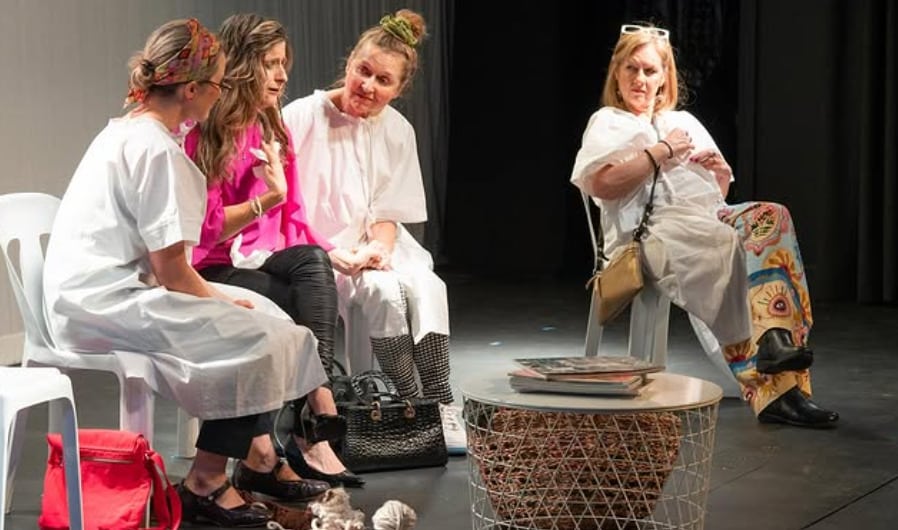
Koreaboo: Showing Now At The Belvoir Theatre

Koreaboo

Koreaboo Rating

Click if you liked this article

1

Koreaboo (Griffin Theatre Company), now playing at Downstairs Belvoir is actor and playwright Michelle Lim Davidson’s story of being a Korean Australian adoptee. But as Lim Davidson states in her playwright’s notes in the program, Koreaboo is not just her story; it is the story of so many international adoptees who have found themselves growing up caught between two cultures, perhaps always grappling with the unanswered questions: ‘Who am I?’ and ‘Where do I belong?’

The intimate space of the Downstairs Theatre at Belvoir is perfect for the cramped, fluorescent-lit convenience store or ‘mart’ in which most of the play’s action takes place. Hannah (Lim Davidson) arrives, straight off a flight from Sydney, at her biological mother, Umma’s, mart during a sweltering Korean summer. It’s soon revealed they’ve had contact before but this time Hannah has high expectations for her visit – she wants to finally connect with her Umma, and she desperately wants some answers to her long-held questions about her Korean family.

Umma, played delightfully by Heather Jeong, smiles sweetly, but her apparent cuteness belies a stubborn determination to avoid her past at all costs. Her life is firmly situated in the present, stacking ramen cups, fixing a pesky fridge light and tending to her colourful collection of garden gnomes. Umma would rather Hannah had never turned up on her neatly swept doorstep. And she doesn’t hesitate to take any opportunity to remind Hannah of this.

Michelle Lim Davidson is a gifted comedic actor, and in writing Koreaboo, she has wisely used comedy to portray a heartbreaking story. Rather than making her story glib, however, the humour serves to help us connect with the pathos of the situation, avoiding melodramatic cliches that other stories of reuniting with lost relatives might fall into. Initially appearing to be an odd couple, it soon becomes clear Hannah and Umma both share a love of performing.

Hannah tries to impress Umma with a rendition of her winning ‘All That Jazz’ number for the Lake Macquarie Eisteddfod 12 years category, but Umma is scathing: ‘Your mother let you wear a sequinned leotard at 12?’ Umma who is obsessed with the talent show Star Power (think Australia’s Got Talent K-style) lives out her own unfulfilled dreams through the contestants on screen. The reality show becomes a point of connection for the two: What if Hannah can revive her long-dormant stage skills and win Star Power? Would Umma finally accept her then?

K-pop culture infuses Koreaboo. Umma randomly quotes from K-pop songs and is obsessed with the eerily pretty Korean pop star, Suga. In fact, the term ‘Koreaboo’ (far from just a cute sounding name as I initially thought), is slang for a non-Korean person who is infatuated with Korean culture, especially K-pop and K-dramas. But, it’s not applied in a complimentary way. Is Hannah a ‘Koreaboo’, someone who is desperately trying to be Korean but never will be?

Derogatory term or not, Koreaboo is a delightful story that deserves to be told, but also to be seen. My hope is that more untold stories of adoptees like Michelle Lim Davidson are given a platform (or stage), rather than being ignored or conveniently brushed under the carpet. How many other cross-cultural stories do Australians have that are waiting to be told? Griffin Theatre Company has shown again that they truly are the grassroots champion of home-grown Australian theatre, giving voice to contemporary, multicultural Australian stories.

To book tickets to Koreaboo, please visit https://griffintheatre.com.au/whats-on/koreaboo/.

Spread the word on your favourite platform!

The Lady Vanishes

The Lady Vanishes

The Lady Vanishes Rating

Click if you liked this article

3

Celebrating its 80th year in style and in a brand-new theatre space, the Genesian Theatre Company presents – The Lady Vanishes, adapted by Derek Webb from the novel on which the Alfred Hitchcock’s classic 1938 film was based.

This production is a nostalgic and atmospheric journey back to a time of intrigue and stiff upper lips – all aboard a European train where one woman vanishes and everyone seems to be hiding something.

The ingenuity of the staging cannot be overstated. The design team masterfully evokes the confined, shifting world of a train carriage through clever use of sliding compartment doors and evocative soundscapes. Seamlessly moving the action from the dining car to corridor to first class, the production invites the audience to feel like passengers themselves, peering down corridors and eavesdropping on hushed conversations. This immersive approach is one of the production’s strongest assets, providing a dynamic sense of movement and urgency.


The story itself remains a compelling whodunit, as Iris Carr – on her journey home – becomes increasingly frantic when a fellow passenger, the governess Miss Froy, mysteriously disappears. What follows is a delightful unraveling of truth and deception, as each character’s potential motive for denial (or deceit) is revealed. The play cleverly engages the audience, turning us into sleuths trying to piece together the puzzle.

Tonally, however, the production feels somewhat uneven. Some actors leaned heavily into broad caricature, while others remained grounded in more traditional realism. This dichotomy occasionally pulled focus from the central tension of the plot.

That said, several performances stood out. The sister duo Evelyn and Rose brought genuine laughs with their dry wit and impeccable timing, while Mrs Barnes was a wonderfully nervous delight. In the central role, Iris Carr shone brightest when allowed to play her role with sincerity and emotional depth.

The Lady Vanishes is a joy to watch and the Genesian’s new theatre space is a fitting stage for this lively, imaginative production – a celebration of the company’s legacy and a testament to the enduring power of classic storytelling. Here is to 80 more years to come!

To book tickets to The Lady Vanishes, please visit https://www.genesiantheatre.com.au/.

Spread the word on your favourite platform!

Eureka Day

Eureka Day

Eureka Day Rating

Click if you liked this article

1

In Eureka Day, Jonathan Spector’s razor-sharp satire of liberal consensus and public health anxiety, a seemingly progressive Californian school board descends into chaos over a mumps outbreak. But what could easily become a smug send-up of anti-vaxxers and virtue-signallers is instead something more nuanced, uncomfortable, and timely. Under Craig Baldwin’s deft direction, Outhouse Theatre Co’s production at the Seymour Centre lands every comic beat while never losing sight of the emotional truths buried beneath the surface.

Although the play is distinctly American in setting, this Australian staging loses none of its relevance. The characters feel instantly recognisable, the debates all too familiar. This is a story not just about vaccines, but about what happens when our desire for clarity and reassurance collides with ambiguity, grief, and fractured trust.

Katrina Retallick is particularly compelling as Suzanne, the new age, soy latte-sipping board member whose calm certainty masks deep personal pain. She walks the tightrope between satire and sincerity with precision, making Suzanne both maddening and deeply human. When the character’s backstory is revealed, Retallick’s performance shifts into something tragic—an aching portrayal of a parent failed by the institutions she once believed in.

Jamie Oxenbould’s Don is equally affecting. The embodiment of well-meaning, moderate liberalism, Don wants nothing more than to keep everyone happy. Oxenbould captures his charm and diplomacy perfectly, but also lets us see the cracks forming under the strain of trying to appease all sides. His unravelling in the brilliantly staged Zoom scene is as funny as it is painfully relatable.

Deborah An brings a quiet strength to May, initially playing her as a reserved and observant figure. But as the stakes rise, An reveals the steel beneath the calm, delivering a performance that builds patiently to a moment of quiet triumph. Christian Charisou’s Eli enters bold and brash, full of passionate conviction, but undergoes one of the play’s most significant emotional shifts. His transformation, grounded in his role as a father, adds weight and tenderness to a character that could easily become just a mouthpiece.

As Carina, Branden Christine is a standout. Starting off as a newcomer eager not to step on toes, she grows into a voice of clarity and compassion. Her confrontation with Suzanne doesn’t just showcase moral courage, but also the empathy that gives the scene its emotional punch. Christine subtly anchors the play’s message: that we must speak up for what we believe in, but also make space to truly hear one another.

Technically, the production is sharp and inventive. The colourful, clean set provides a visual cue for the play’s early optimism, which contrasts starkly with the bleakness of the later hospital scene. The use of live projection, sound, and lighting in the Zoom sequence is a highlight—expertly timed, uproariously funny, and all too recognisable to anyone who survived the remote meeting era.

Eureka Day is a biting, intelligent, and unexpectedly moving production. Outhouse Theatre Co has created a version that speaks directly to Australian audiences, reminding us that the messiness of democracy—and of parenting—has no borders. It’s as hilarious as it is human, and well worth seeing.

To book tickets to Eureka Day, please visit https://www.seymourcentre.com/event/eureka-day/.

Photographer: Richard Farland

Spread the word on your favourite platform!

Rehearsal For Murder: A Classic Murder Mystery That Keeps You Guessing

Rehearsal For Murder

Rehearsal For Murder Rating

Click if you liked this article

1

To me, a ‘Whodunnit Mystery Murder’ should encompass suspense, have interesting characters – each one having a cloaked shadow of suspicion, unforeseen twists and of course, an untimely demise. The Castle Hill Players performance of Rehearsal For Murder had all of this, and more.

Set in the 1950’s in an empty theatre on New York City’s Broadway, director Grant Brennan and the cast and crew drew us back to a time on the cusp of colour television where viewers were used to watching dramas in black and white. This theme was well integrated into the play, noticeable in the costume design of the main characters’ clothes which were all grey. Far from being a dull grey through, costume designer Leone Sharp ensured a timeless and classic feel.

The play opens with the narrator, Alex Dennison (wonderfully portrayed by Thomas Southwell) a successful playwright who lost his fiancé to an apparent self-harming circumstance one year ago. On this anniversary, he has invited his Broadway colleagues to partake in the reading of a new play he’s written, one which coincidentally, (or not so), involves the people who were last involved with his fiancé, actress Monica Welles shortly before her death. Alex’s script plays out certain circumstances that involve Monica and the characters and allows the audience to immediately see that they all have a motive to murder her!

Through cleverly orchestrated visual and audio theatre, the audience becomes involved with the plot, questioning who would benefit from Monica no longer being in the Broadway play. Who’s the murderer? Was it the best friend, Monica’s understudy? Her husband? The producer, an actor, director or the leading man? Through clever use of lighting (by Casey Moon-Watton) dimming and spotlighting at opportune moments, combined with sound effects and the use of The Pavilion Theatre’s space around the audience, it produced a dynamic atmosphere.

Showcasing the typical music of the time, sound designer George Cartledge creates a feel reminiscent of an olden-days radio drama. Alex Dennison narrates the play to the audience, with the backdrop of the music underlying his words. Thomas Southwell’s calm demeanour as a narrator carries the play’s tone throughout the performance.

A standout from this play was from Gina Willison, who portrayed the producer, Bella Lamb. She states that she’s ‘not an actor’, but Alex forces her to read the script he’s prepared, and I sympathised with her indignation at what she was forced to do.

Monica Welles, portrayed with an innocence by Lola Carlton, appeared not in ghostly form but as herself in flashback scenes. It was clever the way the scene seamlessly blended into the past, with Monica interacting with the other characters, each time leaving another hint as to what may have happened to her.

Rehearsal For Murder has a big cast. Brett Watkins (Leo), Ben Wheeler (David), Ella Rose Titterton (Karen) Brett Joachim (Lloyd), Sophia Laurantus (Sally) David Senior (Ernie), Chris Scarpellino (Man) and Melissa Applin (Loretta) all portrayed their characters well and created an interesting storyline. I attended the opening night, and as the production progresses, the New York accent should become more consistent.

During the interval, I heard various audience members talking. They were guessing, calling out the names of characters of who they thought ‘dunnit’. I had a couple of theories, based on who I thought had the most motive. Did I guess right? This was one of the most fun parts of a murder mystery – so I won’t reveal if I was successful or not! You’ll have to see the Castle Hill Players performance to find out.

Rehearsal For Murder is playing at the Pavilion Theatre from 30 May – 21 June 2025. To book tickets to Rehearsal For Murder, please visit https://paviliontheatre.org.au/rehearsal-for-murder/.

Pavilion Theatre
Doran Drive, Castle Hill
Tickets: $30 / Concession $25
www.paviliontheatre.org.au

Spread the word on your favourite platform!

Subscribe to What's The Show

Reviews, show news and what is on, straight to your inbox.