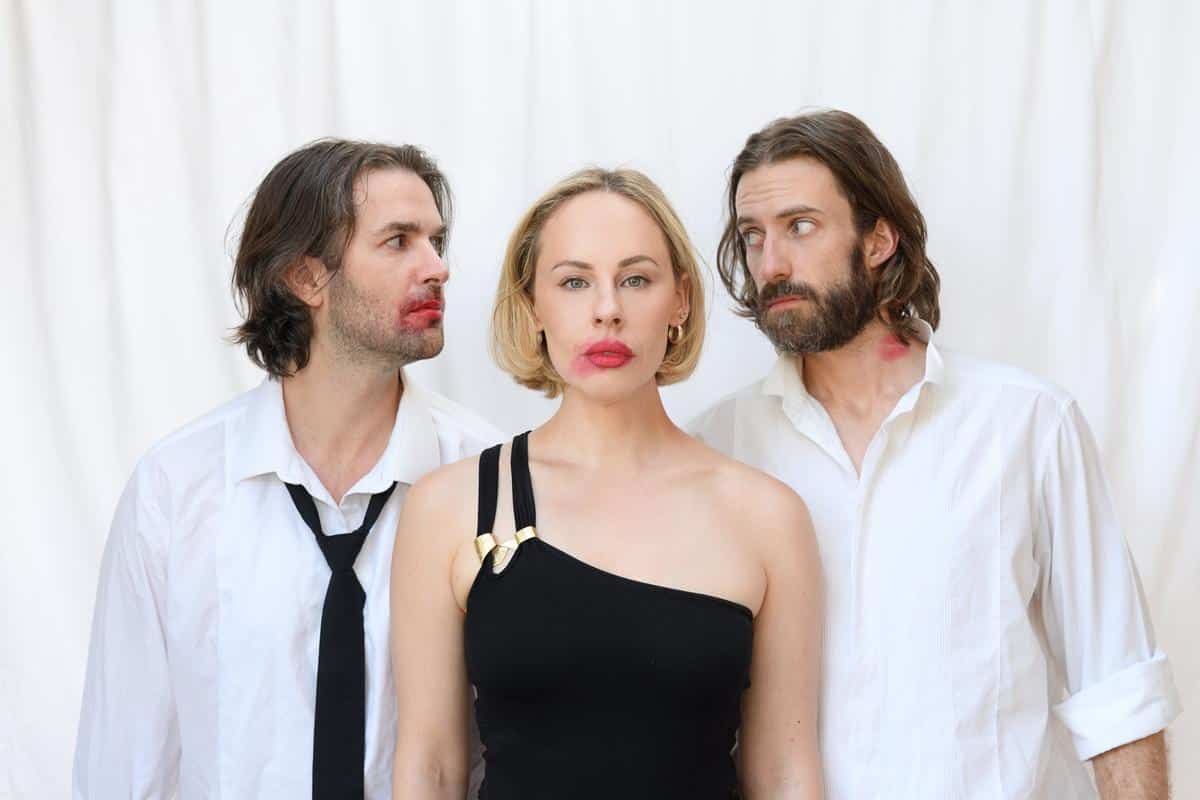
Watching Sport for Jove’s production of Harold Pinter’s Betrayal, now playing at the Old Fitz Theatre, I ran through alternative titles for the piece in my head. Some were: The lies we tell each other and ourselves; Why do we lie to each other? And lastly, why are humans so horrible to each other? On reflection, these are probably more questions the play provokes rather than suitable titles.
Betrayal is certainly a play that will have you wondering about why we cheat on each other. While set over fifty years ago, the theme of infidelity is a timeless one. Pinter wrote the play in reverse. It opens at the end of an affair, rather than at the beginning. In the first scene, Emma and Jerry, both in their late thirties, meet for a drink at a London pub in the spring time. Their conversation soon reveals they have been clandestine lovers, with their affair ending two years before. She is married to Robert who is best friends with Jerry. Jerry is married to Judith. Both couples have children. Emma reveals to Jerry that her marriage to Robert is over, in fact, they’ve broken up the night before. More shocking to Jerry though is that Robert has now learnt about their previous affair.
Desperate to talk to his long-time friend, the second scene sees Jerry meeting with Robert at his house. Their awkward dialogue hints at a brittle friendship. When Jerry finally talks to Robert about his affair with Emma, he is shocked (again) to discover that Robert had already known about the affair at least two years before. Jerry realises Emma has lied to him. How many times has she lied to him before? In his moment of outrage, Jerry seems to forget that he’s been lying too.
From here on, each scene moves backwards in time, travelling towards the final scene in which we see where the seeds of Emma and Jerry’s affair were planted. Pinter’s use of a reverse plot structure is effective. Each scene painfully reveals more to the audience about the couples. We start to see that behind the facade of domesticity lurk secrets and lies. A particularly devastating scene is when Robert discovers Emma’s infidelity as they holiday in Venice. Pinter’s economic dialogue here is especially biting, revealing so much in what is not actually said.


Betrayal is undeniably a bleak play. Under Cristabel Sved’s direction, the performers work hard to portray the ugliness of infidelity and the pettiness we are all capable of in our relationships. Ella Scott Lynch as Emma shines on stage; a woman caught between two men she both loves. Andrew Cutcliffe playing Robert captures the pain and impotency of a man whose wife has cuckolded him with his best friend. Matt Hardie as Jerry is effective in portraying a seemingly likable man who reveals himself eventually. None of the characters are particularly likeable but I think that was Pinter’s point. He has crafted characters who are real and, at times, baffling in their behaviour.
Set and Costume Designer Melanie Liertz has created a minimalistic set that fits well with the stark nature of the story. Vertical blinds are set to good use with scene titles projected onto them as well as photos of (ironically) happy family moments. I did wonder if the choice of these blinds was some kind of metaphor for the characters’ ‘blind’-ness in their relationships? Composer Steve Toulmin uses compelling piano music as transition between scenes. Verity Hampson and Luna Ng’s lighting design adds suitable mood to each scene.
Ultimately, Betrayal never really answers why we betray each other. Perhaps what it shows instead is that there is no answer for why we behave in the ways we do.
Betrayal is now running at the Old Fitz Theatre in Woolloomooloo until August 10.
To book tickets to Betrayal, please visit https://www.oldfitztheatre.com.au/betrayal.
Photographer: Kate Williams