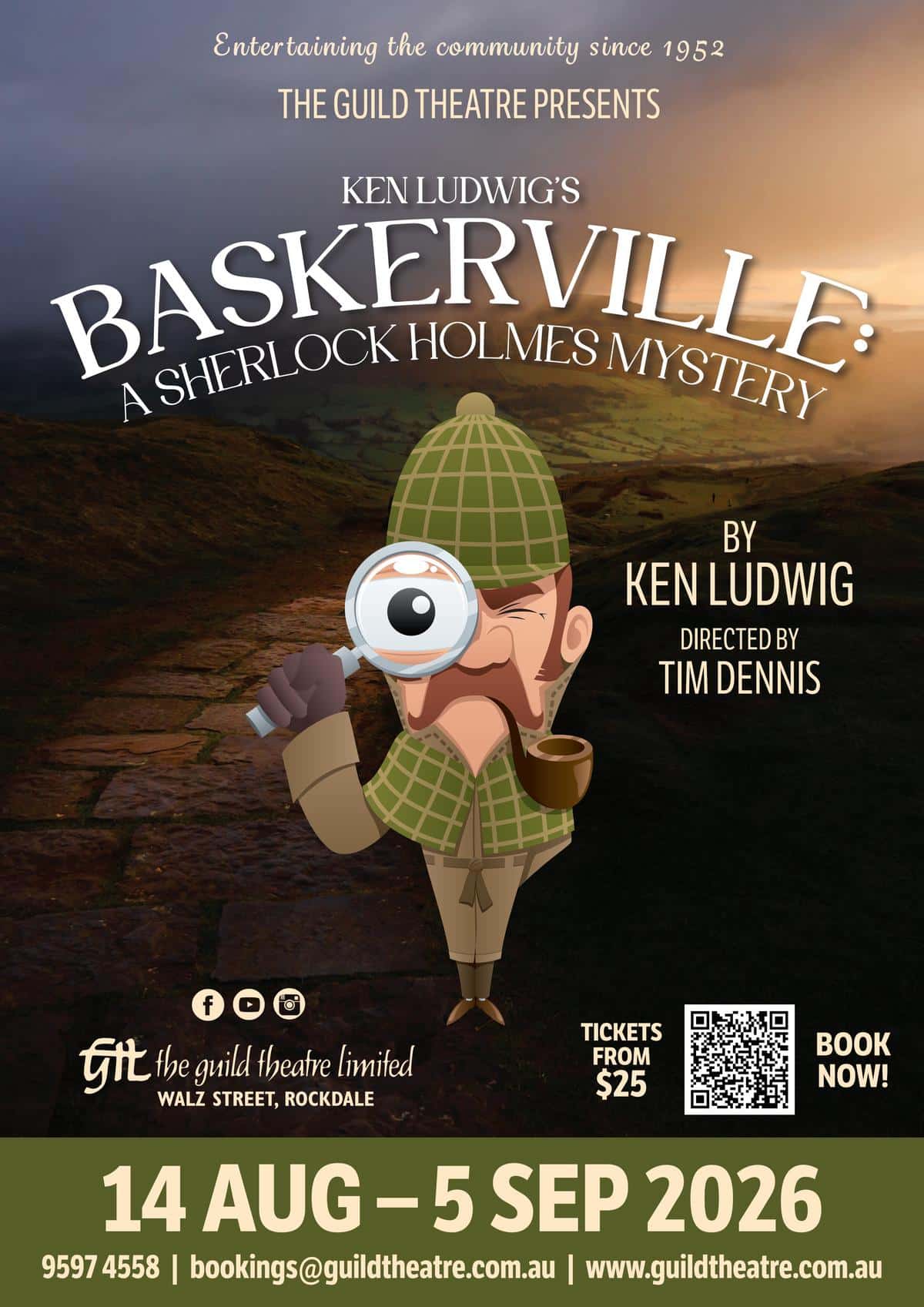
Ken Ludwig’s comedic take on the classic Sherlock Holmes tale brings the legendary Baskerville curse to the stage with a theatrical twist that promises equal parts mystery and mayhem. The Guild Theatre Rockdale Director Tim Dennis shares what makes this adaptation such a thrilling theatrical rollercoaster.
About The Show – Baskerville: A Sherlock Holmes Mystery
What is this show about?
When Sir Charles Baskerville dies under mysterious circumstances, his heir arrives at Baskerville Hall amid rumours of a monstrous hound that has haunted the family for generations. Sherlock Holmes and Dr Watson must unravel a web of secrets, suspects and superstition before the legendary curse claims another victim.
How would you describe this show to someone who has never seen anything like it before?
The Baskerville curse has never been this hilarious. Join Sherlock Holmes and Dr Watson as they race across the moors to solve their most bizarre case yet. Five actors play more than forty characters in a whirlwind of disguises, accents and absurd surprises. This is Sherlock Holmes as you’ve never seen him before.
What is the element of the show that is hardest to explain but unmissable in person?
Five Actors. (Nearly) Forty Characters. One Legendary Mystery.
Who is this show for? Who is going to have the time of their life?
The show will appeal to all ages from teenagers to senior citizens.
Is there anything else you would like to share?
Director Tim Dennis said, “Ken Ludwig has taken one of the greatest detective stories ever written and turned it into a thrilling theatrical rollercoaster. The audience will see five actors transform into dozens of characters at breakneck speed, and I think they’ll be laughing as much as they’re trying to solve the mystery.”
Many thanks to Tim Dennis and The Guild Theatre Rockdale. With its breakneck pace and ingenious character transformations, this promises to be a night where audiences will be laughing as much as they are sleuthing; tickets are available now at trybooking.com for anyone keen to experience Sherlock Holmes as they have never seen him before.
Innes Lloyd – The Lost Casebook of Sherlock Holmes Rating
★★★★★
Click if you liked this article
I had the pleasure of attending The Lost Casebook of Sherlock Holmes by Innes Lloyd last night as part of the Melbourne Comedy festival and it was one of those intimate, slightly chaotic and genuinely enjoyable theatre experiences that remind you what live performance can feel like when it’s happening right in front of you and, occasionally, almost on top of you.
The venue, the Impro Melbourne Theatre, was comfortable but tiny and we were seated so close to the stage I could have comfortably rested my feet on it. My companion described it perfectly, it didn’t feel like watching a play so much as watching people. There’s something disarming (and slightly voyeuristic) about that level of up close and personal proximity. You can see every flicker of expression, every moment of hesitation or delight. At times it made it harder to fully drop into the world of the story, but it also created a kind of immediacy and shared experience that larger productions can’t replicate.
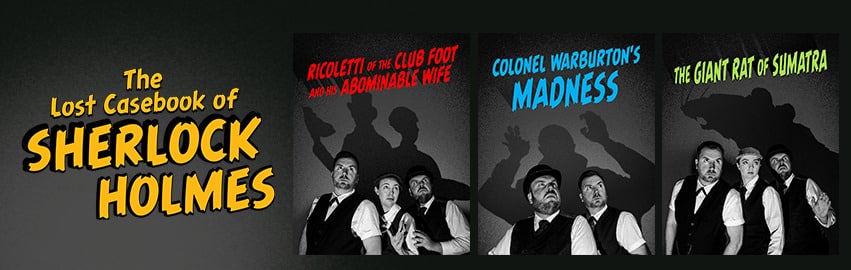
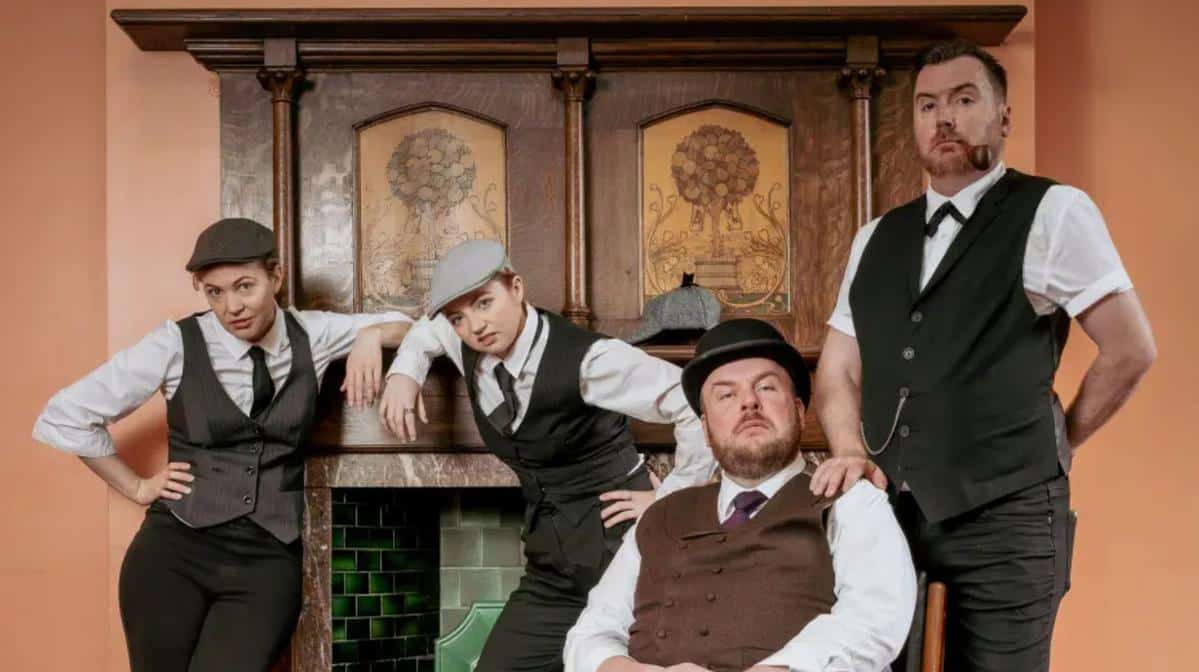
The premise is a clever one: three legendary “lost” Sherlock Holmes case files, mysteries Sir Arthur Conan Doyle himself hinted at across his impressive written works but cases that while connected to existing Sherlock Holmes tales, are entirely improvised – which gives clever improv actors an awful lot of room to play in! From this simple starting point, the four-person cast built a series of unfolding stories, moving fluidly between characters and locations. We met the foul-mouthed Victorian street urchins (the Irregulars), various members of the landed gentry, Dr Watson, Sherlock Holmes himself plus his corpulent brother, Mycroft and bumbling, dim-witted Inspector Lestrade with a particularly memorable foot fetish. There was also a funny thread involving Cluedo that wove its way through the third story, adding another layer of playful absurdity.
What stood out most was the ensemble’s commitment to the form. Improv, at its best, is a kind of high-wire act – a balance between structure and spontaneity, where performers are constantly listening, adapting and building something together in real time. There were a few inevitable fluff-ups (it was opening night), but rather than detracting from the show, these moments often became highlights. The cast leaned into them, supported each other and turned small stumbles into shared jokes, which delighted and deepened the connection with the audience.
That willingness to embrace imperfection is part of what makes improv so engaging to watch. You’re not just seeing a finished product – you’re witnessing the process unfold. There’s a generosity in it – a sense that everyone, performers and audience alike, is in on the same experiment.
The audience appreciated the small facts and trivia woven in about Sherlock Holmes and his creator, Sir Arthur Conan Doyle and are apparently something of an integral part of all Innes Lloyd shows. These touches added a layer of texture and gave the show a gentle nod to its literary roots, even as it gleefully departed from them.
The overall feeling of the performance was one of enthusiasm, wit and genuine enjoyment. The cast clearly put their heart and soul into it and that energy carried the show. Improv is rarely about polished perfection, but rather about play, presence and the joy of watching something take shape in the moment.
All in all, it’s a lively, inventive and warm-hearted night out – especially for anyone who appreciates the unique magic of improv and the thrill of seeing something created right before your eyes.
Nestled in the burbs of New Farm is a church and in that church is the very vibrant Nash Theatre. Each year they produce a radio play – well, extremely well.
A simple set with actors dressed appropriately for the era (1930’s), mircrophone stands at the front of stage and the ‘On Air’ sign glowing with the “Applause” sign lighting up to remind you that you are part of a studio audience – it is marvelous.
But best of all is the live action foley – set up along the back of the stage were three foley artists and I have to say, the horses and carriage sounds – spot on. Congratulations to Mark Corben, Lara and Emma Latham who entertained us with their enthusiasm, facial expressions and creative techniques – yes, I am still giggling at the Baboon.
I often listen to the Sherlock plays on Spotify and I was pleasantly surprised to hear a new one among the mix; ‘ The case of the Blue Carbuncle ” – hilarious. With the actors playing a range of characters from the vagabond thief to the well educated Sherlock and Watson.
Presenting old time radio shows is a great way to entertain an audience without elaborate sets. The stories rely on the actors ability to react appropriately without props, and once again, director Jason Nash has produced excellent work. The American and English accents on the whole were consistent and added to the believability you truly had stepped back in time to the 1930’s.
The roles of Sherlock and Watson were shared amongst the cast which took each story to a different era and there were some interesting accents. Caleb Hocking’s Watson accent for “A Scandal in Bohemia” was definitely unexpected but very humourous and Bruce Edgerton has definitely found his niche with the different characters you find in radio plays. King of Bohemia suits you Bruce.
Radio plays have advertisements and the cast brought these to life very much reminiscent of an era where entertaining folks was simple and mixed with a good dose of humour.
The actresses on stage, Sandy Adsett, Jenny Bonney-Millett and Kiah Latham were immaculately dressed and authentic with their characters, it definitely was a more glamourous era. Bright red lips, pearls, diamonds, heels and furs, they each delivered applause worthy performances and it is a joy to go to a play where you can hear what people are saying – great diction, accents and expression.
The first story, ‘The Adventure of the Speckled Band,” was delivered with the emotion and mystery that set the actors up for a great show run, drawing in the audience and giving us all the shivers at the end. The stories were broken up by the jingles, which also offered great entertainment.
So if you are looking for good quality well priced entertainment here it is, take along a friend and enjoy the show.
Show runs until the 14 March, at Nash Theatre 52 Merthyr Road, New Farm
Tickets via Trybooking – https://www.trybooking.com/events/landing/1490448
Sherlock Holmes And The Adventure Of The Elusive Ear Rating
★★★★★
Click if you liked this article
2
For a book series that came out in the very late 1800s, Sherlock Holmes has not yet failed to capture the minds of the public. Something about that wise-cracking, pipe-smoking, genius detective can’t help but keep his audience on the edges of their seats. And yet, much like Shakespeare, Sherlock runs the very real risk of being done to death. The character has been adapted, and adapted again, and again, and again, well over twenty-five thousand times. So what makes the Pavilion Players production of Sherlock unique? One simple, and yet deceptively elusive reason for the average Sherlock production. It’s funny.
The name of the game for director Paul Sztelma was stylistic cohesion. The script, in its rawest form, doesn’t offer a whole lot in terms of emotional growth or nuanced performance – and if the performances and production value weren’t presented in a very specific way, the audience would’ve eventually noticed. In a less competent team, this would’ve been an all too easy pitfall to trip into. But Sztelma fundamentally understands what he can and cannot do with the script, and so, does not ask his cast and crew to move his audience emotionally. Instead, Sherlock Holmes and the Adventure of the Elusive Ear, presents us with a kitschy, high-camp production more similar to Noel Coward’s Present Laughter than BBC’s dark and gritty Sherlock. By heartily embracing the style of the play, the production evades both the boredom of its audience, and my usual questions as a critic: “What’s the point of the show?” Does it matter? “What was the journey of the characters?” Who cares? The point, put simply, is that it’s good fun to watch.
The other defining choice that this production makes, once again setting it apart from its peers in private detective-ing, is that this production is… hot. It’s not unusual for Sherlock adaptations to make the character borderline asexual, so obsessed with cracking cases that he never really has the time to be human, nor debase himself with such pitiful things as impulses. But Sztelma’s production, and subsequently his entire cast, remind us sharply that these are all smart, obsessive and attractive people locked into an apartment for months at a time, often drunk or high. Which can only mean one thing. By allowing for the sensuality of the characters, Sztelma also allows the cast to explore their relationships on stage beyond the superficial. Although the show is built for fast-paced comedy, when scrutinized closer, it was clear that the characters did have legitimate history with one another, and we could see it behind every one of their interactions.
These two things combined into more than the class act performances on stage. Upon curtains opening, we were presented with the maximalist wonderland set-building of Abby Bishop and Sztelma. Dark burgundy red walls littered with trinkets and easter-egg props worked as a collective to transport us into the style and world of the piece. It also did much of the work in grounding the production, giving us a tether to reality that the cast could not do lest they break that delicate stylistic framework. Production continued to impress, with James Winter’s lighting design supporting the work happening on stage without committing the sin of being distracting, and Chris Harriot and Sztelma’s (the guy did everything) sound design nailing both being light, crisp accents and rock and roll needle drops when required. Costumes by Annette Snars and Jennifer Hurst elevated the piece once more, whilst joining the set in grounding the piece in reality.
Thinking back on this show, and specifically its performances, my mind is drawn much to the 1985 movie Clue, in its shared performance principle of unabashed commitment to character. Standouts of the night in this regard were Brendon Stone’s John Watson, who was both a brilliant physical comedian and retained the dry humour and littered emotional outbursts necessary for an English comedy, and Ben Pobjie’s Oscar Wilde, who gave us a fabulously homoerotic, Tim Curry-esque, pretentious, sensuous performance that stole many a scene for the better. Ben Wheeler’s Sherlock Holmes was delightfully foolish, which made his glimmering moments of intelligence all the more enjoyable, but I was looking for him to relax into the style of the show here and there. Nicole Hardwood’s Irene Adler was a sharp wit undercutting the fat of the egos of the men around her, an impressive badass from start to finish, although I would’ve been interested in seeing her work through each thought slightly more. Oscar Baird’s Vincent Van Gogh was wonderfully neurotic, and his commitment to flinging his body across the stage was something that both impressed and terrified me slightly – I only wished for moments of vocal dynamic shifts, to explore the different ways he could explore that neuroticism. Holky Bramble as Marie Chartier presented an entertaining and seductive antagonist, and was a lovely folly to Irene Adler, though would’ve benefitted from a more intimidating edge, especially as the daughter to one of the most famous villains in written history. As a cast, all six were virtuosos of comedic timing and playing to the benefit of the text, without needing to overperform the comedy – a rare skill set. The fight choreography was fast-paced and fun, not necessarily adrenaline-inducing but I don’t believe it had to be. Across the board, all actors were also fantastic at keeping themselves busy on stage, and never was my eye drawn to someone who was standing on stage zoning out. On a script level, Adler and Chartier’s moments of feminist uprising were a little benign, especially as Adler did almost all the domestic work in the text, and yet I can’t fault the production for that – for this I must point fingers at the original writer David MacGregor. Although, perhaps seeing some more moments of admiration or solidarity between the two women would’ve eased this marginally.
As an entity, Sherlock Holmes and the Adventure of the Elusive Ear proves the importance of stylistic commitment, and in some ways makes the argument that if you understand the limitations of your script, you can almost entirely negate them. Earning its place in other camp theatrical comedies like Clue and The Play That Goes Wrong, this production thrives as a masterclass of comedy and what leaning into the dirty and foolish can do for a production. Sztelma has met the challenge of Sherlock’s time in the sun, and although has not broken open the character in some earth-shattering way, in many ways he’s done something harder – he’s allowed him to continue being enjoyable.