Kid Sister: What a masterfully funny and refreshing television series.
Created and written by Simone Nathan, who also brilliantly portrayed the lead role of ‘Lulu’ in the series; ‘Kid Sister’ is the kind of comedy I love to watch.
Lulu is a young woman living with her family, who are all strongly connected to a small Jewish community in New Zealand. We soon discover the dilemma she faces between tradition and modern life issues and the drama and comedy of navigating relationships along the way.
There were such strong performances across the entire cast, with each actor portraying their characters honestly but with so much comedic heart.
The comedy was tied in with a strong focus on Jewish traditions. For people like myself who have extensive Jewish ancestry but who are not actually Jewish ourselves, this really kept me captivated not only by the human stories but also by all of the Jewish traditions highlighted. Let’s just say I learned a lot!
The overall storyline was somewhat predictable, but Nathan really made the show her own by leaning into the strong focus on the Jewish traditions and family values. That, alongside the tremendously witty humour and extremely strong writing created a unique and enjoyable series.
Having Lulu’s inner thoughts pop in at times as a voiceover truly lent to strengthening the show’s comedic aspect.
Like all good binge-worthy shows, I was left hanging on for each new episode. It really is the kind of show that makes you want to keep watching and learn more about each of the characters and their lives outside of the main storyline.
‘Kid Sister’ really is a brilliant television series. Look no further if you are looking for a comedy that will entertain and keep you engaged. I would watch more of this in a heartbeat.
‘Kid Sister’ is screening in the 2024 Jewish International Film Festival across Australia between October and December. To find out when and where it will be screening in your state, go to: https://www.jiff.com.au/resources/jiff-2024-web-program.pdf
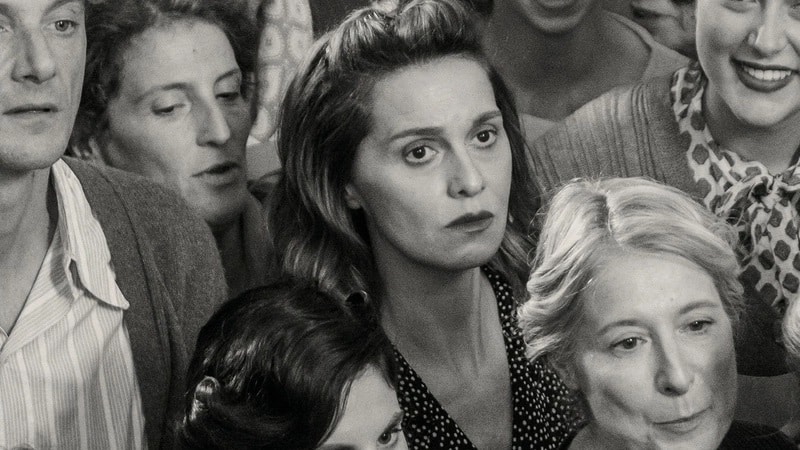
Italy, post WWII. We are being introduced to what one assumes to be another black-and-white, a run-of-the-mill black-and-white post-war movie to doze off to on a rainy Sunday afternoon, panning into a bedroom with a husband and wife waking up to the promise of a new day. “Good morning, Ivano.” And then…SLAP!
Not metaphorically! A big old slap across the face from a husband, Ivano, to his wife, Delia, and whoa! Now we are off!
We’ve just witnessed something horrible; a man slaps a woman across the face, but the reaction it warrants is to burst out laughing. An embarrassed laugh, an unsure laugh, a shocked laugh. The comical, slapstick timing is so perfectly timed and pitched, as the whole film will pan out. Hooray! This film suddenly got interesting.
Directed and starring Paola Cortellesi, a well-respected and much loved Italian actress and comedienne as the main protagonist of Delia along with a perfectly pitched ensemble cast, including Valerio Mastandrea as the horrible husband, and fantastic young actors as their gorgeous teenage daughter and young sons, and her best friend and ally, Marissa. One almost forgets this is Italy in the second half of the 1940’s. Delia cannot go to a refuge with her children or book an uber out of there.
Delia remains, constantly insulted and belittled, working multiple odd jobs to contribute to the household income, raising the children, running the household, looking after her handsy father-in-law. And then, a mysterious letter arrives, intriguingly addressed only to Delia. What is written in this letter? Who sent the letter? Such a mysterious piece of paper which Delia lets herself smile about and is excited enough about that feels the urgent need to hide away from Ivano.
Then, more good news. Her teenage daughter has the promise of marriage to a well-off son of a local café owner. Exciting new that will make Ivano happy. So happy to shout out to the other tenants in their building from their barely furnished ground floor flat that his daughter will be marrying into a respectable household. Are things finally looking up?
Not to be. We soon come to realise through Delia’s eyes that sadly, old habits are often inherited from generation to generation. Is this young man really a new beginning for the younger generation, or just a younger version of the repressive and threatening husband Delia chose instead of her old flame at the local mechanics who is a gentleman and lets her eat chocolate with him that an American soldier gifted to Delia for her kindness to him.
There’s still tomorrow is a story of repression, domesticity, abuse, survival, love, adversity, and finally, female empowerment. Delicious moments are peppered throughout, when you start to look away as Ivano raises his hand to his Delia, assuming the scene is going one way and then, out of nowehere, a perfectly choreagraphed dance sequence is playing out, like a memory being told that is just so painful that the storyteller is making it more pallatable for the audience. The echoes of West Side Story. And my goodnes, it works a treat.
It is easy to understand how There’s Still Tomorrow was the highest grossing film in Italy in 2023, outperforming Barbie and Oppenheimer.
This is the story of Italian women coming together and having the chance to finally stand up and be counted.
I have already reccommended to all my frfiends in Sydney to go to the Palace Cinma in Broadway tonight at 8.30pm and see for themselves this amazing piece of Italian film.
POTERE DELLE RAGAZZE! Tranlation…GIRL POWER!
To book tickets to this or other films click https://italianfilmfestival.com.au/
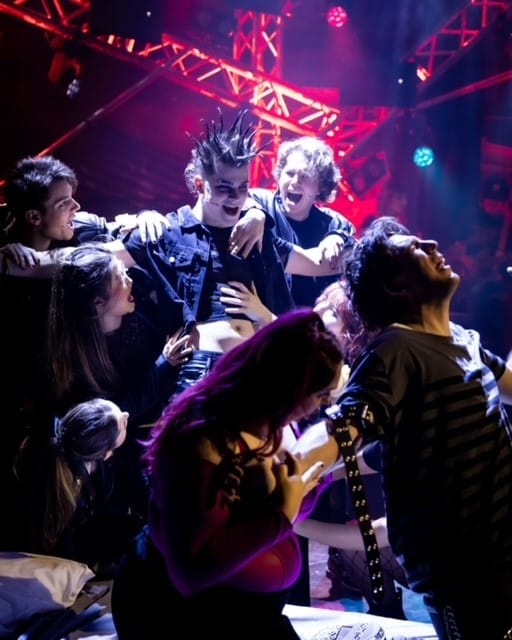
It’s been twenty years this September 2024 since Green Day’s American Idiot album, dubbed a “punk rock opera” by their own band members was released. The title song written by Billie Joe Armstrong, captures the protest against conformity. The essence of this theme explodes onto stage with the title song, fuelled by PACA Production’s energetic ensemble in a blast of dance, music and singing. It was overwhelming in an all encompassing way with the cast dressed in black, their dancing sharp, displaying an even sharper rebellious attitude onstage. We were swept into the narrative of angst and individuality!
American Idiot the musical incorporates all the songs from the album plus a few from their next album which weaves a story of three friends Johnny, Will and Tunny. Wanting to break the monotony of suburbia, Johnny and Tunny leave their town searching for adventures, whilst Will receives some news which forces him into the decision to stay.
Johnny begins his trip full of dreams. He was portrayed by Isaac Koorey, who played his character with a vulnerable innocence that reached out to the audience. Along the way, he meets and falls in love with Whatsername, portrayed by Izzy Tilden. Izzy stepped into Whatsername with ease and her character’s strength and confidence radiated onstage. Of course, the path of True Love in a story is never easy, and we find out their fate at the end, during a song aptly titled “Whatsername”.
Johnny encounters Theo, a dealer of the white stuff in small packets, who distributes the packets to the hungry crowd by initially tossing them around like confetti. River Winn played Theo (and Johnny’s dark shadow) and had effortless magnetism, portraying Theo with wicked relish.
Tunny, played by Nathanial Lawson follows his dreams and finds his way into the U.S. Army, only to find his dreams of serving his country derailed by an incident. Tunny falls deep into disillusionment and the audience falls with him, thanks to Nathanial’s portrayal. One scene a duet with Extraordinary Girl, played by Jane Fleming, was heartfelt, and Jane’s vocals were heavenly!
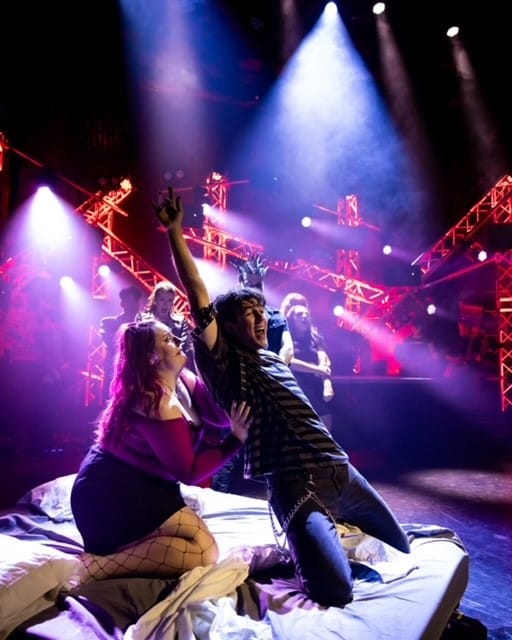
The third friend whose life we follow in the story was Will, played by Cameron Mayhew. Cameron painted an ‘on the couch’ picture, with Will being enslaved to alcohol and drug addiction. His journey was quieter than the other two, but Cameron’s portrayal allowed us to see Will for most of the performance on the couch, having lost his girlfriend Heather (Rachel Bendeich) and family, and unable to do anything about it. It was a very clever decision to have Will on the stage most times, even during the intermission where we could bear witness to Will’s drinking, smoking and TV watching… all the whilst intermittently seeing his self loathing. It was a powerful statement.
The quieter acoustic solo songs sung by Isaac as Johnny, as he played the guitar were beautiful. One standout scene featuring Johnny, Tunny and Will impressed me. The three characters played the song ‘September Ends’ and the audience also appreciated the trio’s acoustic version, accompanied by them strumming the guitar.
Being a musical and having the band onstage added to the energy of this live performance. The dancing by every cast member was dynamic and creative. Co-choreographers Janina Hamerlok and Daniella Giles have created seamless and fun storytelling with this production’s dance choreography. I liked the scenes when the whole 18 person ensemble was onstage dancing together. On a larger stage, this perhaps may not have stood out as well as it did on the smaller one at The Zenith Theatre. The dances were performed tightly in sync.
Another standout of this production was the set by Rodrigo Medina Noel, William Pulley and Victor Mrowka, which had beams crisscrossing across the back which at times cast beautiful patterns on the floor. Posters covered the back wall, and multiple televisions were positioned amongst the beams. The visuals playing on the televisions at the beginning were eye catching and original. A shout out to the head of tech, sound designer and audio engineer Peter Miller for this and the sound throughout the American Idiot musical.
The lighting design by Victor Mrowka and Blake Williams continuously stood out to create mood and focus. Erica Williams, the costume manager coordinated multiple costume changes which kept the characters fresh and realistic.
Under the direction and musical direction of Rodrigo Medina Noel and William Pulley, Green Day’s American Idiot production was sensational! They have taken the characters and woven them into a dynamic production to tell a story of human dreams, traps and self reflection. American Idiot received a standing ovation on their opening night! With songs such as Boulevard of Broken Dreams, 21 Guns, Wake Me Up When and Good Riddance, you’ll be leaving the theatre with a smile, singing at least one of Green Day songs all the way home!
Green Day’s American Idiot is playing at Zenith Theatre & Convention Centre Cnr Railway & McIntosh Streets, Chatswood NSW 2067
27 September 2024 – 12 October 2024. 2 hours with 20 minute interval. Tickets: $52 – $62.
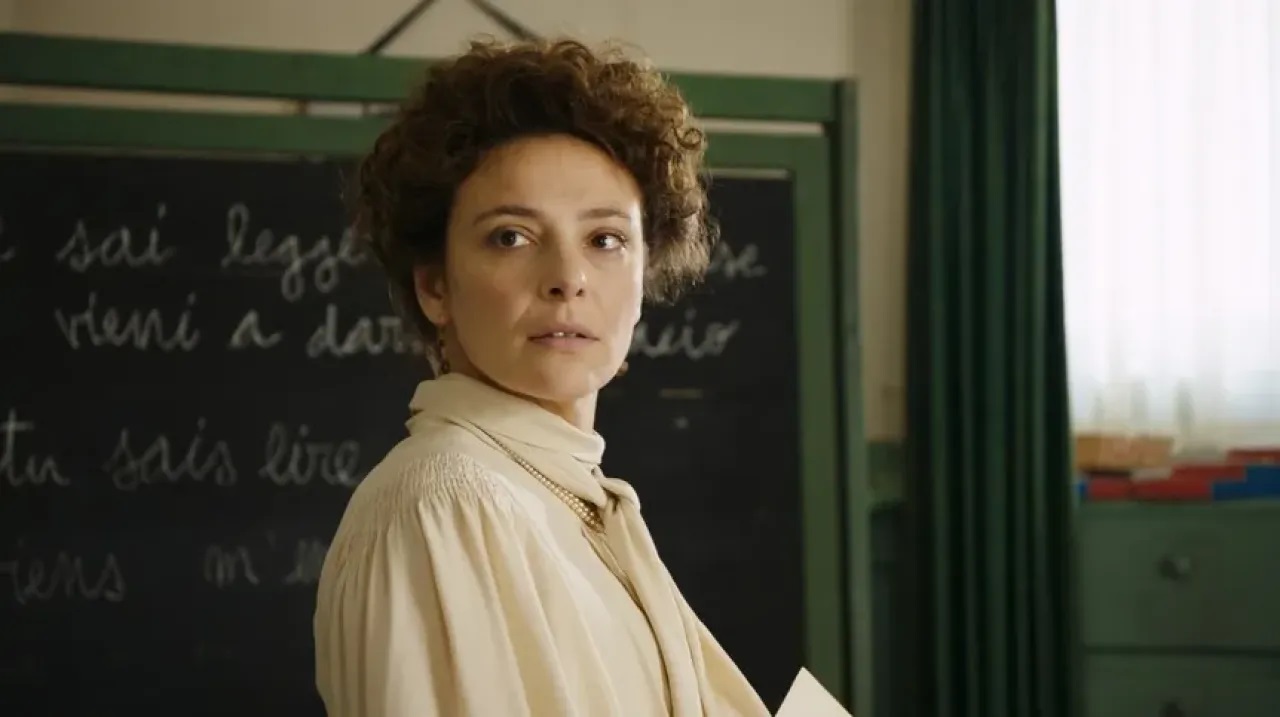
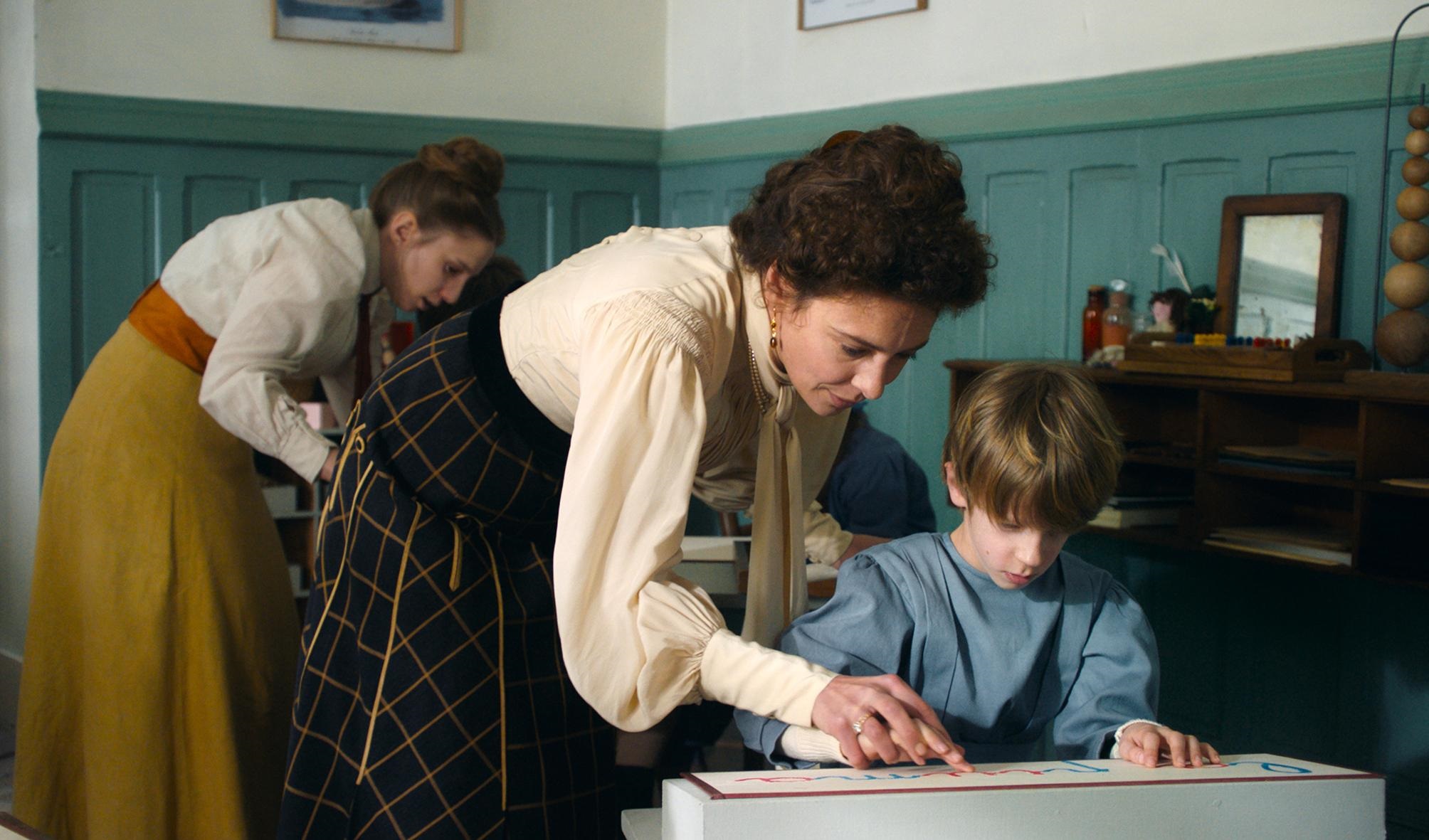
Léa Todorov’s directorial debut feature film ‘Maria Montessori’ offers a biopic of the Italian doctor’s journey in revolutionising children’s pedagogy. Maria Montessori transformed societies positioning of children with disabilities, medical conditions, &/or neurodivergence in education, and women in the workforce.
Set at the turn of the 20th century, the film begins in Paris where the esteemed French courtesan Lili d’Alengy (Leïla Bekhti) is confronted by the return of her estranged daughter Tina (Rafaëlle Sonneville-Caby) into her custody.
Lili is ashamed of the disabilities Tina possesses and frightened she will ruin her social standing so she flees to Rome. There she attempts to admit Tina as a boarder to a pedagogical institute that takes in ‘idiot children’ (as they were then referred to). Maria Montessori (Jasmine Trinca) and Guiseppe Montesano (Raffaele Esposito) manage the facility.
Maria accepts Tina into the program, but is unable to offer accommodation, much to Lili’s dismay she must stay based in Rome until a bed becomes available for Tina. Tina makes great academic and locomotive progress at the school, under the caring support and guidance of Maria.
Lili begins to soften her boundaries; a significant turning point of which, is when she plays the piano at the school, and the children delightedly dance along to the music. The music acts as a bridge, that reframes Lili’s perspective of the children’s mental and emotional capabilities, furthermore uniting her with Maria. Maria was initially judgemental of Lili’s abandonment and disavowal of motherhood to Tina, as Lili becomes more involved the two women forge a friendship.
We learn that Maria and Guiseppe are in secret romantic partnership and have a son together, who lives in the care of another woman in the countryside. Maria longs to live with her son Mario (also with disabilities), but she wishes to maintain her autonomy and without marrying Guiseppe he will not claim the child as his own, so the couple are limited to weekend visits to see him. Maria and Lili’s lives’ parallel each other, despite their significant differences.
Both have been estranged mothers in the pursuit of their independence. Lili is shocked to learn Maria doesn’t get paid for her work at the institute and helps Maria pave a path forward to achieve recognition for her pedagogical approach and the ability to grow and transmit the Montessori method.
The film offers fantastic subtext on the societal framing and transmission of shame, particularly as it effects nonhomogeneous groups. The casting is fantastic. The youth cast have real life physical and cognitive disabilities. It’s impactful to see the positive representation of people with disabilities being empowered not just through the story’s messaging, but also in its delivery. Rafaëlle Sonneville-Caby’s acting and depiction of her character Tina’s journey is incredibly moving.
Tina has a strong appetite and inclination towards learning. Seemingly non-verbal but with expressive emotional intelligence, receiving praise and love ignite her spark and inner determination. Rafaëlle illuminates Tina’s personality with beautiful authenticity. Several of her scenes were so affecting and poignant I found my emotional-physiological response resounding in fierce protection of her character. The story is one of sisterhood between Maria and Lili, and motherhood of each with their children, moreover motherhood as an approach to education.
Quotations such as “The new pedagogy must acknowledge the sublime art of motherhood” and “An education of love” speak to this and are expanded upon where Maria advocates for women to contribute to the workforce “Motherhood will then become a social model.” I think this idea is powerful and gaining traction in society today, for all it can offer – not just to women, but to everyone.
The story is both inspiring, and a heartbreaking rendering of the complex decisions women were required to make in this time and context. An important cinematic offering from Léa Todorov.