Dial M for Murder – A Killer Thriller at the Ensemble Theatre

Dial M for Murder

Dial M for Murder Rating

Click if you liked this article

Where can you find yourself as an observer to a murder, a diabolical plot and the twists and turns of an inverted mystery? Onstage at the Ensemble Theatre’s Australian premiere of Dial M for Murder! Jeffrey Hatcher’s adaptation of Frederick Knott’s 1952 stage thriller masterfully explores classic motives for murder—fear, jealousy, revenge and greed—through a script that continuously kept me guessing about how the story would ultimately unfold.

Set in the 1950’s, two women reunite in London after an absence of time. Set and costume designer Nick Fry added small details which enhanced this period. There’s a rotary dial phone sitting on a wooden stand and art deco furniture in the loungeroom. Sitting together on the couch, a stylishly dressed Margot (Anna Samson) asks Maxine (Madeleine Jones) “How would you murder me?” Maxine begins to casually list, in alphabetical order, several ways that she could kill her. This was an intriguing start to the play, and we learn that Maxine is a writer of murder thriller novels. One of Hatcher’s changes to the original script features Maxine as a female (originally a male), giving a modern update to the story with these two characters being secret lovers in a lesbian relationship, even though Margot was married.

The cleverness of Hatcher’s script is hidden in the breadcrumbs of clues he leaves along the way. In this opening conversation, certain details are hinted at that the audience might not immediately notice but will later have an “aha” moment upon reflection. There is one method mentioned by Maxine highlighted in the characters’ conversation, and it is indeed used in a future scene which appears to throw some suspicion on Maxine.


There are many layers in Dial M for Murder, which could have gotten sticky if not for the wonderful way the director Mark Kilmurry kept the play at a suspenseful pace. Margot’s husband Tony Wendice (Garth Holcombe) wants his wife dead, Captain Lesgate (David Soncin) and Maxine find themselves involved in this situation and Inspector Hubbard (Kenneth Moraleda) is driven to discover the truth. Everyone finds themselves in a tangled web of misinformation and intrigue. As a ‘whodunnit’ mystery murder it is inverted because the audience knows exactly what happened and ‘who did it’ right from the beginning. Then we experience how the detective figures it out. Kenneth as the Inspector reminded me of Columbo and his almost bumbling way of cloaking what he was thinking to appear not so intelligent, until he lays out the crime and you realise how brilliantly logical his mind worked.

Anna Samson brought depth into her character Margot, showing her character’s vulnerability. Her stillness in the aftermath of a tragedy showed reality bleeding into her consciousness and it was powerful. Kudos to Madeleine Jones for Maxine’s broad New York accent.

Garth Holcombe was simply outstanding as Tony! Standing tall dressed impeccably in a dark suit, he appeared as an upper-class suave gentleman. However, it wasn’t long before the audience saw the real Tony; a smug, sneaky, and malicious man intent on carrying out ‘the perfect crime’ to kill his wife. It wasn’t so much in his dialogue, but in the quiet, small, almost imperceptible movements he made – such as a twitch of his mouth or a shift of his eyes that Garth performed which screamed loudly of Tony’s duplicitous and arrogant nature.

Madeleine Picard’s music and sound design during the play’s tense moments was atmospheric and evocative, reminiscent of the suspense found in a Hitchcock film. Combined with Matt Cox’s lighting design, especially during the storm where flashes of lightning dramatically illuminated the characters’ struggle in the life-and-death situation, the effect was truly exceptional.

Scattered throughout the play were some funny lines which were delivered perfectly by the cast to create some pockets of dark humour. Dial M for Murder was a tightly produced, fast paced play which was entertaining and had the audience at the edge of their seats. Although this is a ‘you-know-who-dunnit’ murder thriller, it’s one that keeps you guessing with numerous surprising twists and unexpected developments until the very satisfying conclusion. Don’t miss it!

Dial M for Murder is playing at the Ensemble Theatre. 78 McDougall St, Kirribilli
Season run: 28 Nov 2025 – 11 Jan 2026
Time: 2 hours 20 minutes, including interval
Tickets: www.ensemble.com.au/shows/dial-m-for-murder

To book tickets to Dial M for Murder, please visit https://www.ensemble.com.au/shows/dial-m-for-murder/.

Spread the word on your favourite platform!

Opera For The Uninformed: In The Presence of Light

In The Presence of Light

In The Presence of Light Rating

Click if you liked this article

There’s something rather intimate about being invited to a dress rehearsal of a show. The creatives are milling around you buzzing in nervous excitement. The show is still in bits and pieces on the floor, not yet solid. The world they’ve created is in its teenagehood — not infant in its conceptualism, but not yet fully grown. You feel much like a wildlife photographer, sitting, observing, noticing, but still distinctly on the outside; our presence as critics is both cruelly invasive and fundamentally necessary. In The Presence of Light was my first dress rehearsal invitation, and it offered me entirely new parts of the critic’s experience. Principally, I got to feel how the show was actively coming together around me, and I got to ask a little about what I was walking into.

Spark Sanders-Robinson, creative-lead and the only live speaking (and singing) voice says, when I confess to her I have no experience writing for opera, that this experience is “opera for the uninformed” — that is, it is an operatic experience for those who don’t want to be spoken down to, but instead connected with. She tells me the experience is a deliberation of love, an exploration of what it is in its truest form, instead it being trapped within the bonds of the human experience.

“It’s about death,” she says, then, when Mia Rashid, their dancer prompts, “is it about death?” she responds, “no. It’s about love.” I am, admittedly, prepared for the experience to be completely incomprehensible after this conversation. I have never been so glad to be proven right.

We are tucked into the M2 Gallery in Surry Hills — an itty bitty space, unconventional, echoey, with what almost looks like a frame surrounding the elevated platform this team is using as a stage. The “stage” is bare, ‘cept for a white sheet at the back. Robinson wears a flowy, airy, blue wrap dress — which, with Rashid’s simple white tulle, almost shapeless dress, creates an eerie dreamlike atmosphere, allowing them to become one with the space around them. The space itself is generally unsupportive, and I look up to the ceiling to see what they will do with lighting, because there’s certainly no view-blocking from-home lights milling about. On the floor, there sits a singular projector, surrounded by indistinguishable frames I don’t yet understand. Nathaniel Kong joins us in the room, sits behind the piano.

I ask, upon finding out that Robinson and Rashid will be the only two interacting on stage: “is it a two-hander?” Robinson responds, “kinda a two-hander. Unless you count the piano as a third character.”

We begin.

Recorded responses from what must be over ten or fifteen people fill the room with their overlapping responses, talking about what it is that they love. Although each answer is interesting and beautiful, we cannot catch a single one as they become jumbled and chaotic. Robinson takes the stage and the glow of her projector light snaps on as she begins to talk to the audience (me and their photographer, mind you) about what she defines as love. Or rather, how difficult she finds love to define. She leaves us on a rumination about the use of defining it at all, and the lights go out. Rashid replaces her on stage, taking us through the first of many classical pieces of music in the show. Her movements are wide and grounded, translating the impossible hugeness of love, what it is as a force of nature. Then, as she connects to its fragility and its grief, they go miniscule and wineglass-thin in turn.

Robinson is generally well-known for her use and manipulation of light, no different in this production. Indeed, what makes this light work so interesting across Robinson’s catalogue is the matter in which it interacts with itself, as well as the people on stage. As Rashid becomes something more human, she catches and releases the light in her hand, and love goes from being something that possesses and consumes her, to something akin to hope, a slight glimmer. Different frames of colour over the projector take us from softer yellows, to bright, high-contrast whites that throw sharp, dangerous shadows behind Robinson. Then, as our dancer rejoins us, she is bathed in a pink light that makes her almost inhuman. It is at this moment I understand the deliberation about the piano. Kong and Rashid seem to not just legitimately communicate, but have entire conversations through the call and response of music and dance. Later, when Robinson’s mezzo-soprano rings out through the almost-empty room, I remember this relationship in its more traditional form as the opera and the orchestra interact, representing entire sections through these two individuals.


As a production, I cannot tell you that there was an overlapping narrative to this piece. Rather, it functioned as a series of images, more performance art or a film sequence than a piece of theatre. In one moment, shadow puppets creep over the projector, two faces in profile, then meet in the middle for a kiss. Rashid collapses in between them, bathed in, yet shadowed by their love. To that point, the piece doesn’t attempt to ask or answer something, it invites you to feel the full scope of an emotive experience in all its beauty and wickedness. The performers are all viscerally facing something through their chosen art form, and the size of the space as well as the passion of their performances makes the whole experience incredibly intimate. In Rashid’s rare moments of pause, we can hear the heaving of her breath. In between Robinson’s clear notes, we can feel the sound still bouncing around the room. The body-ness of it all provides us with the raw erotic lens of their conversation.

In a technique I’ve certainly never seen before, a glass bowl is placed over the projector, and Robinson and Rashid take turns dripping water, oil, and ink into it, throwing curling and whispering colour across the stage, bleeding and changing the light. As both performers are in white or almost-white, these moments of colours stain not just the background, but them as well. In one particularly effective moment, an explosion of purples appear across Robinson’s body on stage, as ink is dripped into the centre of the bowl.

In many ways, our fourth character is the continued reappearance of the voices. Although jumbled and confusing through the beginning, they spread out and become clearer. We listen to them talk about their lived experience of love, of grief, of heartbreak, of redemption, of life. This tether of realism affirms the path of images we tiptoe through, as well as providing an edge of human vulnerability to the piece that can sometimes escape a performer.

Although I was invited to the dress rehearsal, I must briefly play the part of the wicked critic and remind the world that no art can be perfect. Indeed, the performance as a whole was brilliant, and my only moments of nitpicking are as follows. Robinson, despite being an incredible mezzo-soprano and having strong monologues, has moments of struggling to sit in her body and relaxing. This, when compared with how viscerally one must be in their body as a dancer, is thrown into rather sharp contrast next to Rashid. Further, each of the three performers had moments of sneaking worried glances at one another, which although can be understood as working through the anxieties and uncertainties of dress rehearsal, manifested as drops in concentration through the show. However, other than this, I truly cannot fault anything else. The light work was inspired and beautifully done; Robinson’s performance both as an actor and a singer was beautiful;, Rashid took my breath away as a dancer; and Kong brought old music to new light through his work on the piano. The last moments of the show, a Joni Mitchell cover, floated through the more conceptual work of the rest of the piece and touched base with the audience, giving us a tether to hold onto even as the stage swan with an iris of pink spinning light.

In a topic so broad and difficult to fathom such as love, sometimes connecting to the conceptual and visual serves the explorative process more than the grounded and naturalistic ever could. In The Presence of Light shows its audience that the emotional experience is not a logical one, but a visual and physical one, and if we can embrace letting go of our need to understand, we, ironically, come much closer to knowing what that emotion truly is. The team, in this tucked away gallery, have in a way presented something that matched my early anxieties of being incomprehensible. But then, can’t we say the same thing about love itself?

To book tickets to In The Presence of Light , please visit https://www.lightsontheatre.com/.

Photographer: Samuel Herriman

Spread the word on your favourite platform!

Kokuhō Opens the 2025 Japanese Film Festival With Power, Precision and Pure Theatrical Brilliance

Kokuho (Opening Night Reception - Japanese Film Festival)

Kokuho (Opening Night Reception – Japanese Film Festival) Rating

Click if you liked this article

The Japanese Film Festival is in its twenty-ninth year, and the festival continues to build its reputation as one of the most significant celebrations of Japanese cinema outside Japan. What began in 1997 with three small community screenings has grown into a nationwide cultural program that brings together new releases direct from Japanese cinemas, rare 35 millimetre prints, guest appearances, Q and A sessions and opportunities to experience both traditional and contemporary Japanese culture.

Opening night in Melbourne this year was buzzing from the moment the audience arrived. There was a warm sense of community at this festival, and that feeling was matched by a spread that included some of the best mochi I have ever had, generously provided by Roboto. The mood was festive, the theatre was full, and the anticipation for the flagship film was high.

This year’s opening film is Kokuhō, directed by Lee Sang il. The title means National Treasure, a fitting name given the cultural impact the film has had in Japan. Based on the best-selling novel by Shūichi Yoshida, Kokuhō stormed the Japanese box office in mid-2025 and continued to grow in popularity throughout the year. Audiences flocked to it repeatedly, word of mouth turning it into a major cultural milestone.

Unusually for a live-action drama, Kokuhō also became a major force on the international festival circuit. While Japanese films that break into global award categories are often animated features, Kokuhō made waves at Cannes and several other significant festivals. It was one of the most awarded and widely discussed Japanese films of the year, raising expectations ahead of its arrival in Australia.

A Story Shaped by Lineage, Ambition and Art

The story begins in Nagasaki in 1964 with a moment of shocking violence. Young Kikuo witnesses the murder of his father, a powerful leader of a yakuza organisation. This trauma marks him for life and shapes his intense desire to build a new future for himself. After his father’s death, Kikuo is taken in by the great kabuki master Hanjirō Hanai, played by the legendary Ken Watanabe. Under Hanai’s strict yet compassionate guidance, Kikuo begins to train as a kabuki performer alongside the master’s own son, Shunsuke.

The film follows the intertwined destinies of the two boys as they grow into men and into rivals. Their training is demanding. Their devotion to kabuki becomes an all-consuming pursuit that demands sacrifice, emotional depth and personal transformation. The film spans several decades, charting their rise through acting schools, rehearsal rooms and eventually onto Japan’s most prestigious kabuki stages.

Ryō Yoshizawa gives a powerful performance as Kikuo. He carries the weight of grief, ambition and longing with remarkable nuance. Ryūsei Yokohama as Shunsuke provides the perfect counterpoint, the son of a famous master who must grapple with the burden of legacy and expectation. The complex relationship between the two men provides the emotional core of the film. They are raised like brothers, yet they push and pull against each other constantly as their shared ambition becomes a source of love, frustration and pain.


Drama in Every Sense of the Word

Kokuhō is a drama in the richest sense. It is a story about artistic excellence, intense rivalry and deep emotional turmoil. It is also a story about Japan itself. The film is set during a period of enormous cultural transition. The country was emerging from the aftermath of the Second World War and moving into a modern future. This tension between old and new plays out both on the stage and in the characters’ lives.

One of the most impressive achievements of the film is the way it integrates kabuki into the narrative. Kabuki is known for its bold makeup, elaborate costumes, stylised movement and heightened delivery. For audiences unfamiliar with it, the artform can at first seem exaggerated. The film teaches viewers how to understand its emotional language. Rehearsal scenes show how performers learn to express pain, longing and joy through intonation and precise physicality. As Kikuo and Shunsuke train, we begin to see how their real lives mirror the classic tales they perform on stage.

The kabuki performances are staged with extraordinary visual beauty. The cinematography captures the richness of the costumes, the elegance of the sets and the commanding presence of the actors. The film allows several kabuki scenes to unfold in full, giving the audience a chance to experience the art form as though sitting in the theatre. These scenes also run in parallel with the offstage story, heightening the emotional impact.

A Film That Welcomes Newcomers to Kabuki

One of the film’s great strengths is its accessibility. Even if you have never seen kabuki before, Kokuhō draws you gently into its world. The characters learn and rehearse in ways that reveal the mechanics of the art. As the audience sees them refine their craft and receive feedback from Hanai, kabuki becomes easier to follow and understand. By the time the major stage scenes arrive, the heightened style feels entirely natural because the film has taught us how to read it.

This makes Kokuhō not only a gripping drama but also a cultural education. It provides a rare cinematic window into an artform that has survived for centuries and continues to hold a revered place in Japanese cultural identity.

A Rich Tapestry of Old and New Japan

The film also explores the social and cultural tensions of the era. Kikuo’s yakuza background places him at odds with the traditions and purity expected of kabuki performers. Meanwhile, Shunsuke must contend with the expectations placed upon him as the heir to a master performer. Japan itself is changing, and so are the worlds these men inhabit. The clash between traditional norms and a rapidly modernising society gives the film an added depth.

Verdict: A Masterwork of Emotion and Artistry

Kokuhō is a triumph of storytelling, performance and direction. It is a sweeping epic that never loses sight of the intimate emotional journeys at its heart. The performances are sublime, the direction confident, and the visual experience unforgettable. It balances scale, beauty and emotional truth.

As the opening feature for the 2025 Japanese Film Festival, it could not be more fitting. It embodies the richness and diversity of Japanese cinema and highlights the festival’s commitment to showcasing films that push artistic boundaries and capture the imagination.

The Japanese Film Festival runs nationwide from October to December 2025. To explore the full program, visit the festival website and enjoy a celebration of Japanese cinema that continues to grow in scope, ambition and cultural impact.

To book tickets to Kokuho (Opening Night Reception – Japanese Film Festival), please visit https://japanesefilmfestival.net/film/kokuho/.

Spread the word on your favourite platform!

Sultry, Sticky, Smoky: Sherlock Holmes And The Adventure Of The Elusive Ear

Sherlock Holmes And The Adventure Of The Elusive Ear

Sherlock Holmes And The Adventure Of The Elusive Ear Rating

Click if you liked this article

2

For a book series that came out in the very late 1800s, Sherlock Holmes has not yet failed to capture the minds of the public. Something about that wise-cracking, pipe-smoking, genius detective can’t help but keep his audience on the edges of their seats. And yet, much like Shakespeare, Sherlock runs the very real risk of being done to death. The character has been adapted, and adapted again, and again, and again, well over twenty-five thousand times. So what makes the Pavilion Players production of Sherlock unique? One simple, and yet deceptively elusive reason for the average Sherlock production. It’s funny.

The name of the game for director Paul Sztelma was stylistic cohesion. The script, in its rawest form, doesn’t offer a whole lot in terms of emotional growth or nuanced performance – and if the performances and production value weren’t presented in a very specific way, the audience would’ve eventually noticed. In a less competent team, this would’ve been an all too easy pitfall to trip into. But Sztelma fundamentally understands what he can and cannot do with the script, and so, does not ask his cast and crew to move his audience emotionally. Instead, Sherlock Holmes and the Adventure of the Elusive Ear, presents us with a kitschy, high-camp production more similar to Noel Coward’s Present Laughter than BBC’s dark and gritty Sherlock. By heartily embracing the style of the play, the production evades both the boredom of its audience, and my usual questions as a critic: “What’s the point of the show?” Does it matter? “What was the journey of the characters?” Who cares? The point, put simply, is that it’s good fun to watch.

The other defining choice that this production makes, once again setting it apart from its peers in private detective-ing, is that this production is… hot. It’s not unusual for Sherlock adaptations to make the character borderline asexual, so obsessed with cracking cases that he never really has the time to be human, nor debase himself with such pitiful things as impulses. But Sztelma’s production, and subsequently his entire cast, remind us sharply that these are all smart, obsessive and attractive people locked into an apartment for months at a time, often drunk or high. Which can only mean one thing. By allowing for the sensuality of the characters, Sztelma also allows the cast to explore their relationships on stage beyond the superficial. Although the show is built for fast-paced comedy, when scrutinized closer, it was clear that the characters did have legitimate history with one another, and we could see it behind every one of their interactions.


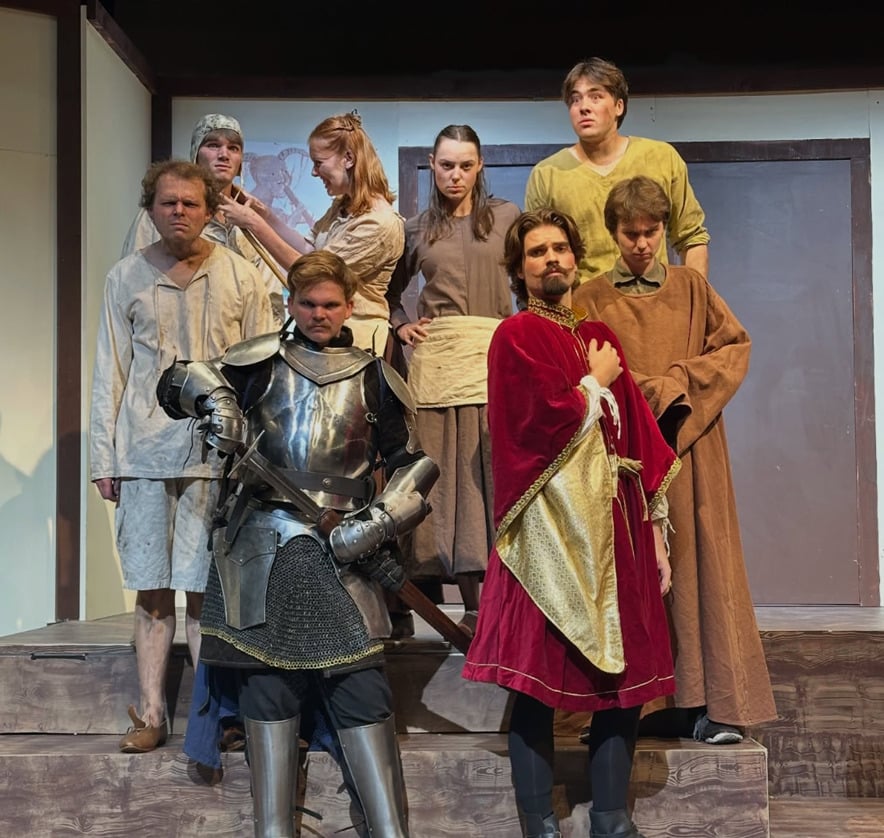
These two things combined into more than the class act performances on stage. Upon curtains opening, we were presented with the maximalist wonderland set-building of Abby Bishop and Sztelma. Dark burgundy red walls littered with trinkets and easter-egg props worked as a collective to transport us into the style and world of the piece. It also did much of the work in grounding the production, giving us a tether to reality that the cast could not do lest they break that delicate stylistic framework. Production continued to impress, with James Winter’s lighting design supporting the work happening on stage without committing the sin of being distracting, and Chris Harriot and Sztelma’s (the guy did everything) sound design nailing both being light, crisp accents and rock and roll needle drops when required. Costumes by Annette Snars and Jennifer Hurst elevated the piece once more, whilst joining the set in grounding the piece in reality.

Thinking back on this show, and specifically its performances, my mind is drawn much to the 1985 movie Clue, in its shared performance principle of unabashed commitment to character. Standouts of the night in this regard were Brendon Stone’s John Watson, who was both a brilliant physical comedian and retained the dry humour and littered emotional outbursts necessary for an English comedy, and Ben Pobjie’s Oscar Wilde, who gave us a fabulously homoerotic, Tim Curry-esque, pretentious, sensuous performance that stole many a scene for the better. Ben Wheeler’s Sherlock Holmes was delightfully foolish, which made his glimmering moments of intelligence all the more enjoyable, but I was looking for him to relax into the style of the show here and there. Nicole Hardwood’s Irene Adler was a sharp wit undercutting the fat of the egos of the men around her, an impressive badass from start to finish, although I would’ve been interested in seeing her work through each thought slightly more. Oscar Baird’s Vincent Van Gogh was wonderfully neurotic, and his commitment to flinging his body across the stage was something that both impressed and terrified me slightly – I only wished for moments of vocal dynamic shifts, to explore the different ways he could explore that neuroticism. Holky Bramble as Marie Chartier presented an entertaining and seductive antagonist, and was a lovely folly to Irene Adler, though would’ve benefitted from a more intimidating edge, especially as the daughter to one of the most famous villains in written history. As a cast, all six were virtuosos of comedic timing and playing to the benefit of the text, without needing to overperform the comedy – a rare skill set. The fight choreography was fast-paced and fun, not necessarily adrenaline-inducing but I don’t believe it had to be. Across the board, all actors were also fantastic at keeping themselves busy on stage, and never was my eye drawn to someone who was standing on stage zoning out. On a script level, Adler and Chartier’s moments of feminist uprising were a little benign, especially as Adler did almost all the domestic work in the text, and yet I can’t fault the production for that – for this I must point fingers at the original writer David MacGregor. Although, perhaps seeing some more moments of admiration or solidarity between the two women would’ve eased this marginally.

As an entity, Sherlock Holmes and the Adventure of the Elusive Ear proves the importance of stylistic commitment, and in some ways makes the argument that if you understand the limitations of your script, you can almost entirely negate them. Earning its place in other camp theatrical comedies like Clue and The Play That Goes Wrong, this production thrives as a masterclass of comedy and what leaning into the dirty and foolish can do for a production. Sztelma has met the challenge of Sherlock’s time in the sun, and although has not broken open the character in some earth-shattering way, in many ways he’s done something harder – he’s allowed him to continue being enjoyable.

To book tickets to Sherlock Holmes And The Adventure Of The Elusive Ear, please visit https://paviliontheatre.org.au/holmes-and-the-elusive-ear/.

Spread the word on your favourite platform!