A Slice Of Community

Community Garden

Community Garden Rating

★★★★★

Click if you liked this article

10

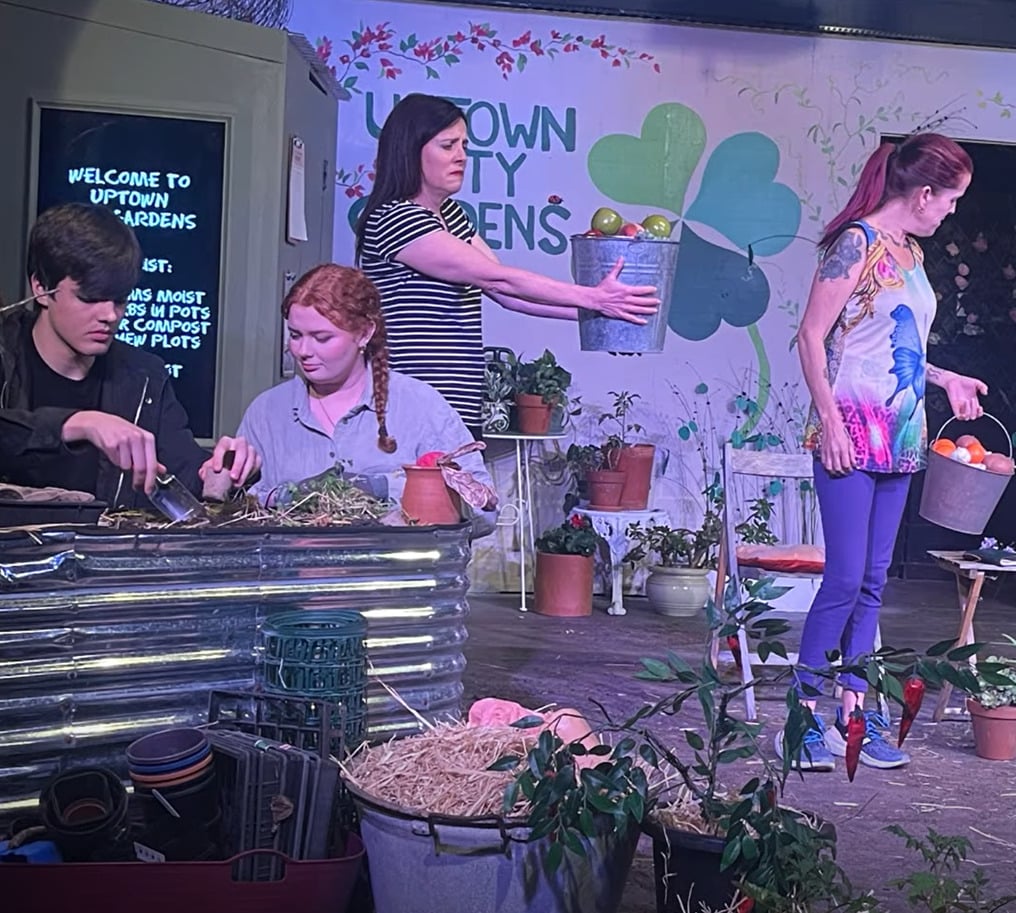
Community Garden is a play with no intermission about a man named Ralph, a nervous and new volunteer at Uptown City Gardens. Throughout the show he is slowly drawn to the strangers in the community, who all offer different stories and upbringings, but who all come together in one garden. This show is written by Justin Borak and directed by Cade Smith. August 7th was the world wide premiere for the Australian version. Justin Borak and Cade Smith worked hand-in-hand to rework the original story to fit Western Australia.

When I walked into Roxy Lane theatre, the foyer was transformed into a small Italian restaurant, representing Gigi’s Italian Family Restaurant, the Italian restaurant in the play. Pizzas were available to order so the audience could come into the restaurant at the end of the show and enjoy their meal, a truly creative way to immerse the audience into the story, even after the show had ended. The art of the set is intricate and realistic while offering lots to look at and the props (including a full-sized cut out of one of the characters) were true works of art that made the audience laugh. The work that went into the set and props, made by Kirsten Halford-Bailey, Nellie Pease, Sophie Harwood, and Cade Smith, hit the mark and it is clear just how much time and effort went into the art. I appreciated the play’s use of technology as they chose to use a screen off to the side of the stage to show the other end of a Zoom call that a character is making. Not many sound effects were used and there was no music, but the performance itself makes up for it. The lighting, designed by Katherine Robertson, was simple, only switching slightly as the tones changed. The costumes, designed by Kirsten Halford-Bailey and the cast, are modest, not drawing too much attention, but they fit the character’s personalities well. Bella, wonderfully played by Zarah D’Costa, is covered in flour to display her hard work at the pizzeria she works at.
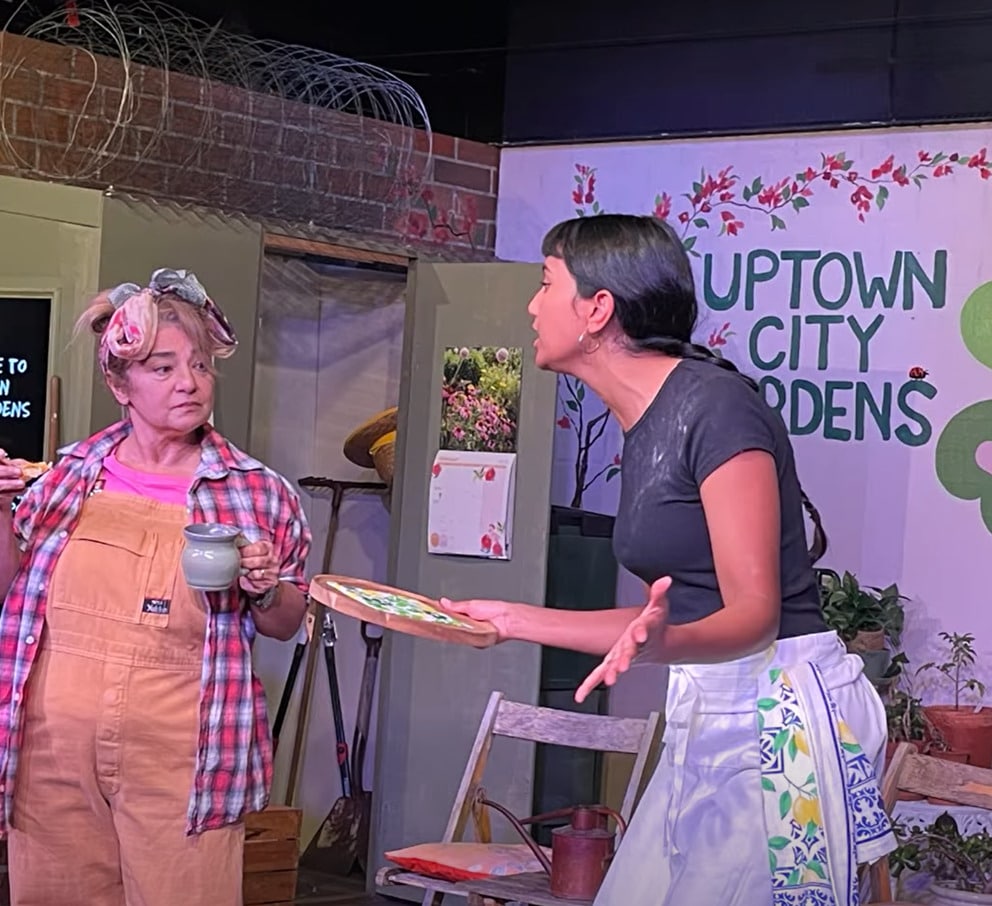
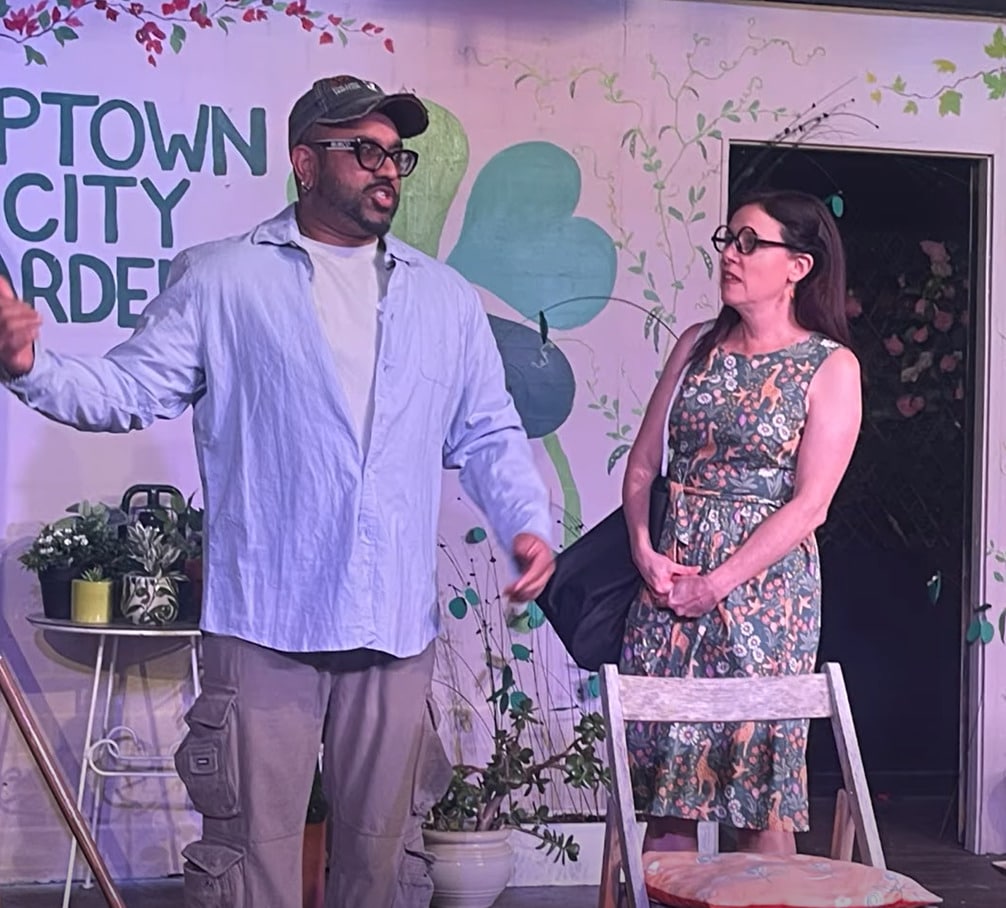
 

Ralph, played by Harry West, is naturally funny and would remind you of someone you know, a friend. His acting is real and friendly, allowing the audience to feel at ease. Elle Fisher plays both Donna and April, naturally owning the stage. She provides comic relief and fills the role of characters that show reality and acceptance. When watching Rachel Calder play Casey, her conversations and actions felt natural, like the audience could be part of the conversation. This show offers even more to relate to as there is LGBTQ+ representation in multiple characters. Several times throughout the performance, audience members fully laughed at the dialogue. The comedy gives the audience a joyous moment in such an intricate production.

This is a heartfelt play that offers many moments that people of all ages can relate to. Community Garden is playing at Roxy Lane Theatre from August 14th, 15th, 16th, 21st, 22nd, and 23rd, and I, for one, plan on visiting my local community garden soon to see what might be in store.

To book tickets to Community Garden, please visit https://www.taztix.com.au/event/roxylanetheatre/.

Spread the word on your favourite platform!

Robots On The Rise

R.U.R. (Rossum's Universal Robots)

R.U.R. (Rossum’s Universal Robots) Rating

★★★★★

Click if you liked this article

5

Rossum’s Universal Robots is a science fiction play written by Karel Capek and directed by Robrecht Herfkens. It is a four act play with two intervals, lasting about two and a half hours.

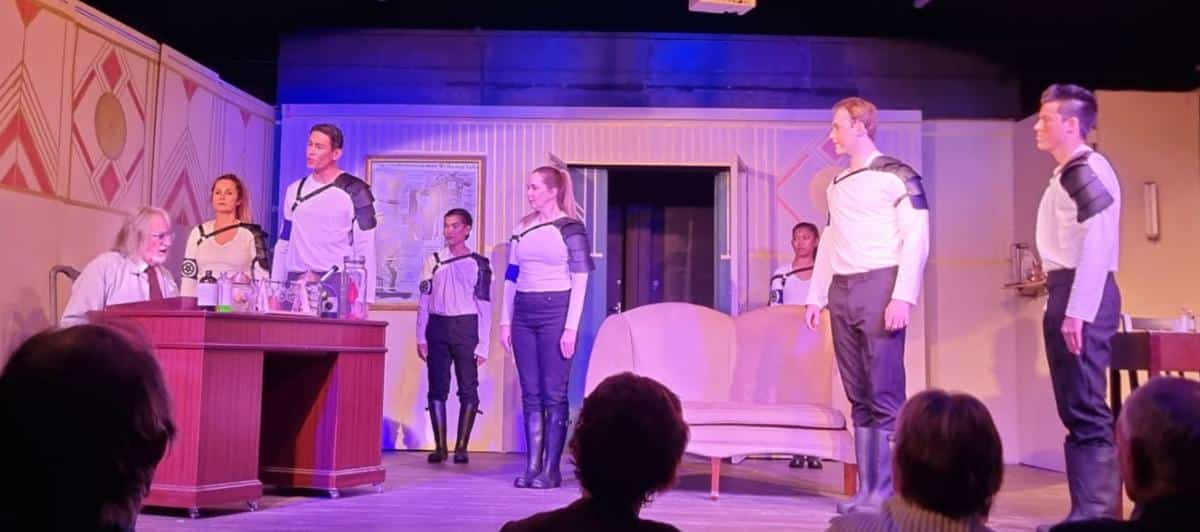
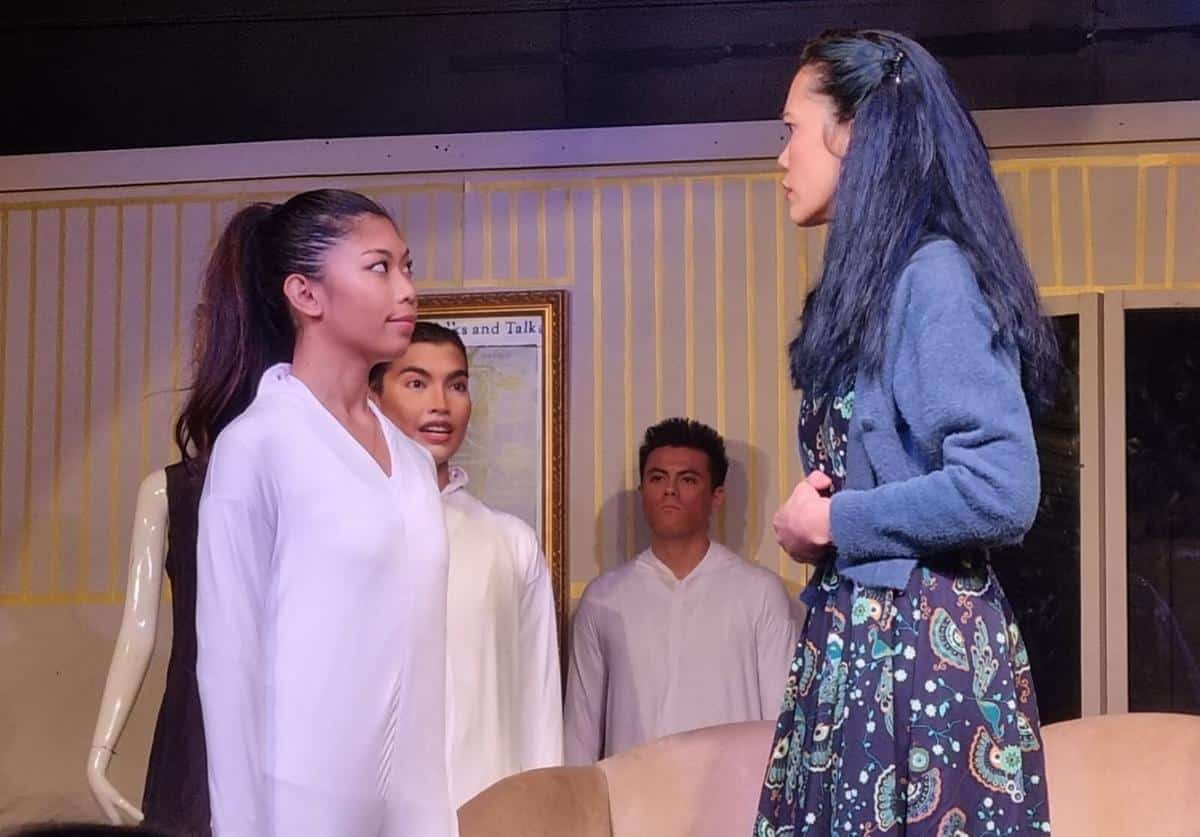
This production is set in the past and the main actors really set the tone of the era. Tod Trotman is amazing at delivering continuous dialogue and does a remarkable job with his mannerisms to capture the era. Candice Preston, who plays Helena Glory, is passionate and does a wonderful job with her expressions. She makes the audience feel included with her dialogue. The production includes a wide cast of all ages and the robots do a magnificent job at making you feel on the edge of your seat as they begin to take over the world. The performance of Radius, played by Stephan Pfister, is unnerving. The actors who play the group of managers continue acting in the background, creating realism to the scene. The way they portray the characters after the interval makes them believably older.


Both the set and costumes also do a wonderful job of setting the era. The set painting is a work of art and in between acts, there are massive changes to the impressive set build, giving the audience plenty to look at. The interior and exterior set is very unique, allowing the audience to view both sets at the same time. Lighting changes are infrequent but effective, especially towards the end, when there is a short strobe light sequence. The costumes are simple but effective. The robots wear simple white jumpsuits and the humans wear dresses and suits. As time passes throughout the performance, the costumes and hair changes reflect the passage of time.

Music is scarce but when it is played, our attention is drawn to it. Sound effects during the performance surround the audience, making us feel included. During the intervals, robotic-like music is played for our entertainment and during the second interval, the theater becomes immersive with the theatre staff dressing up as the robots.

It is very interesting to think about how this play was written in the 1920s but still captures the issues of A.I. that are rising today. I think it was an excellent choice of the theatre to choose this play (and to keep it in the era it was written, as opposed to reimagining it in our future) as the themes are still relatable and it is interesting to see how the robot takeover was envisioned in the past. This is a great show for the science fiction lovers among us.

Rossum’s Universal Robots is playing at Roxy Lane Theatre on May 23rd, 24th, 29th, 30th, 31st and June 4th, 5th, 6th, 7th.

To book tickets to R.U.R. (Rossum’s Universal Robots), please visit https://www.taztix.com.au/event/roxylanetheatre/.
Spread the word on your favourite platform!

Marjorie Prime

Marjorie Prime

Marjorie Prime Rating

★★★★★

Click if you liked this article

2

Marjorie Prime speaks to our deeply human longing for connection and prompts us to reflect on how much of our past we would choose to preserve, and what memories we might leave.

It’s the fragile humanity at the centre of this play that gives power to the storytelling. In an imagined future, we can turn our lost loved ones into ‘Primes’. These realistic holographic recreations provide emotional support as we navigate our grief and move forward with our lives. It’s an intriguing concept that leaves us questioning how far we would go when gripped by uncertainty and grief.

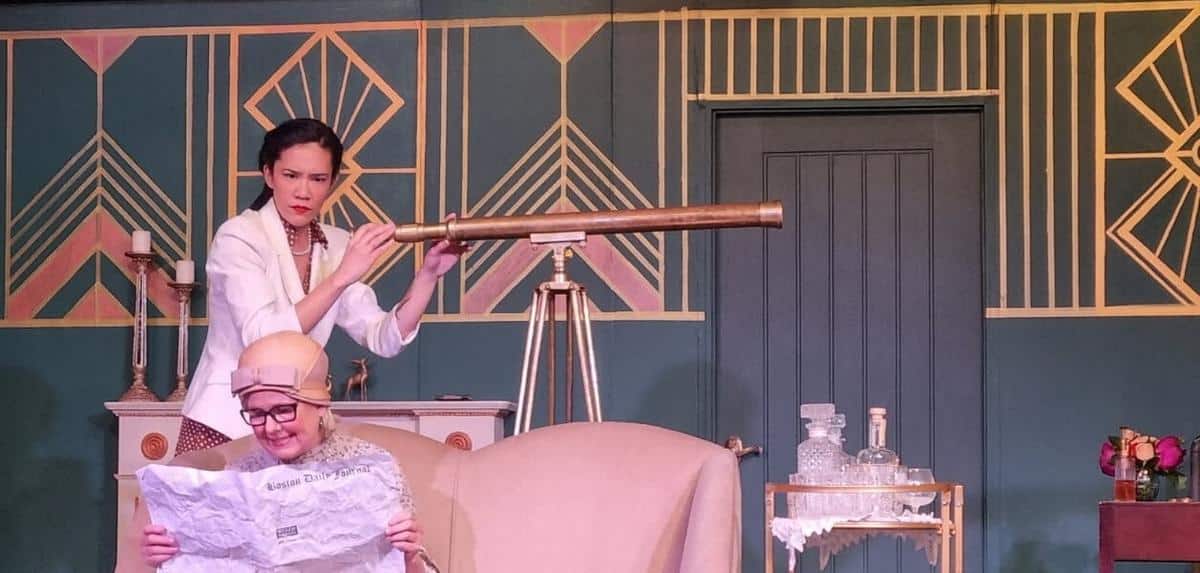
The story introduces Marjorie, an elderly woman living with dementia. Her daughter Tess and son-in-law Jon give her a ‘Prime’ of her late husband Walter to provide comfort. This holographic Walter appears eternally youthful and endlessly patient, sitting perfectly upright, attentive and still as he listens to stories about Marjorie’s life. Each day he absorbs new anecdotes, ready to repeat them later, gradually constructing a version of the man he once was through the memories of others.

The effect is both touching and unsettling. Walter’s kindness is constant, and he pays utmost attention to Marjorie. As she interacts with him, her daughter Tess watches with unease. She struggles with complicated feelings, sometimes resentful of the gentleness her mother shows the Prime, the same warmth she herself longed for growing up. At the same time, Tess is determined to shield certain painful memories from the Prime, hoping to spare Marjorie distress. Her husband Jon, however, sees value in honesty, even if the memories are difficult.


Moments of humour slip gently into the narrative too. At one point Marjorie persuades Walter to embellish the story of their engagement by inserting a movie-theatre outing to Casablanca, improving the memory just a little. It’s a small moment, but one that neatly illustrates how fluid and fragile memory can be.

Between scenes, blackouts punctuate the action, echoing the gaps forming in Marjorie’s mind. As the story unfolds, time begins to stretch and shift. After Marjorie’s death, she herself returns as a Prime. Yet instead of offering comfort to a grieving Tess, she seems to deepen the pain. Years pass in quiet leaps, and while people age and die, the Primes remain with their distorted, incomplete memories of the past.

When the play debuted in 2014, its exploration of artificial intelligence and memory felt speculative. Watching it now in 2026, with AI firmly embedded in everyday life, the questions it raises create discomfort. Is recreating the dead a source of solace, or does it blur the boundaries of grief in ways we may not yet understand?

This production at Roxy Lane Theatre brings the story beautifully to life. Janet Dickinson is compelling as Marjorie, capturing both vulnerability and warmth, while Finn Happ’s youthful Walter embodies the eerie calm of the Prime. Liza Black, who also directs the production, gives Tess a moving emotional depth and is supported by Chris Harris as the steady and kind-hearted Jon.

Short-listed for the Pulitzer Prize for Drama in 2015, Marjorie Prime remains as thoughtful and moving as ever. It’s a tender reflection on memory, technology and the enduring complexity of love.

Congratulations to the cast and crew on a heartfelt and thought-provoking performance. Marjorie Prime is currently showing at the Roxy Theatre from Friday to Sunday at 7.30pm, with Sunday matinee performances at 2.30, until 22 March.

To book tickets to Marjorie Prime, please visit https://www.taztix.com.au/event/roxylanetheatre/.
Spread the word on your favourite platform!

Tooth Fairy Godmothers, Insta-Fame & Laughter: A New Cinderella

Cinderella With A Twist

Cinderella With A Twist Rating

★★★★★

Click if you liked this article

6

Nothing says Christmas quite like a panto! For some people, Christmas is about certain smells or images; for me, it’s Pantos. And judging by the English accents in the audience, I’m not alone. My daughter and I had been practising all week—by which I mean I would shout “he’s behind you!” or “oh no you didn’t!” at random intervals throughout the day. These were mostly met with side-eye, but let it never be said I arrive unprepared.

Jane Sherwood has done a magnificent job directing Yvette Wall’s pantomime. I’ll admit I wasn’t sure how Cinderella would fare in 2025. How do you keep the tradition of male performers playing the ugly stepsisters while still supporting the LGBTQIA+ community? I’m relieved to say they handled it beautifully, and Kevin Winder (Monsterosa) and Clayton van Dijk (Groteska) were fabulous.

The whole cast was outstanding. I have to give a special mention to Siobhan Fowler (Stella Starlet), whose performance as the Russian ballet mistress was perhaps a little too convincing—I had some unexpected ballet-school trauma flashbacks. As I flicked through the program after the show, I kept thinking, “Oh, they were great!” “She was fantastic!” “He was awesome!” and “How did I not realise she played the Fairy Godmother and Kimmy K?” The Evil Stepmother (Candice Preston) nailed the role, and Savage the Cat (Sarah Christiner) prompted a running commentary from my daughter: “Yeah, that’s not creepy
’ ‘Yeah, that’s not creepy at all.” I shouldn’t have started listing cast members, because truly, they were all amazing—and I’m already over my review word count.


This version of the classic story gives Cinderella a playful modern twist. She’s still bullied by her stepmother and stepsisters, still hidden away doing chores—but instead of a ball, the kingdom hosts a talent show riffing off a certain international competition. The laughter was plentiful, and the “talent” was
 well, enthusiastic. What the stepsisters lacked in pitch, they made up for in volume and enthusiasm.

The set design was clever, allowing for quick, effective scene changes—and for anyone still confused, a screen announced exactly where we were, which gave us a giggle.

I’m both glad and slightly devastated that I didn’t receive the program until after the show. The cast look so different out of costume (credit to the costume designer!), and seeing those photos felt like discovering a magician’s secrets. But I do wish I’d read the “feel free to sing along” note beforehand. The songs were so catchy, and I’m sure my daughter and I weren’t the only ones sitting politely when we would’ve happily joined in. So if you’re reading this before seeing the show: you have permission to sing.

If you’ve never been to a panto, here are a few essentials. Audience participation is mandatory. Be ready to boo, hiss, meow (ok, that one is specific to this panto), shout “oh no you didn’t!” and “he’s behind you!”, and generally let loose. You’ll need to know Three Blind Mice and you will need to get up and do the Twist. When the invitation came, my daughter whispered, “Do we have to get up?” and apparently my “Yes—if a child asks you to dance, you dance!” was loud enough that six nearby adults stood up immediately. I stand by it.

Roxy Lane Theatre was filled with wonderful people. From the warm welcome from Chairperson, Kristen, at the door, to the man at the bar hyping everyone up and explaining panto traditions, to the volunteer rushing around stacking extra chairs so kids could see – this was community theatre at its finest. Everyone worked together to make it magical.

Well done to everyone involved. I normally don’t start Christmas activities until the 1st of December, but you helped us kick off our advent adventures a little early this year. Thanks for reminding us of the joy.

To book tickets to Cinderella With A Twist, please visit https://www.taztix.com.au/roxylanetheatre/.

Spread the word on your favourite platform!

Subscribe to What's The Show

Reviews, show news and what is on, straight to your inbox.