The 39 Steps: A Slapstick Spy Thriller That Keeps The Laughs Coming

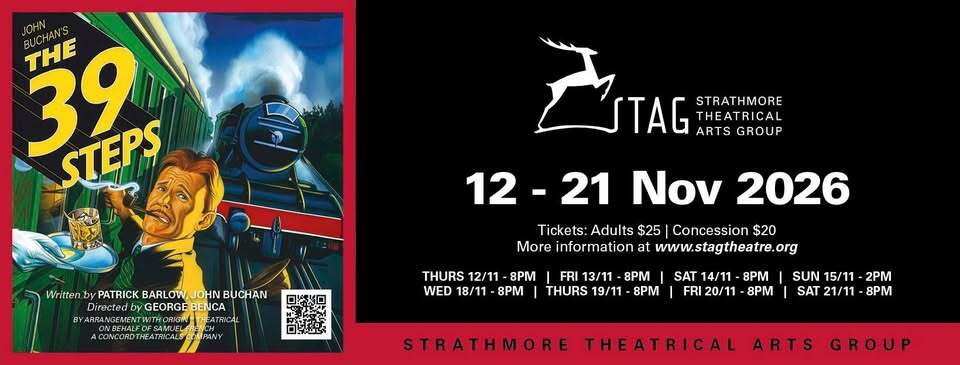
The 39 Steps

The 39 Steps Rating

★★★★★

Click if you liked this article

1

Coming to the end of another fabulous 2026 season for STAG is the 1930’s play The 39 Steps. A fast-paced, hilarious, spoof-heavy, suspenseful spy thriller. Blending Hitchcockian tropes, absurdist Python-isms, and the deliciously evil dashings of James Bond villainery. And on opening night, The 39 Steps pulled out all the stops. From the get-go, it took the audience on a fast-paced ride of round-the-world intrigue, featuring a satirical plot, laugh-out-loud silliness and farcical adventures.

Based on Scottish writer John Buchan’s hit 1915 spy adventure novel, (an immediate commercial and critical hit of that time),The 39 Steps, historically speaking, cleared the benchmark for the beginnings of the spy-tale genre we know of today. It became a 5-book series, and then, in 1935, was loosely adapted by Alfred Hitchcock (his 20th feature film) which was not only declared by the British Film Institute ‘as the fourth greatest British film of all time,’ but cemented Hitchcock's international reputation as well. It was then adapted multiple times for radio, most famously by Orson Welles's Mercury Theatre in 1938, alongside later film and TV versions.

But by 1995, a thrilling stage adaptation of The 39 Steps was devised by Simon Corble and Nobby Dimon. And finally, in 2005, rewritten by Patrick Barlow, it premiered at the West Yorkshire Playhouse before enjoying long-running successes in the West End and on Broadway.

And for good reason.

The 39 Steps follows Richard Hannay, a world-weary, well-travelled 37-year old British gentleman, who returns to London in 1935 after roaming the world and living in Canada. Filled with a tremendous sense of boredom, he decides to go to the London Palladium in the West End to attend a night at the theatre, to seek some much-needed thrills n’ spills.

His wishes come to pass, when he comes into contact with a mysterious woman, Annabella Schmidt, who seats herself next to him. Gunshots are fired and panic breaks out. Annabella then acts fearful and convinces Hannay to let her come home with him. Once they arrive at his flat, she admits that she fired the shots herself as a diversion. She then explains that she is a secret agent being pursued by assassins who are trying to steal vital British military secrets. This is how Hannay unknowingly gets dragged into a chaotic case: of international espionage.

As they drink scotch back at Richard’s West End apartment, and things start to get cosy, Annabella returns with a knife literally stuck in her back. Quickly, she informs him that the foreign spy ring is called "The 39 Steps". Before she collapses and dies, she leaves him a clue alluding to a contact and a location in Scotland called ‘Alt-na-Shellach’, and warns him that a master spy resides there. As she dies on top of him, Richard finds himself the prime suspect - painted as a murderer, and thus, becomes an accidental fugitive on the run, taking the audience on a spy-filled adventure aboard the Flying Scotsman Train up to the Scottish Highlands, on a mission to find this international enemy, save England and thus clear his name. All this, while evading both the police and international agents on every corner who fail to capture him, with hilarious results.

On this pursuit through the highlands of Scotland, he finds himself encountering an array of absurdist Scottish characters, somehow being able to escape their evil clutches. All the while, trying to discover the meaning of the 39 Steps, and stop this evil faction from destroying the world.
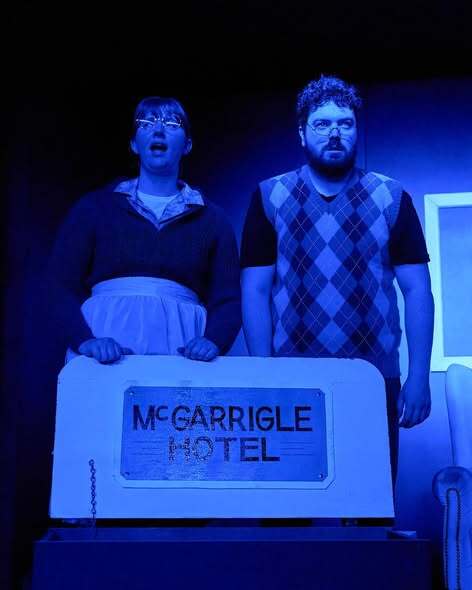
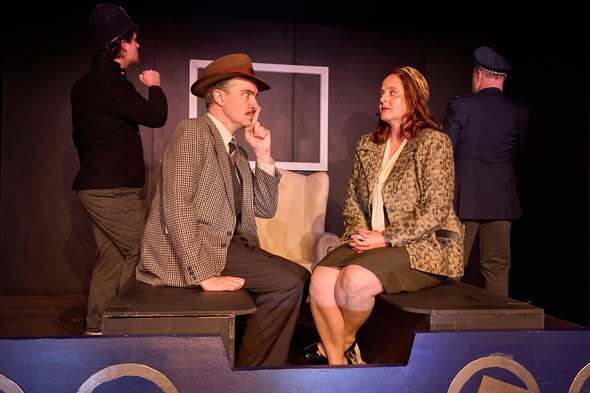
 

But in between this adventurous rogue-ish romp? Lies intrigue. There are romantic entanglements thrown in. Hilarious unforgettable characters, including bizarre innkeepers, entertaining prop playfulness thanks to the brilliant direction by George Benca that literally stop-the-show with uncontrollable laughter, and the truly evil spy-dom that would much satisfy the inner James Bond fan in all of us.

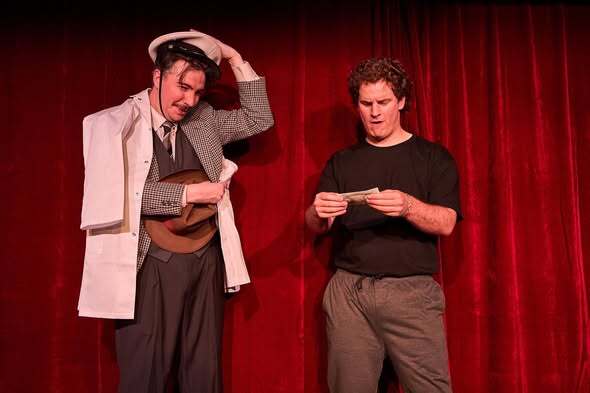
The cast is equally brilliant in this clever masterpiece, many of whom take on a variety of clown roles with classic fluidity, and with gusto. Drew Mason as Clown 3 plays the Sheriff in Scotland convincingly and with a great American drawl, just as he enthusiastically plays a West End variety host at the London Palladium, a mischievous thug, and an ‘overly-excitable’ Monty-esque train inspector.

Oscar Mikic, as Clown 4, doubles in many roles and is suited to the hapless Benny Hill-style British comedy club, if there ever was one. He embodied a plethora of the absurd, including the unforgettable portrayal of humanoid Mr. Memory, a radio announcer with a particular crush, a member of the British police in full Monty-garb, and a humorous lampoon-y Scottish Highlands inspector alongside the sheriff.

Jack Lees, a truly committed actor as Clown 2, was also simply a joy to watch. Understanding the need to morph into larger-than-life satirical characterisation from the get-go. From his arrival as a imposing thug wielding a baton, to a married salesman with a particular fetish for ladies undergarments, to a ghoulish evil spy bringing the house down with a five-minute dramatic death sequence, with ‘Palin-like prowess.’

In this piece, the actresses also took centre-stage, and were the perfect fodder for their male counterparts. Del Jordan was enigmatic and playful as Annabella Schmidt, and equally hilarious as a human fireplace prop that spoke. Sarah Deering as Mrs Higgins & Mrs Jordan played the roles of ‘Bates-like’ sinister housekeeper and evil chatelaine to perfection, as she did attempting to blow a tiny Scottish ‘bagpipe’ while holding an Edinburgh sign at the train station, to the delight of the audience. Kirsten Hennessey as Pamela, had great chemistry with Richard Hannay, her leading man, matching his physicality and wills to great depth.

But Kirsty Taylor as Margaret & Mrs McGarrigle? Had that quality of a great British comedienne. Playing ‘quietly-oppressed’ churchy Glaswegian character Margaret with a deadpan mousy energy, to the extremely funny ‘pepperpot-voiced’ Mrs McGarrigle, a classic female Monty Python archetype - sent the audience into absolute stitches.

The lead actor and narrator, Richard Hannay, played by Sean Paisley Collins, carried the show with confidence, cultivated wit, and clever quips. His depiction of a benign brit on-the-run outwitting danger from the authorities time and again was equally hilarious as it was brazen. His sly cheekiness and love of adventure worked beautifully with his onstage entanglements, appearing playful yet comfortably alone, even while handcuffed: set in his ways as a seasoned strait-laced bachelor in an unpredictable world.

But Broderick McDonald? Was by far my favourite of the bunch. As Clown 1, he played his roles to precision. His versatility shone. His ability to rapidly switch between characters and adopt a range of accents in split-second comic changes was impressive to say the least. He paired well with other actors in scenes as he did on his own, and committed wholeheartedly to the process of veering from British stereotypical sketch comedy into leering, scruffy Scottish loonery. From a British lingerie salesman wearing ladies underpants on his head, to reciting church-going hymns as a Scottish highland madman, to slithering across the stage as a drunk-as-a-skunk detective, Broderick McDonald is the one to watch when it comes to comedy gold.

The slapstick direction by George Benca kept the audience in fits of giggles. In particular, his clever use of props being thrust upon the stage as cinematic staging, allowing them to not only actively drive the story forward; but to add stylised theatrical trickery to The 39 Steps.

My favourites included a bubble gun machine used for the train and airplane smoke, and to depict foggy weather; the airplane props being held by two actors to depict spy planes in flight, the 1930’s wall telephone being thrust out for the actors to pick up and answer, the stuffed lambs that are brought onstage that block the enemies’ get-away car, and the surreptitious way that various members of the cast come onstage to create a huge prop - like the Flying Scotsman Train for example, as if they are in a play-within-a-play.

Very python-esque, n’est-ce-pas?

If you are looking for a historically-minded mystery show that is full of jocular banter, satirical wit and parody-like stylisation, smack dab in the genre of espionage-driven spy films, then The 39 Steps is definitely the show for you to indulge in this week.

The 39 Steps is playing from the 12th - 21st November 2026 at the Strathmore Theatrical Arts Group in Strathmore.

To book tickets to The 39 Steps, please visit https://www.trybooking.com/au/event/1528227.

Photographer: Lee Cook
Spread the word on your favourite platform!

It Takes Two: A Gripping Lens Of Life, Love and Loss

Two

Two Rating

★★★★★

Click if you liked this article

3

In our life’s journey, it’s safe to say that we may likely get to experience the gamut of relational dynamics. Some may be genuine, some may be deemed unhealthy or harmful; but more often than not; they are largely played out behind closed doors, where couples may hide their truth from the outside world for privacy’s sake, or in deeper cases, to protect the masks they portray to the outside world.

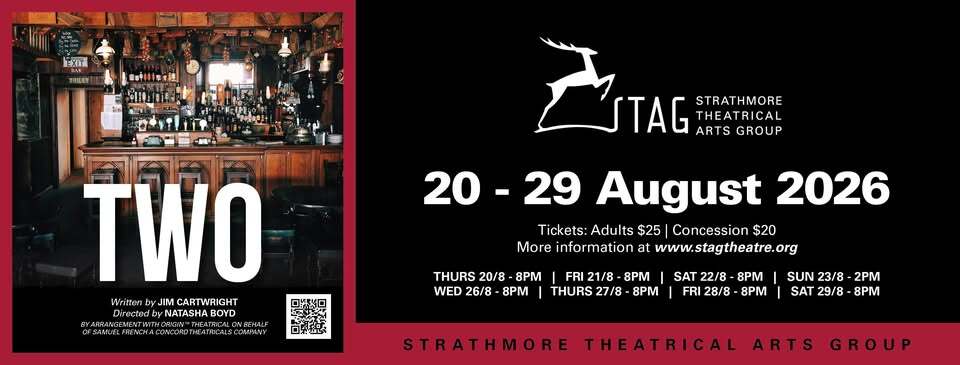
But in the case of playwright Jim Cartwright, his masterful take on the complexity of human relationships, his play aptly entitled ‘Two’, turns the ‘behind-closed-doors’ theory on its head - instead having the audience focus on the fractured relationship between a boisterous, bickering landlord and his counterpart, a landlady - both publicans of a working- class Northern English pub. Tasking us ‘head-first’ with a particular duty - of piecing together the ‘why’s’ behind the ‘cocktail of cracks’ we are witnessing in their relationship. Is it largely due to infidelity? Or is it simply a love/hate relationship where both parties have simply outgrown one another?

But wait — that is not all. For Cartwright dared to take it one step further, and distract us from the issue at hand; perhaps to set the record straight. Setting this couple’s woes aside, we remain glued to this pub setting, and instead are greeted by a revolving door of 14 other pub patrons (all played to perfection by the show’s only 2 leads), where we get to experience the gamut of different relationship dynamics, and how both genders choose to survive within walls of light vs shade; of the highest-of-highs, to the woest-of-woes. There are comedic moments, as well as grimmer ones that are at times, harder to bear witness to.

The difference in this play? Is that surprisingly, BOTH genders are shown in these scenes to be equally as lustful, resilient, bittersweet, deeply troubled and lonely. Posing a question to us about the power play in romantic relationships. Do they go both ways? Are there indeed two sides to the coin? And if so; can both sexes sometimes be deemed equally good or bad, when it comes to relationships?

As we start to question this, Cartwright cleverly places us back into the first dynamic - the blaring energy of the landlord and landlady, to piece together whether there is any hope left in their fractured relationship.


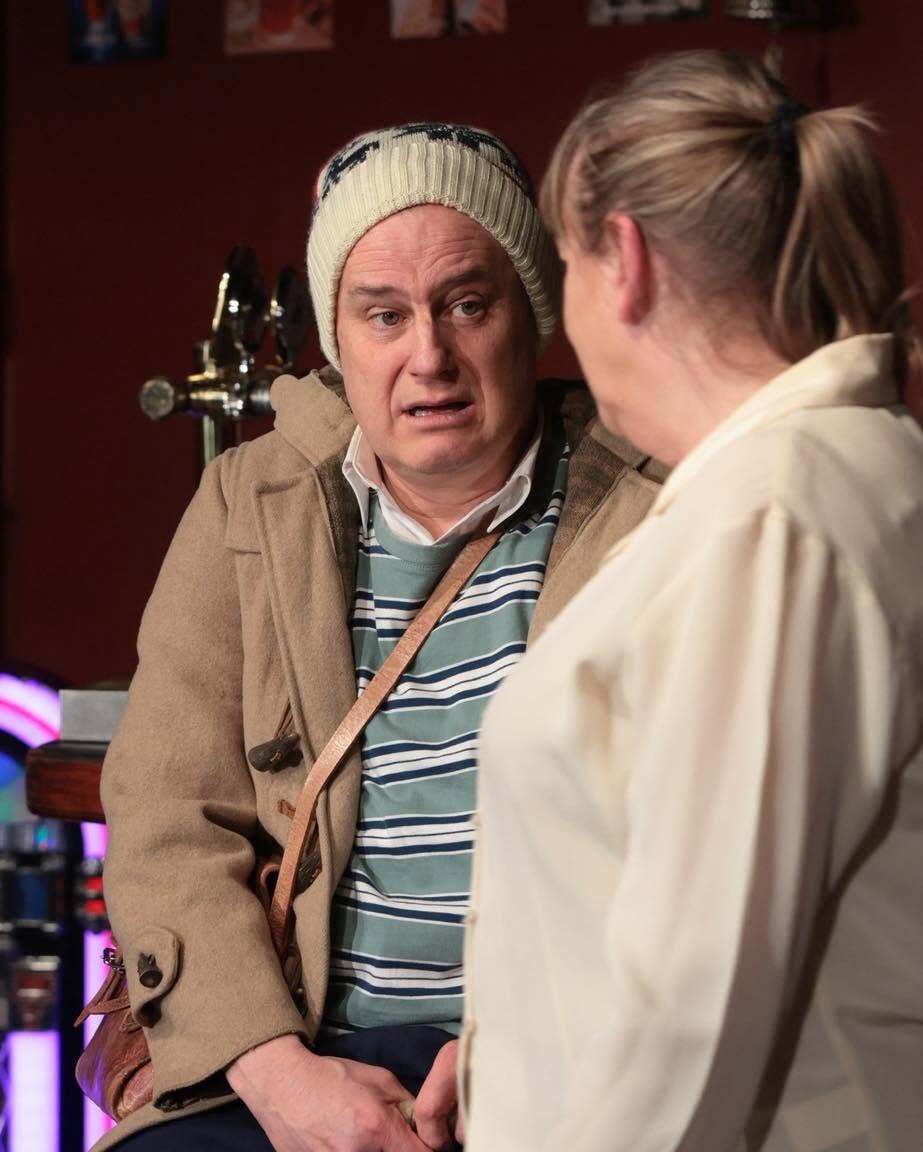
Speaking of which, the landlord, played by the very charismatic Chris Mentor, is simply mesmerising as he is so nuanced in every character he plays. From a sensitive 7 year old boy, to a damaged husband, to a widower tenderly describing his grief. And yet, his presence is unwavering and strong; remaining confident and courageous enough to tell stories that range from deeply funny to deeply broken. From his seamless performance, it is clear why Chris Mentor was cast in this demanding lead role.

As the Landlady, Angelique Pascoe is exquisite, and her energy of ferocity perfectly matched the role required to play the landlord’s counterpart. Every part she played had the bite and the stacks of humour needed to play such complex female characters, many who owned difficult backgrounds and stories not for the faint-hearted. But she conquered each tale with aplomb, as if it spoke to her heart, completely.

Cartwright’s powerful play ‘Two’, is brilliantly directed by Natasha Boyd, who has perfected in her actors the precise bridging of comedy vs pathos needed to keep us hooked; gripping us in every scene with a spectrum of human emotion and an unbridled energy that pulls no punches. Where in a span of 80 minutes, the audience is fully immersed in a fly-on-the-wall experience of witnessing a vivid cross-section of complex characters come to life inside the closed door of a pub. Where we can bear witness to what it truly means to be human in our most challenging moments.

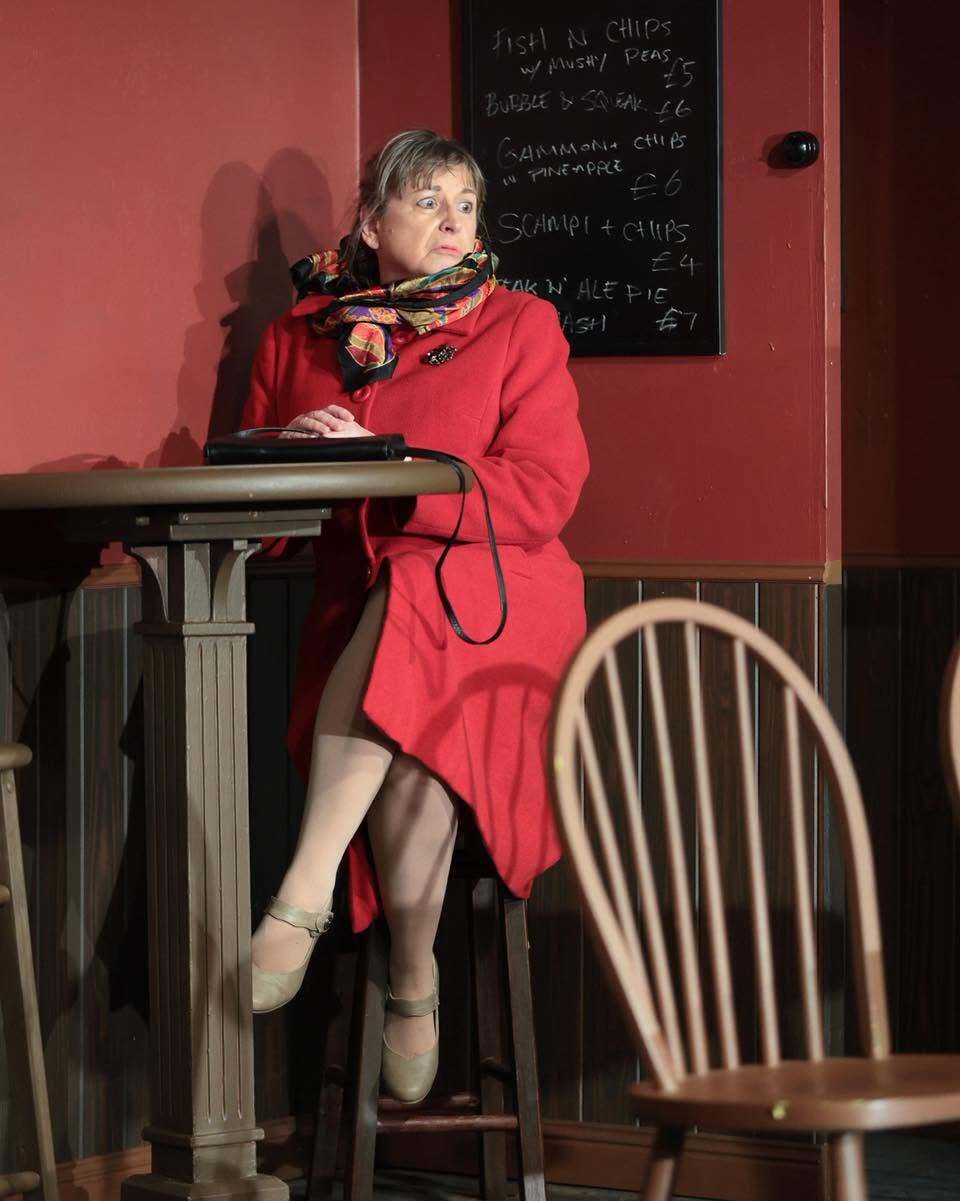
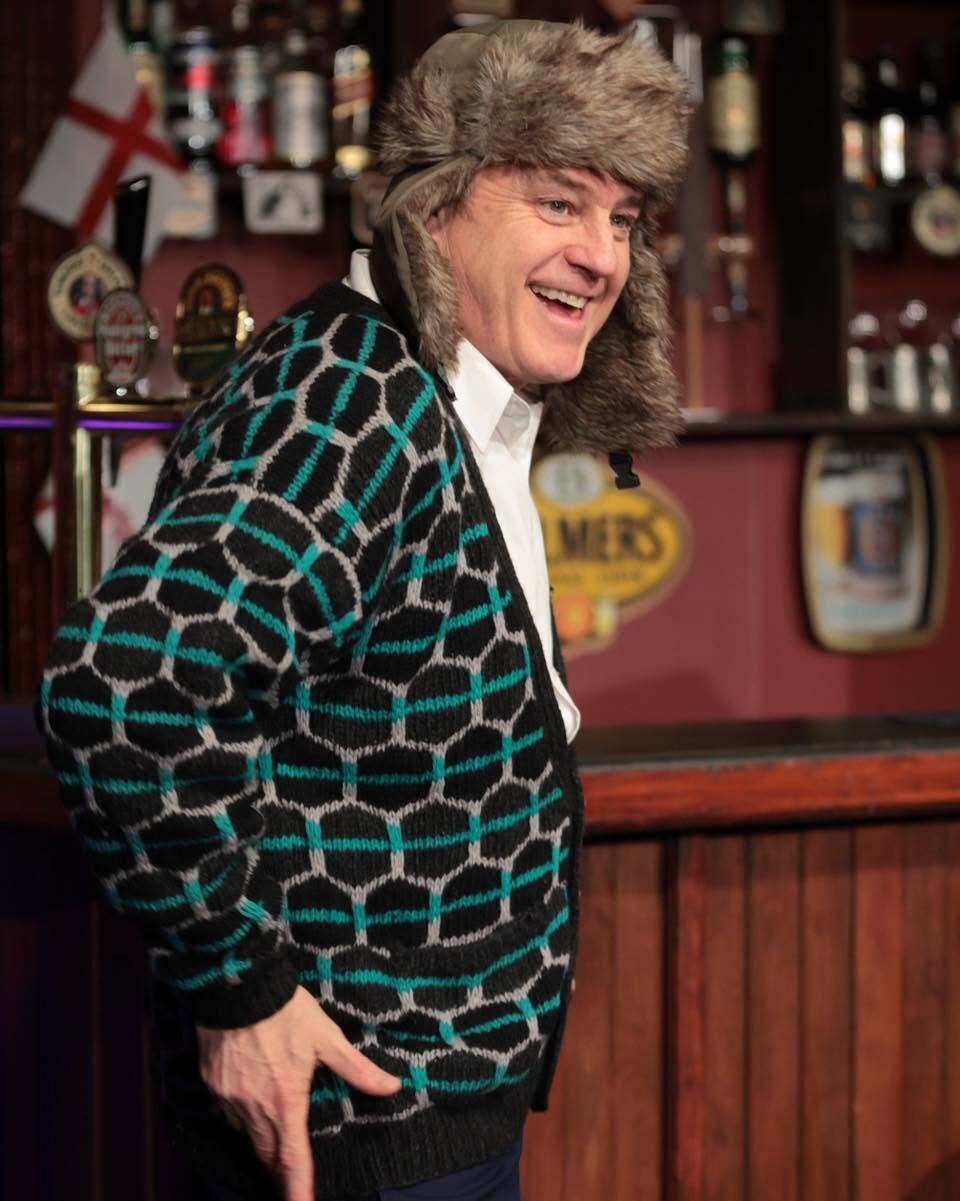
And lastly, I feel it fitting to mention the incredible set design crew that brought this little English pub to life. From the detailed 80”s lighting fixtures to the bright and jolly jukebox. From the old wooden bar and classic dartboard to the colourful wall-to-wall postered ads all in their fine 80’s form. From every angle, not one detail was left out — even creating a makeshift hallway with paintings off one side of the stage, bringing the aspect of pure realism to the audience, whichever way their eyes looked.

All this, was what indeed made STAG’s ‘Two’ a dramatic experience like no other, filled with a scope of comedy, grit, storytelling and a sum of surprises - making this a winning night out at the theatre.

To book tickets to Two, please visit https://www.trybooking.com/events/landing/1528222.

Photographer: Dave Swann

Spread the word on your favourite platform!

Kimberly Akimbo

Kimberly Akimbo

Kimberly Akimbo Rating

★★★★★

Click if you liked this article

2

Last night, I had the pleasure of going to see Strathmore Theatrical Arts Group (STAG)’s production of Kimberly Akimbo, a heart warming coming of age story about a young girl who ages four times faster than she should, her hypochondriac, pregnant mother, wellmeaning but drunken father, less than law abiding aunt and the boy from school who won’t leave her alone. The play, despite being written in 2000 by celebrated playwright David Lindsay-Abaire, is not often performed, particularly in Australia. The delightfully written piece of theatre has been on my list to see for a while, ever since I unfortunately missed the MTC’s season of the musical, so I went in with high hopes.

The cast rose beautifully to meet my expectations, taking complicated emotional notes, physical restraints (I’ve personally never even considered how hard it must be to act with crutches AND bandages on both hands) and specific accents into their strides. Special props must be given to Jeanne Snider who played the leading role of Kimberly. Jeanne has had the unique challenge of embracing both her inner 16 year old and her inner 60 year old and has done so with a grace and whimsy that has beautifully embodied the character to such extent that I am unwilling to posit a guess towards the actress’s true age. I would also like to applaud the efforts of returning STAGer Nathan Slevin, whose steadfast and nuanced performance provided the perfect contrast to the more extravagantly characterised roles undertaken by Emily Goode, Elise Moorhouse and Dante Filippone.


A moment of appreciation must also be given for the set. The theatre space, while small, created a cozy, homelike environment perfectly suited for this quirky little play, and the set was designed with an attention to detail that thrilled and entertained me (the Buffy the Vampire slayer posters in particular made my teenage heart sing). I’m always appreciative of a production that knows how to utilise the space they are given (especially within the penny pinching world of community theatre) and STAG’s Kimberly Akimbo is ticking that box, creating a library, a teen girl’s bedroom, a kitchen, the front seat of a car and even a safari in one small theatrette. The detail in the visuals, from the wall paper to the cereal to the costumes all came together to create a not quite harmonious setting, perfectly encapsulating the strange, overcommercialised, technicolour vibe of the millennium.

To book tickets to Kimberly Akimbo, please visit https://www.trybooking.com/events/landing/1528218.

Photographer: Lee Cook

Spread the word on your favourite platform!

The Beauty Queen of Leenane

The Beauty Queen of Leenane

The Beauty Queen of Leenane Rating

★★★★★

Click if you liked this article

5

Strathmore Theatrical Arts Group (STAG) has once again outdone themselves, with their final production for 2025: Martin McDonagh’s multi-award-winning play, The Beauty Queen of Leenane.

Directed by Matthew Freeman, who did an amazing job in casting four extremely talented actors, who each shone individually in their roles: Sharon Casey as Maureen, Regina Miller as Mag, Chris Mentor as Pato, and Fletcher Lodwick as Ray.

This is Matthew’s second appearance as a director at STAG, last year directing the Cripple of Inishmaan. When asked, he describes The Beauty Queen of Leenane as “a horror disguised as a bleak dramedy.” And when you see this play, you will soon find out why.

Set in the Connemara village of Leenane, Ireland, in the 1990s, the play follows 40-year-old Maureen, who lives with and cares for her 70-year-old mother Mag. From the start, we see that their relationship is extremely strained. After a neighbouring young man, Ray, arrives at the house to invite the mother and daughter pair to a farewell party for his visiting American Uncle, what follows is a story that is humorous, dark, and at times deeply disturbing.

To say that Matthew and his team have curated a masterpiece of community theatre would not be amiss. With outstanding performances from all four cast members, the brilliant writing of McDonagh was brought to life amidst a stunning set that served every need of the play and more.

Sharon is absolutely spellbinding to watch on stage. She holds such a strong stage-presence, and shift gears at all the right moments, keeping the audience utterly enthralled.


Regina was superbly nuanced in her role as Mag, delivering a magnificent standout performance in one gut-wrenching scene; the entire audience was holding their breath and on the edge of their seats (I can’t give any spoilers on the details. You will just have to see it to find out for yourself!).

Chris gave a stellar performance as Pato, really encapsulating the character. And the audience was absolutely taken in by his intimate monologue scene below the stage.

Fletcher brilliantly encapsulated the character of Ray, curating a loveable and memorable character that had so many humorous moments. He managed to find so many intricacies in this character, and it was hard to take your eyes off him when he moved around the stage.

The performances across all four of these actors was just an absolute delight to watch. They were each able to find the honest and real people within these characters, which was just magical to watch.

The intricate attention to detail with the set was outstanding; from the mould-stained walls to the era appropriate appliances, trinkets, and furnishings. The set was really a fifth character of its own. The more you looked, the more detail you would see. The fireplace cracking away so realistically really was the icing on the cake for the magnificent stage design.

With smooth and efficient set changes from the stage managers, and seamless sound and lighting, there was nothing to fault with this play. The team at STAG have pulled together a beautiful production.

This really is one special play, and if you enjoy somewhat dark dramatic plays that also injects a lot of humour, you will not want to miss this production.

‘The Beaty Queen of Leenane,’ is running at STAG from the 13th to the 22nd of November 2025. Keep an eye on STAGs website and social media accounts for their upcoming 2026 season.

To book tickets to The Beauty Queen of Leenane, please visit https://www.stagtheatre.org/.

Spread the word on your favourite platform!

Subscribe to What's The Show

Reviews, show news and what is on, straight to your inbox.