The Captive (El Cautivo) is a Spanish language historical drama exploring the five years writer Miguel de Cervantes spent as a hostage of Moorish pirates in Algiers. Or so it says on the box. There is a lot more to it than that. Cervantes famously wrote Don Quixote, claimed to be the first modern novel and arguably the most important cultural text in Spanish history. While fighting the Ottomans in a Spanish fleet, Cervantes was heavily wounded, losing the use of his right arm. A few years later he was captured by Ottoman corsairs who held him captive in Algiers, hoping for a large ransom rather than selling him as a slave. Little is known about this time in Algiers, so writer and director Alejandro Amenábar has filled the gap using Cervantes’s own themes of invention and imagination.
The film starts with Cervantes (Julio Peña), having been captured amongst other Spanish sailors, lying about his social standing in order to be ransomed instead of being sold as a slave. As he struggles to cope with his captivity, Cervantes invents a narrative of escape that begins to merge with the diegetic reality of the film. This was done in such a way that soon I wasn’t always sure what was meant to be ‘true’ and what was his fanciful imagination. Cervantes entertains fellow prisoners with stories of exotic princesses and heroic escapes, catching the attention of the corsair leader Hasán Bajá (Alessandro Borghi), an Italian who converted to Islam to escape slavery. They form a bond of friendship (and more) that causes outrage amongst the devout Catholic captives, threatening Cervantes’ chances of being ransomed by the Catholic envoys. Cervantes is rewarded for telling a pleasing story to Bajá with a day of freedom to explore the markets and city of Algiers. What he sees beyond the prison wall is then shared with the other captives.
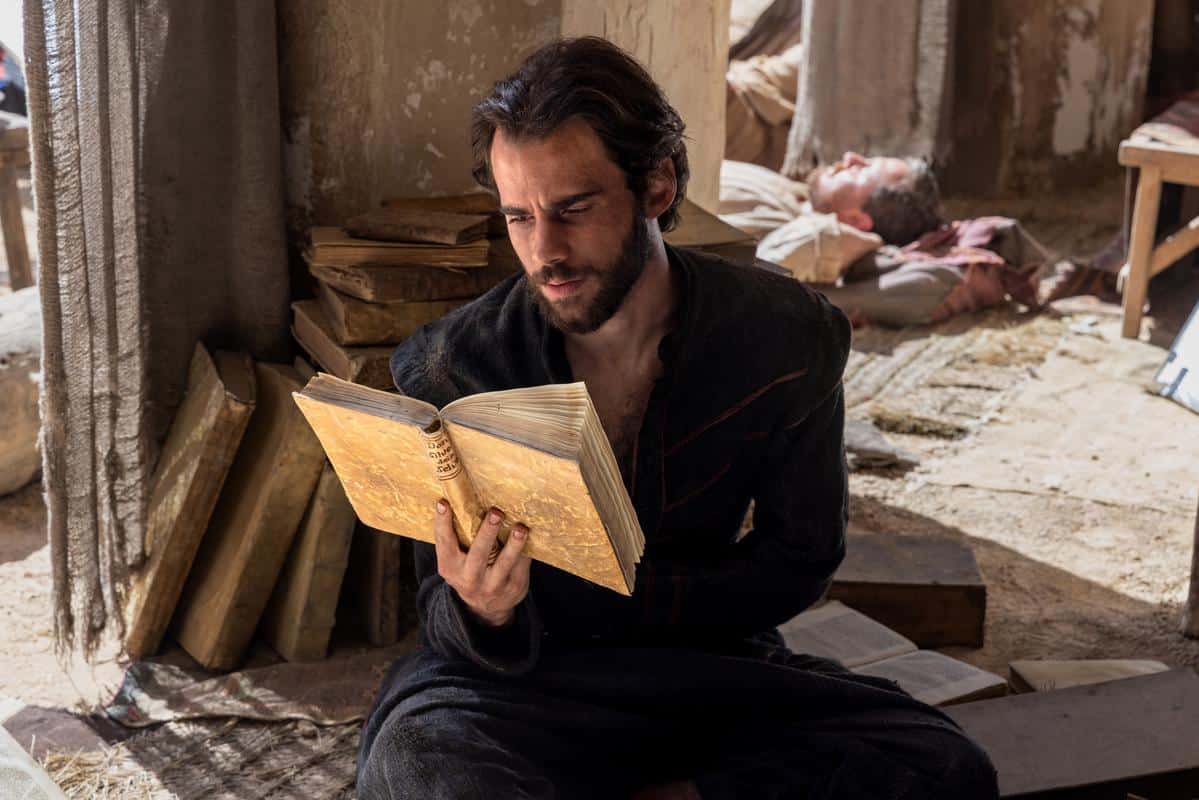
The plot seemed slow and disjointed at first and the setup wasn’t overly clear. It was only when Amenábar began toying with reality that I settled into the narrative. The story is told in such a way that you are never quite sure what is meant to be an invention of Cervantes and what Amenabar wants us to accept as ‘real.’ I found myself doubting if any of the escape attempts, rewards, double-crossing initrigue, and intimate relationships were even actually happening and not just more of Cervantes’ own fanciful inventions. Characters are constantly lying right from the start, the heroes and villains alike, not only to save their own neck, but to create division or gain an advantage. There are many visual references to Don Quixote, too, like windmills and the Catholic envoy, where a tall, thin dignified older priest with a magnificent beard is accompanied by a short fat priest on a donkey, clearly signifying Quixote and Sancho Panza.
Like Don Quixote, The Captive is about the power of lies and losing oneself in imagination. This isn’t really an origin story about a famous writer, or an attempt at explaining history. This is a story about storytelling itself, and that is absolutely fascinating.
The Captive was seen as a media preview for the HSBC Spanish and Latin American Film Festival running through June to July.
https://spanishfilmfestival.com
To book tickets to Hsbc Spanish & Latin American Film Festival, please visit https://spanishfilmfestival.com/.