Today, iconic international magician Dynamo has announced a surprise visit to Australia where he is set to shock the nation by exposing an illusion believed by Australian households nationwide.
Returning to Australia for the first time in more than a decade, Dynamo will trade sold-out arenas for an unexpected Sydney neighbourhood, delivering an exclusive performance with B&D Garage Doors on Wednesday, 26 August.
Alongside his signature mind-blowing magic, fans will witness Dynamo expose an everyday illusion believed by Australian households nationwide—one that has remained hidden in plain sight until now.
“I can’t wait to head back to Australia this month, but this time with an illusion that isn’t happening on stage,” said Dynamo.
“It’s something many Australian households encounter every day without even realising it. Once it’s revealed, it will challenge what Australians currently believe to be true.”
While the exact Sydney location remains under wraps and details of the illusion are being closely guarded, Australians will have the opportunity to witness the performance firsthand, with a limited number of tickets available to win.
For the chance to witness Dynamo’s only Australian performance, visit www.bnd.com.au.
Dynamo’s appearance comes hot on the heels of filming his upcoming series, Dynamo vs. Houdini, which marks the 100-year anniversary of Harry Houdini’s passing and explores what the legendary escape artist might attempt if he were alive today.
An extraordinary community fundraising campaign has forced Ku-ring-gai Council back to the table in a last-ditch bid to save Marian St Theatre.
After more than 250 residents attended Rally in Red on Sunday, 215 supporters have contributed more than $76,000 towards the $100,000 needed to preserve the approved architectural plans for Marian St Theatre before they expire on 19 August.
In response to the campaign, Ku-ring-gai Council has called an Extraordinary General Meeting (EGM) for next Monday to consider rescinding its previous decision to abandon the project and instead undertake the urgent works needed to preserve the approved plans.
Marian St Theatre Action Chair Jessica Blaxland Ashby said the response had been extraordinary. “On Sunday we rallied because we were angry. In just three days, the community has raised more than $76,000 and forced Council back to the table.”
“If we can raise the remaining funds, Councillors have the opportunity to reverse their previous decision and preserve the only approved pathway to reopening Marian St Theatre.”
The emergency campaign was launched after Council voted on 16 June to allow the approved architectural plans to expire. If the plans are lost, campaigners say more than 20 years of consultation, design work and planning, together with $1.7 million of public investment, will be wasted, and reopening Marian St Theatre would be delayed by another decade – or lost altogether. Due to the EGM announcement, the fundraiser has been extended from Thursday to Sunday.
The approved redevelopment, designed by leading theatre architects Tonkin Zulaikha Greer, would transform Marian St Theatre into a contemporary arts centre with spaces for theatre, music, dance, exhibitions and community events.
All donations will be tax-deductible and will be refunded if Council ultimately decides not to preserve the approved plans.
Blaxland Ashby said the campaign had demonstrated the depth of community support. “The community has been extraordinary. Hundreds rallied. Thousands have signed the petition.”
“But we’re not there yet. We still need the remaining funds before the end of Sunday.”
The campaign has attracted widespread community support following Sunday’s Rally in Red, which brought together performers, families, community leaders and artists in a sea of red outside Gordon Library.
Davidson MP Matt Cross reiterated his support for preserving Marian St Theatre both at the rally and in a speech today in state parliament, and encouraged signatures to the petition to the NSW Parliament. Federal Member for Bradfield Nicolette Boele described Marian St Theatre as “a clear case where, rather than building new infrastructure from scratch, we can step in now to preserve and revitalise the spaces that already exist.”
Blaxland Ashby thanked all the generous donors. “If Council won’t save Marian St Theatre, we, the community, will.”
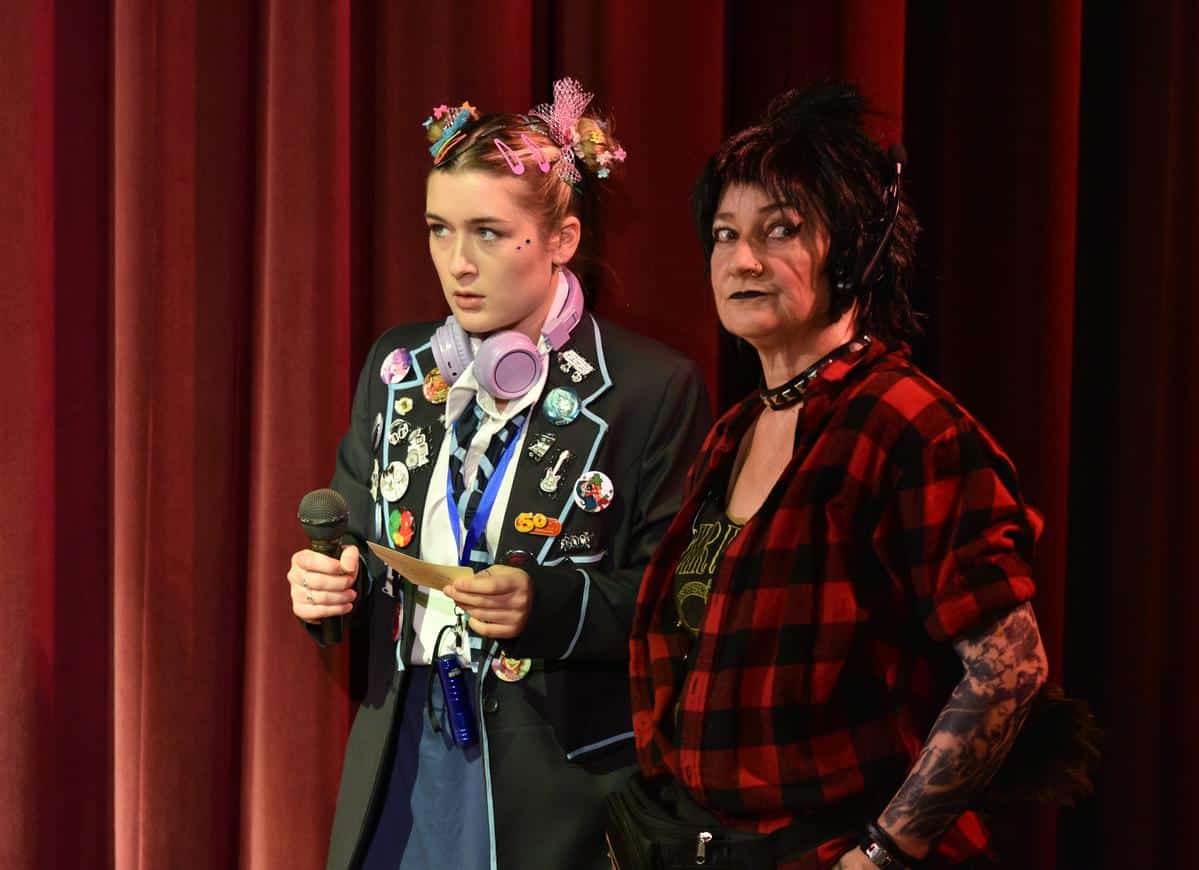
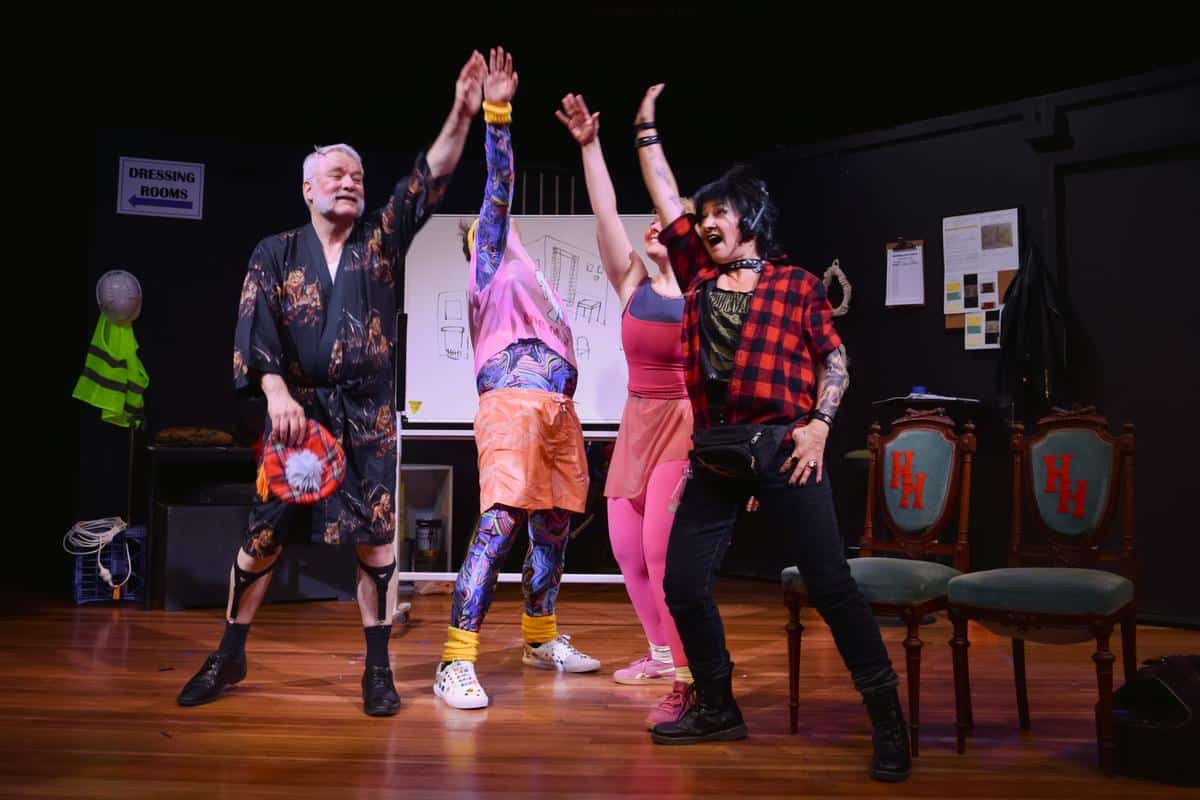
Midnight Murder at Hamlington Hall opens onstage to the upbeat music of Olivia Newton John’s melodious voice singing her famous song “Physical”.Phillipa Chidley, played by Emily Newberry, is warming up for an upcoming play.She is moving in that wonderfully uninhibited and free way that people dance to an 80’s song, when they think they’re alone.Newberry elicits giggles in her pink leotard as she channels Olivia, and it is a great introduction to this wacky, witty, and original play!
It is the opening night of a murder mystery play put on by an amateur theatre group named the Middling Cove Players.The writer / director / actor Shane Tweed (Michael Mulvenna) and the cast and crew are in the last hours of rehearsal when they receive news that the dreaded lurgy has hit several cast members.After a brief discussion about perhaps postponing the play’s opening night, Shane confidently declares that “The show must go on!” The hitch of this?The remaining cast will need to take on two-or-more character roles in their upcoming play.This includes roping in the tough stage manager Karen, played by Kate Kelly (involved in the Middling Cove Players because of ‘communityservice’ for an unknown but possibly violent crime) as well as her niece, played by Ciara Briggs.
Under the tutorage of Murray Fane’s character, they are instructed that each of their characters should speak with a different accent to differentiate the characters to the audience of the play.Thus begins the “play within a play” where the cast, donning some hilarious stereotypical costumes and accents, and moving with exaggerated bluster, begin to perform the murder mystery play. It isn’t easy acting ‘like a bad actor’ but the cast throw themselves into it and achieve their goal! Exaggerated accents appear, limps manifest and many other things add a touch of ridiculous to the play.
Mishaps, big and little, continue to plague the play – from the purposely mistimed lighting and sound effects to the outrageously long sound effect at the end (no spoilers – you’ll know what I am referring to when you see this).
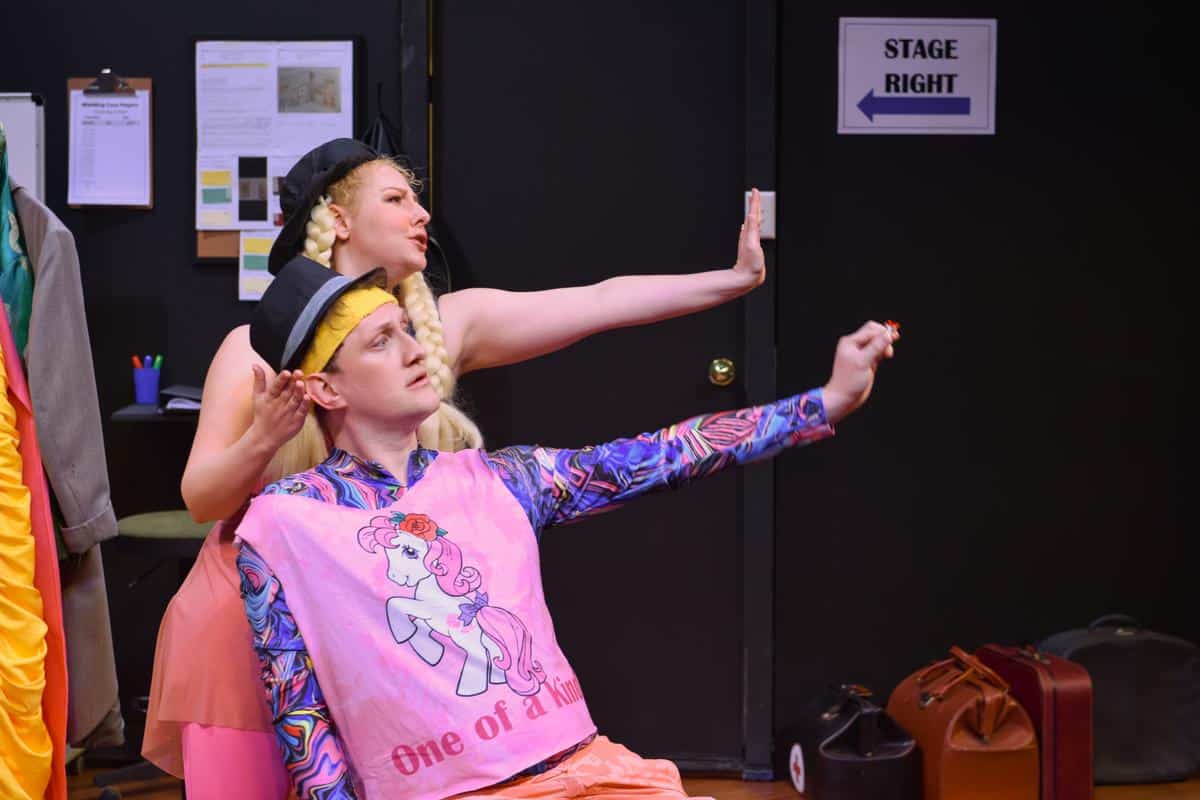
Joy Sweeney’s costume design added depth to the Middling Cove Players’ onstage characters, which included a psychic named Madame Esmerelda (Kate Kelly), a movie star, a Seafarer and an elderly Lady Smythe, all three characters played by Emily Newberry.Sweeney’s clever design of Murray Fane’s costumes were spot on for Colonel Munster, Farmer Giles and the Scottsman and the audience were laughing heartily as Fane races to portray all his characters and their associated costumes, sometimes one after another.This was performed with enormous energy by Fane!
As I had previously seen and loved the work of co-writer Jamie Oxenbould’s comedy Chicken in a Biscuit and the high standard performances by Pymble Players, I had hoped that Midnight Murder at Hamlington Hall was going to be an interesting and funny night of theatre. The play was also co-written by Mark Kilmurry. I wondered if the name Hamlington was a deliberate play on words – a bit of a hidden meaning within the title – as in, they were going to “ham things up”. (They certainly did!) After the performance, I looked back on sound designer Casey Moon-Watten’s opening song “Physical” and thought what a great choice this was.Director Declan Moore’s cast was full of movement, each character portraying their own physical comedy onstage which made the audience laugh, especially throughout the second act.This ranged from a quiet nuanced eye raise, notably by Karen Sharp (played by Kate Kelly), the long, long, long descent from standing to sitting because of ‘old dodgy knees’ (Newberry’s Lady Smythe) to the full on madcap purposeful exaggerated movements of Harry Moorby’s character Doctor Freddie Ermington, as he tries to stand after slipping on water, recovering, only to keep repeatedly slipping and sliding.It was like the audience was watching one of those cartoons where a character keeps tripping and slipping, with hands flailing and legs going every which way!It was a sight to see, and the audience loved it!Mulvenna’s Detective Earnest Black’s comedic intensity as he searches for the murderer, steers the play successfully to its conclusion.
In other standout scenes, the whole cast is seen changing the set and moving props under darkened lighting.Kudos to lighting designer Sean Clarke for this, a scene where the cast are moving quickly around the stage, dodging furniture and moving to music not dis-similar to a loony tunes song.The cast toss props to each other in what looked like a mess, but was, I imagine, a very co-ordinated and polished display of physical comedic timing. If you’ve ever seen a silent movie, Charlie Chaplin style, then you can imagine the zany tone of these scenes.
This could have been a disaster, because the play was ‘full of mishaps’. Instead, Pymble Players were magicians, having produced a carefully constructed chaotic comedy with the illusion of catastrophe! The only trouble I had with this play within a play was picking a favourite character.
Don’t miss watching Midnight Murder at Hamlington Hall!
This play is dedicated to Mr Tom Sweeney OAM, director of over 40 musicals and a long-term member and Vice President of Pymble Players.Declan Moore, the director of Midnight Murder at Hamlington Hall, hopes that “this one brings a smile, Tom!”.
Season run: 31 July – 9 August 2026 at The Zenith Theatre, Chatswood. Run time: 2 hours and 25 minutes, including a 20-minute interval Tickets: www.pymbleplayers.com.au
Hurtigruten Nordic Film Festival Opening Night Reception And Premiere Screening of ÁRRU Rating
★★★★★
Click if you liked this article
What happens when the person you rely on to save almost everything you know and love also turns out to be a monster? Can you walk away? How do you negotiate the constant challenges to life and culture? Do the young want to carry on the flame? These are some of the core questions in Árru, Elle Sofe Sara’s striking debut feature focusing on the lives and culture of the Sami people that inhabit the Sápmi region of Norway, Sweden, and Finland. What better film to represent the unified yet separate cultures showcased at the 2026 Nordic Film Festival.
Using a mixture of genre styles, from surreal cinema, family drama, to musical, Árru starts in white snows of winter covering a vast, almost empty landscape. After the bloody miscarriage of a reindeer, traditional herder Maia (Sara Mariell Gaup Beaska) buries the tiny body in the snow. Together with her brother Danel (Simon Issát Marainen) and daughter Ailin (Ayla Garen Nutti), they continue the rustic life of the Sami, tending to their reindeer, killing and butchering them for meat and clothing. After the snow retreats for summer, the vast grasslands of summer form the backdrop of the narrative drama. We learn that a mining conglomerate is planning to build a large copper mine, reducing the grazing land available. This will force a mass culling of the reindeer and with it the destruction of Maia’s livelihood and her way of life.
Leading the fight is Maia’s charismatic lawyer brother Lemme (Mikkel Gaup), who successfully campaigned against a similar situation in Canada. As he rallies the community through protest and song, Maia and Danel remain wary around Lemme. This reluctance to embrace their possibly saviour and Lemme’s grip of power over his family and the town threatens Maia’s relationship with Ailin, one of his strongest advocates. The film then slowly reveals Lemme’s real character. First, Ailin discovers that Lemme is not as trustworthy as she first believed, and then a drunken confession by Danel at a celebration of culture reveals a dark past that shatters the community. They need Lemme to save their way of life, but can they still allow him to live amongst them.
Sara uses music and song throughout to connect Maia with her ancestors and home, and is clearly an important life of Sami culture. Musical numbers sometimes break the dramatic flow of the film, but remaining beautiful and interesting. During one of the protests, however, traditional song turns into a music video style dance number that seemed like an odd stylistic choice and a bold contrast to the grounded realism of the drama. But that wasn’t enough to pull me out. The performances were authentic and powerful, especially Simon Issát Marainen, who at first seemed brooding and surly but then when we discover why, draws from us empathy and understanding. And while the dramatic narrative forms the core structure of the film and provides plenty of intrigue and conflict, the most appealing part of the film for me was just spending time with the last remaining indigenous group in Europe.
Árru can be seen as part of the Nordic film festival playing nation wide at Palace Cinemas.