“Blackrock,” is a 1996 Australian play written by Nick Enright, and being presented this season by Thrive Productions at BackDock Arts, Fortitude Valley.
The synopsis opens up to several teenagers and their families living in the beachside town, Blackrock. A group of friends reunite after one of them, Ricko, returns from a trip. They plan to attend the birthday beach bash of their friend, Toby, doubling it as a “welcome home,” party. After a night of drinking, drugs and reckless fun, 15yr old Tracy Warner is found on the beach. Rumours swirl and questions of trust and loyalty begin to stir throughout Blackrock. The lives of Jared, Ricko and his friends are never the same.
Lighting and sound was kept simple and was handled well throughout. Different punk rock/ soft rock would play during transitions between scenes as well as when cast members were reminded of the death of their friend or the feelings attached to their loss. The lighting was a white wash and remained consistent throughout the entire play.
The cast’s use of their space was interesting, as there was no easy way to leave stage other than the door in upper stage left. The set design consisted of several black stage blocks and stools on either side for all actors to sit on while a scene played out centre stage. The cast wore actors blacks, collecting props from upper centre stage when needed, emphasising the skills of the actors over embellishments. The cast entered and exited in single file, refraining from facial expressions until they were in character. They took to creating various formations or standing in place when transitioning through each scene change. This may have been handled differently to look a bit smoother between scenes, but made sense given the floor space.
The casting was done well and was a pleasure to watch, despite the seriousness of the play’s themes. All actors performed enthusiastically in their roles and gave great representation of small town, Australian life.
Notable mentions include the roles of Jared, Ricko, Jared’s mother and Tiffany. The emotional depths the characters explored were key to capturing the fullness of their essence, which they executed almost seamlessly. It is a wonderful skill as an actor to be able to portray their characters displays of inner turmoil, how their emotions guide or affect them and whatever convictions their characters hold onto that offer them strength.
Over time, layers were peeled back to explore the headspace of characters like Jared and Ricko; once thought to be birds of a feather, but then challenged beyond what either of them ever expected. Their performances were impressive and highly engaging, making me eager and looking forward to seeing them in future productions.
I recommend this Australian Drama to audiences 15yrs onwards, as scenes contain references to sexual assault, suicide and violence that could be triggering or upsetting for some.
The stage adaptation of one of “A Murder is Announced,” directed by Jaqueline Kerr, was performed by the Villanova Players on Friday. A wonderful portrayal of one of Agatha Christies most loved stories, brings back the beloved Mrs Marple and introduces various delightful and intriguing characters in the English Countryside. When a notification of a murder is printed in the local paper, everyone is curious to discover who and what will happen at 6:30pm that evening…
The stage was set in the sitting room of Miss Blacklock, carefully decorated with several armchairs, a loveseat and a small coffee table positioned center stage. The false walls were a sage green and were complimented by artwork hanging on the wall and two red doors. There was ample space for several actors on stage at one time, with no issues for blocking and good use of space. The furniture and props were thematically correct and welcoming.
Sound and lighting was fairly standard, involving a white light above the stage for most scenes. The scene where the announced murder occurs involved a sudden lowering of the light and a few flashes of light that sensitive viewers should be aware of. Prior to the performance, music aligning with the time period set the tone appropriately. The costumes suited each of the characters, aligning with the fashions of the time period. Makeup and hair were also notable, kept simple but gracefully complimented the female actresses.
The actors portraying Mrs Marple (Desley Nichols), Inspector Craddock (Leo Bradley) and Miss Blacklock (Phillipa Bowe) did exceptional in their roles, seamlessly committing to the dialogue and motivations of their characters. It was highly enjoyable to watch as they three of them interacted with one another as well as with characters such as Bunny (Lorraine Fox), Mitzi (Robyn Stumm), Patrick (Reece Milne), Julia (Isabella Stone), Edmund (Steven Eggington), Clara (Jill Cross) and Phillipa (Sioban Evans). The role of Rudy Shertz and Sgt. Mellors (John Evans) was also a good addition to the ensemble.
The style of dialogue, articulation and gradual defining of relationships between each of the characters seemed more than natural to each actor, making it very easy to apply praise for their great work in this production. Each scene cleverly directed and increasingly engaging to the audience. Many in the crowd audibly oohed and aahed at each new development, as a new secret was revealed and the plot thickened.
Because of their rousing performances (along with the director’s attempt to engage the audience with an opportunity to guess the murderer prior to Act 1), it was a thoroughly enjoyable evening for all who attended. All in all, a highly recommended whodunit that will keep you guessing until the end!
Bright Young Things is a coming of age production about several young game show contestants who seek to win the grand prize and be named the country’s brightest. Produced by Sun & Wine Arts Company, this show was written by Georgia Christou and directed by Claire Yorston.
Upon sitting down in the audience, I was immediately drawn to the stage design. There was a table in front of the stage with an actor, soon revealed to be Rochelle’s father, sitting at it looking at a telephone. On stage sat six chairs on upper stage left with five actors seated (the game show contestants). All actors, waited patiently, watching as audience members settled in. This offered an interesting and engaging image that drew me in, along with the red lighting over them.
Despite the lack of space, the actors maintained good blocking throughout the show. It was good to see how the production utilised the space it had. The stage design consisted of the game show space onstage and a green room/Rochelle’s house were in front of the stage at the table. Minimal props such as a telephone, maps and a bowl of potato chips, were used to indicate scene changes, which allowed for smoother transitions.
All costumes were basic but effective for each character’s personality and development. An example of this was when one of the contestants, Shian, tried on Rochelle’s jacket. Untying her hair and adjusting her outfit was a way to show the character’s personal realisation of her independence and newfound confidence.
Throughout the play there was an effective use of audio effects and music. Including when the phone was ringing, the show theme, and game show buzzers. The lighting was fairly standard and accompanied the scenes well, shifting between white wash and spotlights when necessary, when representing the more intimate character moments.
Some of the highlights that stood out to me included the use of symbolism and dynamics. I reference the symbolism of authority and control displayed throughout, growing and decreasing as the play went on. The role of the corporate bosses were represented initially by two actors. Each scene where they were trying to portray a stronger sense of control, an actor was added to the group, the voices speaking in unison and growing louder and stronger. As it got softer and weaker, actors were removed.
As the game show progressed, the contestants grew in confidence in themselves, revealing more of the bosses agenda and as well as the potential of who the characters knew they could be.
Another key point of possible symbolism was displayed in Rochelle’s flashback of her mother leaving. Instead of only using the two actors, multiple cast members appeared, echoing words Rochelle had heard her mother say. As Rochelle relived her trauma, the memory acted as a distraction, losing her the place in the final round of the competition. This was an especially interesting portrayal of emotional depth and context for her character, as we had only seen glimpses prior.
All actors performed respectfully well and worked together to tie the production together. Notable moments in particular were during the monologues of the contestants, including Esther and Bernie. Congratulations to all for a fantastic performance.
“She Kills Monsters,” is a tale of Agnes, a High School teacher who is grieving the loss of her younger sister, Tilly. When packing up her sister’s room, Agnes find a notebook that contains a DnD world of Tilly’s design. Seeking to truly understand who her sister was, she seeks the help of a goofy DM, Chuck, who leads her through this creation in the hope that they can uncover what Tilly had left behind. Secrets, friends and life lessons lead Agnes to not only learns about her sister’s creative and courageous life, but how she can honour Tilly through her own.
This production, directed by Brenna Corben and written by Qui Nguyen (2011), gives a comedic tribute to the world of role-playing, tabletop games and the people who play them. Re-set in a Queensland, fictional town, it was great to see the way the different characters were being represented and how they interacted with one another. From the costumes, simple yet classic, to the way they were presented in Tilly’s world vs “real life.”
The sound and lighting included basic but reasonably varied lighting choices, that served the purpose of each scene. While the transitions could have been smoother, overall the media and colours used added to the theatricality of the production. In particular, the audience thoroughly enjoyed the voice overs overlaying the transitions to scenes in the school setting. The Australian references were enjoyable and easily identified, while also paying tribute to memories of our schools days. Overall, the audience engagement was highly positive and jovial, laughing at each joke wholeheartedly and enjoying the musical additions when applied. For example, at the sound of the “Friends” theme song, a majority of the audience knew to clap at the end of the first line.
The stage design incorporated the fantasy theme through their use of vines and platforms decorated in a faux stone wall covering. A table was placed center stage, while three block were placed around it, two of which raised slightly higher than the block behind. While there were times where the blocks seemed under-utilized, the stage design was adequate for each scene and required minimal movement adjustments for the different scenes. It was an interesting choice to turn down the lighting between each scene, as the transitions could have been smoother without the need for a lighting change.
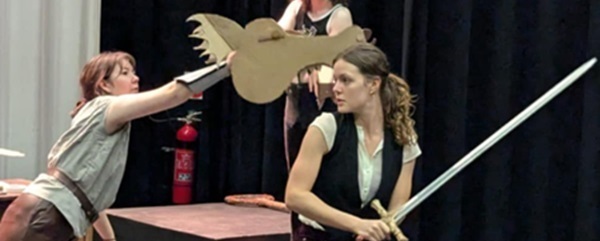
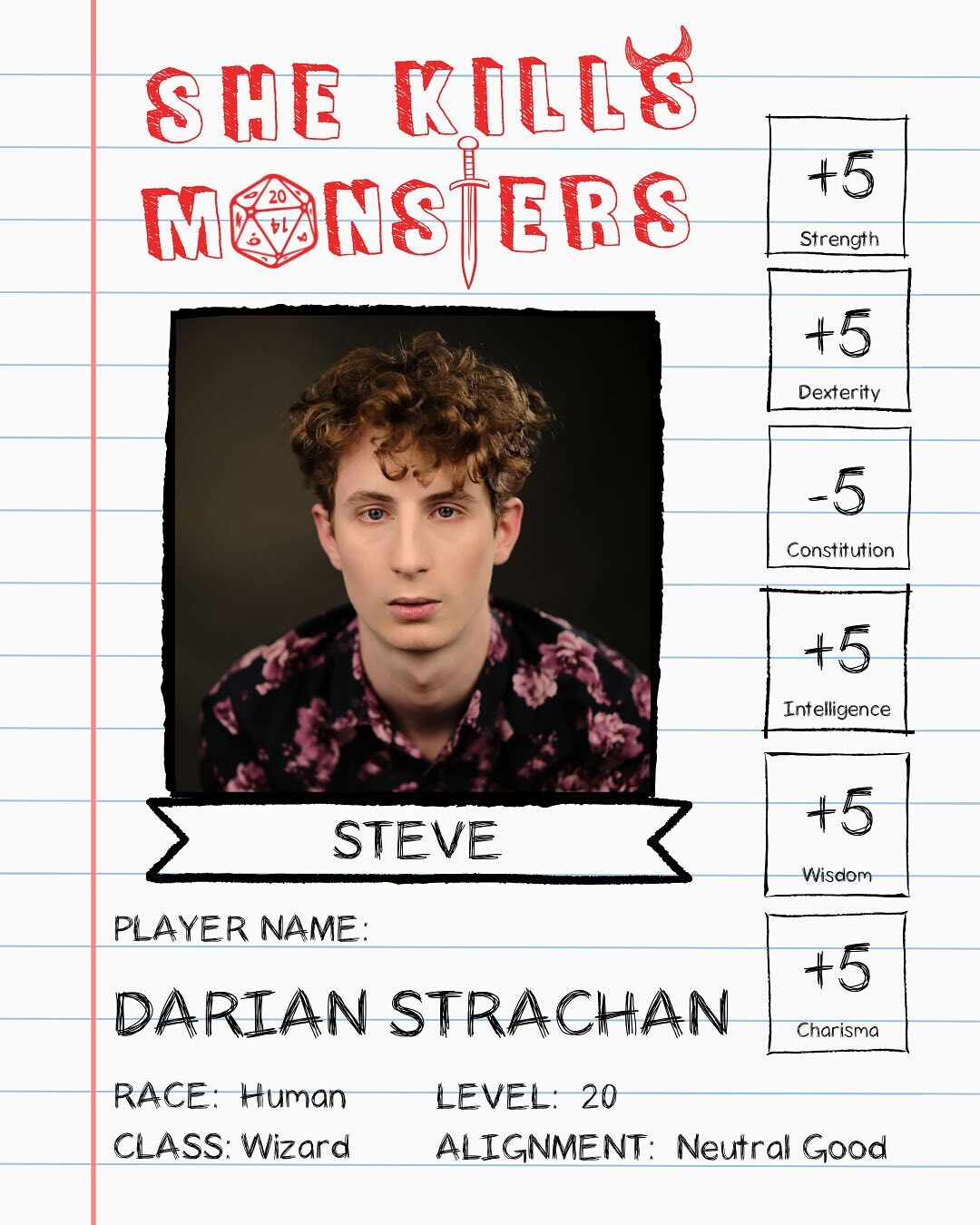
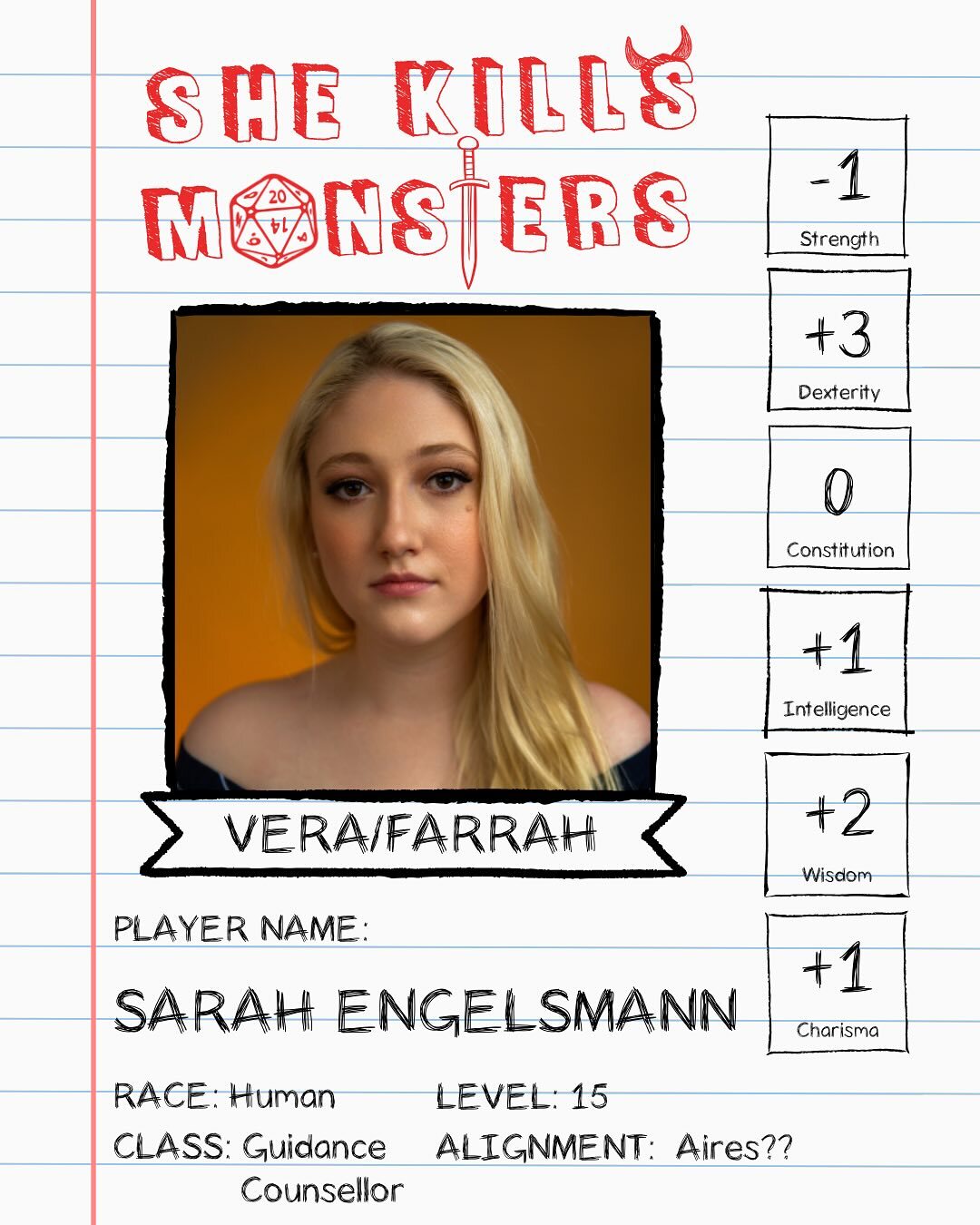
The use of space and dynamics were particularly interesting in the way that Chuck, the DM played by Cristian Stanic, would sometimes move in sync with what was happening in the DnD world, as though they were attempting to illuminate what was happening through true DM style. Being surrounded by the DnD characters, Lilith (Laura Renee), Kalliope (Erin Hall), Orcus (Amber Lawson), Tilly (Genevieve Whittred) and Agnes (Alyssa Byrne), this seamlessly integrated into the story. The scene with the “final boss,” was especially enjoyable, as the use of LED lights in the eyes of the dragon and the choreography added a dynamic and theatrical effect that tied the show in a neat bow.
There were moments that the use of blocking (planned positioning of actors on stage) could have used some adjustments. There were moments when an actor’s back was to the audience or one actor stood behind another, their face being obstructed from the view of the audience while giving lines. While this can sometimes be utilized for dramatic effect, it seemed out of place and unpolished in these instances. This also meant that at time, the bounds of the scene were made unclear as it related to moments that were supposedly shared by only one or two actors. Was a scene meant to be private or did it occur in front of the rest of the party?
The actors that were most notable included those in the roles of Tilly, Lilith, Miles, Orcus and Agnes. The role of Tilly (Genevieve Whittred) was a great depiction of a teen who was trying to figure life out and how she hopes to enjoy it. When following Tilly’s highs and lows throughout the play, Whittred allowed us to witness a portrayal of Tilly that depicted a free-spirited, direct and creative youth who gave her friends a means to escape their current realities. Renee’s portrayal of Tilly’s love interest, Lilith/Lilly, was especially notable as their struggles were uncovered over the course of the play. It was wonderful to see the layers of the character unfold in her depiction of Lilly and how she interacted with Agnes in the latter half of the show, to be contrasted with the blunt and beautiful, demon princess that was Lilith’s character in the DnD realm. It would have been nice to see Lilith’s character explored further through conversations with Agnes or other members of the party.
A similar note can be made about the roles of Miles (JJ Jones) and Orcus (Amber Lawson). The audience found the comedic addition of Orcus’ character thoroughly enjoyable, however did not see too much character development where he or Miles were concerned. Jones played a highly believable Miles, who challenged Agnes when they shut them out of their journey. Both actors played interesting roles that could have been explored further to uncover more emotional depths, and about Agnes’ grieving process or Tilly’s friendships. While the actors were limited to the script material, they did a commendable job in their performances.
Alyssa Byrnes’ portrayal of Agnes offered exactly what one may expect from a grieving, avoidant elder sister. Agnes’ reluctance to face her emotions, difficult truths about Tilly and her relationships were adequately expressed through Byrnes’ facial expressions and body language, which opened up more as the play continued to follow Agnes on her journey with her grief and newfound comrades. While there were times where I felt Agnes lacked the appropriate level of energy for the scene that required it, the overall portrayal was believable and ended strongly. This was especially evident in the few scenes between herself and Lilly, as well as the scene with the “final boss,” the multiple-headed dragon at the end of her quest for Tilly’s spirit.
I am interested to see how each of these crew and cast members evolve in future productions and am eager to see what worlds they venture to next.
Spread the word on your favourite platform!
Subscribe to What's The Show
Reviews, show news and what is on, straight to your inbox.