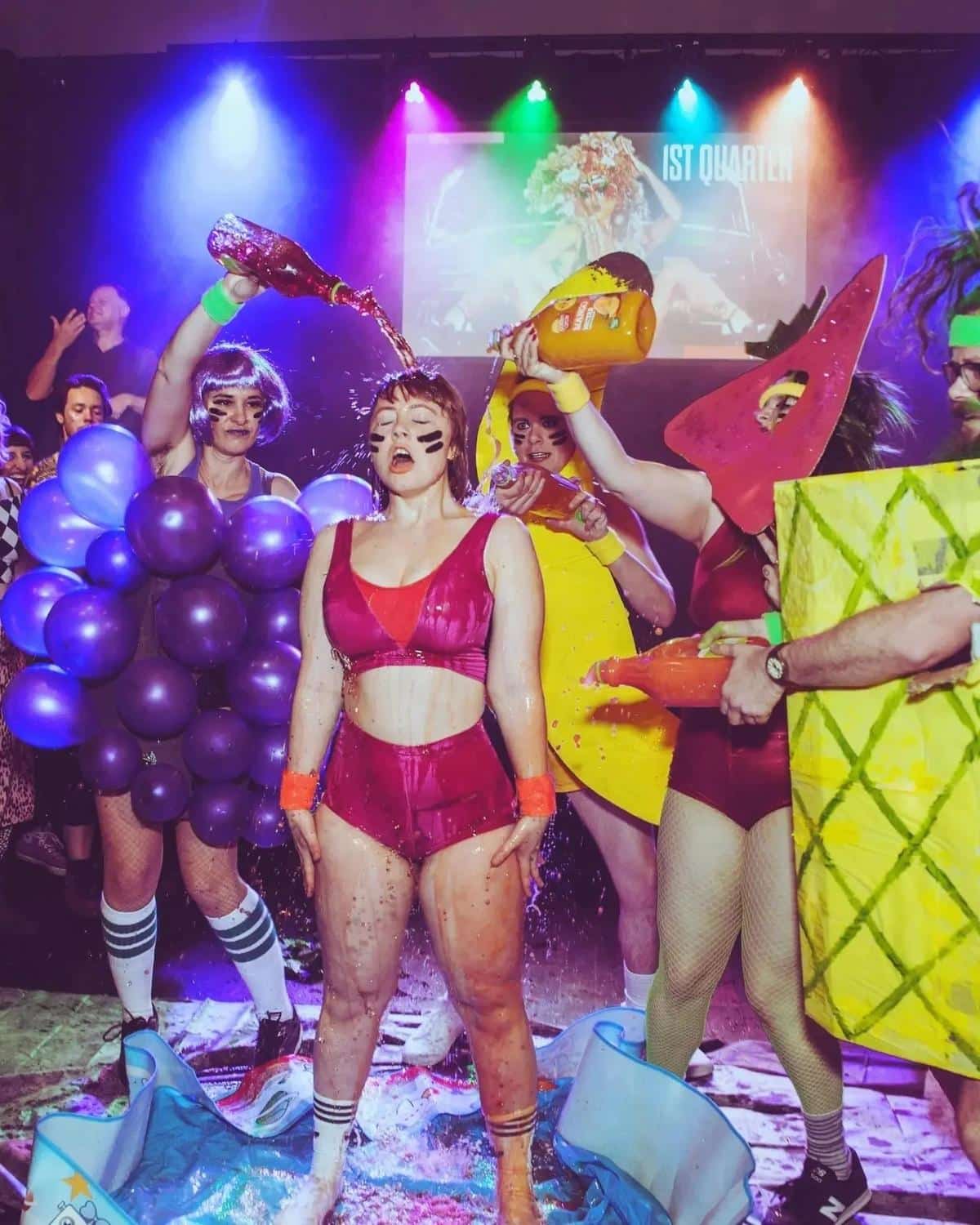
Well, this is an interesting, fun show. It’s comedy clowning at its best. It’s a rollicking, frolicking comedy about fruit, its position in society, and its relevance to the main character, Cherese.
We learn why fruit is fun, why she loves all fruit, and why she also loves us, the audience. The show consists of a variety of sketches that flow smoothly from one to another.
For Cherese Sonkkila, this is her debut Fringe show. She has plenty of energy, and it keeps flowing. Hopefully, we will see more work from she/her in the future.
The sketches have a variety of styles, from song and dance to monologues. There are costume changes off stage, although in a couple of places, the performances are a fraction too long. But it was opening night.
This is a show worth seeing. It is a fun event with some audience participation, which I normally don’t like, but I enjoyed it. So, get a ticket or several and take yourself to the Mill on Angas Street.
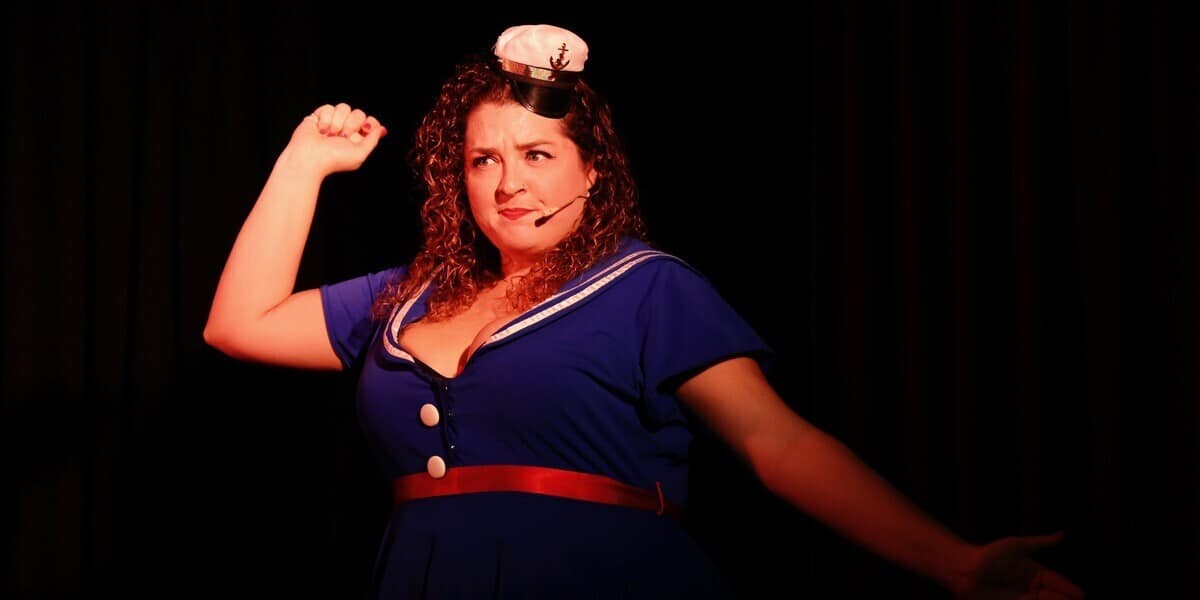
If you’re in the mood for a wildly absurd, delightfully unhinged, and incredibly physical comedy experience, then Mel McGlensey Is Motorboat is your perfect Fringe vessel. Docked at the Bally in Gluttony, this boat-woman hybrid performance is a riotous ride through high-energy clowning, audience interaction, and some very “nautical but nice” humour.
McGlensey, a 2024 Golden Gibbo nominee and winner of Best Comedy at Adelaide Fringe 2024, fully commits to her larger-than-life character. With a sailor’s outfit ingeniously doubling as boat parts—including some particularly buoyant “floatation devices”—she embraces every wave of ridiculousness with infectious enthusiasm.
From the moment Motorboat sets sail, the audience becomes her crew, each assigned a boat type in a flurry of improvised banter that McGlensey expertly weaves back into the show for maximum comedic payoff.
The story? Motorboat dreams of leaving the dock and venturing into the great unknown, but she’s held back by the booming, omnipresent voice of Captain Daddy. But as any good Fringe audience knows, staying anchored is never an option. What follows is a rollicking, often improvised voyage where McGlensey’s quick wit, expressive clowning, and razor-sharp comedic instincts keep the crowd both on edge and in stitches.
The humour is far from subtle—expect a bit of salty language and some audience participation—the energy and commitment of the performance keeps things afloat for the entire show.
With her formidable improv skills and natural comedic presence, McGlensey delivers a show that is as silly as it is skilful. Whether you’re a tugboat, an ocean liner or a lowly kayak, Motorboat is a high-spirited, side-splittingly funny voyage well worth embarking on. Just batten down the hatches—things are bound to get a little choppy!
The CRAM Collective’s latest production of FAG/STAG is a winner! (CRAM stands for Create, Revise, Augment and Merge). They are a comparatively young company in every sense of the word and definitely a company to watch. Focussing on film and live theatre, they are developing a dedicated following, as indicated by the full house I attended and other full houses during the season.
FAG/STAG – “This rare breed of heterosexual human male enjoys the company of homosexual human males in preference to or en liu of, perhaps selectively, other heterosexual males.” – Urban Dictionary
This production explores what it means to have a best mate when you’re stuck being your worst self.
It features Corgan and Jimmy who are BFFs. Their lives are filled by Tinder, Grindr, white lies, big nights and too many pints. Lawn bowls, Donkey Kong, wiping vomit into the shower drain. Unanswered texts, bad sex, moving back in with Mum and Dad. In the month preceding the wedding of Corgan’s ex-girlfriend the two struggle to get their life in gear enough to even hire a suit.
The Howling Owl is a unique venue, right in the middle of the CBD and the home of Adelaide’s Premiere Gin Den as a bonus, this boutique theatre is the perfect setting for an up close and personal glimpse into the lives of two very different young men at an age when youth is beginning to diminish, and the realisation of adulthood is creeping in.
Jeffrey Jay Fowler and Chris Isaacs have crafted an extremely incisive script which is sure to resonate with young adults and those of us who can remember when we were that age.
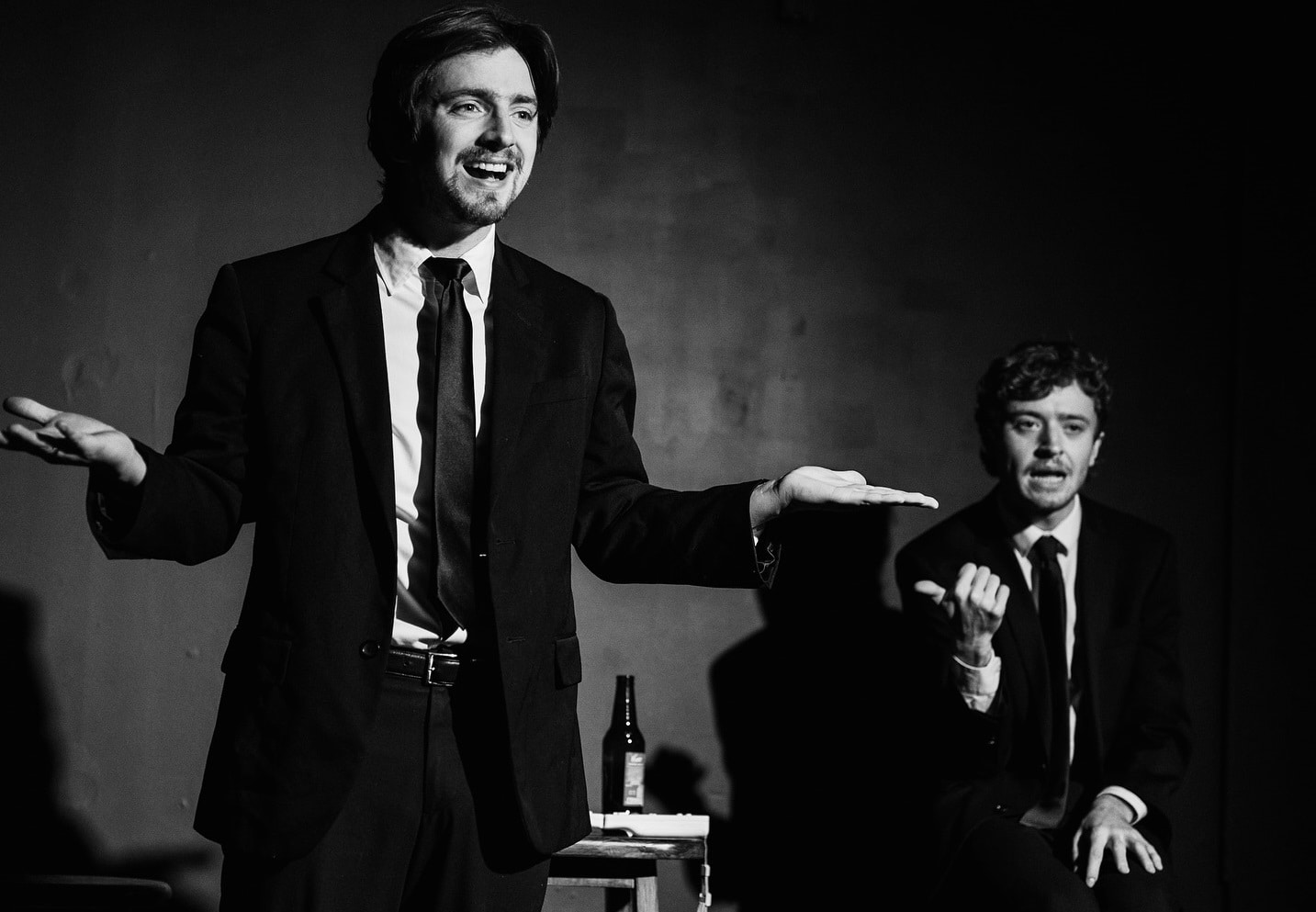
Connor Reidy’s direction gives us an intimate look at the lives of two men whose bond is their friendship. Together with his cast and creatives he has focussed on their inner thoughts (voiced to the audience). Using 3 stools, a couple of bottles of beer and two Nintendo handsets, his direction takes us to the highs and lows of friendship especially when complicated by sexual orientation. The play also deals with the confronting topics of self-harm and drug use.
Reidy’s direction is supported by Antoine Jelk’s creative sound design linking the scenes, and Aaron Herczeg’s atmospheric lighting which perfectly sets the mood.
Henry Cooper and Connor Pullinger inhabit their characters of Corgan and Jimmy. They are totally believable and relatable to the audience. United by their love of Donkey Kong and friendship, they pour out their souls to us, the audience. They show us the good, bad, and ugly sides of friendship while drawing us into their lives.
I particularly enjoyed Jimmy’s love/hate relationship with his ‘ex’ and the melon air freshener in his car that serves as a reminder of their time together. I also enjoyed Corgan’s addiction to Tinder and his ‘swipe right’ girls, and the acceptance of his friend’s sexuality.
Both the actors give highly polished, emotional performances that begin as stand up but quickly dive deep into inner thoughts and feelings taking us on a wild ride!
FAG/STAG is sixty minutes packed with laughs, sighs and maybe some tears, that will leave you questioning relationship with your BFFs and your role in making these friendships meaningful and lasting! Bravo CRAM Collective!
Margaret Mitchell’s Civil War epic, Gone With the Wind, was published in 1936 and became an international bestseller. It was adapted into a movie in 1939, which garnered eight Academy Awards, including Hattie McDaniel’s win for Best Supporting Actress, which made her the first African American actor to take home an Oscar. However, the movie almost never made it to the big screen.
The producer, David O. Selznick, shut down production after 30 days because he was unhappy with the script. He called in hot shot writer Ben Hecht, who had never read the book, and director Victor Fleming to do a rewrite. Playwright Ron Hutchinson locks Hecht, Fleming, Selznick and his secretary in a room for five days and reimagines how the script was finished in Moonlight & Magnolias.
Hutchinson’s play, based on historical events, is written as farce, but the characters also deal with serious questions about race and the fragile position of Jewish executives in Hollywood. The roles of Selznick, Hecht, and Fleming are based on historical figures. This play adds a secretary, Miss Poppenghul, who stays near the office while the men are locked inside for five days, surviving on peanuts and bananas.
Director Harry Dewar’s production focusses on the tension between the three creatives. He makes full use of the large stage dominated by an elegant Art Deco set in green and peach with a huge picture window at the back designed by Skye Mc Vicar and lit by Richard Parkhill. His blocking is almost choreographic at times utilising every corner of the set.
The play opens to a montage of Hollywood in the 2930s (by Brandon Boyer) with the cast cleverly included. A nice touch!
Adam Gregory Schultz plays David O. Selznick with a manic intensity, dominating the stage and pushing the narrative forward. He is a multi-tasker managing multiple props, phone calls, intercoms, bananas and peanuts with equal ease! He scenes with Hecht in Act 2 are a highlight.
Terry Crowe plays Ben Hecht the frustrated script writer with compassion. He is the realist of the creative team. The play uses Hecht’s character to raise questions about whether the script glorifies the Old South. He doubts that the movie will be a hit and doesn’t even want writing credit on the script for fear that it will ruin his career. Hecht asks Selznick at one point, “Why don’t you make a movie that makes America look its ugly face in the mirror?” To which Selznick replies, “Because no one wants to see that. America wants to see the way it thinks it looks.”
Scott Battersby plays Victor Fleming the director, pulled from the set of The Wizard of Oz to work on Gone With The Wind has many of the show’s ‘one-liners’ which he delivers with precision. His portrayal of Melanie giving birth in Act 2 is hysterical!
Rebecca Gardiner plays the well-meaning secretary Miss Poppenghul with patience alternating with exasperation. Dealing with Selznick is enough, but now she has two extra egos to deal with. Special mentions need to go to the costume coordinator Makala Modra and especially the props team Janet Jauncy and Karen Prior who progressively cover the stage with crumpled paper and scripts as time passes in the play.
My reservation with this production is the vocal tone of Act 1 which lacked light and shade with the result that the actors had nowhere to go when angry and some of the laughs were lost. This was resolved in Act 2.
Moonlight and Magnolias is an exposé of the side of Hollywood we do not see, the prejudices of the period, and of course the egos that brought us one of the most iconic movies of the last century!